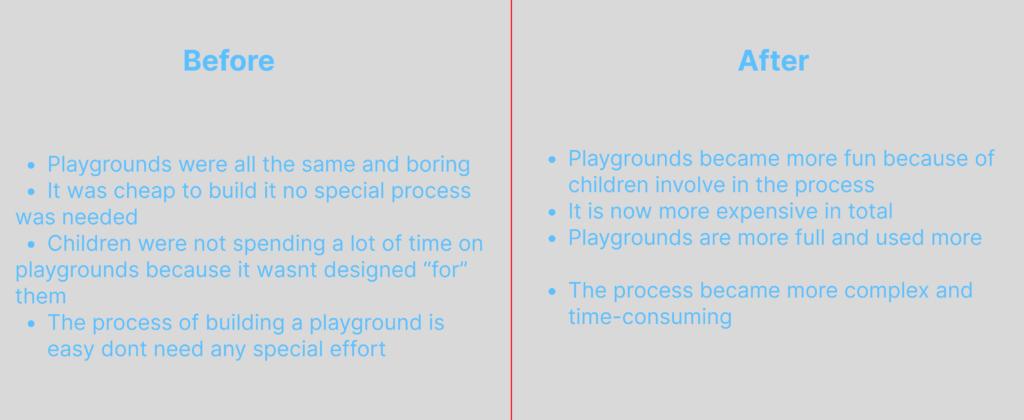
In the “before” scenario, playgrounds were often standardized, repetitive, and primarily driven by efficiency and cost. Design decisions were made without involving children, resulting in spaces that did not fully respond to their needs. As a consequence, children were less engaged, and playgrounds were not used to their full potential. The process itself was straightforward and inexpensive, but it lacked depth in terms of user experience.
In contrast, the “after” scenario highlights what changes when children are included in the design process. Playgrounds become more engaging, diverse, and meaningful, as they reflect children’s real experiences and desires. This leads to increased use, longer engagement, and a stronger sense of ownership among children. However, this shift also introduces new challenges. The design process becomes more complex, time-consuming, and resource-intensive.
