Believing in a well-constructed fiction, even if only for a moment, can change the way we see reality. But that shift becomes truly significant only when the fiction is shared, when it is embraced by many rather than experienced by just one person.
One of the greatest obstacles to genuinely new ways of thinking today is the widespread assumption that everything worth knowing has already been discovered, and that what is real, possible, or true has already been established. In this context, imagination can start to feel unnecessary, even naïve. Society often presents itself as the only version of itself that could exist. Yet much of what we consider true is not purely objective. It emerges from shared narratives, from stories that people collectively accept and pass on. These narratives shape the way we understand the world and provide the common ground on which societies are built. As Dunne and Raby point out, even our idea of reality can be challenged when we encounter a different way of seeing. Alternative narratives expand the boundaries of what feels possible, reminding us that there is never only one way to live, organize society, or interpret the world. This is the idea behind what they call micro-utopias: small imagined worlds that exist outside dominant narratives and suggest alternative ways of thinking and living. As they write, «They inspire us to ask why the real is “real” and the unrealistic is not — who decides? Is it market forces, an evil genius, chance, technology or secret elites? These projects celebrate people’s capacity to create their own imagination» (Dunne & Raby, 2013). The value of these speculative worlds does not lie in whether they can actually be realized, but in their ability to make us question assumptions that usually go unnoticed.
For a story to have this kind of impact, however, it cannot remain private. It has to circulate. It needs to be shared, repeated, and adopted by others. Stories become powerful not simply because they are original or compelling, but because they enter the collective imagination. Once enough people believe in them, they stop functioning as fiction and begin to shape reality itself. They become habits, convictions, social norms, institutions, and myths. Yuval Noah Harari develops this idea extensively in Sapiens: A Brief History of Humankind. According to Harari, what distinguishes humans from other species is not physical strength or individual intelligence, but our ability to create and maintain collective fictions. Human societies are built not only on tangible objects and material resources, but also on shared abstractions such as money, nations, religions, corporations, and human rights. None of these things exist in a physical sense, yet their effects are undeniably real because large groups of people collectively agree that they matter. These shared beliefs shape how we behave, the decisions we make, and the ways we organize our societies. Recognizing this changes how we think about reality itself. Reality is often not simply something that exists independently of us; it is also something that people continuously construct and sustain through shared belief. Once we understand this, it becomes easier to imagine that things could be otherwise.
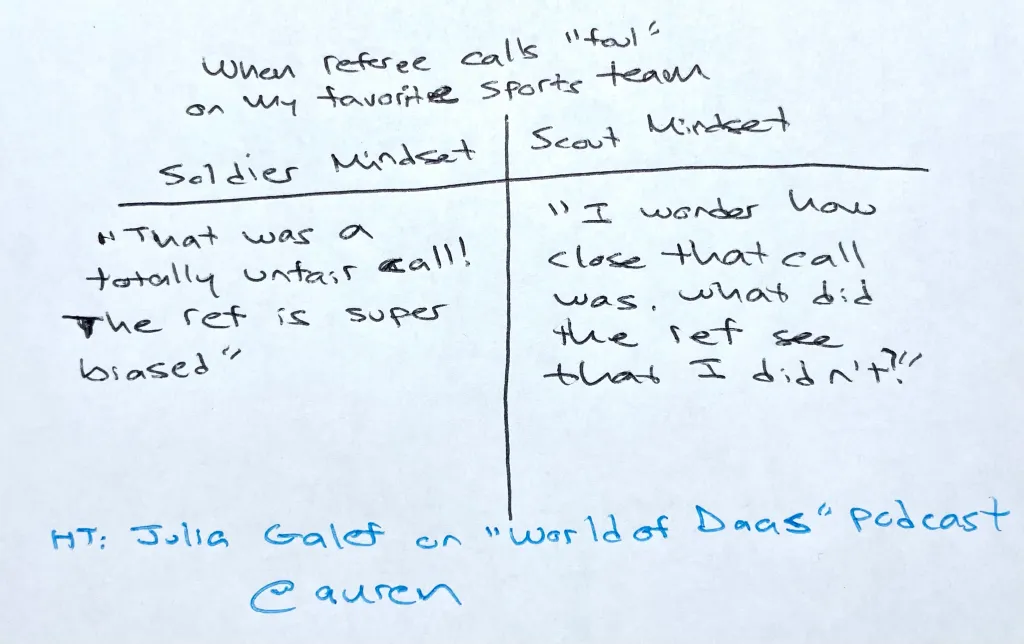
A similar point appears in Julia Galef’s The Scout Mindset, although she approaches it from the perspective of individual belief. Galef argues that our opinions are not always guided by a genuine search for truth. More often, they are influenced by what makes us feel safe, comfortable, or secure. When we want something to be true, we tend to ask ourselves, “Can I believe this?”, looking for reasons to accept it. When we do not want it to be true, we ask, “Do I really have to believe this?”, searching instead for reasons to reject it. She describes this tendency as motivated reasoning: the habit of interpreting information in ways that support our existing preferences and assumptions. To explain this process, Galef introduces two contrasting mindsets. The soldier mindset treats beliefs as territory that must be defended. Information that challenges those beliefs is seen as a threat. The scout mindset, by contrast, is driven by curiosity. Rather than defending a position at all costs, it seeks to understand reality as accurately as possible, even when doing so requires changing one’s mind. We move between these two attitudes constantly, but it is the scout mindset that allows us to remain genuinely open to unfamiliar ideas and alternative possibilities. In many ways, this is also the mindset encouraged by Speculative Design. Its purpose is not to predict the future, but to create enough distance from the present that we can begin questioning assumptions we normally take for granted. Galef also argues that beliefs become particularly difficult to challenge when they are closely tied to our sense of identity. This is why she suggests that we should “hold our identities lightly”. The phrase sounds simple, but its implications are profound. Being able to change our minds without feeling that we are losing ourselves is essential if we want to engage seriously with new perspectives. Speculative Design relies on this openness. It asks us not to decide whether a scenario will happen, but to consider what that scenario reveals about the present and about the beliefs we rarely stop to examine.
What does it really mean to believe in something? It is not simply a matter of accepting facts. Belief is also tied to stories, emotions, habits, and cultural values. Our understanding of reality emerges from all of these elements working together. This is why narrative is so powerful: it does not merely describe the world, it actively participates in shaping it. The stories that circulate through politics, media, religion, science, and design influence what we consider normal, desirable, or possible. In Speculative Design, these stories take the form of objects, scenarios, and visual languages that appear to come from the future while speaking directly to the present. Like myths, they do not simply describe the world as it is; they suggest what it might become. Understood in this way, design is about more than function or aesthetics. It becomes a way of proposing alternatives, a tool for making different realities imaginable and, for a moment, allowing them to feel real.
