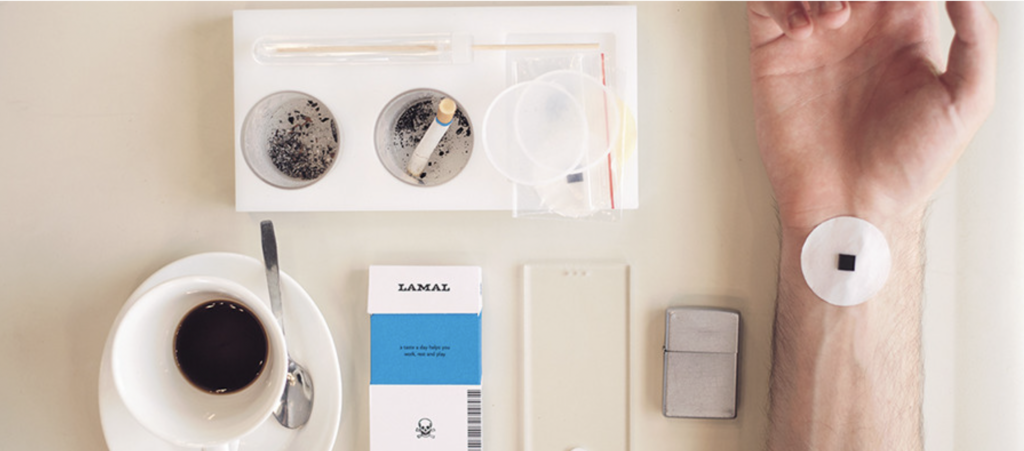
One of the most effective moves in Speculative Design is to take something familiar and push it beyond its usual limits. A habit, a social behaviour, a cultural value, something so ordinary that it barely attracts attention, is amplified until it becomes impossible to ignore. This is the logic behind what is often called cognitive estrangement: making the familiar seem strange enough that we can see it differently. Like hyperbole in rhetoric, exaggeration reveals contradictions, tensions, and assumptions that everyday familiarity tends to conceal.
Rather than inventing entirely disconnected futures, speculative projects usually start with something already present in the world. A technology, a social trend, a way of thinking, a system of values. The future that emerges is often less an invention than an extension. Existing tendencies are followed a little further, sometimes to the point of absurdity, sometimes to the point of discomfort. What appears unrealistic at first often feels unsettling for the opposite reason: it remains recognisable. The scenario may be exaggerated, but the logic behind it is already here. By creating a small distance from reality, speculative projects allow us to notice things that have become too familiar to attract our attention. This is what gives exaggeration its critical potential. Instead of describing the world as it is, it pushes certain aspects of it just far enough that they become visible again. Things that normally seem neutral or inevitable suddenly appear questionable. The familiar becomes strange, and once it becomes strange, it can be examined. In this way, speculative scenarios often function as a form of social commentary. They are not concerned with prediction so much as revelation. Their purpose is not to tell us what the future will be, but to expose the implications hidden within the present.
Eutropia and Quick Fix both work in this way. Conceived by Ivica Mitrović and Oleg Šuran, Eutropia imagines a Mediterranean city-state that has achieved prosperity, security, and social wellbeing through the complete monetisation of personal data. Privacy has disappeared. Surveillance is no longer controversial because it is understood as a reasonable exchange for comfort, efficiency, and stability. The collection of personal information is woven into every aspect of daily life and accepted as part of the social contract. The project takes the logic of today’s data economy and simply follows it to its conclusion. That is precisely why the scenario feels plausible. It is not difficult to imagine its world because parts of it already feel familiar. Quick Fix focuses on a different aspect of contemporary culture. Through an installation designed to resemble a vending machine, users can instantly purchase followers, likes, and online popularity. Social recognition becomes something that can be acquired as easily as a drink or a snack. The gesture is deliberately excessive, yet the logic behind it is immediately recognisable. The project takes a dynamic already present within social media platforms and turns it into a literal transaction. What is normally hidden behind algorithms, metrics, and platform design is brought to the surface and made visible. The result is both humorous and uncomfortable. We recognise the exaggeration, but we also recognise ourselves within it.
Neither project is really about the future. Both use fictional scenarios to talk about the present. Their worlds may be exaggerated, but they remain firmly connected to realities that already exist. Like a distorted mirror, they reflect contemporary society back to us in a form that makes certain details impossible to ignore. What emerges is often not something unfamiliar, but something we have stopped noticing.
In this sense, exaggeration becomes far more than a stylistic device. It becomes a way of thinking. By pushing existing tendencies beyond the limits of comfort, Speculative Design creates the conditions for a different kind of awareness. The audience is not asked to believe that these futures will happen. Instead, they are invited to consider why the scenarios feel plausible in the first place. The critical value of the project lies precisely in that moment of recognition, when an imagined future reveals something that has been present all along.