In the first part of this two-part blog series, I explored two well-known character analysis models – Jungian Archetype Theory and the Big Five personality framework. While both offer interesting perspectives for analyzing fictional characters, they fall short of covering the full scope needed for a truly systematic analysis. That’s why, as promised, I’ll introduce another model that is much more detailed and was specifically created for analyzing fictional characters in film and media. I know what you might be thinking:
“Great, another post on dry theoretical character analysis!”
But hang in there – soon we’ll dive into the practical side.
The Character Clock
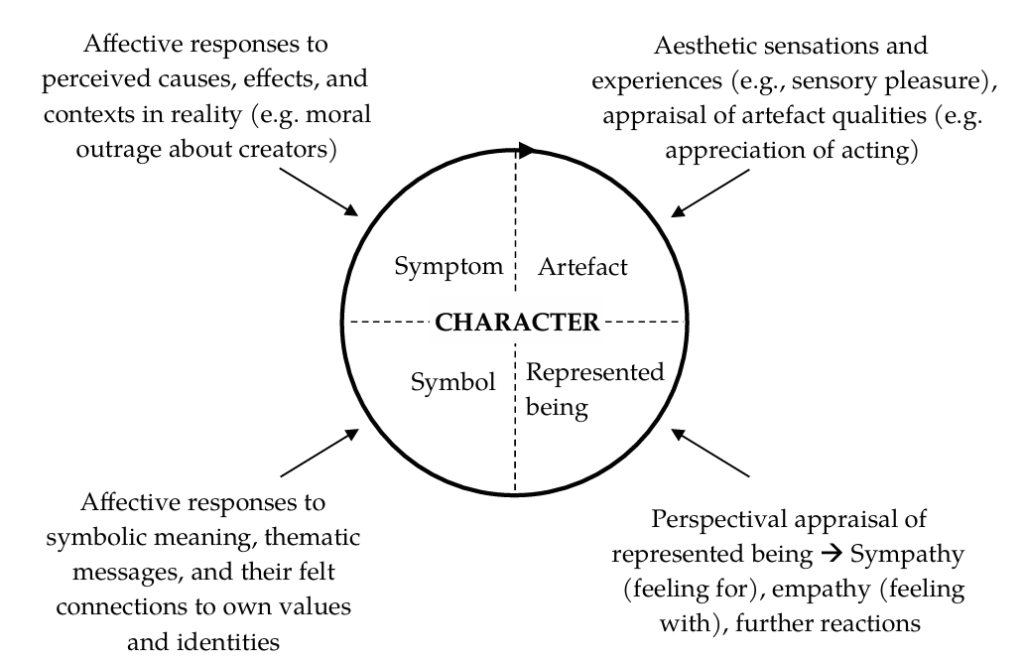
Jens Eder introduced a new character analysis framework called the “Character Clock” in his book Characters in Film and Other Media. The purpose of this model is to analyze different dimensions of fictional characters to provide a complete understanding that includes not only their personality but also their appearance, symbolic meaning, and the context in which the character was created. The name comes from the shape of the model, which resembles a clock and symbolizes how our understanding of a character moves through the four parts he defined.
- Artefact:
The first aspect we notice about a character is their appearance and how they are presented on screen. This includes not only their looks but also their voice, movements, and how these elements are arranged through acting, camera work, and writing style. This stage focuses on the character as a crafted piece of media itself, before considering what the character represents. - Represented Being:
At this stage, we begin to view the character as a person within the story – a being with a personality. We consider their relationships, emotions, actions, and social roles in the story’s world. This involves imagining the character’s traits and inner life as part of the narrative. - Symbol:
Characters often symbolize something larger than themselves. Here, we understand that the character not only exists in the story world but also functions as a symbol representing ideas, themes, or social issues. This stage deals with the deeper, often hidden meanings the character can carry. - Symptom:
Finally, a character can reflect aspects of the real world in which the media was produced. This includes cultural values, political messages, and social stereotypes that influenced the creation. This stage examines why the character was created in a certain way and how audiences might interpret them based on the production and viewing context.
Not every part of the character clock is equally useful for every character or story because some characters might be mostly about their story role, while others are specifically designed as a symbol or to make social commentary.
Defining My Research Focus (Wtf Was This All About?): A Systematic Approach to Villain Analysis
Moving from “How to analyze characters in film and media in general” to “What I aim to research and what is necessary to do that,” I want to combine these methods to suit my specific use case. My goal is to analyze villains systematically, compare them, and highlight what differentiates common villains from the most popular villains, those we actually root for despite their immoral actions. Keep in mind that this is just my main goal. If I manage to create a reliable statistical model, you could use it to compare fictional characters in any way you like. For example, you could compare heroes and villains, sidekicks and heroes, or antiheroes and villains. The possibilities become almost endless once you establish an analytical method focused on building a large database with statistically and systematically researched values.
Adapting the Character Clock: Building a Customized Model for Villain Analysis
I really like Jens Eder’s approach with his Character Clock because it covers all the aspects of a fictional character and not only the personality. Therefore, I want to base my model on his but with a few modifications.
First of all, I don’t want to include the Symptom part. I know that the Symptom is also an interesting aspect of character analysis, but I think it’s more efficient, when analyzing multiple villains, to start with a smaller scope. Otherwise, the analysis for just one character would take way too much time to even gather a database. You could write a whole book analyzing one character if you try to cover each of these four aspects, so I am trying to break it down to the most important ones.
Secondly, I want to mainly focus on the Artefact and the Represented Being parts because they are not only the things we notice first when seeing a character on screen, but also the easiest to compare. I also want to include the Symbol briefly for every character by noting if they represent something bigger, what it is, or if there is even a deeper meaning behind the character.
And last but not least: How do I want to systematically analyze the Artefact and the Represented Being?
I want to use the Big Five for analyzing the Represented Being since it fits perfectly for analyzing multiple characters and is suitable for creating comparable diagrams.
For the Artefact, on the other hand, I want to use a framework called ACIS (Audio-Visual Character Analysis) a systematic method designed for analyzing how characters are represented and visible in audiovisual media, developed by Christine Linke and Eckart Prommer and published not too long ago in 2021. I will present this framework in the next part of this blog series as well as continue to describe what my approach will look like.
I know I promised this to be a two-part blog, but during my research, I realized that I have to cover much more to actually develop my own framework. Sorry!
See ya in the next one.
Literature:
- Eder, Jens. Characters in Film and Other Media: Theory, Analysis, Interpretation. Open Book Publishers, 2025.
- Linke, Christine, and Elizabeth Prommer. “From fade-out into spotlight: An audio-visual character analysis (ACIS) on the diversity of media representation and production culture.” Studies in Communication Sciences 21.1 (2021): 145-161.
Disclaimer: This text was proofread for punctuation, grammar, and spelling errors with the help of Perplexity. The content of the text remains unaffected.
