#slowness #slowliving #slowinteraction #digitalcalm #calmtechnology

In today’s world, the concept of “slowness” usually has a negative connotation and is considered a negative trait.
Slow internet is annoying
Slow loading means an error
A slow user is inefficient
And it seems to me that recently, interest in the concepts of “slowness” and “mindfulness” has been growing. Many celebrities are leaving social media, or never joined in the first place, and we are returning to slow content — long videos lasting 30+ minutes, watching interviews lasting several hours, and preferring slow conversational content.
Researchers, designers, urbanists, psychologists, and app developers are all talking about the concept of “slowness”
Slowness as a cultural concept 🏛️
In fact, the concept of “slowness” began long before digitalization. Philosopher Hartmut Rosa expresses this idea in his book Social Acceleration:
“We live in a world where acceleration has become the norm, and anything that cannot be accelerated is perceived as an obstacle.” [1]
This is where the need for a certain slowdown arises — not as a rejection of progress and marginality, but as a return to attention, depth, and presence.
In pop culture “slow living” — the idea of conscious slowing down — has gained enormous popularity when it comes to everyday household chores. Popular bloggers are increasingly promoting this topic, with people like Matt D’Avella and Tam Kaur making videos about digital overload, their own rituals of mindfulness, and how to cope with the pace of modern life.
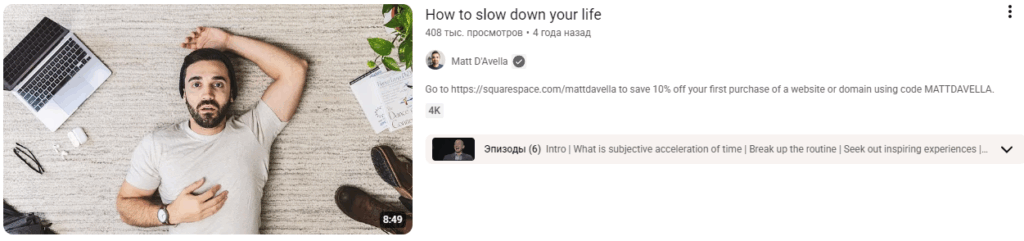
[2] Matt D’Avella. “How to slow down your life.” YouTube, 2019.
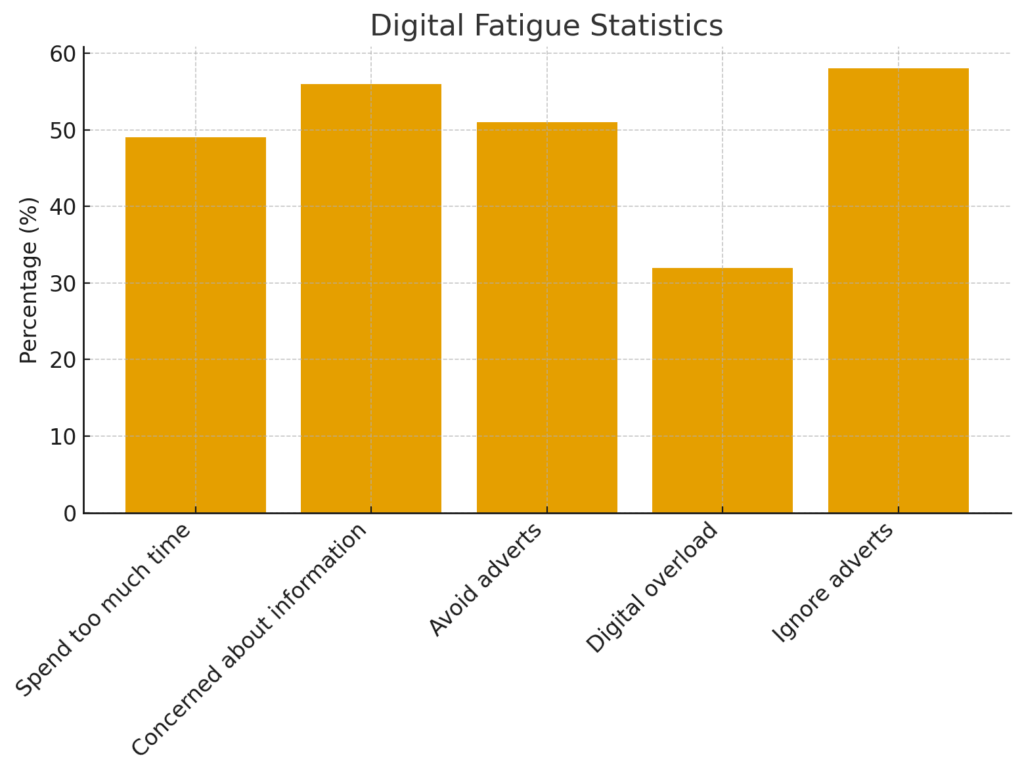
“In 2023, the study shows that close to every other person say they spend too much time on electronic devices. And as many as one third of consumers state that they suffer from digital overload.” — The global Trend Tracker Report 2023 (Toluna & Two Sides) [3]
That is:
📌 almost every second person believes that they spend too much time in front of screens;
📌 a third of respondents directly mention a state of digital overload.
Slowness and digital experience 🤳
When talking about the concept of “slowness” in the field of interfaces, it should no longer mean “anti-productivity” After all, slow design in a digital environment is:
📌unhurried design;
📌an interface that respects attention;
📌a system that does not consume resources;
📌a conscious way of interacting.
In 2001, Lars Hallnäs and Johan Redström proposed the concept of Slow Technology. They wrote that technology can be: “…not instruments of acceleration, but mechanisms of reflection.”[4]
A little later, Mark Weiser and John Brown introduced the concept of “calm technology” — technology “that informs but doesn’t demand our focus or attention.”[5] In this concept, information moves around our focus and awareness, not in the middle. Information is there when we need it and disappears unnoticed when we don’t need it.
This philosophy is now actively used in HCI (Human–Computer Interaction) and manifests itself as:
📌The use of smooth transitions
📌Breathing apps with slow animation
📌Minimalist phones without visual noise
Even when talking about TikTok — a platform originally conceived as high-speed, several-second content — the duration of videos has been increased to several minutes — up to 10.[6]
“You can create videos of different lengths:
Videos you record in TikTok can be up to 10 minutes long.
Videos you upload in TikTok can be up to 60 minutes long.”
Why is it important for designers to study slowness? 🤔
For designers, “slowness” is not about slowing down, but about the quality of the experience we create.
Slow design allows the user to:
📌Relieve overload and anxiety
📌Increase attention to content
📌Be aware of their own pace
📌Support the user rather than exhaust them
Trends such as temporal design — the design of time, rhythm, and pauses—are already emerging in the field of interactive design.

[7] Image source: Cranford Teague, “What is Temporal Design Thinking?” Medium, 2020.
“Temporal design thinking broadens the scope beyond interaction points and linear journeys into a wider world of how the goal for the product might fit into the actors’ wider goals and needs over time.”[8]
Sources 🛈
[1] Hartmut Rosa. Social Acceleration: A New Theory of Modernity. Columbia University Press, 2013.
[2] Matt D’Avella. “How to slow down your life.” YouTube, 2019. Available at: https://youtu.be/bmr1-K4dfvg?si=SeERSkPiQAbXTpva
[3] Two Sides & Toluna. Trend Tracker Report 2023. Two Sides Global, 2023. Available at:
https://www.holmen.com/ko/paper/insights/paper-inspiration/digital-fatigue/
[4] Lars Hallnäs and Johan Redström. “Slow Technology – Designing for Reflection.” Personal and Ubiquitous Computing, vol. 5, no. 3, pp. 201–212, 2001.
[5] Mark Weiser and John Seely Brown. “The Coming Age of Calm Technology.” Xerox PARC, 1996. Available at:
https://calmtech.com/papers/coming-age-calm-technology.pdf
[6] TikTok Support. “Camera Tools: Creating Videos.” TikTok Help Center, 2024. Available at:
https://support.tiktok.com/en/using-tiktok/creating-videos/camera-tools
[7] Image source: Cranford Teague, “What is Temporal Design Thinking?” Medium, 2020. Available at:
https://cranfordteague.medium.com/what-is-temporal-design-thinking-dd0845e7fc3c
[8] Cranford Teague. “What is Temporal Design Thinking?” Medium, 2020. Available at:
https://cranfordteague.medium.com/what-is-temporal-design-thinking-dd0845e7fc3c
