When a Research Topic Feels too Big

At some point in the research process, a topic can start to feel overwhelming. What once felt exciting and full of possibilities slowly turns into a space of uncertainty, where everything seems relevant and nothing feels clear enough. This is exactly where I currently find myself in my thesis journey.

My initial interest in playground design came from a simple question: why do most playgrounds still look the same? The more I read and explored, the more layers I discovered—safety regulations, standardization, adult-centered design, lack of child participation, educational values, urban constraints, and social expectations. Each of these aspects felt important, meaningful, and worth investigating. However, instead of clarity, this richness created a sense of being lost.

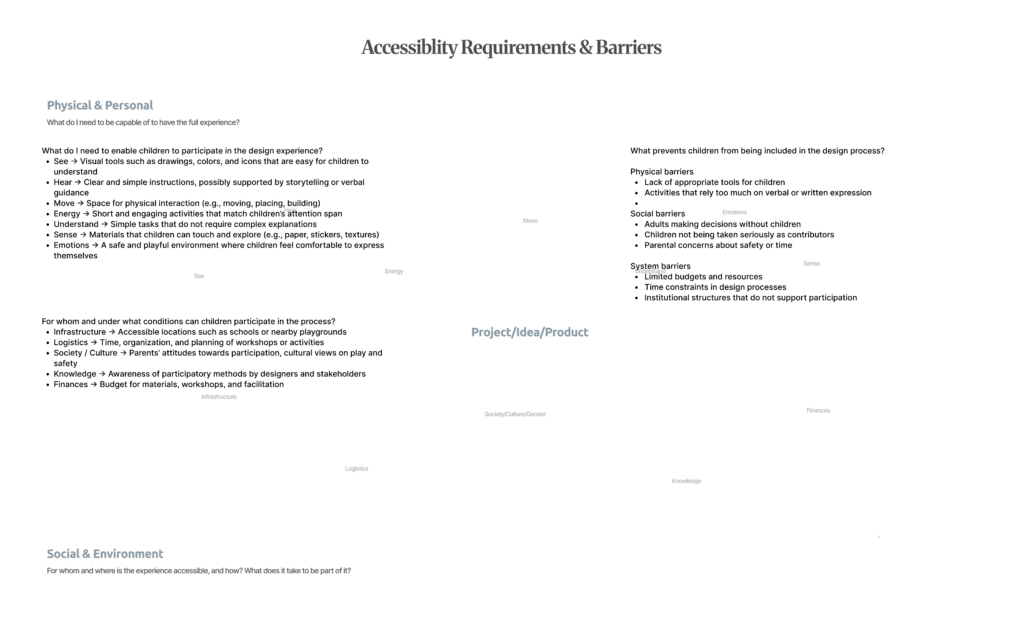
This moment of doubt made me question whether I should change my research question or narrow my scope. Should I focus only on school playgrounds? Should I shift my attention from playgrounds as spaces to the design process itself? Or should I concentrate on one specific issue, such as how children can be meaningfully involved in the early stages of design?

As I move forward, my goal is not to simplify the topic, but to clarify my role as a designer within it. Accepting that a research topic can feel too big is an important step toward shaping it into something focused, intentional, and personal.

Why Do Playgrounds Still Look the Same?

Public playgrounds have existed for little more than a century, yet their physical appearance has changed surprisingly little. Swings, slides, and climbing frames arranged on soft surfaces remain the dominant model in cities around the world. While these spaces are widely accepted as “safe,” they are often criticized for being repetitive, predictable, and limited in terms of creativity. This raises an important question: why do playgrounds still look the same despite decades of research on child development and play?

One key reason lies in the rise of risk-averse attitudes toward childhood. As Tim Gill explains in No Fear: Growing Up in a Risk-Averse Society, parents and institutions have increasingly prioritized supervision and risk elimination over children’s independent exploration (Gill, 2007). Concerns about injury and liability have led to strict safety standards, which strongly influence playground design. As a result, playgrounds became standardized environments optimized to minimize physical risk rather than to support imagination or curiosity.

Historically, early playgrounds were often supervised and included equipment that would be considered unacceptable today due to injury risks. However, from the mid-20th century onward, safety regulations and cost considerations encouraged uniform solutions. Impact-absorbing surfaces and fixed equipment became the norm, reinforcing a one-size-fits-all design approach. While research shows that the actual risk of serious injury in playgrounds is extremely low, fear continues to shape design decisions more than evidence does (Gill, 2007).

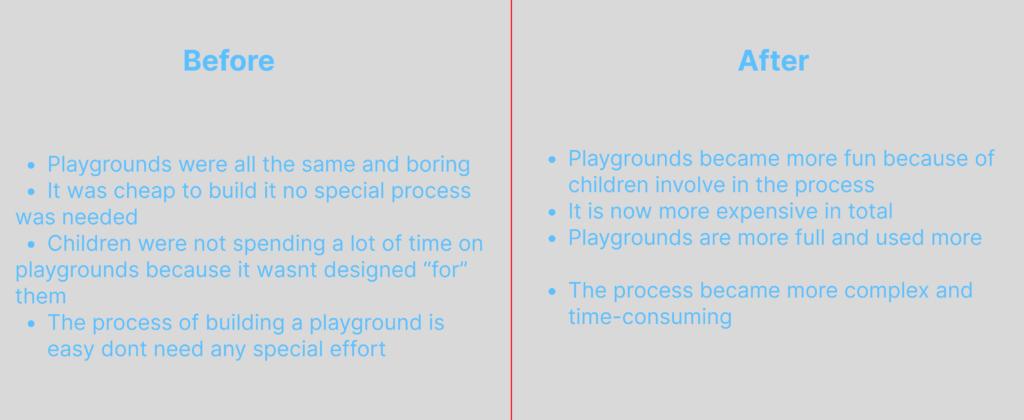
Another reason playgrounds remain unchanged is their adult-centered design process. Children are rarely involved in early design stages, and decisions are typically made based on adult assumptions about safety, order, and control. Brown et al. (2021) highlight that many playgrounds are designed to meet regulatory and accessibility requirements but fail to consider how children actually experience play. This often results in environments that are inclusive in theory but limited in playful engagement.

The persistence of similar playground designs is therefore not due to a lack of alternatives, but to a system shaped by fear, regulation, and adult perspectives. Reimagining playgrounds requires shifting the focus from eliminating risk to designing meaningful play experiences, where creativity, curiosity, and social interaction are valued alongside safety. For designers, this opens an opportunity to rethink playgrounds not as fixed installations, but as dynamic environments that support children’s development in richer and more diverse ways.

References

[1] T. Gill, No Fear: Growing Up in a Risk-Averse Society. London, UK: Calouste Gulbenkian Foundation, 2007.

[2] D. M. Y. Brown et al., “A Scoping Review of Evidence-Informed Recommendations for Designing Inclusive Playgrounds,” Frontiers in Rehabilitation Sciences, vol. 2, 2021.

[3] Future Foundation, Changing Patterns of Parental Time and Supervision, Report, 2006.

Different Types of Playgrounds and Their Contributions to Children’s Development

Playgrounds have long been recognized as essential environments supporting children’s physical, cognitive, and social development. In the academic literature, playgrounds are commonly categorized into three main types: traditional playgrounds, adventure playgrounds, and contemporary playgrounds (Barbour, 1999; Campbell & Frost, 1985; Hayward et al., 1974). Each category reflects distinct design philosophies, material choices, and forms of play engagement.

1. Traditional Playgrounds

Traditional playgrounds typically consist of standardized, manufactured equipment such as metal swings, seesaws, climbing ladders, and slides. Because these structures are usually mass-produced and selected from catalogues, their design tends to be predictable and uniform.
Although they support fundamental motor activities, research shows that these fixed structures offer limited flexibility and often constrain children’s play to predefined movements. Coffin & Williams (1989), for instance, found that children spent very short periods in areas where equipment lacked complexity and plasticity, suggesting that static structures may not sustain long-term engagement or imaginative play.

Figure 1 (traditional playgroun)

2. Adventure Playgrounds

Adventure playgrounds represent a contrasting philosophy. Originating in Europe and still widely implemented—approximately 1,000 adventure playgrounds exist today, with over 400 in Germany, and many in England, Holland, France, and Denmark—they emphasize flexibility, creativity, risk-taking, and child autonomy (Solomon, 2005; IPA, 2007).

These playgrounds typically include loose parts, such as wood, ropes, tires, and moveable objects that children can manipulate, combine, or repurpose. This dynamic environment “multiplies the opportunities” for exploration and problem-solving. Research strongly supports their value: Hayward, Rothenberg & Beasley (1974) found that children spend more time in adventure playgrounds and display higher levels of cognitive play compared to traditional and contemporary playgrounds. Similarly, Strickland (1979, cited in Hugh, 1995) emphasized that adventure playgrounds facilitate greater cognitive and social development.

Loose parts, in particular, appear central. Both Hayward et al. (1974) and Brower & Williamson (1974) (cited in Maxwell et al., 2008) demonstrated that mobile, manipulable materials are preferred by children and encourage more complex play behaviors than fixed equipment.

Figure 2 (adventure playground)

3. Contemporary Playgrounds

Contemporary playgrounds blend elements of traditional structures with more innovative, multi-functional designs. Barbour (1999) describes these playgrounds as including linked, multi-purpose structures that allow varied points of entry and exit. They often incorporate features that stimulate dramatic play, such as platforms, tunnels, themed structures, or interconnected climbing systems.

Coffin & Williams (1989) observed that multifunctional play structures encourage richer social, verbal, and psychomotor behaviors compared to single-use equipment. These findings indicate that contemporary designs—by expanding children’s choices and encouraging imaginative engagement—occupy a middle ground between the fixed nature of traditional parks and the flexibility of adventure playgrounds.

Figure 3 (contemporary playground)

Across studies, several consistent themes emerge:

  • Flexibility and manipulability support cognitive and social development.
  • Complex, multi-functional equipment fosters richer interaction and longer play duration.
  • Traditional playgrounds, while valuable for basic motor skills, offer limited opportunities for creativity and problem-solving.

References

Barbour, A. C. (1999). The impact of playground design on the play behaviors of children with differing levels of physical competence. Early Childhood Research Quarterly, 14(1), 75–98.

Brower, D., & Williamson, D. (1974). Loose parts and creative play. In Maxwell et al. (2008)

Campbell, S., & Frost, J. L. (1985). The effects of playground type on children’s play behaviors. In J. L. Frost & S. Sunderlin (Eds.), When children play.

Coffin, G., & Williams, G. (1989). The influence of playground equipment on children’s play. Journal of Environmental Psychology, 9(1), 15–20.

Hayward, D. G., Rothenberg, M., & Beasley, R. (1974). Children’s play and urban playground environments: A comparison of traditional, contemporary, and adventure playgrounds. Environment and Behavior, 6(2), 131–168.

Hugh, S. (1995). Play environments and cognitive development.

IPA (International Play Association). (2007). Playground statistics and global overview. IPA Publications.

Maxwell, L. E., Mitchell, M. R., & Evans, G. W. (2008). Effects of play equipment and loose parts on preschool children’s outdoor play. In Children, Youth and Environments,

Solomon, S. (2005). The science of play: How to build playgrounds that enhance children’s development. University Press.

Strickland, E. (1979). Cognitive play in adventure playgrounds. I

Reimagining Playgrounds: Designing for Children’s Creativity and Curiosity

In many modern cities, playgrounds have become safe but standardized spaces that often limit children’s imagination and curiosity. The playgrounds rarely encourage creative play or free exploration. My research topic, “Reimagining Playgrounds”, focuses on how design can move beyond fixed and adult-centered models to create more stimulating environments that inspire creativity, encourage discovery, and support children’s natural sense of wonder.

By combining insights from interaction design, environmental psychology, and industrial design I aim to explore, how thoughtful design can transform ordinary playgrounds into spaces for imagination, learning, and social connection.

Research Questions

Central Research Question: 

  • Can playgrounds be designed to foster children’s creativity without being safety-focused and adult-centered?

Sub-Questions:

  • Why have most playgrounds maintained a similar design and appearance since the 19th century?
  • What role do safety standards  play in limiting creativity in playgrounds?
  • What design strategies can balance safety, accessibility, and creative freedom in contemporary playgrounds?
  • What role may interaction design play in making play experiences more inclusive, sensory-rich, and appealing?
  • How can children be actively involved in the early stages of the playground design process?

video by https://www.youtube.com/watch?v=SWDqoFqcvUU

Relevance for the Design Field and Approaches

Playground design is highly relevant for designers looking to build more inclusive and engaging public spaces because it lies at the heart of interaction design, urban design, and educational psychology. The videos How to Let Kids Design Their Own Playgrounds [1] and Why Safe Playgrounds Aren’t Great for Kids [2] demonstrate how user participation and emotional engagement can redefine traditional playgrounds. Allowing children to co-design or test prototypes during the early stages of the design process supports a human-centered and participatory approach, where young users become active contributors rather than passive participants. Design can address current issues—such as the lack of diversity, interactivity, and sensory richness in playgrounds—by employing co-creation workshops, interactive prototyping, and play observation as research tools. Examples like the Lappset Sona Interactive Play Arch [3] show how technology and interaction design can transform physical play into responsive and social experiences. Through these approaches, design can balance safety with creative freedom, fostering environments that stimulate curiosity, movement, and collaboration.

My Personal Motivation

My personal motivation for choosing this topic comes from a few things. As a designer, my ultimate goal is to meet people’s needs in creative and playful ways, which continually encourages me to become a better designer. I want to create spaces that allow children to express their creativity freely while socializing and learning from one another—a space that feels meaningful and inclusive for everyone, even if in different ways. In today’s modern world, we have many facilities and technologies that could be used more thoughtfully for children, who will one day become the adults shaping our future. Designing better playgrounds, therefore, is not just about play—it’s about nurturing curiosity, empathy, and creativity in the next generation.

Upcoming Research Phase

In the next phase of my research, I aim to take a closer look at how different types of playgrounds function in practice. I plan to explore various playground categories—from traditional and standardized ones to more experimental or nature-based examples—to identify what works well and what fails to support children’s creativity and curiosity. 

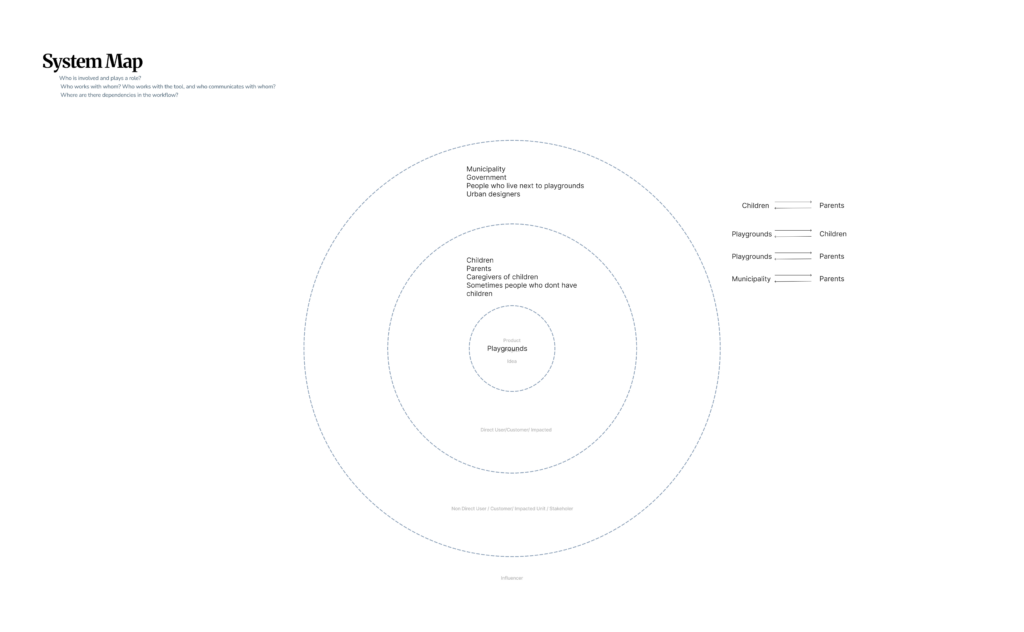
Another  step will be to analyze how and when designers involve children in the design process, both physically (through participation or co-creation workshops) and verbally (through interviews or observations). 

Finally, I will conduct on-site observations in different playgrounds around the city, paying attention to how children use the space, how they interact with each other, and which features seem to inspire the most creativity or playfulness. 

Expected Challenges

One of the most crucial—and challenging—aspects of my research will be figuring out how to strike a balance between safety regulations and creative flexibility in playground design.

At some point ı will also need to conduct interviews with children and parents to better understand their needs and experiences; however, this may be challenging since I do not speak German fluently, which could make communication and building trust more difficult.

References

[1] K. Botsoglou, “Creativity in Playgrounds: A Literature Review,” European Regional Conference: Perspectives of Creativity and Learning in Early Childhood, University of Thessaly, 2011.

[2] D. Harwood, M. Huang, and M. Somma, “We’re Trying to Find Cool Things in the Forest: Exploring Children’s Curiosity and Creativity in the Outdoors,” International Electronic Journal of Elementary Education, vol. 15, no. 1, pp. 33–42, 2022.

[3] D. M. Y. Brown, T. Ross, J. Leo, R. N. Buliung, C. H. Shirazipour, A. E. Latimer-Cheung, and K. P. Arbour-Nicitopoulos, “A Scoping Review of Evidence-Informed Recommendations for Designing Inclusive Playgrounds,” Frontiers in Rehabilitation Sciences, vol. 2, 664595, 2021.

[4] M. Colville-Andersen, “How to Let Kids Design Their Own Playgrounds – and Give Them Back the Streets,” YouTube, 2023. [Online]. Available: https://www.youtube.com/watch?v=SWDqoFqcvUU

[5] Why Safe Playgrounds Aren’t Great for Kids, YouTube, 2020. [Online]. Available: https://www.youtube.com/watch?v=SWDqoFqcvUU

[6] Lappset Sona Interactive Dance and Play Arch, YouTube, 2021. [Online]. Available: https://www.youtube.com

[7] J. L. Frost, S. C. Wortham, and S. Reifel, Play and Child Development, Upper Saddle River, NJ: Prentice Hall, 2001.

[8] N. D. Ridgers, Z. R. Knowles, and J. Sayers, “Encouraging Outdoor Play: The Role of Forest School in Fostering Social and Creative Development,” Early Child Development and Care, vol. 182, no. 3, pp. 431–444, 2012.

[9] AI Assistance: Parts of this proposal were developed with the assistance of ChatGPT (OpenAI, GPT-5, 2025) to refine language, structure, and citation formatting. All conceptual ideas, analysis, and final edits were made by the author.