Accessibility requirements and barriers

Breaking down the accessibility requirements of this project felt like one of the more hard exercises of the whole research process, because we are used to think everything would have been “easy and smooth” since it’s a niche digital research product. But there was much more behind.

What the user should be capable of

On a physical and personal level, sight would be the most relevant sense, since the experience is largely text-based, but it can be made compatible with screen readers and text-to-speech tools from the start. Hearing is not a requirement at all. Movement needs are minimal too, limited to basic typing, clicking, or scrolling, with voice dictation and keyboard-only navigation as fallbacks.

On the cognitive level is where it gets more demanding. Following an iterative loop of prompting, reviewing, and editing requires sustained mental focus and a willingness to sit with a process that is genuinely not instantaneous. As well as the need for a strong digital literacy to navigate AI tools or terminology, and enough language confidence to work in what are predominantly English environments. Though nowadays everything can be translated in real time.

Financially, the core methodology is designed to be of course a free to access tool, to be used as a starting point or guideline to use AI tools. Infrastructure needs are also few: a device and internet connection.

Who is it meant for and where does this happen

The methodology will be designed for anyone engaging with storytelling on a professional or exploratory level, from researchers and creatives to students and private users. It lives entirely in digital space, which means it can happen in any place and environment.

What it does require is probably the mindset: willingness and awareness to co-create with a machine, and enough critical thinking to question what the machine gives back.

The barriers

Two barriers kept coming up in the entire thinking process. The first was language, since AI tools lean heavily on English, nuance is often the first casualty of translation. The solution here could be to develop a simplified and even more visual version of the methodology that relies on basic English, diagrams, and examples rather than dense theoretical language.

The second barrier was knowledge. The informatics specific terminology involved is genuinely intimidating and not of common knowledge (it was for me too). The solution I thought for this issue was to add a vocabulary directly into the framework itself, so all the basic knowledge can be in the same place as the product.

To conclude, cognitive overload is also worth a mention. When the prompting loop feels endless and the output feels overwhelming, the step-by-step structure of the methodology becomes less of a nice-to-have and more of a way to escape.
Close your eyes and imagine: what’s the future like?

After outlining the actors and affected people and sectors within a possible new direction in the creative process, let’s try to visualize what the current state of things look like and what what it could become after the introduction of a new methodology.

Before

  • involvement of AI in all stages of storytelling generation/ideation/creation
  • no precise and documented knowledge on how to do it in this precice field
  • the prompts to ai tool not well written, without puropose
  • Too many requests = extreme waste and environmental impact
  • Unethical use of AI

After

  • easy to use / step by step methodology to understand and use a correct workflow in the creation process
  • Aware and ethical use of AI tools
  • Less prompts / requests sent with more efficient answers
  • Open a new dialogue
  • Set a standard or starting point for the field

Right now, most creatives are figuring this new directions out alone. A structured methodology could change that and optimize our workflow without making us feel left out of the process. It’s not just about better prompts, yet it’s about reflecting on how an entire field relates to a tool that is now part of our everyday life.

Who is involved?

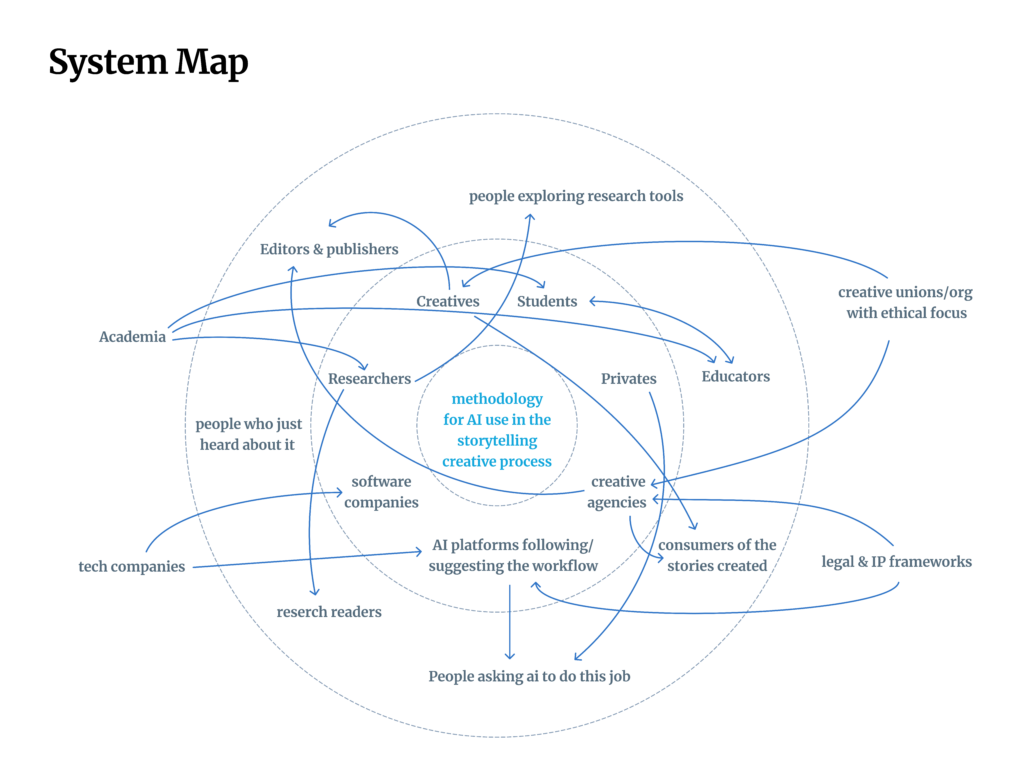
Trying to make sense of how AI fits into the creative process meant also looking first of all at who is actually involved in this process and who could be potentially affected by something new in this field. The system map I put together tries to capture the messy, layered connections that a new methodology for AI-assisted storytelling would actually have to deal with. What surprised me most has been how quickly the actors in the circles can expand and increase. The part I keep coming back to is where genuine human intentionality sits in all of this. When so many actors are pulling in different directions, tracing where creative agency actually lives feels less like a technical problem and more and more a human one.

The impact of generative models on data driven narratives. A quick overview

After starting with a giant question mark about the role played by AI nowadays in the field of data visualization, I decided to start with a literature review to narrow down and frame better on which topic/s to focus. So I have decided to investigate better how LLMs and generative models intervene in data driven storytelling (meant as turning data into easy-to-read and easy-to-understand stories that help turning insights into action).

A systematic review regarding telling stories with data deeply guided my curiosity and focus on the topic of human intentionality. In addition, many papers were also questioning the modern role of the author in the creative process. I want to understand better where the author exactly stands today and how empathy and human intention, that are not entirely replicable by machines, fit in a world dominated by algorithmic storytelling. Therefore, I am exploring the co construction of meaning to observe how humans and algorithms might merge to build these new narratives.

As my literature review expanded, several critical points have emerged. I’d like to explore how algorithm suggestions might perpetuate a structural bias compared to a possible unintentionally “human manipulation”. It is also crucial to question whether relying on automated micro narratives is always the right choice when considering a diverse user base. To conclude (as if this was not already enough qeustions) I plan to explore the sociological aspect of the epistemic control, understanding to whom may it belong.

But for now, let’s keep the focus on just the creative process adopted to create a narrative starting from data and see how the data community behave when involving AI!