ClimaSynth: Enhancing Environmental Perception through Climate Change Sonic Interaction

In this entry I will be reviewing a NIME (New Interfaces for Musical Expression) paper I read, ClimaSynth: Enhancing Environmental Perception through Climate Change Sonic Interaction. The authors are Eleni-Ira Panourgia and Angela Brennecke from Film University Babelsberg KONRAD WOLF and Bela Usabaev from the Cologne Academy of Media Arts. The paper was published in 2024 from the International Conference on New Interfaces for Musical Expression.

The document describes ClimaSynth, an interactive application that aims to communicate climate change through sound, using interaction as a means to raise awareness about the changing environment. ClimaSynth explores the relationship between acoustic and climatic effects by allowing users to manipulate sound through an interface.

I believe it is relevant for New Interfaces for Musical Expression because it explores how we can use simple sonic parameters to communicate big issues. At the same time, it is relevant for my research because it shows a way to draw attention to an environmental cause.

The web-based application developed wishes to enhance environmental perception and explore how sound can express aridity and drought. It achieves this through contrast and familiar sounds, which are associated with climate conditions. The aim is also to investigate the issue through non-human perspectives.

The sonic experience wants to be accessible, with a blurred distinction between content and interface. The authors wanted to create a minimal UI that united sound and vision. Other applications in this format already exist, such as Sound Canvas, Lines and GrainTrain. Riverssounds, another one, allows users to navigate river ecosystems with mouse interaction.

Climate change also means that environments sound differently. This interactive application tries to communicate this using a sound design technique called granular synthesis. It transforms audio by breaking it down into microscopic fragments called “grains”. In this case, granular synthesis is used to manipulate recordings. 

The user can select a soundscape from a drop-down menu: “birds near water”, “river water” and “tree bark”. Each of these corresponds to a field recording. They can then adjust two parameters with sliders, “areas” and “spread”, which are then translated visually and sonically. By modifying these parameters, it is possible to transition between two extremes: the birds singing alone or accompanied by insects, the river becoming dryer and the tree bark readjusting its flexibility, all changes caused by drought. 

The “spread” value is visually translated as a purple area around the mouse, that can be more or less dense. With zero spread the grains are sampled from the same point, while a higher value allows for a broader selection of grains.

The “area” value shows the number of black dots around the mouse. Lower values allow the sounds to be individually perceived, while higher values make us perceive them as connected.

The conceptual originality of ClimaSynth is using parameters to communicate climate change and identifying which ones convey the idea the best. The non-human perspective of the applications makes the user almost feel like they are a fish in the river or the tree itself.

The idea of melting interface and content is coherent and shows that sound and visual elements can also communicate greater problems without needing any words.

The paper is missing information about target audience, testing and participants.

I also think that it is not very accessible to someone not from the field because the way the parameters work is not intuitive. Their visual translation is clear, but I found the sonic changes difficult to grasp. Before reading the paper, I was not sure of what the interactions meant. I would have wished for clearer naming of the parameters or labels on the two ends of the sliders, as a sort of cue of their effect on the sound. 

With the climate changes not being too evident on screen or sonically, I think the result is limited, although after playing with it for a while it is possible to perceive the changes.

As a consequence, I believe that the mapping could be more thoughtful, but the instrument is still performable beyond the lab. It explores musical expression in a way that is closer to nature and it surely conveys a message.
I agree with what is stated in the conclusion of the paper: “This approach offers a promising direction for conveying the complexity of climate change through rich sonic encounters with changing environmental states.” 

The conclusion also mentions the possibility to integrate more parameters and environmental or location-specific data in the UI, and I can imagine the interface changing for each recording, to make the experience more immersive.

I reckon the application could be displayed in exhibitions about environmental issues, but it could also be used to promote behavioural change in interactive ads.

The method explored has potential to communicate the complex issue that is climate change, and it was of great inspiration for my research theme, as I am interested in how interaction can raise awareness about light pollution. Using parameters, whether visual or sonic and analysing them is a way to communicate environmental changes and I will take it into consideration when working on my light pollution project.
Filme und ihr Einfluss auf die Umwelt

Topic: Green Filming

Alle kennen sie, viele lieben sie, aber nur wenigen ist ihr Einfluss auf die Umwelt bewusst: Film-, Fernseh- und Videoproduktionen. Hinter dem schönen Schein des emotional aufgeladenen Storytellings und der akribisch durchdachten Inszenierungen verbergen sich oft Produktionsprozesse, deren ökologischer Fußabdruck sogar Bigfoot Konkurrenz machen könnte.

Der Umwelteinfluss von Filmproduktionen

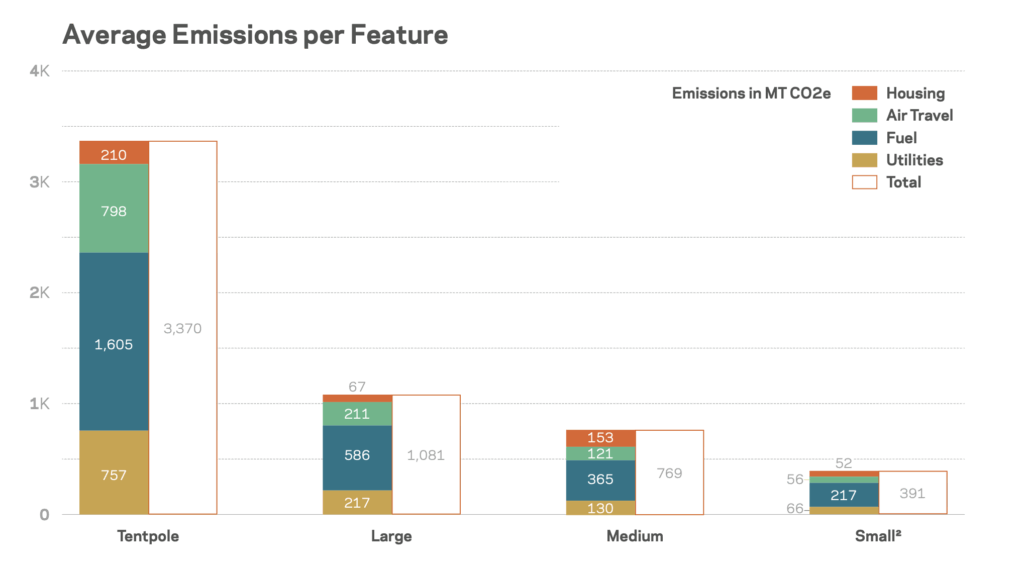
Die Sustainable Production Alliance (SPA) veröffentlichte 2021 einen Bericht, der sich mit dem durchschnittlichen CO2-Ausstoß von 161 Spielfilmen und 266 Fernsehserien auseinandersetz. Dieser Bericht umfasst den gesamten Bereich zwischen großen Tentpole1 Filmen bis hin zu kleinen Filmproduktionen, welche allesamt den Production Evironmental Accounting Report (PEAR) verwendeten. (vgl. SPA 2021, S.1)

Aus diesem Bericht geht hervor, dass der durchschnittliche CO2-Fußabdruck von Tentpole Produktionen bei 3.370 Tonnen lag. Pro Drehtag sind das in etwa 33 Tonnen. Bei großen Filmproduktionen lag der Wert bei 1.081 Tonnen, bei mittelgroßen Filmen waren es 769 Tonnen und bei kleinen Filmproduktionen ergaben sich 391 Tonnen. (vgl. SPA 2021, S.2)

Chart showing the average emissions per feature film.

Abb. 1: Durchschnittliche Emissionen pro Film. (Quelle: SPA 2021, S.2)

Um diese Zahlen besser einordnen zu können ist hier ein Vergleich: Die durchschnittlichen CO2-Äquivalenten Emissionen in Österreich lagen 2023 pro Kopf bei 7,5 Tonnen. (vgl. Statistik Austria 2025, S. 32) Das bedeutet, dass eine Tentpole Produktion pro Tag in etwa so viel CO2 ausstößt, wie 4,4 Personen in Österreich in einem Jahr. Rechnet man das auf den gesamten Produktionszeitraumes einer Tendpole Produktion auf, so stößt diese ungefähr so viel CO2 aus, wie 449 Österreicher:innen in einem ganzen Jahr. Auch kleine Filmproduktionen verbrauchen in diesem Vergleich bereits eine nennenswerte Anzahl an Emissionen und zwar 391 Tonnen. Das ist in etwa so viel wie 52 Personen in einem Jahr ausstoßen.

Wie diese Beispiele zeigen, haben Filmproduktionen einen signifikanten Einfluss auf die Ausschüttung von CO2 und anderen Treibhausgasen, welche wiederum bekannterweise den Klimawandel beeinflussen. Aus diesem Grund ist es essenziell, dass bei Filmproduktionen vermehrt ein Augenmerk auf nachhaltigere Produktionsabläufe gelegt wird. Aus dieser Überlegung heraus entwickelte sich die Begriffe Green Production und Green Filming.

Was ist „Green Filming“ / „Green Production“?

Das Green Filming hat das Ziel, die Filmproduktion so nachhaltig wie möglich umzusetzen. Dabei sollen vor allem die Kohlenstoff-Emissionen bzw. CO2-Äquivalente maßgeblich verringert werden und ein „[…] schonende[r] Umgang mit Ressourcen, Müllvermeidung, Kreislaufwirtschaft, Umwelt und Naturschutz“ (LAFC o.D.) implementiert werden.

Hierbei werden sowohl ökologische als auch wirtschaftliche und soziale Belange berücksichtigt und es wird ein Augenmerk auf das Treffen von verantwortungsvollen Entscheidungen während aller Phasen der Filmproduktion gelegt.
Das bedeutet, dass sowohl während der Preproduction, der Produktion und der Postproduction die Grundsätze der nachhaltigen Entwicklung eingebunden werden. Beim Green Filming arbeiten im besten Fall alle Abteilungen der Filmproduktion Hand in Hand zusammen, um das Ziel der nachhaltigen Produktion zu erreichen. Das bedeutet, dass von Regie, und Kamera über das Szenen- und Kostümbild bis hin zur gesamten Crew alle Personen eingebunden werden. (vgl. LAFC o.D.)

Aber Green Filming befasst sich nicht nur mit der ökologischen, sondern auch mit der sozialen Komponente der Nachhaltigkeit. Aus diesem Grund wird auch darauf geachtet, dass alle Abläufe der Filmproduktion mit möglichst geringen Auswirkungen auf die betroffenen Personen durchgeführt werden. Hierbei wird nicht nur auf die während des Drehs involvierten Mitwirkenden geachtet, sondern auch auf die Menschen Rücksicht genommen, die in der Nähe der Drehorte leben und direkt oder indirekt von den Dreharbeiten betroffen sind. (vgl. LAFC o.D.)

Conclusio

Es ist erkenntlich, dass die Filmproduktion ein großes Verbesserungspotenzial im Bereich der Nachhaltigkeit hat. Bereits kleine Produktionen stoßen in etwa so viel CO2 aus, wie 52 Österreicher:innen in einem ganzen Jahr. Das Green Filming hat sich zum Ziel gemacht, diese Emissionen maßgeblich zu verringern und die Filmproduktion in Richtung Nachhaltigkeit zu lenken. Es bleibt zu hoffen, dass in Zukunft so viele Filmschafende wie möglich auf die Maßnahmen des Green Filmings umsteigen und somit zur Schadstoffreduzierung und Umweltverschmutzung beitragen. Auf diese Weise können in Zukunft beeindruckende und mitreißende Filme erschaffen werden, ohne dabei die Umwelt in Mitleidenschaft zu ziehen.

1 Der Begriff Tentpole Production beschreibt einen Film, der einen großen Profit erzielen soll. Außerdem ist das Ziel, durch diesen Film weitere Investition für zukünftige Produktionen zu erlangen. (vgl. Cambridge Dictionary o.D.)

Literaturverzeichnis

Cambridge Dictionary o.D.Cambridge Dictionary (o.D.): tentpole. In: Cambridge Dictionary, https://dictionary.cambridge.org/fr/dictionnaire/anglais/tentpole (zuletzt aufgerufen am 24.11.2025)
LAFC o.D.LAFC (o.D.): Wissensschatz Nachhaltigkeit. Was bedeutet Green Filming? In: LAFC Evergreen Prisma, https://www.lafc.at/greenguide/pool.php?ggid=4&aid=1172&cp=0 (zuletzt aufgerufen am 24.11.2025)
Statistik Austria 2025Statistik Austria: Umweltgesamtrechnungen. Modul – Luftemissionsrechnung 1995 bis 2023. Wien: Statistik Austria 2025
SPA 2021Sustainable Production Alliance (01.03.2021): Carbon Emissions of Film and Television Production. In: Sustainable Entertainment Alliance, https://greenproductionguide.com/wp-content/uploads/2021/04/SPA-Carbon-Emissions-Report.pdf (zuletzt aufgerufen am 26.11.2025)