Last, but not least I am going to focus on some more material of activist poster design. Then I will add my next steps for my thesis, so you know what I will be doing in the future and how I will add to my collection of materials and research.
The topic I already focused on in part 6 of my blog posts was global warming and the environment. Therefore, I want to add some more posters here that focus on this exact topic.
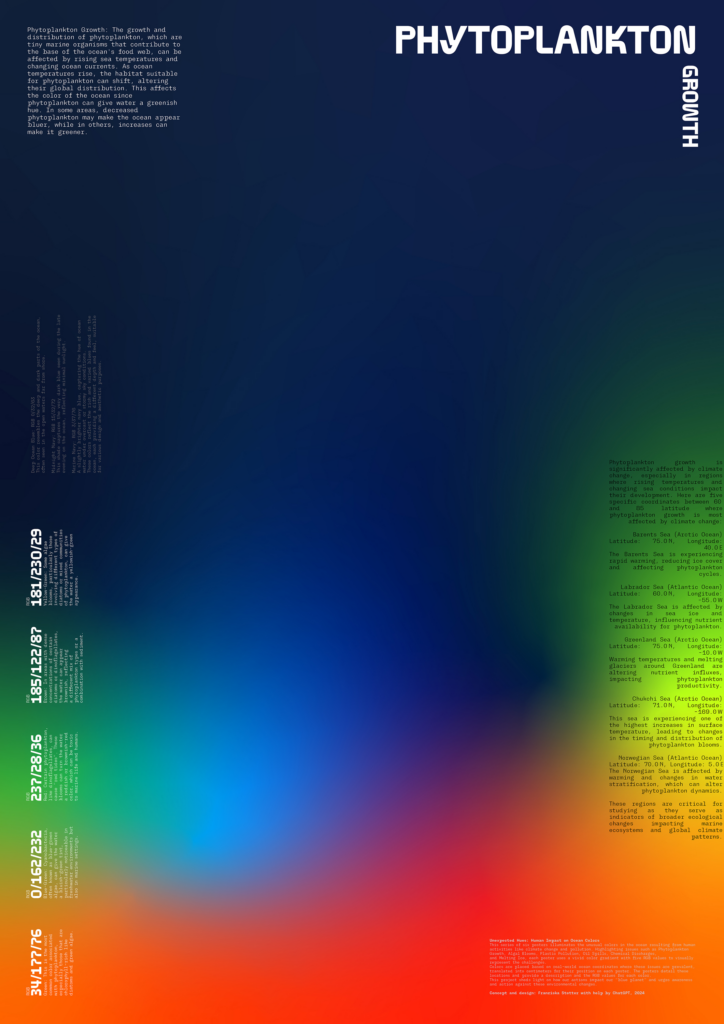
“Unexpected Hues – Human Impact on Ocean Colors” is an interesting poster series by Franziska Stetter. It wants to raise awareness on certain oceanic problems the environment is facing. There are six posters on the topics: “[…] Phytoplankton Growth, Algal Blooms, Plastic Pollution, Oil Spills, Ocean Acidification, and Melting Ice […]” (Stetter, 2026) Each of the posters
“[…] using a vivid gradient of five RGB color values to represent changes in ocean color caused by environmental disruptions. These colors are placed based on real-world coordinates where these issues are prevalent, translated into their position on each poster. Accompanying each visual are detailed descriptions that explain the context, data, and meaning behind the chosen hues, creating a blend of scientific data and visual storytelling.” (Stetter, 2026)
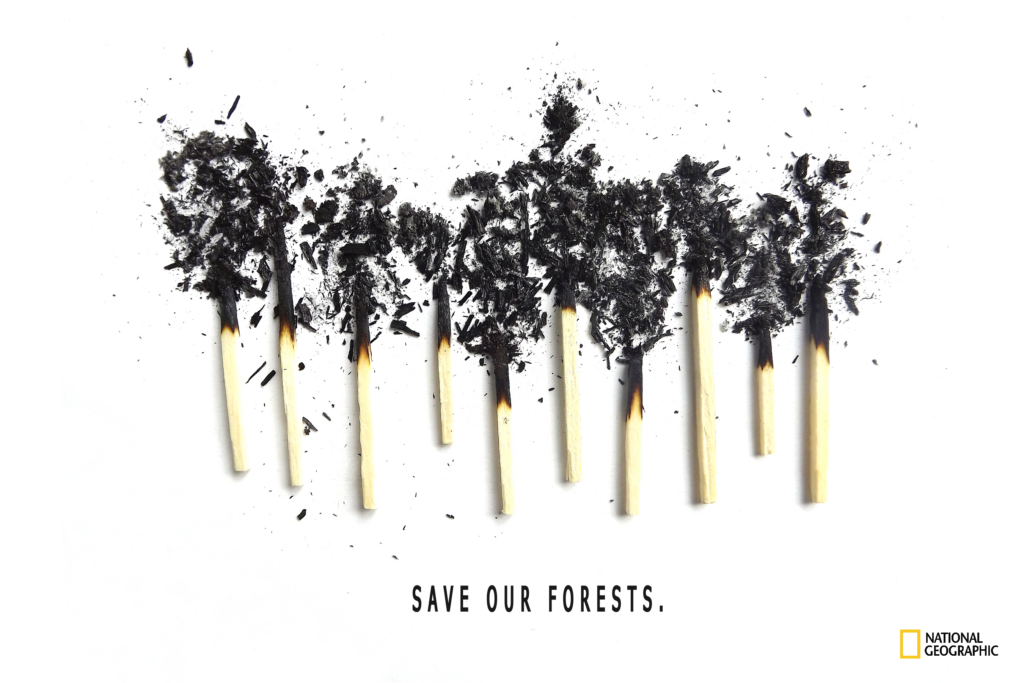
In this poster Brynn Seitzman has focused on one of the effects of global warming. The typography is a call to action and makes us aware that our forests need saving. Through this quote the picture becomes alive, we do not only see burnt out matchsticks anymore, but trees, a whole forest that was burnt down by wildfire, caused by global warming and climate change.
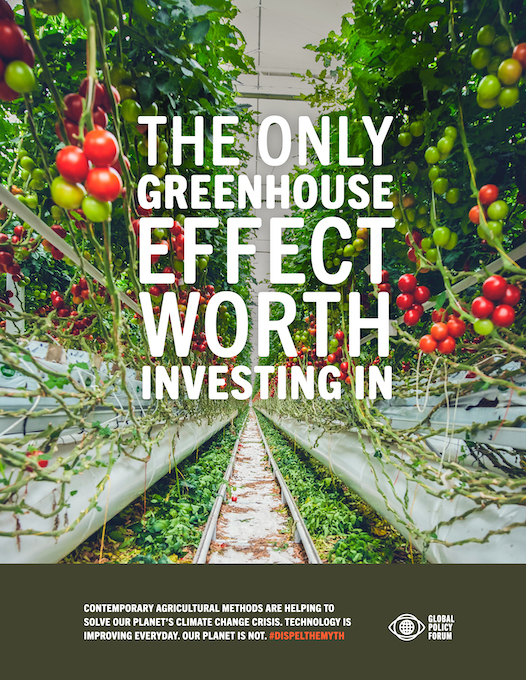
This next poster was created by Jack parker, Evan Hamilton and Gabe Salas, students from the Texas State University. It focuses on showing what can be done against climate change within the field of agriculture through new technology. Since the greenhouse effect is a phenomenon tied to climate change, it is interesting to use this quote to advertise for new agricultural greenhouse solutions that help us live in an environment that is constantly getting hotter.
To summarize, these were some examples of advocating for change in caring more for the environment. The next steps of my thesis will be to synthesize my findings and tie them together more closely, as well as, to find even more examples that help me make choices to create my own design activist works. In the end, I want to apply the results of my research to my own practice as a designer. This will make it easier for me to create alongside my personal values and connect them to my future brand. It will add more value to my work and hopefully steer my portfolio and my future work life into directions I am interested in that make people think twice about their actions.
Thank you all for your interest in my research journey. I have still got quite a way to travel with this, but I’m more sure than ever to start creating on my own, seeing what I can do with all the insights I have gained into this broad and extremely important issue.
Sources:
Parker, Jack; Hamilton, Evan and Salas, Gabe: Dispel the Myth. In: Graphis Online, 2020. URL: https://graphis.com/entry/9165a4b3-1837-4ce2-8927-bc7a7d8f8245. Accessed 2026, Jan. 26.
Seitzman, Brynn: “Save Our Forest”. In: Graphis Online, 2015. URL: https://graphis.com/entry/acc0d43f-f96c-417b-bc4e-0fefbb27435d. Accessed 2026, Jan. 26.
Stetter, Franziska: Unexpected Hues – Human Impact on Ocean Colors. In: Graphis Online, 2026. URL: https://graphis.com/entry/80052a8b-1c57-4772-bc12-69183332c9fc. Accessed 2026, Jan. 26.