Design & Research II – System, Impact, and Inclusion

Design & Research 2 | For: Katerina Sedlackova

Following my prototypes, I am now looking at how my project fits into the bigger world. I have broken this down into three parts: the system, the change it creates, and who can actually use it.

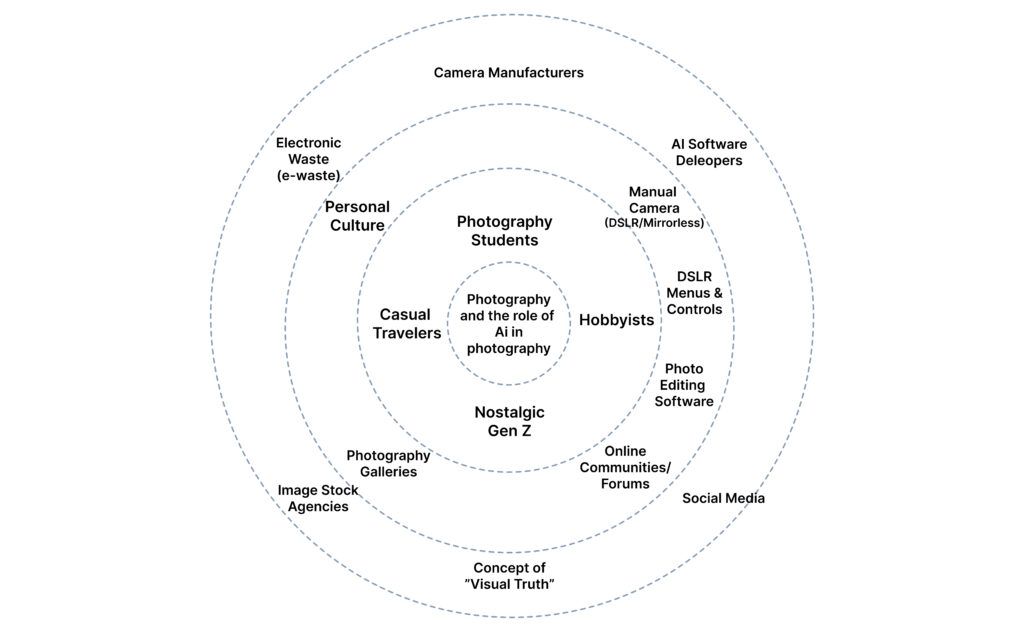
This diagram illustrates the broader ecosystem surrounding my camera-AI guidance system. I have mapped it from the core outwards to show how the project connects to the world.

The Core: The interaction between the Photographer and the Manual Camera.
Direct User Context: Students, hobbyists, and “Nostalgic Gen Z” looking for a creative rhythm.
External Ecology: The heavy hitters—Nikon/Sony (Hardware), Adobe/Midjourney (AI), and Instagram (Social). I also included E-waste, as the sustainability of our gear is part of the system.

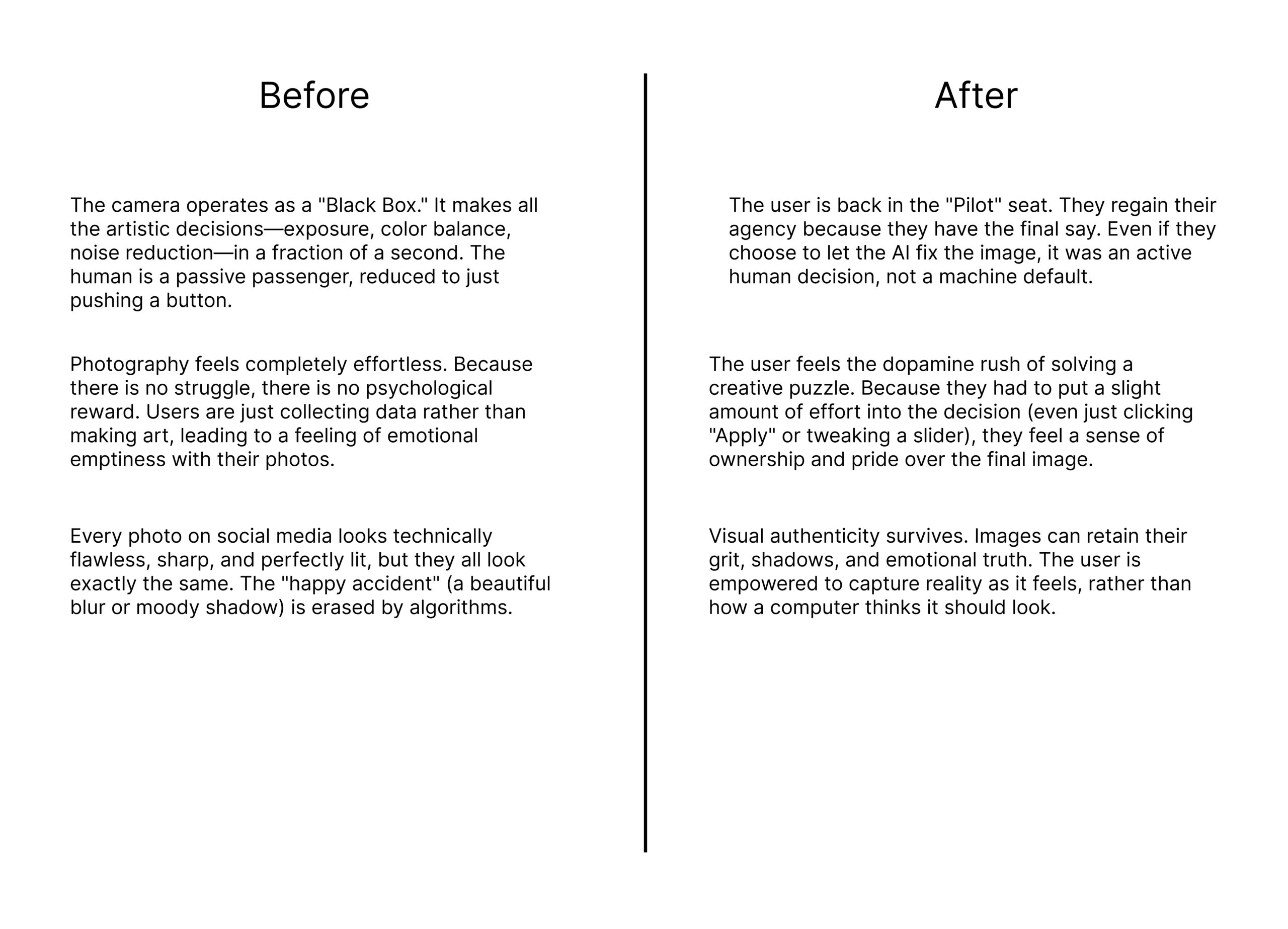
This comparison highlights the shift from automation-first snapping to learning-aware photography.

The Goal: The goal is to move the user from being a passive passenger of an automated process to an active “Pilot” who understands their tools.

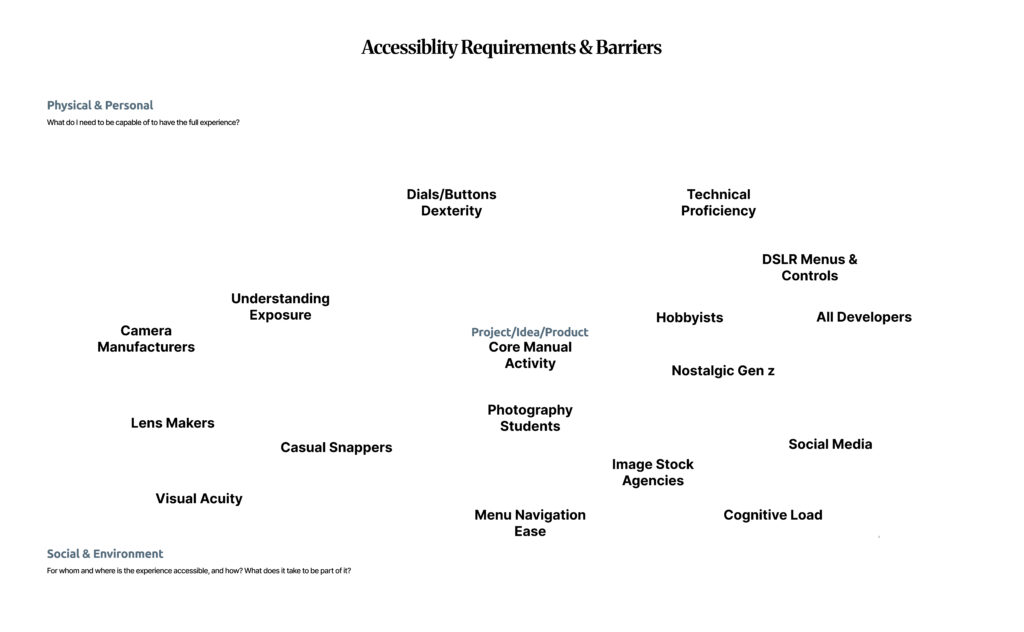
Accessibility in photography is not just about “talent”; it is a systemic issue. Using the floating barrier map, I identified the physical and cognitive hurdles that stop people from mastering manual photography.

Design & Research II – Lo-Fi Prototypes 1/6

Following my research on “Automation in Photography,” I have spent this week diving deeper into my project by creating three different prototype scenarios. Even though I haven’t tested these with real users yet, the act of making them helped me see points I was missing and gave me a better direction for my Master’s thesis.

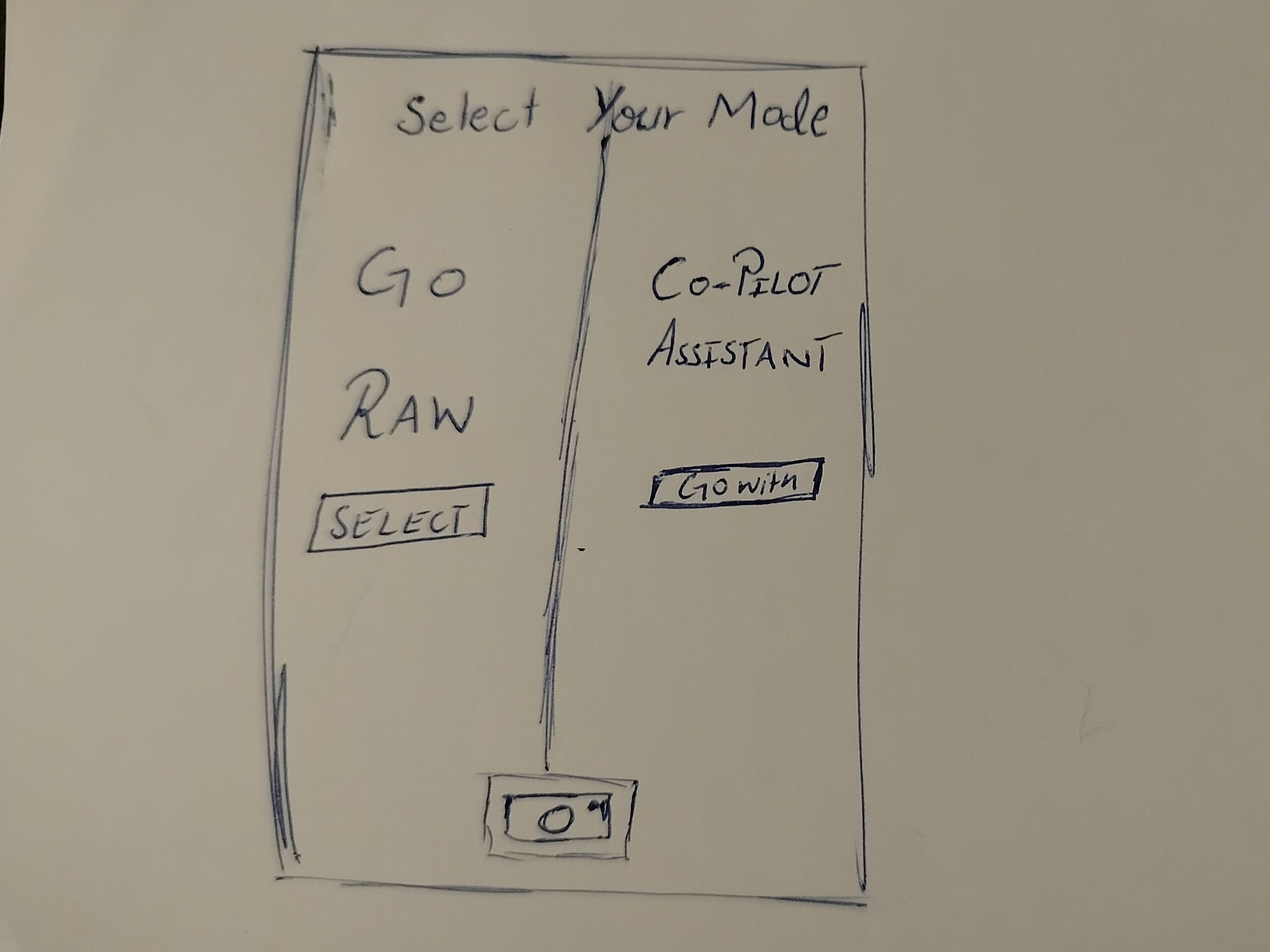
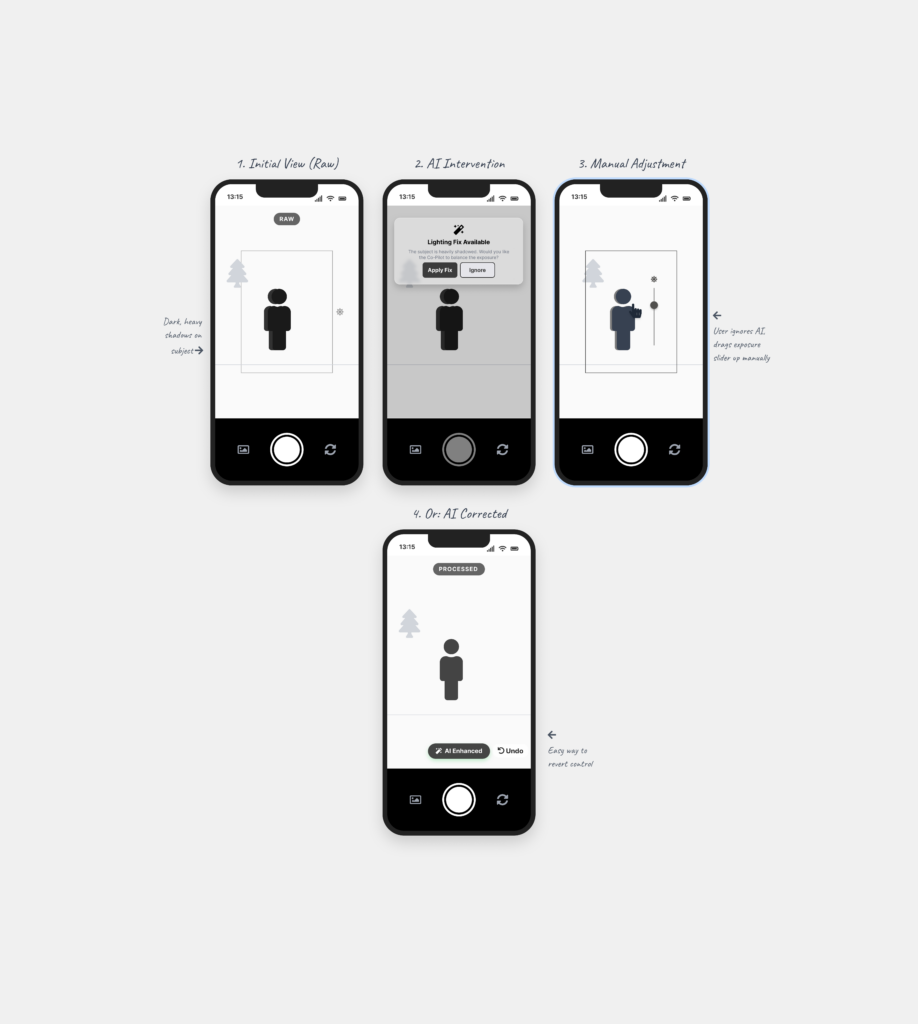
In this one, when the user opens the camera, they have to choose between two options. One is a Raw Mode where the user has all the control, and the other is an AI Automation mode.

The Goal: To see if forcing the user to pick a mode at the start makes them more intentional about how they want to take the photo.

This is a digital assistant that pops up on the screen while you are shooting. It explains what is happening based on the scene. For example, it might say “increase shutter speed because you are shooting action” or “reduce ISO because there is too much light.”

The Goal: To see if giving the user a “why” helps them stay in control instead of the camera just fixing the settings automatically.

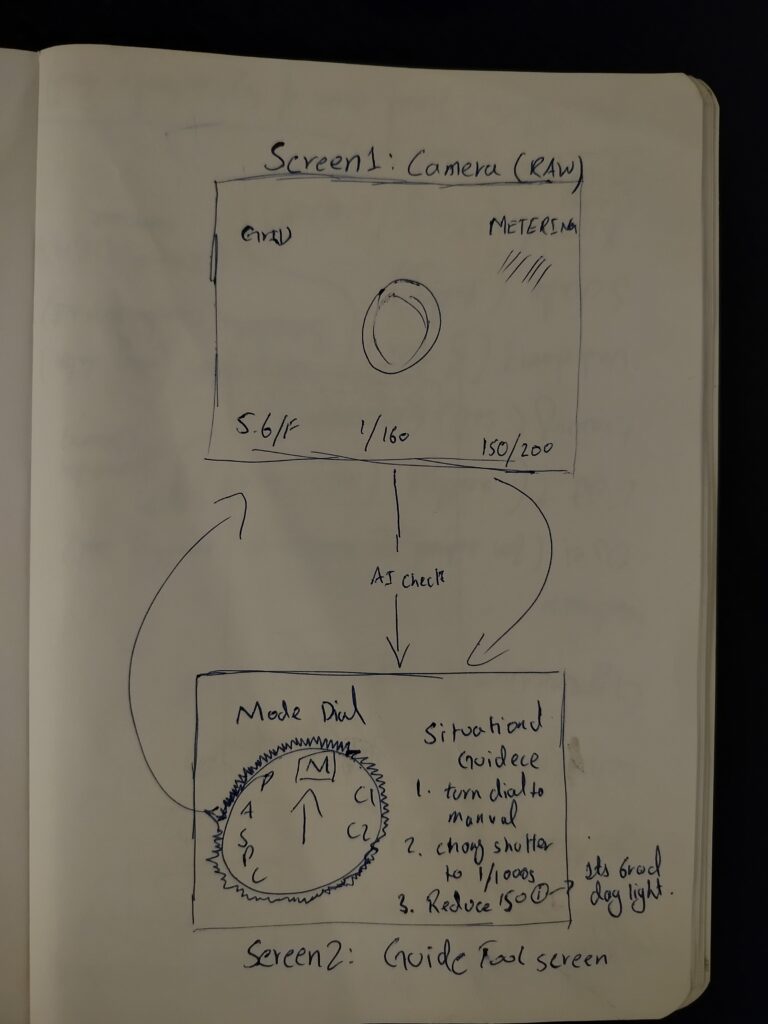
This is for professional cameras. A separate device (like a phone) is attached to the camera to guide the user. It shows suggestions on which physical dials to turn to get the right settings.

The Goal: To see if the AI can act as a teacher that helps the user learn how to use the manual settings on their professional camera.

Creating these scenarios helped me see which directions I might follow, but it also left me with a big question about the design process. I understand that if you have a clear vision, prototyping early can save a lot of time. But when you are still in the early stages of defining and understanding the problem, I found it extremely difficult.

To be honest, it doesn’t make total sense to me to build a solution when I haven’t even fully decided what the actual problem is yet. While I know it is supposed to be beneficial, I personally didn’t find it that helpful at this stage. It felt a bit like guessing. However, the exercise did at least show me which side of the camera-AI idea has the most potential, even if the final direction is still a bit blurry.

5# Product & Business Idea – Design & Research II (Katerina)

Thanks! 🙏

4# Customer Profile & Value Proposition Map – Design & Research II (Katerina)

3# Inclusion & Accessibility – Design & Research II (Katerina)

BRANDING POLITICS: Look again – questioning politics, branding, and the choices we make

By now, one thing should be undeniable: politics rarely announces itself clearly. It doesn’t always arrive as a policy proposal or a campaign speech. More often, it slips in quietly – through visuals, voices, aesthetics, platforms and vibes. It disguises itself as lifestyle, taste, entertainment or common sense.

That’s exactly why questioning matters.

Especially for creatives.

If you can identify branding tactics, you can identify persuasion. If you understand visual language, tone and emotional framing, you can see how power is communicated – and how it is normalised. Political movements rely on design to simplify complex realities, mobilise emotion and create belonging. Sometimes this is empowering. Sometimes it’s manipulative. Often, it’s both.

Questioning doesn’t mean disengaging. It means becoming literate in the systems shaping perception. Asking who benefits from a particular visual language. Whose voices are amplified. Whose experiences are aestheticised. And whose realities remain invisible.

This is where creative skill becomes political responsibility.

Design, media, communication and storytelling are not neutral tools. They structure what is seen, what is felt and what is remembered. As branding logic increasingly dominates political communication, the ability to recognise it becomes a form of power. To see branding is to see strategy. To see strategy is to slow it down.

And slowing down matters.

Because political branding thrives on immediacy. On emotional shortcuts. On recognition before reflection. Questioning interrupts that flow. It creates distance. It makes space for complexity.

This brings us full circle – back to where this series began.

Politics doesn’t start at the ballot box. It starts earlier. Smaller. Quieter. With a repost. A purchase. A design choice. A silence. A black or white shirt at H&M.

Everything is political – not because everything is dramatic, but because everything participates. Every choice exists within systems of power, culture and meaning, whether we acknowledge them or not.

The real question isn’t whether you’re involved.

It’s whether you’re looking closely enough, at how involved you actually are.

Sources:
• Foucault, M. (1980). Power/Knowledge. Pantheon Books.
• Hall, S. (1997). Representation: Cultural Representations and Signifying Practices. Sage.
• Couldry, N. (2012). Media, Society, World. Polity Press.

BRANDING POLITICS: Politics as lifestyle – when ideology becomes everyday practice

If politics truly permeates everything – and by now it should be clear that it does – then lifestyle is where it settles most comfortably. Not loudly, not dramatically, but quietly. In routines. In habits. In choices that don’t feel political until someone points out that they are.

What we eat, wear, watch, share and buy increasingly functions as political expression. Ethical consumption, sustainability, boycott culture, conscious branding, “voting with your wallet” – these practices allow individuals to align ideology with daily life. Politics becomes something you do without necessarily noticing you’re doing it.

This shift reflects a broader transformation in how political identity is constructed. Rather than being expressed primarily through formal participation – voting, party membership, protest – politics is increasingly embedded in personal identity and self-presentation. Being political is no longer just about what you argue for, but about how you live.

Sociologist Pierre Bourdieu famously argued that taste is never neutral. Our preferences in food, clothing, art and media reflect social positioning, cultural capital and power relations (Bourdieu, 1984). In contemporary culture, taste has become explicitly political. Aesthetic choices signal values. Consumption communicates alignment. Lifestyle becomes ideology, translated into everyday practice.

This is precisely why branding plays such a central role in modern political movements. For a cause to last, it must integrate seamlessly into daily routines. It must be wearable, shareable and repeatable. When politics becomes habitual, it becomes resilient. A movement that fits into everyday life is harder to abandon than one that only exists in moments of crisis.

But lifestyle politics also exposes deep contradictions.

Who gets to participate in ethical consumption? Who can afford sustainable fashion, organic food, or locally produced goods? When political engagement is tied to purchasing power, participation becomes uneven. What presents itself as moral choice can quickly slide into exclusion.

There is also the question of effectiveness. Critics argue that lifestyle politics risks reducing systemic issues to individual responsibility. Buying the “right” products may soothe personal conscience without challenging structural inequalities. Political action becomes symbolic rather than transformative.

And yet, dismissing lifestyle politics entirely misses its cultural power. Everyday practices shape norms. Norms shape expectations. Expectations shape politics. What feels normal today was often radical yesterday.

Lifestyle politics operates in the slow lane of change. It doesn’t replace institutional reform or collective struggle – but it does influence how those struggles are understood, supported and sustained. It turns abstract values into visible behaviour.

Politics doesn’t only live in institutions or protests.
It lives in habits.

And habits, once formed, are hard to break.

Sources:
• Bourdieu, P. (1984). Distinction: A Social Critique of the Judgement of Taste. Harvard University Press.
• Giddens, A. (1991). Modernity and Self-Identity. Polity Press.
• Micheletti, M. (2003). Political Virtue and Shopping. Palgrave Macmillan.

BRANDING POLITICS: Beyond the feed – other media channels shaping modern political movements

Social media dominates contemporary discussions of political activism – but focusing exclusively on feeds, algorithms and platforms obscures a crucial reality. Modern political movements are multi-channel by necessity. They operate across digital and physical spaces simultaneously, adapting their messages to different media logics.

Street posters, stickers, murals, banners and wheat-pasted flyers remain powerful political tools precisely because they resist digital ephemerality. You don’t scroll past them. You encounter them. Public space becomes a medium, and a battleground.

Cultural theorist Henri Lefebvre famously argued that public space is never neutral, it is produced through power relations, regulation and resistance (Lefebvre, 1991). Protest media that occupies physical space interrupts everyday routines and asserts political presence without requiring consent or algorithmic approval.

Zines and independent print publications function in a similar way. Historically rooted in feminist, queer, punk and anti-capitalist movements, zines prioritise depth, intimacy and community over reach. Their aesthetics – imperfect, handmade, intentionally “unpolished” – reject corporate design standards while still operating within recognisable visual languages.

Community radio also plays a vital role, particularly outside metropolitan centres. It sustains local political discourse, amplifies marginalised voices and maintains continuity between moments of heightened protest visibility. Unlike social media, it is less driven by virality and more by presence.

Even fashion operates as a political media channel. Clothing transforms bodies into mobile communication surfaces. Slogan T-shirts, pins, patches and colour-coded accessories allow individuals to signal political alignment in everyday life. Once again, branding logic reappears: visibility, recognisability, repetition.

What unites these channels is not nostalgia, but strategy. Modern movements do not choose between online and offline media. They occupy all of it. Each channel fulfils a different function – mobilisation, education, identity-building, memory.

The feed is loud.
But the street still speaks.

Sources:
• Lefebvre, H. (1991). The Production of Space. Blackwell.
• Duncombe, S. (2008). Notes from Underground: Zines and the Politics of Alternative Culture. Microcosm Publishing.
• Couldry, N. (2012). Media, Society, World. Polity Press.

BRANDING POLITICS: Press record to protest – podcasting as a political movement

Podcasting doesn’t look like protest – and that’s precisely why it has become so politically powerful.

There are no marches, no placards, no visually striking crowds filling public squares. Instead, there is a voice. Sometimes just one. Conversational and opinionated. “So here’s the thing…” And suddenly, politics unfolds in your headphones while you’re cooking dinner or commuting to uni.

Podcasting has emerged as one of the most influential – and underestimated – political media forms of the 21st century. Unlike social media platforms that reward speed, outrage and brevity, podcasts thrive on slowness. They offer time, continuity and deeper narratives. In an attention economy built on fragmentation, this temporal commitment is, in a way, radical.

Media scholars argue that podcasts foster strong forms of parasocial interaction – one-sided relationships in which listeners feel emotionally connected to hosts (Llinares, Fox & Berry, 2018). This perceived intimacy generates trust, loyalty and long-term engagement. From a political perspective, this is an incredibly powerful mechanism.

Political podcasts do not simply distribute information. They construct ideological worlds. Over time, listeners adopt not just the host’s language, but also references and interpretive frameworks. The podcast becomes more than content – it becomes a brand, a community and a shared worldview. Intro music functions like a logo. Catchphrases become insider language. Live shows and merchandise transform listening into belonging.

Unlike traditional broadcast media, podcasting bypasses institutional gatekeepers almost entirely. Anyone with a microphone and internet access can participate. This accessibility has allowed marginalised voices to build substantial audiences without relying on mainstream media approval. At the same time, it has enabled the formation of highly insulated ideological spaces.

Podcasting mirrors protest branding in an unexpected way: it replaces visual symbolism with sonic identity. Tone of voice, rhythm, pacing and repetition become political tools. Where protest movements rely on imagery in public space, podcasts occupy private space – directly inside people’s heads.

This private consumption does not make podcast politics passive. On the contrary, it often deepens ideological commitment. Listening is sustained, habitual and intimate. Political ideas are not encountered accidentally, they are chosen, returned to and internalised.

Political change does not always shout. Sometimes, it whispers – consistently, convincingly, and every single week.

Sources:
• Llinares, D., Fox, N., & Berry, R. (2018). Podcasting: New Aural Cultures and Digital Media. Palgrave.
• Spinelli, M., & Dann, L. (2019). Podcasting: The Audio Media Revolution. Bloomsbury.

BRANDING POLITICS: Same fight, different fonts – movement interconnectivity in modern politics

At first glance, political movements tend to present themselves as singular, distinct and morally unique. Each cause claims urgency. Each struggle insists on its own language, symbols and priorities. Climate activists block streets and glue themselves to infrastructure. Feminist movements organise marches and online campaigns. Labour unions strike. Nationalist movements rally under flags and slogans. Different demands, different enemies – different aesthetics.

And yet, once you start paying attention to how these movements communicate, the differences begin to blur.

Political movements rarely invent themselves from scratch. They emerge within existing cultural, political and media environments, borrowing tactics, visuals and narratives from those that came before them – and from those they oppose. Social movement scholars describe this process as movement spillover, where ideas, organisational forms and symbolic repertoires travel across movements, even across ideological boundaries (Meyer & Whittier, 1994).

A slogan migrates. A colour palette resurfaces. A gesture becomes universal.

The clenched fist is perhaps the most recognisable example. Originally associated with labour movements and anti-fascist resistance, it has since been adopted by feminist, anti-racist, queer and climate justice movements. In each context, its meaning shifts slightly – empowerment, solidarity, resistance – but its emotional core remains intact. Symbols accumulate histories. Movements inherit them whether they want to or not.

What becomes particularly striking is that opposing movements often rely on remarkably similar branding tactics. Uniform clothing. Simplified messaging. Strong emotional narratives. Clear distinctions between “us” and “them.” Even when political goals are fundamentally incompatible, the communication logic remains the same. Everyone is competing within the same attention economy.

This mirroring effect is especially visible in polarised political landscapes. Progressive and reactionary movements alike frame themselves as authentic, silenced or under threat. They claim moral urgency. They mobilise fear, hope or nostalgia. Communication theorist Paolo Gerbaudo argues that contemporary mobilisation is less about rational persuasion and more about emotional identification – movements succeed by making people feel part of something (Gerbaudo, 2018).

Belonging, however, requires recognisability.

This is where branding becomes essential. A movement must be instantly identifiable, repeatable and scalable. Limited colour palettes, recognisable symbols, consistent tone of voice – these elements allow movements to circulate across platforms and contexts without losing coherence. Whether it’s climate justice or nationalist populism, the mechanics are often identical. Same fight, different fonts.

Interconnectivity also becomes visible through coalition-building. Climate justice movements increasingly align themselves with labour rights, feminist politics and anti-racist struggles, recognising shared structural enemies. These alliances reshape visual language too. Messaging becomes broader. Symbols soften. Aesthetics adapt in order to accommodate multiple identities without collapsing into incoherence.

Yet this process is never frictionless. Interconnected movements must constantly negotiate whose priorities are foregrounded and whose are marginalised. Branding choices become political decisions.

Ultimately, movements do not operate in isolation. They exist within shared cultural systems, media infrastructures and design logics. Same platforms. Same visual languages. Same struggle for attention.

Different politics. Same design rules.

Sources:
• Gerbaudo, P. (2018). The Digital Party. Pluto Press.
• Meyer, D. S., & Whittier, N. (1994). Social Movement Spillover. Social Problems, 41(2).