As I started researching product examples that demonstrate how interactions could be designed in a calm and respectful way, I came across the Calm Tech Institute Awards. Through this initiative, the Calm Tech Institute recognizes products, services, and technologies that are designed according to the principles of calm technology. Products are evaluated through a 81-point criteria covering categories such as:
- attention: Products are evaluated on how they work with (or against) human attention.
- periphery: How does the product engage other senses through peripheral attention?
- durability: How does the product break down? Does it offer support to customers in some way?
- light: Does the product use warm lighting or harsh, blue lights?
- sound: How does the product sound? For products with moving parts, what actions have been taken to prevent excess noise?
- materials: What kinds of materials are used?
The award spans a wide range of product and service domains, including:
- Smart Appliances
- Transportation
- Electronics
- Artificial Intelligence
- Automotive
- Health
- Homes
- Vacation Rentals
- Museums
- Education
- Websites and Apps
This framework shifts the focus away from novelty and constant engagement, instead emphasizing thoughtful, human-centered design.
In this and the next blog entry, I want to take a closer look at some of the products that have received this award and explore how they translate calm technology principles into real-world design.
“Dreamie” by Hello Ambient
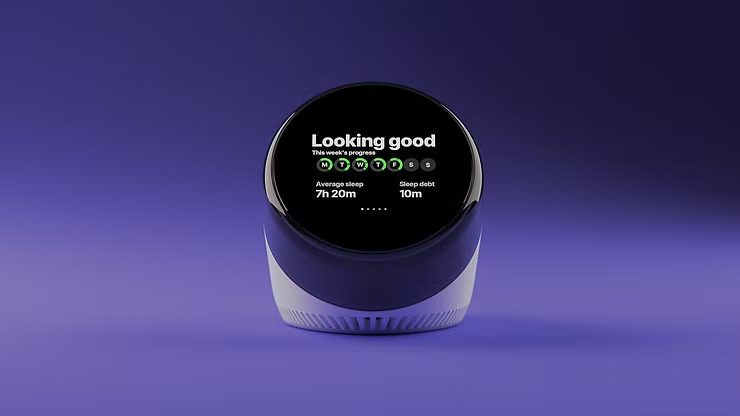
Last year’s highest certified product is a bedside sleep companion called Dreamie. The device is designed to reduce phone usage in the bedroom. A space that should ideally be reserved for rest and recovery. Looking at sleep behavior research from the American Academy of Sleep Medicine (AASM), it quickly becomes clear why this is such a relevant use case for calm technology.
ccording to the AASM, 87% of adults keep a phone in their bedroom, and the majority of them report not getting enough sleep due to phone usage. Other studies show that just one hour of screen time after going to bed increases the likelihood of insomnia symptoms by more than 50%. Screen use at night is also associated with an average loss of 24 minutes of sleep. These numbers highlight a clear opportunity for a device that keeps technology present, but firmly in the background—supportive rather than disruptive.
Based on their research, the AASM recommends several habits to improve sleep quality:
- Disconnect from devices at night
- Leave your phone in another room
- Follow a relaxing nighttime routine
- Have a sleep schedule
- Turn off push notifications
Dreamie, developed by Hello Ambient, directly addresses these recommendations and turns them into design requirements. Instead of asking users to rely on willpower alone, the device offers an alternative that fits naturally into existing bedtime routines.
At its core, Dreamie is more than a smart alarm clock—it is a carefully considered design solution. Recognizing how hard it can be to resist media consumption before sleep, the device provides calm, sleep-focused audio content. This creates a gentle alternative to scrolling through a bright, distraction-filled phone screen, helping users wind down rather than stay engaged.
In addition, Dreamie tracks sleep patterns without requiring wearable devices, reducing friction and discomfort. It also features a daylight-based alarm, which is widely considered to be a more natural and less jarring way to wake up compared to traditional sound alarms. Interactions are handled through tactile, physical controls, allowing for eyes-free adjustments in the dark—an intentional design choice that avoids bright screens and supports a calm, sleep-friendly environment.
Taken together, these features strongly align with calm technology principles. Dreamie avoids competing for attention, supports healthy sleep habits, and stays in the background when not needed—showing how research-driven insights and calm interaction design can address a widespread problem.

References:
- Front. Psychiatry, 31 March 2025: “How and when screens are used: comparing different screen activities and sleep in Norwegian university students“
- https://www.calmtech.institute/calm-tech-certified?
- https://www.calmtech.institute/post/calm-tech-institute-awards-dreamie-highest-certification-for-phone-free-sleep-innovation
- https://www.helloambient.com
AI Assistance Disclaimer:
AI tools were used to improve grammar and phrasing. The ideas, examples, and content remain entirely the author’s own.
