User Interfaces in Video Games – The quest for genre-appropriate and usable game UI
Last time I answered the question of what the first video games were, namely Tennis for Two and Spacewar!. Today, I’ll be taking a step further and covering the universally known earliest video game Pong, as well as taking a quick look at the progression of games and their interfaces further.
Early Game Interfaces (Arcade and Home Consoles)
Are we getting to the UI yet?
Yes! Games finally became commercially successful and available to the general public outside of science fair and university contexts thanks to the shift away from giant computers that weighted dozens of kilos and cost thousands.
1972 – Pong
Source: [1]
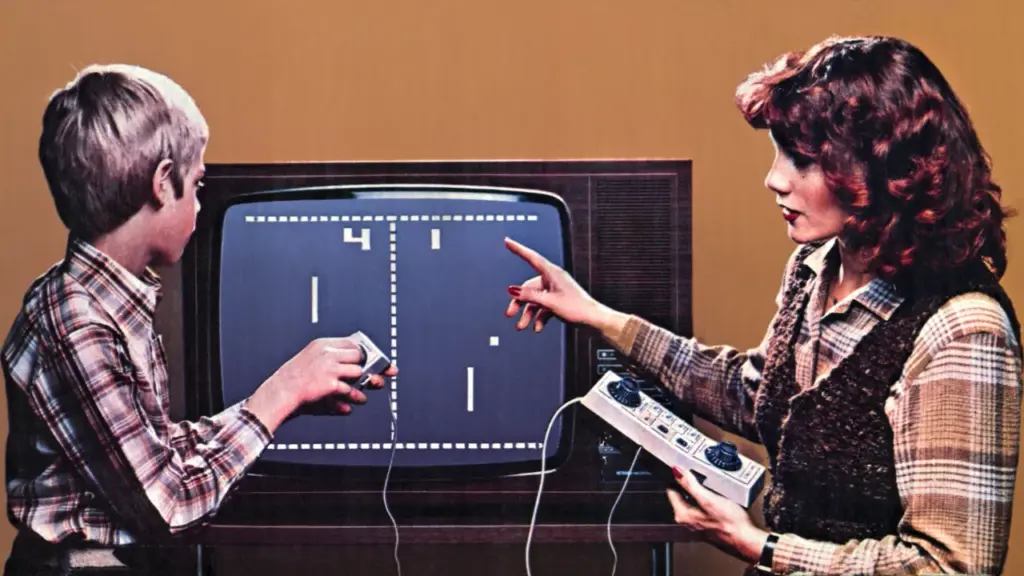
Pong was developed by Atari which was a company formed by Nolan Bushnell and Ted Dabney, and programmed by Al Alcorn. It used dials for vertical movement of paddles where players competed to hit the ball back and forth [2]. This is where we notice the first truly UI element of a game, which is the score counter on the top of the screen.
1978 – Space Invaders

Source: [3]
Released 20 years after Tennis For Two, Space Invaders was developed by Tomohiro Nishikado and it marks the rise in popularity of arcade games, with two buttons for moving left and right and one for firing projectiles [4]. In this new age of arcades, one of the very first innovations in game interface design, the high score and the high score screen, were born [5]. The high score was a different motivation compared to the other games mentioned so far which were based on competition between two players. Space Invaders and many popular arcade machines featured single player experiences, where the high score screen would incentivize not only beating your friends but also beating your own score. Arcades were the place where HUDs were born, with more and more permanent UI elements aiding players emerging.
As much as I would love to talk about the entire history and progression, and go all the way from Pac-Man to modern games, I’ll keep it to these two blog posts. They will serve as a sort of starting point for when I dive deeper into the history for my actual thesis.
References
- [1] J. O’Driscoll, “Pong at 50: the video game that ‘changed the world’,” The Week. Accessed: Dec. 15, 2025. [Online.] Available: https://theweek.com/news/technology/958675/pong-at-50-the-video-game-that-changed-the-world
- [2] R. Sheposh, “Pong (electronic game),” EBSCO. Accessed: Jan. 11, 2026. [Online.] Available: https://www.ebsco.com/research-starters/history/pong-electronic-game
- [3] Z. C. Cohen, “‘Space Invaders’ Video Game Takes Aim at Big-Screen Adaptation,” Time. Accessed: Dec. 15, 2025. [Online.] Available: https://newsfeed.time.com/2011/07/12/space-invaders-video-game-takes-aim-at-big-screen-adaptation/
- [4] D. Hansen, “Space Invaders 1978: A First Invasion”, in Game On!: Video Game History From Pong and Pac-Man to Mario, Minecraft, and More, Harrisonburg, Virginia, USA: Feiwel and Friends, 2016, pp. 172-193.
- [5] J. Novak and K. Saunders, “History of Game Interface Design: how did we get here?”, in Game Development Essentials: Game Interface Design, Clifton Park, NY, USA: Thomson Delmar Learning, 2007, ch. 1, pp. 6-8.
