#slowness #slowliving #slowinteraction #digitalcalm #calmtechnology
In my last three blog posts, I want to focus more on the city and the human experience in the city, the moments when we slow down and speed up, why this happens, and how design can shape our experience. In the last 10th blog post, I will describe an idea that came to me while using maps for traveling, hiking, and using maps in the three countries where I have lived.
Cities often have a default sense of urgency. We rush through the streets, quickly moving between buildings and rarely stopping unless there is a clear reason to do so. This feeling of acceleration is usually associated with modern lifestyles or digital technologies. However, long before the advent of smartphones and notifications, the city itself was already shaping the speed at which we move.
🏛️ Architecture as an Invisible Script
“First we shape the cities — then they shape us.” — Jan Gehl, Life Between Buildings (2011) [1]
Urban planning determines not only where we can go, but also how we get there. Wide, straight streets encourage continuous movement. Narrow sidewalks discourage lingering. Long building facades with minimal variation encourage visual scanning rather than observation. Even the absence of benches, ledges, or secluded corners suggests that stopping is not expected.

[2] Vester Voldgade, Copenhagen.
🤳🏾 Cities as Interfaces
From an interactive design perspective, a city can be viewed as an interface consisting of physical components:
👉 streets as navigation paths;
👉 intersections as points of interaction;
👉 buildings as visual landmarks;
👉 public spaces as potential places to pause — or missed opportunities.
As in digital systems, default settings matter. When urban space is designed primarily for efficiency, throughput, and movement, speed becomes the implicit norm. There is little friction, but also little invitation to linger.
Urban planner Kevin Lynch in his book “The Image of the City” emphasized how spatial clarity aids orientation and movement, but also warned that excessive legibility can turn a city into a mere transportation environment rather than a place where new experiences can be had.
[3] Urban Planning Elements: Kevin A. Lynch.
🏃♀️ Designing for Flow, Not Staying
Modern cities are increasingly optimizing flows: transportation efficiency, pedestrian capacity, visibility, and safety. While these goals are valid, they often result in spaces that are difficult to inhabit at a leisurely pace. Transitional areas—entrances, plazas, underpasses—are designed to move people through, not allow them to linger.
This logic stands in sharp contrast to alternative urban models such as the Cittaslow movement. The Cittaslow manifesto explicitly challenges acceleration as a default urban value, proposing a city designed not primarily for throughput, but for quality of everyday life. [4]
🦥 What is a Slowcity:
The Cittaslow manifesto contains seventy recommendations and obligations, the main ones being the following :
- Enhancement of the historic urban heritage by avoiding the construction of new buildings.
- Reduction of energy consumption.
- Promotion of ecological technologies.
- Multiplication of green spaces and leisure areas.
- Cleanliness of the city.
- Priority to public transport and other non-polluting transport.
- Reduction of waste and development of recycling programs.
- Increase in the number of pedestrian areas.
- Development of local shops.
- Development of community infrastructures and equipment adapted to the disabled and the various ages of life.
- Development of a genuine participatory democracy.
- Preservation and development of local customs and regional products.
- Exclusion of GMOs.
🏎️ Pace as a Design Outcome
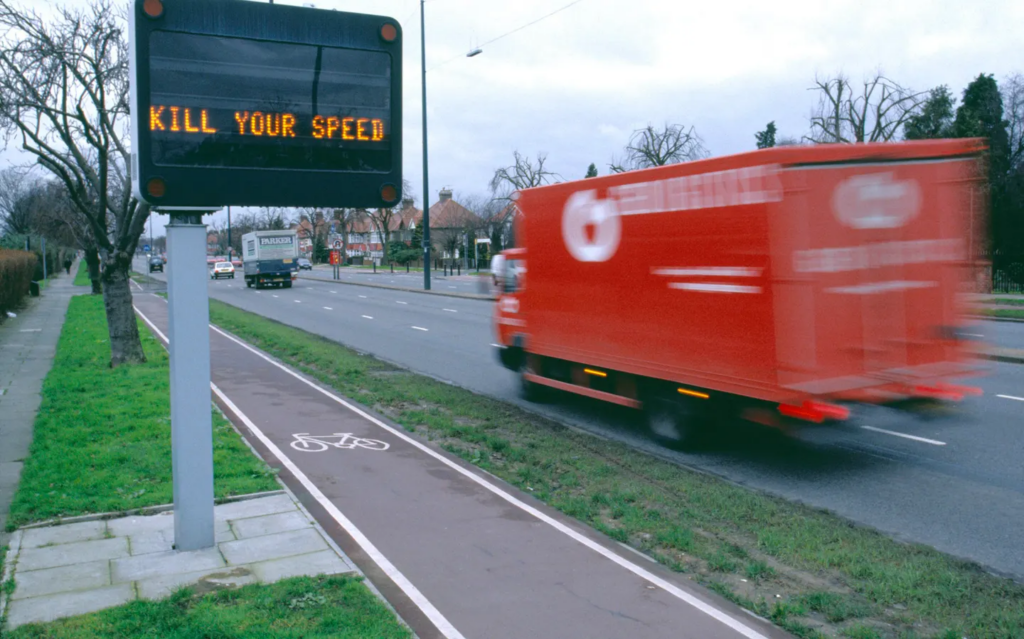
[5] Making Cities Slower… And Safer For All.
Speed in the city is rarely a personal choice. It is determined by structural decisions: street width, building density, visibility, and the presence or absence of places to rest. These elements together determine the rhythm of the city.
Understanding the city as a designed system helps shift the focus away from blaming individuals for driving too fast. Acceleration is often not a mindset—it is an architectural condition.
Speed in the city is rarely a personal choice. It is shaped by structural decisions embedded in street design and urban layout. When movement is prioritized over presence, speed becomes the default — even in spaces meant to be shared.
“City streets aren’t the sole domain of cars and their drivers. They’re also home to pedestrians of all ages, to cyclists, mobility scooter and wheelchair users, to groups of playing children, and mass transit passengers. They are shared spaces, which means they need to provide safety to all.” — Making Cities Slower and Safer for All, Forbes (2024) [6]
Sources 🛈
[1] Life Between Buildings: Using Public Space. Jan Gehl. Island Press, 2011. Available at: https://cus.ubt-uni.net/wp-content/uploads/2024/11/Jan-Gehl-Life-Between-Buildings_-Using-Public-Space-2011-Island-Press.pdf
[2] Vester Voldgade, Copenhagen. Massengale Blog. Available at: https://blog.massengale.com/2015/07/19/vester-voldgade/
[3] Urban Planning Elements: Kevin A. Lynch. YouTube. Available at: https://www.youtube.com/watch?v=A8OuADNE1EQ
[4] In Praise of Slowness: Let’s Slow Down the City! Citego. Available at: https://www.citego.org/bdf_fiche-document-1735_en.html
[5,6] Making Cities Slower and Safer for All. Forbes. Available at: https://www.forbes.com/sites/lauriewinkless/2024/07/17/making-cities-slower-and-safer-for-all/
