10 | Reflections and Next Steps

In this research, I have explored the world of object perception and communication from multiple perspectives: from the psychology of perception to the involvement of the body and the senses, and finally to the semiotic analysis of design and brands. I discovered that objects are never neutral: they guide behavior, communicate values and influence emotions and social relationships, often even before they are consciously interpreted.

Personally, I found the topic very engaging. It is fascinating to see how even simple gestures, like turning on a faucet, can carry cultural meanings and design choices.

For the next steps of the research, I would like to delve deeper into the practical and social dimensions of object perception through interviews, workshops or other direct observations. I want to understand how people interpret and use objects in everyday life, what values they associate with certain designs and how affordances guide behavior. At the same time, I would like to further explore the connection between objects and visual communication, reflecting on how to design more conscious and coherent messages.

The next step will be to observe firsthand how people interact with objects, transforming theoretical reflection and analysis into real, meaningful experiences.

Biophilia and Interaction Design. Final blog post considerations

In this latest article, we gather the key reflections that emerged on the relationship between nature, technology, and interaction design.

This research was born from a personal paradox.
I’ve always loved being immersed in nature, but in everyday life, I’ve often found it difficult to care for plants. Lack of time, space, and continuity. From here, a question arose: what if technology could help us reconnect with nature, instead of distancing us from it?

As the indoor generation, we spend approximately 90% of our time indoors: homes, offices, schools, and transportation. Although we often don’t realize it, our lives unfold almost entirely indoors.
Yet, humans have a profound connection with the natural world. For much of our evolution, we lived outdoors, following the rhythms of light, seasons, and ecosystems. This connection has been progressively neglected in recent centuries.
The concept of biophilia reminds us of this: we have a natural need to connect with life and vital processes, not just to live in efficient and comfortable environments.

Home automation systems today are highly advanced. They manage light, temperature, security, and energy efficiently. But they focus almost exclusively on physical comfort.
These technologies don’t take into account deeper needs: emotions, perception, and a connection with time and nature. Smart homes know when to turn on a light, but they don’t know how we feel. They don’t help us build a connection with living things.
This gap isn’t technical, it’s human. And this is precisely where interaction design can make a difference.

The research followed a qualitative and exploratory approach.
The goal is not to measure performance, but to understand experiences, perceptions, and behaviors.
The analysis focused on three key aspects:

  • engagement
  • feedback
  • emotional connection

Three main directions emerge from the research.

  • The first concerns emotional connection. Interdisciplinary approaches, such as the use of sound, can make plants’ vital parameters visible. Transforming biological data into sounds or musical outputs allows for a more sensitive and empathetic relationship.
  • The second concerns engagement. Mechanics inspired by video games and gamification can make plant care more engaging, encouraging continuity and attention over time.
  • The third concerns nature-based user interfaces. Tools like Makey Makey show how natural elements can become an active part of the interaction. But above all, how it is possible to integrate biological inputs in a sensorial way.

What if technology could bring nature back into our daily lives?
This was the central question of the entire project. The current market certainly already offers several solutions capable of integrating some of the principles discussed, such as gamification.
The next step could be to make these technologies more accessible and even more interdisciplinary. Integrating different media, such as sound, is also important because many home automation systems today are primarily voice-based and therefore inaccessible to those who cannot use their voice.
But perhaps the most important question is not what technology can do for nature, but rather to continue asking what nature can teach us about how to design better interactions.

09 | Semiotics in Brand Communication

In the field of visual communication and marketing, semiotics becomes a strategic tool.
A brand’s success depends not only on product quality but also on its ability to create a coherent and recognizable universe of meaning.

Brands as Systems of Signs

A brand communicates through its logo, colors, shapes, materials, packaging, sounds, and tone of voice. All of these elements function as signs that refer to shared cultural values.
Coca-Cola, for example, uses red to convey energy, vitality, and sociability.
Apple emphasizes simplicity, essentiality, and innovation through clean forms and carefully selected materials.
Nike tells stories of overcoming limits and determination, embodying the archetype of the hero.

Floch’s Contribution to Communication

Jean-Marie Floch shows that a brand functions like an object: not only for what it does but for the meaning it produces within a network of values and relationships.
His semiotic square of values allows us to analyze brand positioning: some emphasize efficiency, others pleasure, and still others identity or ideals. Effective communication arises from balancing these values and maintaining consistency over time.

Coca-Cola, for example, does not highlight the product’s functional qualities but builds a predominantly playful narrative. Through colors, images, and music, it associates the beverage with moments of sharing and happiness. In this way, consumption is not just about the object—it becomes a socially shared ritual, where emotional experience outweighs product function.

Objects, Advertising, and Perception

Packaging, commercials, and digital interfaces do more than inform: they guide emotions, expectations, and behavior. Semiotics shows that the form of the message is part of the message itself: colors, images, symbols, and rhythm act before the content is even consciously processed. Meaning emerges in the encounter between design and interpretation, between what the brand proposes and what the audience perceives.

Advertising and Meaning-Making

Advertisements do not merely describe a product; they shape the way we see and experience it.
An object becomes “desirable” not only for its material characteristics but for the meaning attributed to it. A smartphone, for example, is not just a tool: through images, colors, music, and storytelling, the brand communicates innovation, elegance, and social status. In this sense, the advertisement transforms the product into a symbol, influencing consumer perception, emotion, and behavior.

With the web and social media, brand communication no longer stops at the message: the audience contributes to creating meaning around objects, shaping perceptions and values.

A brand is not just a product or a logo: it is a complex system of signs capable of acting on culture and emotions. Today, with digital evolution and active consumer interaction, brands become open, ever-changing worlds, where meaning, aesthetics, and participation coexist.

Sources:
• Prastani, A. (2025). Semiotics: How It Supports Companies in Marketing Strategies. Online article.
• Floch, J.-M. (2000). Semiotics, Marketing and Communication: Beneath the Signs, the Strategies. Palgrave Macmillan.
• Codeluppi, V. (2020). Semiotics and Advertising: The Problem of the Brand. Filosofi(e)Semiotiche, Vol. 7, No. 1.

08 | Semiotic Analysis of Everyday Objects

Every object, even the most mundane, constructs meaning through what it invites us to do and through the way it fits into everyday practices.

The Faucet

A faucet immediately communicates how it should be used: turn, pull, push.
But it does more than indicate the action—it also conveys how the gesture should be performed. A minimalist steel faucet suggests control, precision, and modernity, while one with separate knobs evokes tradition, ritual, and a slower, more deliberate interaction.
Turning the water on and off is not a neutral gesture: the rotation of the knob, the resistance of the mechanism, and the flow’s gradualness shape how the body relates to the object. A knob faucet requires attention, a lever faucet speeds up the gesture, and an automatic faucet introduces values of control and efficiency, delegating part of the responsibility to the object itself.
Here, the practical value intertwines with the utopian: it is not just about getting water, but about suggesting an idea of comfort, hygiene, and lifestyle.

The Chair

The chair is one of the most studied objects in design precisely because it connects body, space, and culture. A rigid, upright chair communicates formality, discipline, and control over the body; a low, soft armchair, on the other hand, invites relaxation, lingering, and informal use of space. Its ergonomics are not merely functional—they guide behavior and social interaction.

The Remote Control

The remote control is a clear example of an object-interface. Its role is to translate a complex technological system into a series of simple gestures. Button layout, colors, and visual hierarchy communicate what is important, what is secondary, and what is reserved for advanced users.
When a remote is difficult to use, the problem is not with the user: it is the object that communicates ineffectively, making the connection between gesture and function difficult.

The Water Bottle

Even a water bottle constructs meaning through its material and visual characteristics.
A lightweight plastic bottle conveys practicality and quick consumption, while a glass bottle suggests quality, care, and sustainability. Shape, cap, and label do not speak of the water itself but of its symbolic value, consumption context, and the brand identity it represents.

The Smartphone

The smartphone is an object-system: it communicates through screen, sounds, vibrations, and interfaces.
It is not just a tool, but a node of intersubjectivity: it connects apps, notifications, images, and social timing. The interface is not neutral: it invites, guides, interrupts, and captures attention. Every gesture (tap, swipe, scroll) is anticipated, designed, and normalized. In this sense, the smartphone becomes a delegated actant: it acts for us and on our behalf, reorganizing time, attention, and social interaction.

In all these cases, objects never communicate alone: they acquire meaning within networks of objects, spaces, instructions, and habits. This is what semiotics calls textuality: an object can be read like a text, but its meaning emerges only in context and through the relationships it maintains with other elements.
Kitchen, bathroom, desk: these are not random collections of things, but systems of objects that produce social meaning, identity, and lifestyle. Analyzing them reveals the design choices that transform signs into experience.

Sources:
• Floch, J.-M. (1995). Visual Identities. Continuum. 
• Marrone, G. (n.d.). From Design to Interobjectivity: Introductory Issues. Filosofi(e)Semiotiche, Vol. 7, No. 1, 2020.

07 | Semiotics and Design

Semiotics is the discipline that studies how signs produce meaning. Applied to design, it helps us understand how objects communicate values, roles, and worldviews, even in the absence of words.
An object is never neutral: it is designed by someone, placed in a cultural context, and interpreted by its users. Semiotics does not only ask what an object represents, but analyzes the relationships it activates: with the body, with other objects, with daily practices, and with social systems.
In this sense, semiotics does not merely decode isolated objects; it studies the networks of relationships that generate meaning and helps us understand how objects influence behavior, emotions, and interpretations of the world around us (Mangano & Ventura Bordenca, 2024).

Greimas and Structural Semiotics

Algirdas Julien Greimas (1917–1992) is one of the fathers of modern semiotics. His theory showed that meaning does not arise from isolated elements but from relationships and oppositions. Meaning is always constructed: through structures, roles, and values in tension with each other.
Applied to design, this perspective implies that an object communicates not only through its function but also through the value it assumes within a system of oppositions such as useful/useless, simple/complex, modern/traditional. Every artifact, therefore, is never neutral: it is part of a kind of everyday narrative, assuming different roles and guiding behavior, perception, and social interactions.
A chair, for example, is not just a support for sitting; it can communicate elegance, informality, authority, or a particular lifestyle.

Floch and the Semiotics of Design

Jean-Marie Floch (1947–2001) applied Greimas’ semiotics to design, visual communication, and consumption. In his book Visual Identities (1995), Floch demonstrates how even a simple object, like the Opinel knife, can communicate much more than its function.

The Opinel is not just a cutting tool: through its essential form, humble materials, mass production, and rural associations, it conveys values of authenticity, tradition, simplicity, and reliability. It is an object that tells a way of life and a cultural belonging even before it is used.
For Floch, objects are actants: not passive tools, but elements capable of acting on humans, guiding behavior, choices, and desires. The object becomes the protagonist in the relationship with the user.

One of his best-known contributions is the semiotic square of values, often used to analyze products, brands, and communication. Floch identifies four major value regimes:

  • Practical function, utility, efficiency
  • Utopian ideal values, identity, vision
  • Critical quality/price ratio, rationality
  • Ludic pleasure, aesthetics, gratuitousness

These values do not exclude each other but coexist and balance. Every object or design project communicates a specific combination of these regimes.

Semiotics of design, therefore, does not study “what an object means,” but how it produces meaning within a system of relationships.

Sources:
• Mangano, D., & Ventura Bordenca, I. (Eds.). (2024). Stories of Semiotics and Design. AIS/Design Journal: History and Research, Vol. 11, No. 20.
• Greimas, A. J. (1987). On Meaning: Selected Writings in Semiotic Theory. University of Minnesota Press.
• Floch, J.-M. (1995). Visual Identities. Continuum.

06 | Munari and the Communication of Objects

Bruno Munari (1907–1998) devoted much of his research to a simple yet radical question: how do objects communicate even before they are rationally understood?
In his work, Munari shifts attention from content to the way an object is perceived, explored, and used by the body. Shape, materials, weight, texture, and sequence guide experience before any conceptual or linguistic interpretation, showing that perceiving is already a form of understanding.

His Work

The Prelibri are a series of small books designed for children who cannot yet read: they contain neither words nor traditional narrative images, but use different materials, tactile surfaces, cuts, holes, and transparencies. Each book invites touching, flipping, folding, and observing.
“They should give the feeling that the books are actually made this way and contain surprises. Culture indeed comes from surprises, that is, from things previously unknown” (Munari).
The meaning does not arise from written content but from the very act of flipping through, from the rhythm of the pages, the color variations, and the weight of the paper. The book communicates through direct experience.

In the Libri illeggibili, Munari removes text entirely to focus on the material elements of the book. Shape, color, sequence, and texture become perceptual messages, teaching that object communication can occur without words.

The Tactile Laboratories complete this vision: experiences where material qualities guide action and understanding without the need for instructions or pre-defined functions.

These examples show how objects can educate perception: surfaces invite exploration, forms suggest action. Objects do not require instructions because their use is embedded in their structure. Munari demonstrates that communicating does not mean transmitting fixed content, but opening possibilities for experience: the sign becomes experience, and the body becomes the primary recipient of meaning.

Sources:
• Corraini Edizioni. (n.d.). I Prelibri di Bruno Munari.
• Pastore, Z. (2019). Prelibri di Bruno Munari: How They Are Used and What They Are For. Nostrofiglio.
• Corraini Edizioni. (n.d.). The Unreadable Book.
• Corraini Edizioni. (n.d.). Bruno Munari’s Tactile Workshops.
• Fois, E. (2021). Bruno Munari, the Poet of Design Who Taught to See with New Eyes. DEESUP Magazine.
• Fabbri, M. (2021). Munari and the Perception of Objects. Disegno, Unione Italiana Disegno.

Feedback and Gamification in Plant Care: Learning Through Interaction

How can feedback and gamification make plant care more intuitive?

In recent years, a growing number of projects have sought to simplify complex everyday tasks by integrating new technologies into daily life.

CES (Consumer Electronics Show) is one of the most important international conferences dedicated to technological innovation. CES 2026, held in Las Vegas, showcased numerous projects related to wellness, smart homes, and sustainability. Among these, one of the most interesting was LeafyPod, a smart vase that combines technology, design, and nature.

In this article, we’ll explore why LeafyPod is a good example of how feedback and gamification can improve the plant care experience, making it more intuitive, engaging, and learning-oriented.

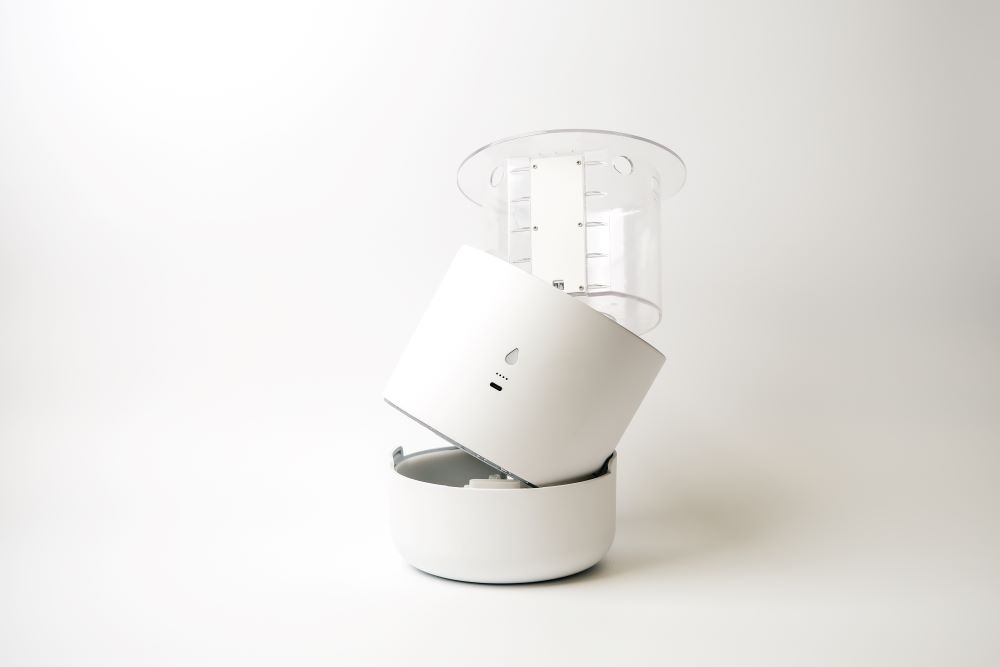
LeafyPod is a smart pot designed to support the care of indoor plants. Through sensors that detect soil moisture, light, temperature, and environmental conditions, the system provides clear guidance on when and how to intervene.
What’s unique about LeafyPod is that it doesn’t just collect data, but translates it into simple, user-friendly information. Through a dedicated app, users can identify a plant, receive personalized instructions, and track its health over time. The system uses an artificial intelligence engine that learns from the plants’ actual conditions and improves the guidance provided.

This year’s version features an expanded AI engine to support a much larger number of indoor plants. Users can search for any plant by name, explore an ever-expanding global catalog, or take a photo for instant plant identification along with personalized care instructions. [2]

Image 1. App and pot design of LeafyPod from LeafyPod.com

One of the most interesting aspects of LeafyPod is the way it uses feedback to foster learning. The app’s notifications, alerts, and prompts transform plant care into a series of small daily goals.
Gamification isn’t present in the form of explicit games, but through positive micro-interactions: reassuring messages, visible progress, and clear suggestions. This approach helps build a routine and maintain motivation, transforming plant care into a gradual and rewarding experience.
In this way, LeafyPod uses feedback not only to inform, but to guide user behavior, creating continuous interaction.

Despite its innovative approach, LeafyPod also has some limitations to consider. LeafyPod isn’t cheap: individual planters cost tens of dollars, and to work properly with the app and Wi-Fi connection, you often need to purchase an additional Bridge. This can make the initial investment more expensive, especially for those with multiple plants.
According to the official specifications, LeafyPod doesn’t currently integrate directly with smart home systems like Alexa, Google Home, or Apple HomeKit. This limits the possibilities for automation and integration with other devices already present in the home, although such features may be introduced in the future.

Image 2. Structure of LeafyPod, AI powered smart planter

References

[1] LeafyPod, “LeafyPod – Smart planters for indoor plants,” [Online]. Available: https://www.theleafypod.com/. [Accessed: Jan. 2026].

[2] CES VPORoom, “LeafyPod advances indoor plant wellness at CES 2026 with universal AI plant engine and seamless smart care experience,” Jan. 6, 2026. [Online]. Available: https://ces.vporoom.com/2026-01-06-LeafyPod-Advances-Indoor-Plant-Wellness-at-CES-2026-with-Universal-AI-Plant-Engine-and-Seamless-Smart-Care-Experience. [Accessed: Jan. 2026].

[3] CES VPORoom, “LeafyPod advances indoor plant wellness at CES 2026 with universal AI plant engine and seamless smart care experience,” Jan. 6, 2026. [Online]. Available: https://ces.vporoom.com/2026-01-06-LeafyPod-Advances-Indoor-Plant-Wellness-at-CES-2026-with-Universal-AI-Plant-Engine-and-Seamless-Smart-Care-Experience. [Accessed: Jan. 2026].

[4] Consumer Technology Association, “CES – Consumer Electronics Show,” [Online]. Available: https://www.ces.tech/. [Accessed: Jan. 2026].

05 | Perception and Affordances in Objects

The concept of affordance, introduced by psychologist James J. Gibson in his ecological theory of perception (1979), describes how objects directly communicate their potential use. According to Gibson, perception is not a complex mental process, but a direct one: information for action is already present in the objects and the surrounding environment.

Possibilities for Action

Affordances indicate the actions that an object or space makes possible. Shape, material, and arrangement suggest how to interact: a handle invites grasping, a flat surface supports weight, a button prompts pressing. To perceive something is to immediately grasp what can be done.
Affordance is not an absolute property of the object but emerges from the relationship between object and user. A tall chair allows an adult to sit, but not a small child; a step may be navigable for a person, but not for a stroller. In this sense, objects communicate action possibilities that are directly perceivable, emerging from the interaction between body, environment, and context.

Affordances and Design

In design, affordances become a tool for non-verbal communication. When an object is well designed, its affordances are clear; when they are ambiguous, they cause confusion or errors. Iconic examples are Norman doors—doors designed so that users perform the wrong action. The error is not the user’s but the design’s, because perceived and actual affordances do not match.
Donald Norman further developed the concept, distinguishing between real affordances (actions that are actually possible) and perceived affordances (actions the user believes are possible). In effective design, these two dimensions align. Even in digital environments, buttons, icons, and links use color, shadow, and visual feedback to make affordances visible: communication occurs at the perceptual level, even before cognitive processing.

Gibson and Norman show that objects speak to the body before they speak to the mind. Shape, materials, and placement in the environment become the language through which the material world communicates with us.

Sources:
• Gibson, J. J. (1979). The Ecological Approach to Visual Perception. Houghton Mifflin.
• Norman, D. A. (2013). The Design of Everyday Things: Revised and Expanded Edition. Basic Books.
• UX Design. (2019). Introduction to the Norman Door.
• Santagostino Magazine. (n.d.). Affordances in Psychology.
• Unicusano. (n.d.). The Ecological Theory of Gibson.
• Psiche Altervista. (n.d.). The Ecological Theory of Perception by Gibson.

04 | Perception and Interpretation of Objects

Perception is the process through which the brain organizes and interprets sensory information to build a meaningful experience of the world. These processes occur automatically and unconsciously, through the interaction between what we perceive and what we already know.
Perception is therefore subjective: our past experiences, expectations, selective attention, and prior knowledge shape the way we observe the world. Sensory systems receive physical stimuli and transform them into neural signals, which the brain processes, attributing form, meaning, and identity.
In this sense, perception represents the link between a physical object and the meaning we assign to it. Shapes, colors, materials, and movements are interpreted in milliseconds, guiding our reactions even before conscious processing occurs. As James J. Gibson notes, “perception is not an internal representation of the world, but a direct process of exploring the environment” (Gibson, 1979), highlighting the active role of the observer in interacting with objects.

Visual Object Recognition

Visual recognition occurs in two main stages: an initial stage of structural description and a second stage of cognitive processing.
In the first stage, the physical features of the stimulus—such as luminance, color, shape, and orientation—are analyzed. This phase allows the figure to be distinguished from the background, without yet assigning meaning to the perceived object.
The second stage occurs when the perceived shape is compared with memory. It is at this stage that the object is recognized as familiar, engaging attention, memory, language, imagination, and consciousness.
A clear example is Bev Doolittle’s Pintos: at first, only indistinct patches are perceived, but when the horses become recognizable, the perception of the image changes dramatically. As Mecacci observes (2001, p.123), “this ‘knowing’ that we are perceiving something involves another very complex mental process called consciousness: we are aware of perceiving, remembering, and needing to pay attention.”

Bottom-Up and Top-Down Processing

Visual recognition also relies on two complementary modes: bottom-up and top-down processing.
Bottom-up processing starts from sensory data, analyzing individual elements of the stimulus. It dominates when an object is new, ambiguous, or unexpected. For example, you might first notice a buzzing near your ear and then a small moving object, allowing you to recognize a fly.
Top-down processing, on the other hand, relies on knowledge, expectations, and pre-existing mental representations. A common example is moving around your house at night without turning on the lights, navigating based on your knowledge of the objects’ arrangement.
The balance between these modes depends on the familiarity of the object and the context. Familiar objects or those consistent with the environment favor top-down processing, while unusual objects require more careful analysis of sensory data.

Feature Integration Theory

According to Anne Treisman, visual perception occurs in two stages: the first automatically detects elementary features such as color, shape, orientation, and movement; the second integrates these features through attention, forming a coherent whole—the object as we perceive it.
Perception is therefore an active process, with attention playing a central role in making sense of visual information. Understanding these mechanisms is essential for analyzing how objects are perceived, interpreted, and used.

Sources:
• Gibson, J. J. (1979). The Ecological Approach to Visual Perception. Houghton Mifflin.
• Mecacci, L. (2001). Manual of General Psychology. Giunti.
• Britannica, T. Editors of Encyclopaedia (n.d.). Perception. Encyclopaedia Britannica.
• Neuroscienze.net. (n.d.). Visual Perception and Design.
• Santagostino Magazine. (n.d.). Selective Attention.

03 | THE FIVE AXIOMS OF COMMUNICATION APPLIED TO OBJECTS

To better understand how objects communicate, I found it particularly useful to apply to design the five axioms of communication formulated by Paul Watzlawick. Originally developed to describe human communication, these principles can also be interpreted in a design context, offering an interesting perspective on how objects relate to the people who use them.

1. It is impossible not to communicate

The first axiom states that it is impossible not to communicate: even silence or the absence of action is a form of communication. The same applies to objects.
Every object communicates something, even when it is not being used. An empty chair, a switched-off lamp, or a smartphone left on a table still convey information: about the context, intended use, user, or situation. In design, no object is neutral: shape, material, and presence always communicate, even unintentionally.

2. Every communication has a content and a relationship aspect

According to Watzlawick, every communication conveys content but also defines a relationship. Applied to objects, the content concerns the primary function: a chair is for sitting, a handle is for opening a door.
The relationship, on the other hand, relates to how the object “positions itself” toward the user. A rigid, minimal chair communicates a different relationship than a soft, enveloping chair. Through design, the object suggests how it wants to be used and what kind of experience it offers, establishing an implicit relationship with the body and the user.

3. The nature of a relationship depends on the punctuation of communication sequences

This axiom highlights how the meaning of communication depends on how the sequence of exchanges is interpreted. In the case of objects, communication is never one-way: the user interacts with the object, and the object responds through use, repeating this interaction over time.
A poorly designed object can generate frustration, which in turn affects how the user uses or perceives it. Conversely, an intuitive and coherent object strengthens a positive relationship. The meaning of an object is therefore built over time, through repeated use and experience.

4. Communication can be digital or analog

Watzlawick distinguishes between digital communication (verbal, codified) and analog communication (non-verbal, visual, sensory). Objects communicate primarily in an analog way: through shape, color, weight, materials, and proportions.
An object does not “explain” in words how it should be used, but suggests it visually and physically. The most effective instructions are often implicit in the design itself. In this sense, visual design becomes a fundamental language to guide the user without the need for text.

5. Communication exchanges are symmetrical or complementary

The last axiom concerns the type of relationship between participants in communication. Applied to objects, we can ask: does the object leave freedom to the user, or does it impose a precise behavior?
Some objects establish a complementary relationship, strongly guiding action (think of a turnstile or a safety device). Others establish a more symmetrical relationship, leaving room for interpretation and personalized use. This design choice profoundly influences the user experience and how the object is perceived.

Applying Watzlawick’s five axioms to objects allows us to read design as a communication system, where every product actively participates in creating meanings and relationships. Objects do not just “function”; they communicate, respond, influence behaviors, and help define our relationship with the everyday world.

This perspective reinforces the idea that communication design is not limited to visual or graphic elements but extends to product design and the objects that inhabit our daily lives.

Sources
• Watzlawick, P., Beavin, J. H., & Jackson, D. D. (1967). Pragmatics of Human Communication: A Study of Interactional Patterns, Pathologies, and Paradoxes. W. W. Norton & Company.
• Norman, D. A. (2013). The Design of Everyday Things: Revised and Expanded Edition. Basic Books.