About the Book
The book was written by the British vertebrate palaeontologist, author and palaeoartist Dr. Mark P. Witton and is meant to be an introduction to paleoart, as well as its history and the processes accompanying it.

Leaping Laelaps by Charles R. Knight, 1897
Reconstructing Extinct Animals
After briefly introducing the subject, the book goes into the history of palaeoart. It started back in the late 1700s, originating along with palaeontological science. Though it might have begun long before, influencing the depictions of many different mythical animals (e.g. the head of a cyclops was inspired by a fossil elephant skull). A lot of early paleoart has been lost over the years, however, since many depictions weren’t preserved after they became scientifically obsolete.
The next chapter discusses the process of researching, resource gathering and planning that goes into creating a piece of palaeoart. It’s not just anatomy that matters, but also the time and place of the fossil find. For this the latest information on the subject species is gathered, along with its contemporary fauna and flora and its habitat to create the closet possible depiction.
Fossils
The fossils are crucial glimpses into the proportion, size and appearance of an extinct animal. Not just skeletons, but also exoskeletons, shells and preserved tissue of corals and plants. These findings can be used to make predictions about the skeletal form, proportions and articulation. A lot of species were only partially preserved – here its necessary to know what goes into the reconstruction of a skeleton.
Techniques like phylogenetic bracketing are used here, where the position in the evolutionary tree is used to infer things about the extinct animal. Cross-scaling is also a useful tool, hereby bone elements common to two species are scaled to the same size – assuming that non-common elements can be scaled to the same degree, too. Here the most reliable bones to use for would be those of the upper limb.
Tissue
Musculature is one of the most critical aspects in reconstruction, as it provides major contours of the animal’s bodies. It’s essential to have a good understanding of the muscle distribution and bulk to create a realistic depiction of an extinct animal. Fatty tissue overlying the musculature is much more difficult to predict, but nonetheless important and thus should be considered. There are trends we can observe when it comes to the distribution of fat, however. Reptiles for examples often have fat behind their heads, around their torsos and around their tails, while mammals and birds tend to mostly deposit their fat around their torso, as well as neck and face. Aquatic species have fat tissue around their whole body – here it is used to minimize heat loss.
Only leaning on the skeletons as reference can lead to making the reconstructed animals seem underweight, or forgoing their internal organs completely. As a rule, the curvature of the stomach should be a gentle arc between the sternal and the pelvic region.
Skin
Skin type and colouration are among the most debated, controversial and seemingly unknowable components of palaeoart, given how rarely skin gets preserved. Data about this has made many leaps forward however, updating how we view certain extinct animals frequently. Skin can vary in toughness and texture, while fur and feathers rarely get preserved.
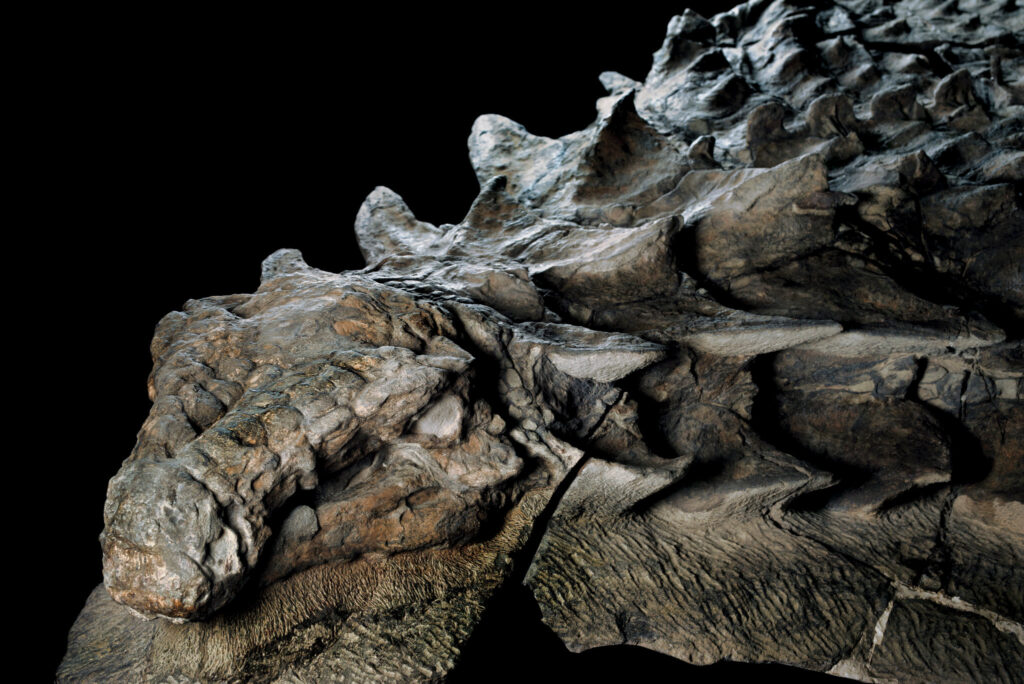
mummy of a nodosaur found in Alberta, US – one of the best preserved dinosaur skin and armor ever found
Dermal tissue can be as tough as resistant as cartilage, while not being reliant on bones like other armoured skin. Instead it can be inferred from evenly-distributed projections growing out of the bone. Many horns and crests have no bony components, instead being formed from stiffened, toughened skin. They are rarely preserved, because of which they are reconstructed based on the bony structures that once supported them. The same goes for fins, flukes and flippers if they aren’t supported by limb bones.
What can we take away from this?
A lot of the knowledge in this book can not only be used for palaeoart, but creature design overall. Its important to understand what we’re depicting when trying to create a believable animal. Nothing happens in a vacuum, evolution goes hand-in-hand with its environment. Knowing not only the basics of anatomy, but also why certain physical attributes developed and for what purpose can aid us in creating immersive (fictional) worlds.
Sources
- Wikipedia. Die freie Enzyklopädie (07.12.2025), s.v. Mark P. Witton, https://en.wikipedia.org/wiki/Mark_P._Witton (zuletzt aufgerufen am 30.12.2025)
- Witton, Mark P.: The Palaeoartist’s Handbook. Recreating prehistoric animals in art. Ramsbury, Marlborough: The Crowood Press 2018 [E-Book]
