As mentioned in the previous blog post, the final step of the project at this stage is to prepare and conduct surveys at at least two train stations in Germany. To achieve this, all preparations for the survey execution must be carefully planned and completed. Once this is done, the questions can be tested in a pilot phase before being used in a public setting.
Locations
To gain a more diverse insight into the opinions and experiences of travelers at German train stations, I plan to conduct surveys at two different locations. If the project is continued at a later stage, this approach could be expanded to include additional stations in order to further broaden the range of perspectives. For the current phase, however, two locations are realistic given the available time and resources. The selected stations are Augsburg Main Station and Berlin Main Station. These two locations differ significantly in terms of size, geographical context, and user demographics, which should provide insights from a wide range of travelers in varying situations.
Questions
There are several types of questions that can be used in a survey, including open-ended and closed-ended questions, as well as formats such as nominal scales, Likert scales, rating scales, and yes-or-no questions. To begin the survey, closed-ended questions are particularly useful because they offer predefined answer options, making them quicker and easier for participants to respond to. They also allow for the collection of clear, comparable data. These questions can then be followed by open-ended questions, which do not restrict responses and give participants the freedom to express their thoughts in their own words, allowing for deeper qualitative insights (Content Square, 2024).
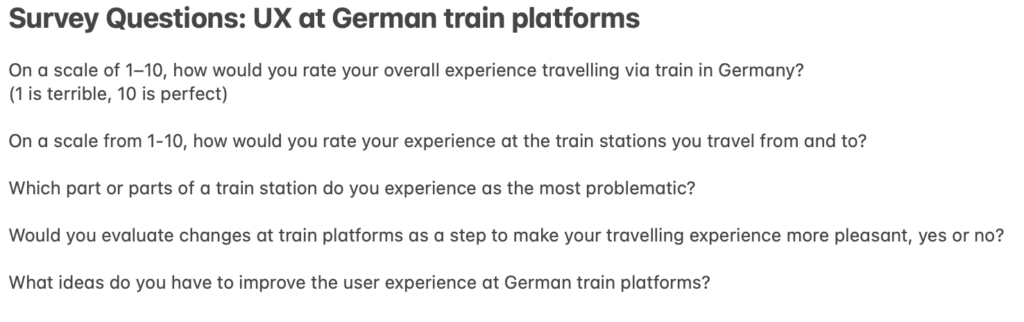
For this project, I will primarily use closed-ended questions, specifically rating-scale questions and yes/no questions. These formats provide participants with clear answer options, making the survey quick and easy to complete while still producing structured and comparable results. In addition, I will include a small number of open-ended questions to gather more detailed and in-depth responses. Overall, the survey will be designed to be brief, keeping the required effort for participants as low as possible. A shorter questionnaire also allows me to approach more people within a limited time frame, enabling the collection of a wider range of perspectives.
The questions I’m planning to ask are:
Approach
Before finalizing the questionnaire, I will test the questions with people in my immediate surroundings. Based on their feedback, I will make the necessary adjustments to improve clarity and effectiveness. This process will result in a finalized version of the questionnaire, which will then be used at the selected train stations.
I plan to record the interviews after obtaining the participant’s consent. As I do not intend to ask any personal or sensitive questions, data protection regulations should not pose an issue when using the collected information. The interviews will be recorded on my phone and later used to support a more accurate and efficient analysis of the data. I plan to visit each selected location one to two times and approach as many travelers, station employees, and other relevant individuals as possible.
Information Gathered
This week, I was able to develop a more detailed and finalized plan for the survey process. I also deepened my understanding of different question types and identified those most suitable for this project, allowing me to integrate them effectively into my research design.
Next Steps
I will allocate up to two weeks for conducting the surveys, particularly because the research location in Berlin requires travel. During this period, I aim to collect as many responses as possible to analyze the data thoroughly and draw meaningful conclusions.
References
Content Square. (5. November 2024). 24 on-site survey questions to ask your users. Von Content Square: https://contentsquare.com/guides/surveys/questions/ abgerufen
