Abstract
Can technology bring nature back into our daily lives?
This research explores how nature and technology can work together to strengthen the human connection with the natural world in indoor spaces. It examines the integration of biophilic design principles within smart-home systems and identifies key gaps and opportunities in the field of interaction design.
Overview
Biophilic Timeline
The rapid urbanization and the technological progress of the modern world have profoundly transformed everyday life, especially in domestic environments.
Today, most people spend the majority of their time indoors, separated from the natural environments in which human beings have evolved for over 99% of their history [1].” This growing separation from nature is due to many factors and reflects the mindset of a technologically driven, sedentary society that views contact with nature as outdated or secondary.
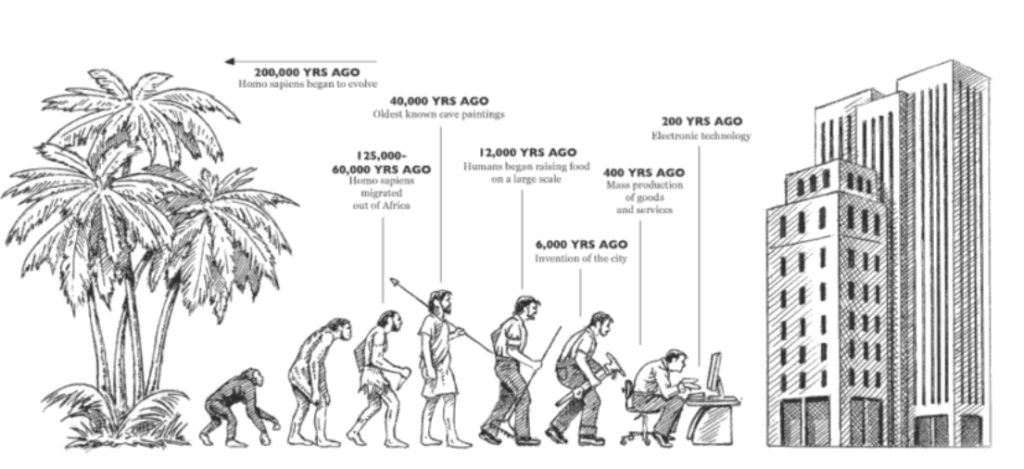
Fig. 1: A schematic timeline of human evolution and technological-social development. From: https://www.habitarmonia.eu/nature-in-the-space-/-biophilic-design
Over the past decades, architecture has begun to acknowledge the importance of reconnecting people with nature. In response to the growing awareness of the psychological and ecological benefits of natural contact, several projects have sought to integrate greenery and natural elements into urban contexts. Initiatives such as the Vertical Forest exemplify these efforts, showing how architecture can merge built and natural environments to restore a sense of balance and connection with the living world [1]. However, the integration of biophilic principles within modern smart-home technologies remains at an early stage.
The State of Smart-Home Technologies:
In a Smart-home environments all the devices can gather information and transfer it to a special app, or perform certain actions automatically. Current smart-home systems manage lighting, climate, security, entertainment, and energy consumption.
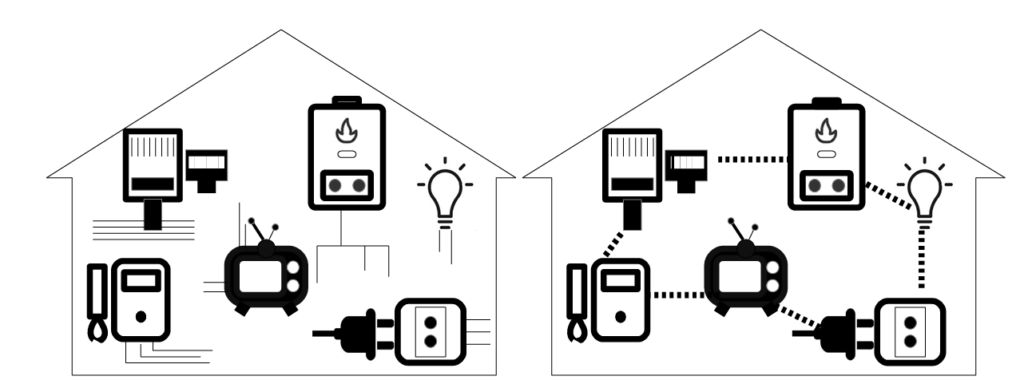
Fig. 2: Standard electrical systems versus smart-home system. From: https://ec.europa.eu/programmes/erasmus-plus/project-result-content/4df4e928-8958-4552-80da-146977e666b9/Smart_Home_systems_FINAL.pdf
Overall, these technologies mainly address physical comfort and efficiency, overlooking deeper human needs linked to emotion, perception, and connection with nature [3].
This gap represents both a challenge and an opportunity for the future of home automation.
The Emergence of Biophilic Design
According to the biophilia hypothesis, humans seek more than comfort. Edward Wilson described biophilia as humanity’s evolutionary need to connect with nature, an “life and lifelike processes” [4]. That’s why humans need and prefer environments that evoke sensory richness, emotional resonance, and ecological awareness [1], [2]. Biophilic design aims to restore this connection by incorporating natural elements, materials, and processes into built spaces. Research shows that such environments can enhance well-being, reduce stress, and support mental restoration [1], [2]. Biophilic architecture often uses light, vegetation, and natural patterns to evoke the sensations and rhythms of the natural world [1].
The Role of Interaction Design
Interaction design plays a decisive role in bridging the gap between unctional efficiency and biophilic engagement. By developing interfaces that are sensory, emotional, and ecological, designers can transform smart-home systems from passive regulators of comfort into active mediators of human–nature connection. Gamification elements can further motivate users to care for plants, monitor environmental data, or follow natural cycles, turning routine tasks into meaningful rituals.
Methodology
The research adopts a two-phase methodological framework to explore how biophilic principles can be integrated into smart-home systems. The first phase involves a descriptive analysis of how experts understand the relationship between biophilia and domotics, including:
– Mapping current technologies, perceptions, and design frameworks in domotics
– Reviewing existing literature on biophilic design, smart-home technologies, and human–nature interactions
The second phase is exploratory, focusing on speculative design scenarios that imagine new ways for humans, nature, and technology to coexist in domestic settings.
Expected Challenges
A major challenge in biophilic domotics is ensuring accessibility and inclusivity. Not everyone has the same access to technology, natural resources, or ecological knowledge. Therefore, hould be intuitive, adaptable, and sensitive to different levels of engagement. Another challenge lies in integrating biophilic features within existing smart-home infrastructures. Many homes were not designed with biophilia in mind, and retrofitting can be costly or technically complex.
In conclusion, as we design the homes of the future, we must remember that true well-being does not come from mastering artificial environments but from maintaining a meaningful relationship with the living world.
References
[1] S. R. Kellert, J. H. Heerwagen, and M. L. Mador, Biophilic design: The theory, science, and practice of bringing buildings to life. Hoboken, Nj: Wiley, 2008.
[2] S. H. Kellert and E. O. Wilson, The biophilia hypothesis. Island Press, 1993.
[3] J. Heerwagen and B. Hase, “Building biophilia: Connecting people to nature in building design,” Environ. Des. Construct., vol. 3, Jan. 2001.
[4]E. O. Wilson, Biophilia. Cambridge, MA: Harvard Univ. Press, 1984.
