My thesis investigates the strategic role of communication design in the contemporary music industry.
The starting point is a simple observation: in the streaming era, music itself has become a commodity, almost invisible, endlessly available, and economically devalued. In this context, the most successful artists are no longer competing on sound alone. They are competing on worlds.
What I want to study is how artists and communication designers build complex, multi-platform narrative ecosystems — coherent systems of visuals, stories, objects, and experiences that extend far beyond the album cover. These are not just marketing campaigns. They are designed worlds, and the designer’s role within them is closer to that of a narrative architect than a graphic designer.
In October 2024, fans of Tyler, the Creator began receiving mysterious cardboard boxes in the mail. Inside: a map, a mirror, a mask, and a handwritten note. No explanation. No release date. No album title. Just objects, carefully designed physical artifacts that arrived weeks before anyone knew Chromakopia existed. By the time the album dropped, thousands of people had already held a piece of its world in their hands.
This is not marketing. Or rather, it is not only marketing. It is communication design operating at a level of strategic and narrative complexity that the discipline has rarely theorized in the context of the music industry. And Tyler, the Creator is arguably its most complete contemporary practitioner.
What makes Tyler’s work so relevant as a starting point for this research is not just the visual quality of his albums, though that is remarkable in itself. It is the systematic consistency with which he builds, across every release, a coherent narrative world. Each album introduces a character: not a fictional persona entirely detached from reality, but a version of Tyler himself pushed into a specific emotional and aesthetic universe. Goblin was a troubled teenager talking to an imaginary therapist. Igor was a lovesick figure in a blonde wig whose story unfolded across the album’s tracks like acts of a play. Tyler Baudelaire, the protagonist of Call Me If You Get Lost, was a wealthy wanderer with a European sensibility, announced through fake DJ flyers and street posters scattered across American cities before anyone had heard a single note.
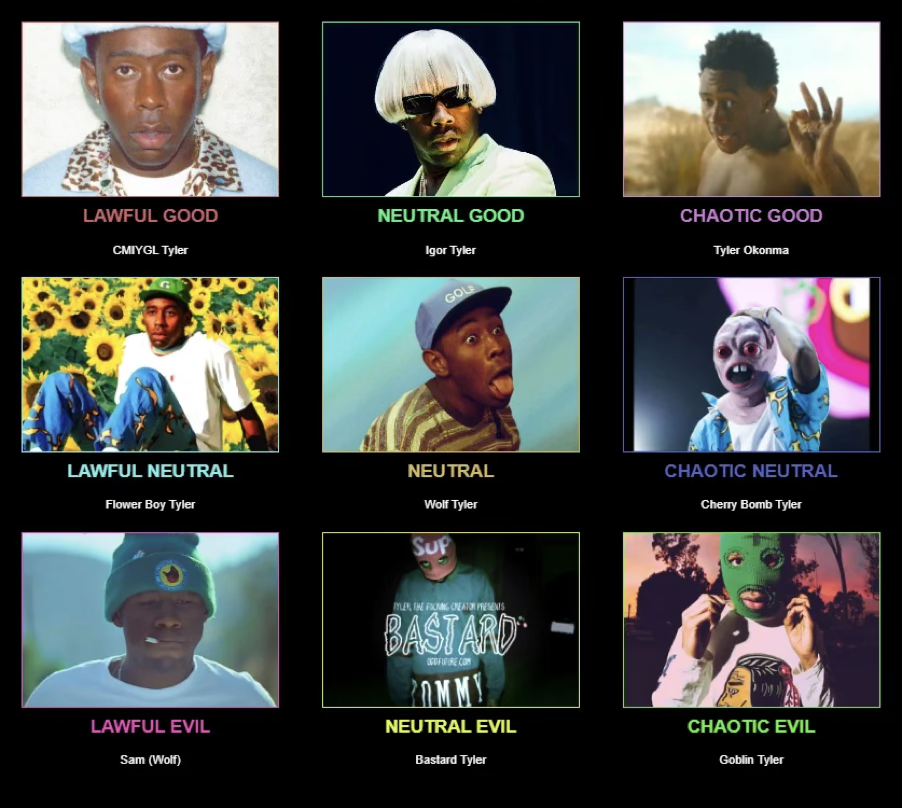
Each of these characters does not exist only in the music. They exist in the visual language of the album packaging, in the art direction of the music videos, in the clothing collections released by Golf Wang (Tyler’s own fashion brand) in the Camp Flog Gnaw festival, which began as a narrative element of an album and became a real annual event. The world precedes the music, accompanies it, and survives it.
This is what I mean when I use the term world-building. Not a metaphor, but a precise description of a design practice: the construction of a coherent narrative and visual ecosystem across multiple platforms and media, where every designed element, an object, an image, a typeface, a physical experience, is a fragment of a larger system. The designer’s role in this process is not to decorate a product, but to architect a world.
