Personal experiments:
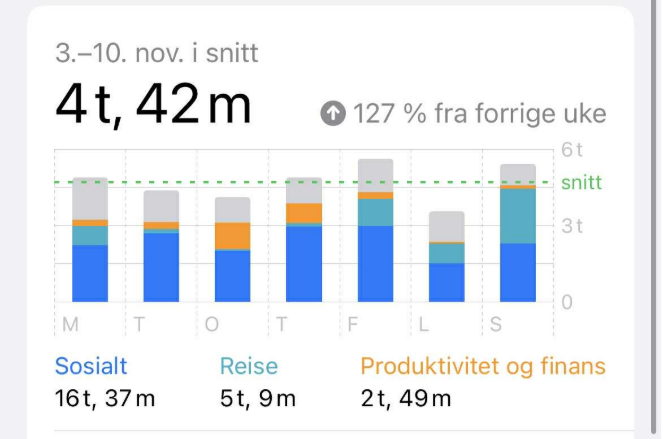
Screentime before:
What I spend most of my time on is the category “social”. The second one is “travel” which is just when I have gps on my phone while driving to and from my hiking trips. The third category is “productivity and finance”.
Screentime after setting a time limit on most used social media apps:
One week into setting a timelimit on my most used social media apps, my screentime went down by 54 minutes on average. The third of the top three categories changed from “Productivity and finance” to “entertainment”.
As i mentioned in a previous blog post, I didn’t feel like setting the time limit was working due to it being too easy to ignore. The screentime dropping slightly could be an indicator that even though I ignored the limit, maybe it was a little nudge to a little more conscious use of social media platforms and made me limit my use somewhat.
The third category being changed to “entertainment” shows that when i met my limit for the social media apps, sometimes i just exited that app and opened up another application used for entertainment.

I’m still not where I want to be with my screentime and will continue to implement my tools for reducing it and cupdate later on how also following the 30 min scroll time project affects me.
Secondary research
This week I also conducted more secondary research about the reasons why humans tend to doomscroll and some of the side affects it leads to.
Why do we doomscroll?
Why we doomscroll can be explained by how our brains are wired for threat and novelty. As Harvard Health Publishing explains, the brain’s fight-or-flight response pushes us to scan for danger when we perceive uncertainty or risk, and doomscrolling feeds directly into that impulse. Meanwhile, Newsweek notes that, especially for younger people, social media serves like a “digital pacifier”, a convenient distraction from stress, loneliness and boredom. Which makes doomscrolling feel like a quick way to cope even when nothing has really changed. In these situations it works as a quick fix and not as a long term solution. Because news feeds and apps constantly deliver new content at irregular intervals, each swipe can feel like a small “reward”, encouraging us to keep scrolling in search of the next one.
How can doomscrolling trigger anxiety?

Constant exposure to negative or alarming content through doomscrolling can have serious repercussions for our mental and physical health. According to Harvard experts, doomscrolling overloads our stress response: extended exposure to distressing news can lead to symptoms like trouble speeling, muscle tension, headaches, irritability, or even elevated blood pressure. A 2023-2024 review even links excessive doomscrolling to decrease overall well-being and increases existential anxiety, a sense of dread of panic about life and the future. Moreover, as Newsweek points out, what feels like staying informed or reducing uncertainty often does the opposite, delivering “fleeting relief” but ultimately reinforces worries because each new negative headline renews anxiety instead of easing it.
Why doomscrolling is most common with younger people
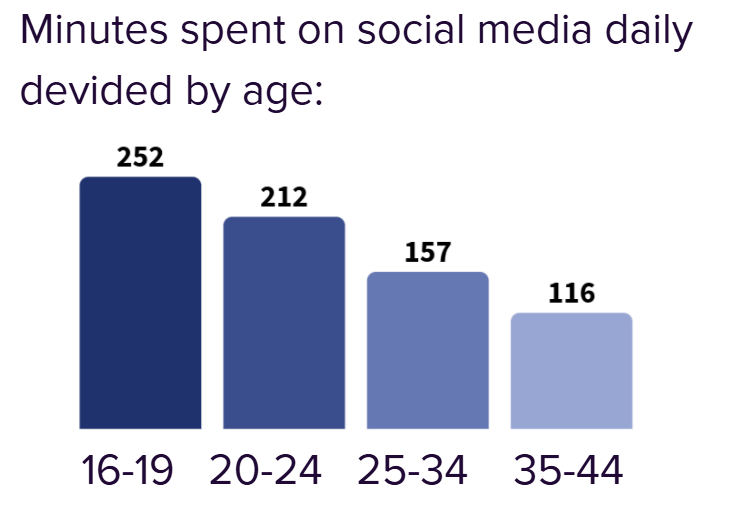
Doomscrolling appears to be especially widespread among younger age groups. In a 2024 survey cited by Newsweek, around 53% of gen Z respondents identified themselves as regular doomscrollers, a far higher rate than the general adult population. The article explains this by noting how deeply intertwined social media is with younger people’s daily lives: manually use their phone for hours, and social platforms often act as distraction from stress, isolation, or uncertainty. Because younger people are more frequently online and more exposed to algorithm driven content cycles, their risk of falling into habitual doomscrolling (and the mental health consequences that come with it) becomes much greater than for older generations.
“Anxiety among young adults almost tripled between 2019 and 2023 in the U.S. according to Department of Health and Human Services data cited by the report. ”
Sources:
https://www.newsweek.com/gen-z-doomscrolling-problem-2065999
https://www.health.harvard.edu/mind-and-mood/doomscrolling-dangers
https://www.ipsos.com/en/axa-mind-health-report-mental-health-continues-deteriorate-around-world
