Customer Profile & Value Proposition Map
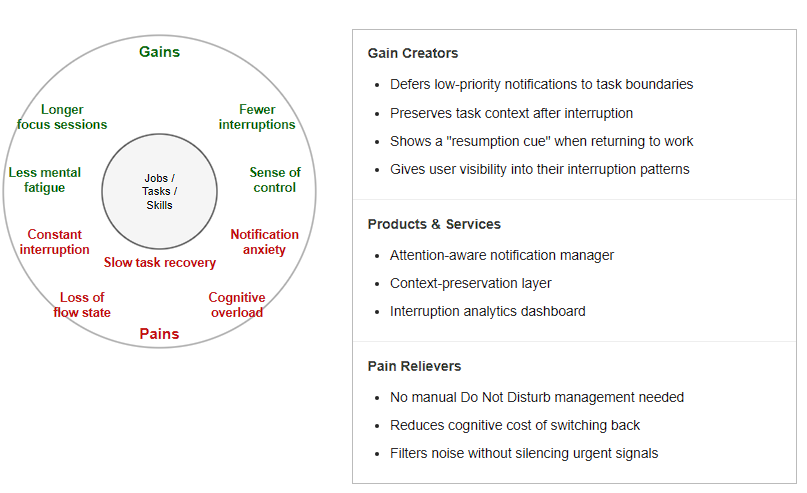
Persona I – The Deep Worker
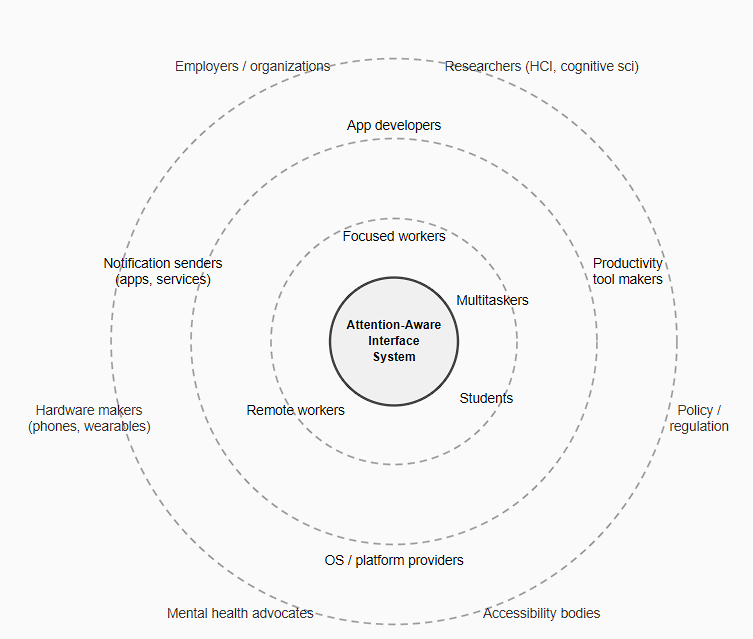
A knowledge worker or student who needs extended periods of uninterrupted focus to do their best work. They are productive in flow states but regularly pulled out of them by notifications, messages, and contextual switches. They need a system that protects their attention without requiring constant manual management.
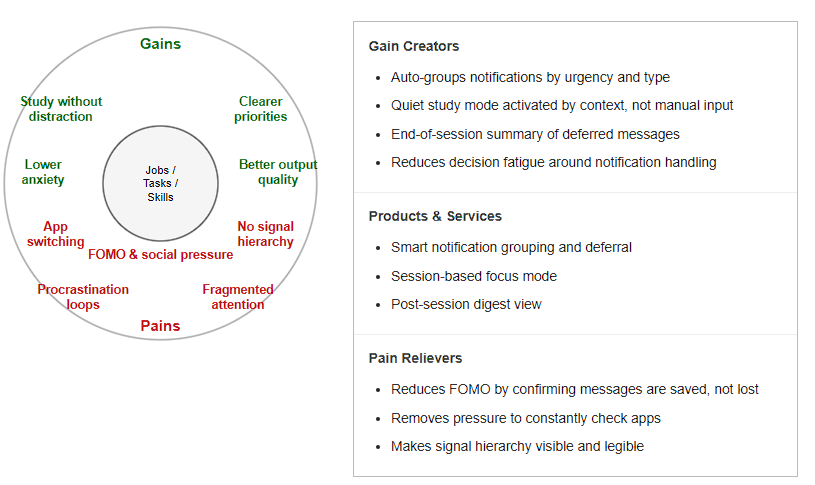
Persona II – The Overloaded Student
A university student juggling coursework, communication apps, and social media across the same device. They struggle to distinguish between urgent and non-urgent signals, and often spend more time managing notifications than doing the actual work. They need a system that reduces the noise without them having to think about it.
Business Idea
What problem are you solving?
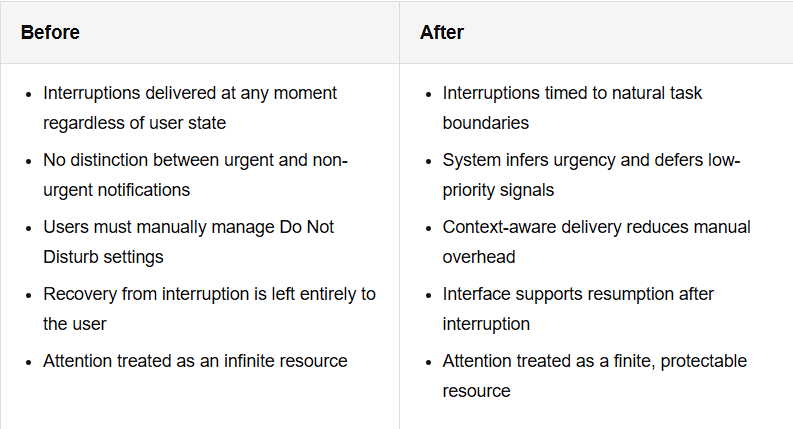
Digital interfaces are built to deliver information as fast as possible: but human attention does not work that way. Every interruption carries a cognitive recovery cost that current systems completely ignore. The result is a generation of users who are constantly reactive, chronically distracted, and unable to reach the deep focus states where their best thinking happens. There is no mainstream product that treats attention as a resource worth protecting at the system level.
Why should we care about it?
Attention is not just a productivity concern, it is a mental health issue. Sustained notification overload is linked to higher cortisol levels, reduced working memory performance, and increased anxiety. At the same time, the economic cost of fragmented attention in knowledge work is measurable: studies estimate billions in lost productive hours annually due to interruption-driven task switching. The problem affects every person who works or studies with a digital device which is effectively everyone.
What is the solution? How does it work?
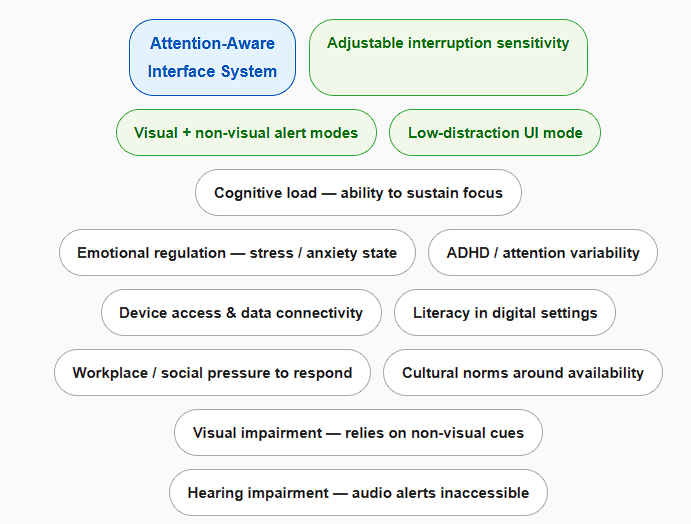
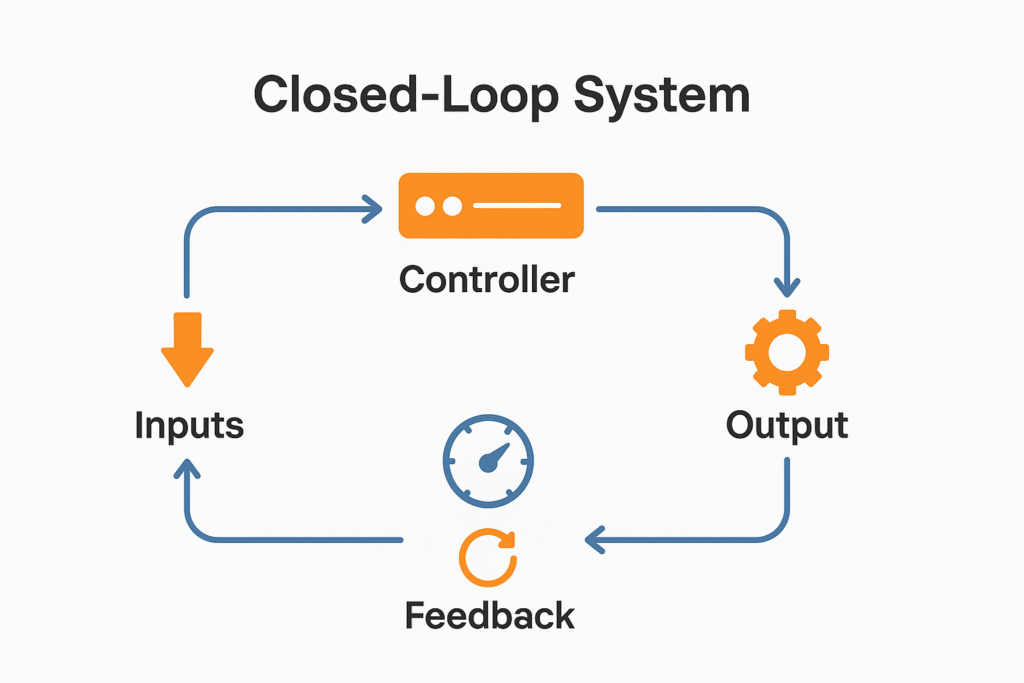
An attention-aware notification layer that sits between the operating system and the user’s apps. It uses behavioral signals: typing rhythm, app dwell time, task duration, time of day, to infer whether the user is in a focused state. When focus is detected, non-urgent notifications are held and batched for delivery at a natural task boundary. When an interruption does occur, the system provides a resumption cue, a lightweight context snapshot that helps the user return to their previous task faster. No manual configuration required; the system learns the user’s patterns over time.
Who is the target audience / customer?
The primary users are knowledge workers and students: anyone whose productivity depends on sustained focus. The paying customers are organizations: companies that want to reduce burnout and increase deep work capacity among employees, educational institutions looking to support student focus, and productivity software companies that want to integrate attention-awareness into their existing tools as a premium feature.
What is going to happen? (Change & Impact)
We move from a model where every moment is equally interruptible to one where digital systems respect the rhythm of human cognition. Interruptions do not disappear, they are timed better. Users reclaim extended focus periods without having to fight their devices to do it. Over time, this reduces the normalization of fragmented attention and establishes a new expectation: that technology should protect focus, not just compete for it.