Communication: what is it, what makes it good, and how does it present itself? 

[1] states that “a central puzzle that people face, from a design perspective, is how to make communication possible that was once difficult, impossible or unimagined.” This problem is exacerbated when the communication topic is one’s own body awareness and proprioception – and it’s an even bigger problem when you add the extra element of being suspended in the air. 

I believe that a possible solution to my identified design problem is redesigning the communication strategies used in aerial silks teaching, but to do so, we must first understand what communication design actually is. [1] defines it as “an intervention into some ongoing activity through the invention of techniques, devices, and procedures that aim to redesign interactivity and thus shape the possibilities for communication.” We, as designers, must design communication strategies in the preferred form of interactivity of the receiver, eliminating the nonpreferred forms [1]. 

According to [2], good communication must be effective (achieving the objective), appropriate (conforming to the rules of a situation), satisfying (fulfilling expectations), efficient (achieving the valued outcomes relative to the amount invested), verisimilar (having clearly understood symbol-referent links), and task-achieving (accomplishing the correct interpretation). It is also located in perception rather than in behavior [2]. This means that good communication is evaluated by people’s subjective perception that a communicator and their performance are appropriate and effective [2]. 

Communication can be classified by channel (i.e., the medium, means, manner, and methods): verbal or non-verbal [3]. Verbal communication can be either oral (either face-to-face or via a distance) or written, whereas non-verbal communication is more subtle [3]. Non-verbal communication consists of facial expressions, gestures, body language, eye contact, touch, space, and personality [3]. Communication can also be classified by style: formal (as in, within the professional environment) or informal (also called word-of-mouth) [3]. 

In the context of aerial silks, effective communication must: 

  • Reference mutually understood signifiers for basic movements (e.g. Footlock, hip key, S-wrap, etc.) 
  • Be both visual (observation of a teacher/video) and verbal (naming the steps) 
  • Be memorable (or in its defect, have a communicator repeating the steps while the aerialist does the figure) 

Plus, I would add that communication in aerial silks does not terminate once the communicator gives the steps to the aerialist; but rather, it ends once the aerialist has climbed the silk and actually felt the figure in the air. 

– 

Sources:  

[1] M. Aakhus, “Communication as Design,” Communication Monographs, vol. 74, pp. 112-117, March 2007. 

[2] B. H. Spitzberg, “What is Good Communication?,” Journal of tbe Association for Communication Administration, vol. 29, pp. 103-119, January 2000. 

[3] R. Kapur, “The Types of Communication,” Multidisciplinary International Journal, vol. 6, pp. 1-7, December 2020. 

Communication in the air: An observational study 

For the last blog post, I conducted interviews to figure out aerialists’ attitudes toward learning body awareness. For this one, I would like to see their behavior rather than their attitude, in order to be able to compare and contrast what they say versus what they do. 

This time, I decided to make a video blog (vlog) for this week’s entry, chronicling the different ways that teachers and students have tried to explain new figures to me (the constant participant in all of this). 

Own video. 

In the video, you can see how the Slovenian teacher, who focuses on making the figures look pretty and performative, moves my body in order to try to make me understand how I should move. This is directly contrasting what the Ukrainian teacher does, since she only uses verbal input while I’m in the air (since it’s also higher up). You can also see how the lack of a standardized language makes it hard to understand each other. In the video, I translate literally the name of one movement in Spanish (“camiseta” – “shirt”) and the teacher doesn’t understand me. For context, I had to learn the English names for some basic moves (“hip key”, which is used in the video, was not a word I knew before coming here; I called that move “tijera” or in English, “scissor”).  

In the video, you can also see how the learning process in silks doesn’t go in incremental steps. Since it’s in the air, people have to try out the full figure immediately. Unlike in silks, in gymnastics, you can see that there’s different prerequisites before fully trying out a new move. This helps in understanding what the body must do to successfully complete it without help (even though I still haven’t been able to figure out the 2nd move). 

What’s not shown in the video, however, is that throughout the past few weeks’ class observation, I’ve noticed a pattern present in novice explainers (read: when it’s not the teacher, but another student explaining a figure or correction). Usually, they would say “left hand”, and when they see it’s the wrong hand, they correct it with “no, the other left”. If it’s a move where the person must go into the silks or wrap around them, and the apprentice doesn’t do it correctly, novice explainers usually say “no, the other way”, even when there’s many “other ways to wrap around (sometimes, novice explainers go as far as to say “no, the other other way”). When asked about this, they all agreed that learning new skills in aerial silks is half about trial and error in learning how their body is supposed to move, and half about trial and error in learning how to communicate the steps from person to person. 

– 

Source: own observation. 

Overcoming the body awareness problem through empirical means: the layman’s approach 

In the past blog post, I talked about scientific studies that proved that externalizing the internal sensations of proprioception through sound and sight helped increase athletic performance and artistic expression. 

However, this week, I decided to take a different approach to answering the question I proposed 2 blog posts ago: have there been experimental tests to try to overcome [learning body and silk awareness off the ground] in a different way? 

Instead of looking to scientific papers, I turned to my aerial silks colleagues, conducting informal group and individual interviews (n=10(+1) participants) that yielded interesting results. I asked them if they ever experienced the problem of trying to both communicate and understand body awareness and proprioception in a new figure, and what they empirically found to be solutions to this. 

One participant (female, 38, Austrian) said she had a lot of problem differentiating left from right (even in normal life). Since this participant knew how to sew, she created her own unitard she uses for training, in which one half of the body is blue, and the other half is red. She also created one for her daughter (female, 7, Austrian), who is also learning silks and has the same problem. The participant cited that both her and her daughter have found success with this method, as it’s easier to both see and communicate if they have the correct leg and arm placements when learning a new figure. 

Another participant (female, 36, Mexican) is a teacher, and says she takes magnetic bracelets to class. When she finds students struggling with body orientation, she gives these bracelets to them and asks them to put them on one side of their body. This way, when they’re up in the air, she can refer to left and right as “the side with/without the bracelet”. She also explains that in her 7 years of teaching, she has found that with every new student, she learns different ways of explaining the same figure, since everyone has their own understanding of their body in space. However, she mentions that since she’s very cautious, she makes sure that every student first feels comfortable doing new figures close to the floor, and then she tells them they can finally try them out higher up. Her teaching assistant (female, 24, Mexican) echoes this sentiment, and adds that when she herself learns new figures, she likes to analyze and experiment different ways to get in and out of it while she’s on the silk, rather than in theory outside of it. 

A second teacher (female, 33, Slovakian) had a completely different experience. In her words, some people just aren’t meant to be aerialists, and if they can’t learn through copious practice then maybe it isn’t for them. Her approach to teaching proprioception centered more around diligent practice and repetition rather than finding novel ways to teach, which she says has worked for her students. She also incorporates “floorial” (aerial on the floor) exercises at the beginning of her workshops, to increase artists’ body awareness and get them in tune with the silk.  

One student (female, 25, Austrian) said she would like to be able to have a video of the figure she’s referencing while she’s in the air, for example by projecting it on a wall. However, another student (female, 26, Austrian) said she wouldn’t like that, since she would still struggle with orientation if she’s upside down. This student also said she prefers communicating with references relative to her position (e.g. “the free leg” or “the upper arm”), instead of left and right. A third student (female, 23, Austrian) contradicted this sentiment, as she said, “my right leg will always be my right leg, and the upper/lower reference confuses me”. Both of these 2 last students, however, agreed that most of the time, while being in the air, they move one leg/arm slightly and ask, “this one?” to confirm if it’s the correct one. 

Two students (female, 33, Mexican; and female, 42, Mexican) echoed the same sentiment: they first watch the teacher do the figure, and then watch someone else. The first student (33-year-old) said she repeats the steps verbally to the teacher to confirm, while the second one said she likes to take a video of the demostration in order to watch it multiple times. The second student says, “When I’m on the silk, after the first two or three steps, I find it difficult to relate what I saw in front of me to what I have to do when I’m the one who’s tangled up. I take the steps I can and go back to watch a recording.” What’s also interesting to note is that this second student separates new figures into 2 categories: hard mental process and hard corporal process. She says, “When the physical corporal process is complicated and not just the mental one, then there are other challenges, which I usually address with repetition. Front balance, for example, I added to the preparations/warm-up to better position my hands, support myself, etc. The same goes for the double bracelet (unstandardized name).”’ 

Finally, a third teacher (female, 39, Ukrainian), while teaching a new figure, said “the first time you just do something, and then after you can figure out what to do.” This directly contrasts the teaching philosophy of the Mexican teacher interviewed, who is more methodical and splits up each figure into smaller steps, always on the floor, before allowing students to try something new in the air. 

– 

Source: own interviews. 

What is up, down, left, and right when you’re airborne and spinning? Where is my body and where should it go? 

In the last post, I proposed the question: have there been experimental tests to try to overcome [learning body and silk awareness off the ground] in a different way?  

Consider the following image of a split in the air [1]: 

Image from Silks Stars, 2025. [1] 

To get into a Carpenter’s square (unstandardized name), the first step the aerialist must do is turn her body in between the 2 pieces of fabric. Then, she must go in front of one piece of fabric and then hook her foot in it, like so: 

Own gif, 2024. 

However, this begs the question that this post is titled after, and exemplifies the interaction design problem once again. In this specific example, the direction of the 2 turns is explained as “towards the pinky toe you see”, since this is a reference relative to your body and not relative to the environment. The next moves are explained as “stand up, bring your hand up to the silk as if you had a fever, go in front of it, and bring the foot that you’re standing on to the top of the silk.” 

3 other experimental studies address the body awareness problem through external stimuli regarding vision, sound, or both. These are explained in the next paragraphs.  

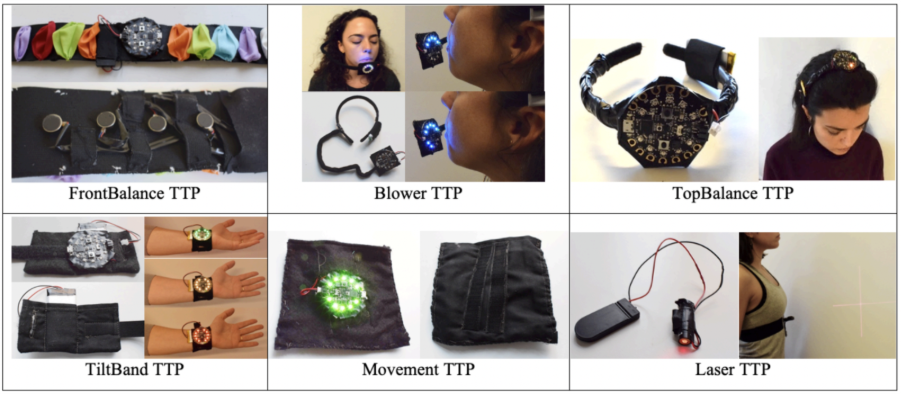
In an experimental study, [2] created technology training probes to “augment proprioceptive information and make it available through exteroceptive senses.” These consisted of an embedded system sewn into different wearable fabrics, each designed specifically for different body parts and circus disciplines [2].  

Image from Márquez Segura et al., 2019. [2] 

In training with the wearable devices, [2] discovered that focusing on external stimuli made children enjoy the exercise more and improved their overall performance, specifically: children were focused more, were more aware and in control of their posture, were more aware of their movement patterns, could maintain challenging positions longer, were able to engage and relax different body parts easier, had more endurance, could move past fear, and enjoy the exercise more. This study wasn’t focused on aerial silks specifically, but it proved that, in floor acrobatics, externalizing proprioception through a range of lights and sounds helped children with sensory-based motor disorder [2]. 

In another study, [3] created an aerial hoop which “generates auditory feedback based on capacitive touch sensing.” They added electrodes to a normal hoop in order to detect different touch data, which is then turned into auditory feedback through non-obstructing hardware housed in a wooden box [3]. 

Image from Liu et al., 2021. [3] 

The study found that the extrinsic auditory feedback helped artists to be more aware of the quality of their movements, including details that they would normally not pay attention to [3]. However, this study was done with expert hoop artists, which mentioned it would not be an accessible tool for beginners who are at first barely learning what their body must do [3].  

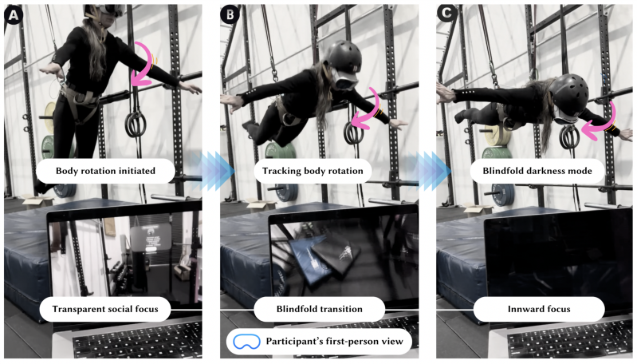
In a third experiment, [4] used a head-mounted VR headset to partially blind participants while being suspended from a 2-point harness, as shown in the picture.  

Image from Topaz et al., 2025. [4] 

While not specifically designed for circus disciplines, the study found that when they took vision away from participants, they were forced to focus more on their internal sensations, muscles, and body movements, increasing their bodily awareness [4]. Two relevant quotes from participants of the study were as follows: “The black environment helped me focus on the muscles to regain balance” and “When I used to perform, I was far above the audience. Using the blindfold application reminded me how stimulating and distracting I find the outside world. It felt very peaceful and focused to be in the virtual world alone with my body” [4]. 

– 

[1] “Flexibility,” Silks Stars. Accessed: Nov. 23, 2025. [Online.] Available: https://www.silksstars.com/category/foundations/flexibility/ 

[2] E. Márquez Segura, L. Turmo Vidal, L. Padilla Bel, and A. Waern, “Circus, Play and Technology Probes: Training Body Awareness and Control with Children,” Proceedings of the 2019 on Designing Interactive Systems Conference, vol. 1, pp. 1223-1236, June 2019.  

[3] W. Liu, A. Dementyev, D. Schwarz, E. Fléty, W.E. Mackay, M. Beaudouin-Lafon, and F. Bevilacqua, “SonicHoop: Using Interactive Sonification to Support Aerial Hoop Practices,” Proceedings of the 2021 CHI Conference on Human Factors in Computing Systems, vol. 1, pp. 1-16, May 2021. 

[4] A. Topaz, M.F. Montoya, R. Patibanda, J. Andres, and F. Mueller, “Blindfolded in the Air: Towards the Design of Interactive Aerial Play,” Proceedings of the First Annual Conference on Human-Computer Interaction and Sports, vol. 1, pp. 1-16, November 2025. 

Moving in the Air ≠ Moving on the Ground 

In traditional performing arts and circus arts (dance, acrobatics, gymnastics, etc.), people’s bodies move relative to the ground; however, in aerial silks, people are suspended in the air – making this an art in which the natural, ground-based restrictions aren’t present [1]. Additionally, in silks, artists must understand their own body not in relation to a fixed position, but rather in relation to themselves and the moving silks. Head orientation, limb placement, and proprioception play a key role in mastering different figures or sequences [1].  

In order to successfully perform a figure or individual movement, teachers must explain to students what both their body and the silk must do. This differs from other circus arts like hoop or pole and even from other, more defined sports like gymnastics, since in these areas the apparatus is heavily limited by gravity and statically positioned. In contrast, silks explanations have to take into account also how the apparatus must be placed. 

According to [2], “The silk can be viewed as an extension of the body so that the aerialists can tacitly learn how to execute the movements without analyzing the exact distance between their body, silk tail, and ground.” As such, embodied learning is paramount to silks, using somatic methods in combination with verbal language to transfer information, especially regarding one’s physical safety [2]. 

In my own experience as an aerial silks student, especially since I have been a student of many different teachers with different teaching styles, most of the new figures I (and my classmates) learn have to be explained in at least 2 ways: both shown in the air by the teacher, and with verbal step-by-step instructions given while the figure is made. Usually, this means that a student (specifically beginners, as in my class) must see a figure 2 or 3 times in order to finally understand what he or she needs to do (through observational learning). 

However, observational learning is not the only thing at play here. Some students, even when understanding the technical theory of what they need to do, still struggle with their own body awareness and silk awareness while off the ground. Currently, according to 3 different teachers I talked to, the only way to overcome this is through practice. But, I wonder, have there been experimental tests to try to overcome this in a different way? (The short answer is yes, but the long answer will be explored in the next blog post) 

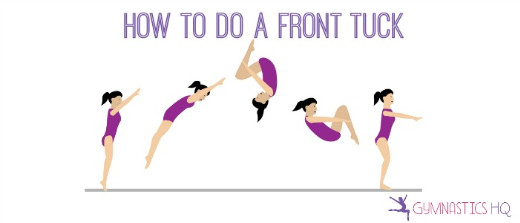
Furthermore, this week’s class observation I conducted yielded interesting results: in gymnastics class, instead of learning how to do a Running Front Tuck directly on the apparatus it should be performed on and trying to complete it on the first try, the teacher first instructed the gymnasts to run and jump straight up on a mini trampoline. Then, the next step was running, jumping, and doing a normal forward roll. Next, it was a handless forward roll, finally resembling the proper move. However, none of the gymnasts were able to land on their feet, and instead, the teacher was happy with them understanding the movement and landing on the mat, even if it was still in the tuck position (step 4 of the image) [3].  

Image from Gymnastics HQ, 2024 [3]. 

In contrast, in the silks class, the teacher explained a Metronome Drop (unstandardized name, but it’s what this teacher called it) by showing it, giving some verbal instructions and trusting the student to understand. Then, the student tried it out unsuccessfully twice, and finally was able to understand the knots on the third try. There was no gradual incrementation of steps as in gymnastics, rather the aerial student had to grasp the full movement from the beginning, without any progressions. 

– 

[1]  L. Froehlich, “Enhancing Aerial Circus Training Practices using a Synthesis of Traditional Coaching, Laban Movement Analysis, and Alexander Technique Frameworks,” B.A. dissertation, Dept. Dance, Scripps College, Claremont, CA, 2020.  

[2] M. Kosma, N. Erickson, C.J. Savoie, and M. Gibson, “Skill Development Versus Performativity Among Beginners in Aerial Practice: An Embodied and Meaningful Learning Experience,” International Quarterly of Community Health Education, vol. 41, pp. 173-187, January 2021. 

[3] “How to Do a Front Tuck: Drills and Exercises to learn a Front Flip in Gymnastics,” Gymnastics HQ. Accessed: Nov. 19, 2025. [Online.] Available: https://gymnasticshq.com/how-to-do-a-front-tuck/ 

Interaction Design in Aerial Silks: Teaching Proprioception in High-risk Scenarios

Aerial silks are pieces of fabric hung from the ceiling and used as an apparatus for dance. In this practice, people are suspended in the air, and students must be able to figure out how their own body must move in order to successfully complete a figure or sequence, while not falling to the ground in the process.  

As such, I ask, is there a way to blend the digital and physical world to help in the learning of new aerial silks figures? What can we as interaction designers do to help design the transfer of information of each movement in a figure or sequence? Can we use digital and/or analog methods to enhance people’s proprioception to make it easier to learn new figures? 

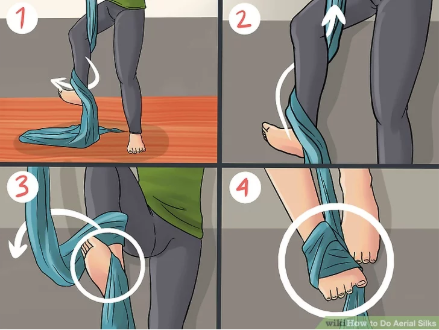
For example, one of the first skills you need to learn is how to do a basic foot lock. [1] explains it with the following image: 

Image from [1]

My personal motivation for this topic is the fact that I’ve been learning aerial silks for about a year and a half, in 4 different studios with 12 different teachers. Throughout this process, both the teacher and I have had to adapt to each other’s learning and teaching styles, respectively, and I have observed how different strategies help different students. Even with advanced students and teachers, the vocabulary used is not always the same, and the memory processes involved oftentimes affect the time it takes to learn a new sequence. 

This is relevant for design fields especially when thinking about full-body experiences. As we move to a more technologically integrated future, fully immersive interaction will become even more common. In this, one of the most important senses to study is proprioception – how do we teach people to be aware of their body? Besides that, this research is also relevant for the sports science field, as its findings can be used to help in the teaching of not just aerial silks, but also other non-standardized acrobatic sports. Design could help these fields through using user research and prototyping methods to reduce uncertainty in the unstandardized teaching methods and providing a good approach to help people with a less developed proprioceptive sense. 

Some of the challenges I expect are encountering little or no previous research exactly regarding this topic. I expect to find research about proprioception, maybe some research about silks, but not too many scientific papers combining the two. I also expect to find a challenge in the fact that everyone learns differently, and not only each individual country but also each individual aerial studio and teacher has its own internal language to define specific movements. In other, more studied fields, the best practice is to have a international committee where the rules are standardized for the profession worldwide. For example, gymnastics has the International Federation of Gymnastics, which is responsible for the language dictating every move. [2] 

Moving forward, I plan to: 

  • start talking with different aerial teachers and students in informal interviews to gather some background about how they deal with this problem 
  • delve deeper into shared resources to gain more knowledge 
  • ideate and list possible solutions depending on the findings 

[1] B. Borzillo. “How to Do Aerial Silks.” WikiHow. Accessed: Nov. 4, 2025. [Online]. Available: https://www.wikihow.com/Do-Aerial-Silks  

[2] “Mission and values”. Federation Internationale de Gymnastique. Accessed: Nov. 11, 2025. [Online]. Available: https://www.gymnastics.sport/site/pages/about-missionValue.php