Reimagining Playgrounds: Designing for Children’s Creativity and Curiosity

In many modern cities, playgrounds have become safe but standardized spaces that often limit children’s imagination and curiosity. The playgrounds rarely encourage creative play or free exploration. My research topic, “Reimagining Playgrounds”, focuses on how design can move beyond fixed and adult-centered models to create more stimulating environments that inspire creativity, encourage discovery, and support children’s natural sense of wonder.

By combining insights from interaction design, environmental psychology, and industrial design I aim to explore, how thoughtful design can transform ordinary playgrounds into spaces for imagination, learning, and social connection.

Research Questions

Central Research Question: 

  • Can playgrounds be designed to foster children’s creativity without being safety-focused and adult-centered?

Sub-Questions:

  • Why have most playgrounds maintained a similar design and appearance since the 19th century?
  • What role do safety standards  play in limiting creativity in playgrounds?
  • What design strategies can balance safety, accessibility, and creative freedom in contemporary playgrounds?
  • What role may interaction design play in making play experiences more inclusive, sensory-rich, and appealing?
  • How can children be actively involved in the early stages of the playground design process?

video by https://www.youtube.com/watch?v=SWDqoFqcvUU

Relevance for the Design Field and Approaches

Playground design is highly relevant for designers looking to build more inclusive and engaging public spaces because it lies at the heart of interaction design, urban design, and educational psychology. The videos How to Let Kids Design Their Own Playgrounds [1] and Why Safe Playgrounds Aren’t Great for Kids [2] demonstrate how user participation and emotional engagement can redefine traditional playgrounds. Allowing children to co-design or test prototypes during the early stages of the design process supports a human-centered and participatory approach, where young users become active contributors rather than passive participants. Design can address current issues—such as the lack of diversity, interactivity, and sensory richness in playgrounds—by employing co-creation workshops, interactive prototyping, and play observation as research tools. Examples like the Lappset Sona Interactive Play Arch [3] show how technology and interaction design can transform physical play into responsive and social experiences. Through these approaches, design can balance safety with creative freedom, fostering environments that stimulate curiosity, movement, and collaboration.

My Personal Motivation

My personal motivation for choosing this topic comes from a few things. As a designer, my ultimate goal is to meet people’s needs in creative and playful ways, which continually encourages me to become a better designer. I want to create spaces that allow children to express their creativity freely while socializing and learning from one another—a space that feels meaningful and inclusive for everyone, even if in different ways. In today’s modern world, we have many facilities and technologies that could be used more thoughtfully for children, who will one day become the adults shaping our future. Designing better playgrounds, therefore, is not just about play—it’s about nurturing curiosity, empathy, and creativity in the next generation.

Upcoming Research Phase

In the next phase of my research, I aim to take a closer look at how different types of playgrounds function in practice. I plan to explore various playground categories—from traditional and standardized ones to more experimental or nature-based examples—to identify what works well and what fails to support children’s creativity and curiosity. 

Another  step will be to analyze how and when designers involve children in the design process, both physically (through participation or co-creation workshops) and verbally (through interviews or observations). 

Finally, I will conduct on-site observations in different playgrounds around the city, paying attention to how children use the space, how they interact with each other, and which features seem to inspire the most creativity or playfulness. 

Expected Challenges

One of the most crucial—and challenging—aspects of my research will be figuring out how to strike a balance between safety regulations and creative flexibility in playground design.

At some point ı will also need to conduct interviews with children and parents to better understand their needs and experiences; however, this may be challenging since I do not speak German fluently, which could make communication and building trust more difficult.

References

[1] K. Botsoglou, “Creativity in Playgrounds: A Literature Review,” European Regional Conference: Perspectives of Creativity and Learning in Early Childhood, University of Thessaly, 2011.

[2] D. Harwood, M. Huang, and M. Somma, “We’re Trying to Find Cool Things in the Forest: Exploring Children’s Curiosity and Creativity in the Outdoors,” International Electronic Journal of Elementary Education, vol. 15, no. 1, pp. 33–42, 2022.

[3] D. M. Y. Brown, T. Ross, J. Leo, R. N. Buliung, C. H. Shirazipour, A. E. Latimer-Cheung, and K. P. Arbour-Nicitopoulos, “A Scoping Review of Evidence-Informed Recommendations for Designing Inclusive Playgrounds,” Frontiers in Rehabilitation Sciences, vol. 2, 664595, 2021.

[4] M. Colville-Andersen, “How to Let Kids Design Their Own Playgrounds – and Give Them Back the Streets,” YouTube, 2023. [Online]. Available: https://www.youtube.com/watch?v=SWDqoFqcvUU

[5] Why Safe Playgrounds Aren’t Great for Kids, YouTube, 2020. [Online]. Available: https://www.youtube.com/watch?v=SWDqoFqcvUU

[6] Lappset Sona Interactive Dance and Play Arch, YouTube, 2021. [Online]. Available: https://www.youtube.com

[7] J. L. Frost, S. C. Wortham, and S. Reifel, Play and Child Development, Upper Saddle River, NJ: Prentice Hall, 2001.

[8] N. D. Ridgers, Z. R. Knowles, and J. Sayers, “Encouraging Outdoor Play: The Role of Forest School in Fostering Social and Creative Development,” Early Child Development and Care, vol. 182, no. 3, pp. 431–444, 2012.

[9] AI Assistance: Parts of this proposal were developed with the assistance of ChatGPT (OpenAI, GPT-5, 2025) to refine language, structure, and citation formatting. All conceptual ideas, analysis, and final edits were made by the author.

Research blog 5.11.2025

Can design help prevent doomscrolling?

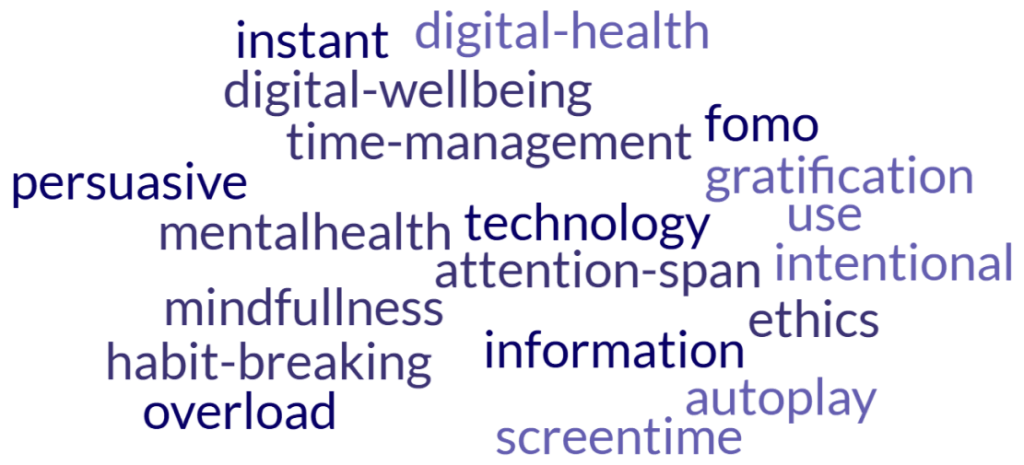
With social media platforms like Instagram and Tiktok it’s easy to get trapped in a cycle of never-ending scrolling. These platforms are designed to keep our attention for as long as possible, making it hard for the user to put the phone down and move on. They are tempting the user with a never ending supply chain of content with an algorithm perfectly fitted to the individual user. I myself, and many other people in my life have experienced this fist hand. You scroll on social media constantly having new content pop up and all of a sudden, an hour or two has passed by. It is called doom scrolling when this chain of content has a negative affect on the user, leaving them with feelings like sadness, anxiety or stress. This does not only affect people’s mental health but can also shape how people perceive the world and interact with technology. The algorithm is often so good that people still continue to scroll endlessly even though the content the consume is mainly negative, because it shows the type of content they find interesting, not recognising that overconsumption of these topics can be bad for their mental health. 

Research questions

  •  How can interaction design be used to reduce or prevent doomscrolling 
  • Can designers prevent the negative side affects of social media usage while still keeping the good parts?   
  • What role does interface design play in helping users manage their screentime? 

Potential challenges

  • Will external nudging be enough or is personal motivation needed  
  • Design is part of the problem and hopefully also the solution 
  • Getting designers to take ethical responsibility and puting it over their/ the companies buisnes goals.  

Possible approaches

The project could explore different ways of limiting peoples screentime or the content they consume by for example nudging the user to take breaks or swich focus, or simplifying the design of this kind platform to strictly necessary features. 

Personal motivation

This topic is very relevant for todays time, espessially with younger generations that are growing up with the access of smartphones and tablets, being so used to having access to constant entertainment. Personally, this topic also raises the question of ethical design. Is it ethical of an app designer to design a platform so well formed that the user get trapped? The designer is doing its job very well, and is probably getting paid what they deserve, but is it right when the use can lead to healt issues? One can argue that the platforms also inflict a lot of joy when used corectly. Is there a way to use design to keep the joy and decrease the negative side affects? I want to find out.  As an interaction designer, I want to find out how we can design digital environments that promote healthy use of social platforms rather than feeding this addiction. 
 

Relevance to design

The issue of doomscrolling is highly relevant to the design field, as designers shape the interfaces, flows, and feedback systems that can either encourage or help prevent compulsive use. Domscrolling highlights how design directly influence user behavior, attention, and wellbeing 
For interaction designers, the topic questions current engagement-driven patterns such as infinite scrolls and autoplay, and prompting exploration of more mindful, reflective, and balanced alternatives. From a product and service design perspective, it highlights the need to prioritize digital wellbeing. 
On an ethical level, designers should consider their responsibility within the users mental wellbeing, within both mental heath and peoples attention span and consider moving from maximizing engagement toward supporting healthy digital habits. 

Upcoming research

Personal experiments

I will try to find affective ways of reducing screen time by testing 3 different recomended methods on myself the following weeks.

After the experiments i will answer some questions like: Did i manage to decrease my screentime? Did aything happen to my consentration? Did my mood encrease or decrease? Did I miss using my phone? What did I do instead of scrolling? Did I feel like I missed out on anything by not being online as much?

I will also gather information online via articles, videos, podcasts and such. In addition i plan on holding interviews with social media users among my peers to gather a wider understanding of the issue
 

References

[DesRes 1] Agile_x_SelfCheckout No. 1: Creating User-Centered Strategies that align with Business and IT Goals in an innovative Agile Environment

Designers are empathetic visionaries seeking to find the right answer to their user’s desires. Besides breaking down Desirability designers are also responsible for building bridges towards Viability and Feasibility. In business context designers are therefore forced to view challenges holistically within the larger business scale. In order to succeed they need to adapt to business language. By integrating their human-first approach new opportunities and possibilities open up. Their scope of work increases: driving processes and communication, breaking down silos and avoiding risks are suddenly part of their daily work.

The major goal of this project is to identify and collect methods that could be used by designers to build trust with allies in the company.

Value of Human Centred Design

The number of companies understanding the value of human centred design is constantly increasing.

AirBnB: back in 2008 when the booking platform was first introduced, the visionaries of AirBnB were exposed to different challenges, such as the one to offer trust for guests towards their hosts. A major design enabled this by emphasising on more transparency. This was done by adding verified profiles and allowing feedback of other guests to be displayed. (Vishal Peshne, “UX Case Study: The Success of Airbnb’s User-Centered Approach,” Medium, Jan. 26, 2025. https://medium.com/@vishal.peshne/ux-case-study-the-success-of-airbnbs-user-centered-approach-7557f3d769b9)

Juicero: this example of an American start-up perfectly describes, why a good solution is worth nothing without the right problem statement, and it’s influence on financial aspects. Juicero allows its customers to buy an electrical juice-squeezer that operates by simply putting a pre-made bag of juice in the machine. However, quickly users figured out, that in order to open the said bag, they don’t need the machine at all. You can simply do so with your bear hands. (“TOOLS FOR TOMORROW,” Tools for Tomorrow, 2024. https://www.tomorrow.tools/ (accessed Nov. 10, 2025).

Image by Trenton Schulz

My Motivation

During my bachelor’s I was working as a UI & UX at a local start up. I was enthusiastic and motivated to start. As the first ever UX designer at the company I was quickly challenged with a number of obstacles:

Explaining what UX is about

We need to put emphasise on iteration and process driven outcomes. Stakeholders often seek deliverables. It can be difficult to define a specific deliverable, as artifacts such as Prototypes might suffer from a lack of granularity.

User Centred Mindset

UX-Professionals must always push their agenda to sensitize why it’s important to develop a product according to user needs. Ideas for products must constantly be challenged, whether they will deliver actual value for users and/or customers. This is also why problem statements should be focused on precisely before jumping to conclusions too quickly.

Integrating UX in an agile Environment

The company already had existing processes, most of them closely related to agile ways of working. UX and agile do go hand in hand. However, I once attended a talk, where the speaker mentioned, in her early years of agile training, there was no word of UX yet to be heard. Therefore, it can be challenging to spread awareness on the topic.

Relevance for Designers

As product designer in order to cooperate with our stakeholders and team members we must adapt to their language. In terms of human centred design, it is no good to distance yourself as a designer from other disciplines (e.g. Engineering, Business, Dev-Teams and most of all users).

We must be willing to collaborate, especially with our close colleagues from Product Management. This may include gaining trust with the Product Owner one has to report to.

Recherche Weg

In order to get a grasp of this complex topic I would like to perform two expert interviews with UX professionals with a lot of experience. I could imagine this becoming a bit difficult, as they won’t most likely be able to disclose any confidential information within their companies.

Furthermore, I am planning on attending a few talks from UX professionals (e.g. UX Graz, or some online alternatives for networking) to get an understanding of UX designer’s agenda in companies of all kinds. As of right now, I can imagine focusing on larger corporations and enterprises.

Possibility to Collaborate with a Business

At the WUC 2025 I had the opportunity to connect with Ines Lindner, a UX-Strategist at REWE International. Her responsibility is to tangle the challenge of merging enterprise architecture with human-centred values. In her talk she dives through the different processes that were enabled by Ines and her colleagues to ensure a smooth collaboration between the different parties from Design, Business and IT. One approach introduced by the speaker are so called “fusion teams”. These are teams, consisting out of employees from these mentioned parties. It allows them more freedom in collaboration and especially communication between departments. This is an essential step for breaking down silos, for which Ines has come up with a unique metaphor. Instead of bluntly referring to the different departments as “silos”, as it’s often done in business context, she uses the terms “city” and “houses”.  If I’m lucky I have a chance for collaborating with REWE for my thesis topic. In this case however, the whole topic would be connected to the use case of cash registers in the stores such as BILLA, BIPA, Penny etc.

Image by REWE Group

If the possibility of connecting with REWE doesn’t work out, I might reach out to BOSCH Sicherheitssysteme, where I did my internship.


References

Jurgen Appelo, Management 3.0. Pearson Education, 2010.

‌A. Cooper, R. Reimann, and d D. Cronin, About face 3 : the essentials of interaction design. Indianapolis, Ind.: Wiley, 2007.

S. Flores and N. Yu, “Placing Desirability at the Center of Innovation,” BCG Global, Jan. 16, 2024. https://www.bcg.com/x/the-multiplier/placing-desirability-at-center-of-innovation

B. Flyvbjerg and D. Gardner, How Big Things Get Done. Currency, 2023.

F. Laloux, Reinventing organizations: A guide to creating organizations inspired by the next stage of human consciousness. Nelson Parker, 2014.

Bridging the Gap 

Image by congerdesign from Pixabay

#digital-literacy #trust #interactiondesign #inclusive-design #older-adults #usability #accessibility 

With the current development of technology, our world is becoming more digital every day. As a result, digital literacy, the ability to use, understand and critically engage with digital technologies, is becoming essential for full participation in society. 

However, a significant portion of older adults rarely or never use digital technology in their everyday lives. This is not simply a matter of disinterest, but often the result of exclusion: many digital products are not designed to meet their needs. Age-related changes such as declining vision, hearing, motor skills and cognitive flexibility make it more difficult to learn and adapt to new systems. When technology assumes prior experience or fast learning, it unintentionally leaves many older users behind. 

Yet, digital literacy offers clear benefits for older adults. It can strengthen social connections by allowing them to stay in touch with family and friends, thereby supporting mental well-being. Beyond that, digital engagement can foster independence, stimulate cognitive activity, help overcome physical barriers and even support a sense of identity and belonging in an increasingly digital world. 

Still, psychological barriers remain. Many older adults believe they are “too old” to learn new technologies or lack confidence in their ability to do so.  

Interestingly, digital exclusion is not only an issue of age. Anyone, regardless of generation, can experience it if they lack access, confidence, or understanding of digital systems. The topic, therefore, is not about age alone but about how design can make technology inclusive, trustworthy and empowering for all users. 

Research Focus

Main Questions

How can interaction design support older adults in learning digital skills and becoming more digitally literate?

How can design make digital systems understandable, transparent and trustworthy for older users?

SubQuestions

  • How do older adults approach learning?
  • How do older adults approach learning new digital technologies?
  • What barriers (cognitive, emotional, or physical) affect their ability to learn digital skills?
  • What teaching or onboarding methods are effective for older adults?
  • What competencies are essential for older adults to be digitally literate?
  • How does digital literacy affect older adults’ independence, social participation and well-being?

Relevance for Design Fields

In many wealthy countries, people aged 65 and older are the fastest-growing demographic. With increasing life expectancy, older adults are living longer, staying active and continuing to pursue personal interests well into late life. They want to manage their finances, shop online, research topics and stay in touch with friends and family. However, age brings physical and cognitive changes. Hearing, vision and dexterity often decline, making interaction with technology more challenging. Most websites and apps are designed by and for younger users, which can make them inaccessible for older adults.

Digital literacy is a fundamental factor when designing interfaces for products and services. The level of digital competence within a user base guides decisions about interface complexity, navigation and functionality. For users with limited digital literacy such as older adults, interfaces need to be clear, predictable and forgiving, providing guidance and feedback that supports learning.

Possible Solutions

  • Integrating older people in the design process from the beginning.
  • Combining digital interactions with real life interactions.
  • Teaching basic digital literacy.

Challenges

Recruiting participants for my research may be challenging, especially ensuring a great range of experience levels. Motivating older adults to engage in learning and actively work on improving their digital literacy can also be difficult. Additionally, designing interfaces and interactions that effectively accommodate users with different levels of digital literacy is complicated.

Preview

In my next step I would like to already integrate some interviews with people. I want to grasp what the problem for them really is. I also plan to go deeper into the research of digital literacy for older people, read up on education and learning for the aging population.

Personal Motivation

As I was working on the topic of accessibility for my bachelor’s thesis, I became especially interested in how digital products can be made more inclusive. This is also when I found out that older adults often struggle to understand the functionality of websites, apps or other digital tools. I like to think that, one day, everyone has equal access to digital products, regardless of age or ability. I chose this topic because I believe good design should leave no one behind. Older adults should be able to use digital products independently, without relying on others and feel empowered while doing so. Being able to navigate technology confidently helps them participate more fully in social life, explore new interests and stay connected with friends and family. This is not just about convenience, it’s also about mental well-being, as social inclusion plays a key role in maintaining cognitive and emotional health. I’m also curious about how older adults’ social networks (family and friends) can play a role in spreading digital literacy. If friends, family, or community members can support each other, it could create a positive effect, helping even more people gain the skills and confidence to engage with technology. Ultimately, my focus is on designing solutions that empower, include and connect older adults in the digital world.

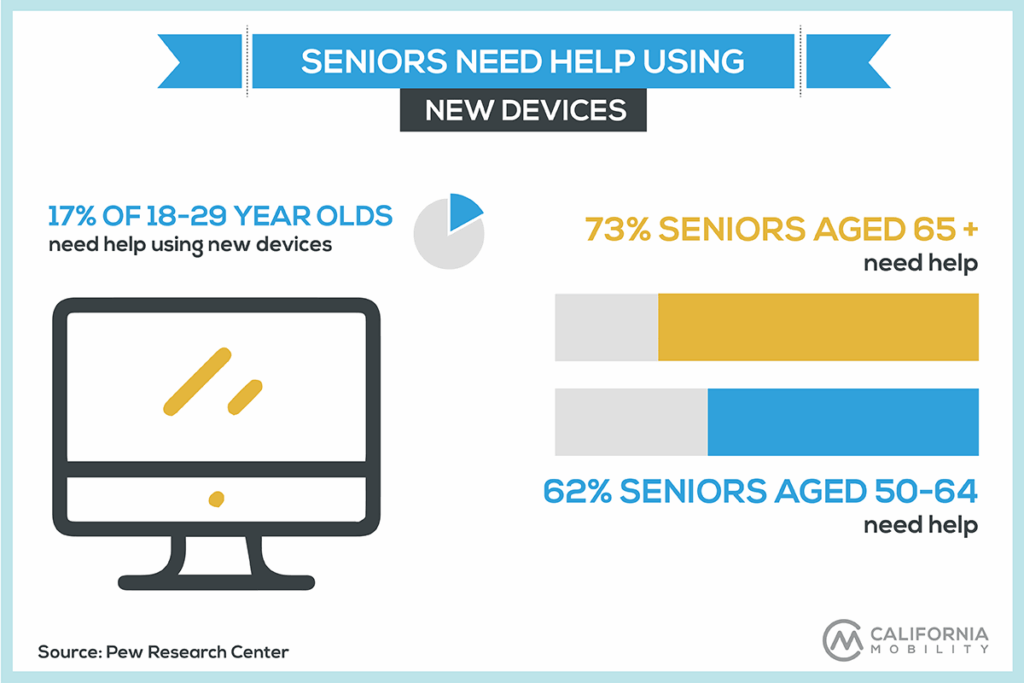
Another thing that really opened my eyes came from a talk at the WUC. I learned that many older adults would be happy to use technology if someone simply showed them how (guidance through interaction design). Surveys presented at the talk highlighted that 20% of older adults would use digital products more often if they were easier to use and 19% would engage more if they could see a clear benefit. These findings made me realize that, for many older users, the barrier is not disinterest, it’s accessibility, guidance and perceived value.

Index

Grabowski, S. (2024, October 2). A guide to interface design for older adults. Adchitects. https://adchitects.co/blog/guide-to-interface-design-for-older-adults

Kane, L. (2019, September 8). Usability for older adults: Challenges and changes. Nielsen Norman Group. https://www.nngroup.com/articles/usability-for-senior-citizens/

Landra, A. (2021). Impact of digital literacy on mobile user interfaces: A process for outlining UI design guidelines for people with low digital literacy (Master’s thesis, Politecnico di Milano, Scuola del Design). Politecnico di Milano.

Vercruyssen, A., Schirmer, W., Geerts, N., & Mortelmans, D. (2023). How “basic” is basic digital literacy for older adults? Insights from digital skills instructors. Frontiers in Education8–2023. doi:10.3389/feduc.2023.1231701

Weck, M., & Afanassieva, M. (2020). AGEING PEOPLE’S TRUST IN DIGITAL ASSISTIVE TECHNOLOGY: INITIAL TRUST FORMATION.