#3 Das Geheimnis großartiger Charaktere

Wie schon in den ersten zwei Blogeinträgen erwähnt, ist der Mensch, der Charakter, mit Abstand der wichtigste Faktor für die Gefühlsübermittlung an den Zuschauer und die Zuschauerin. 

Anfangs kann ohne Bedenken behauptet werden, dass ein narrativer Film höchst auf die Charaktere beziehungsweise Schauspieler und deren Leistung und Taten beruht. Nur ein gut geschriebener Charakter und die dazu passenden Taten können einen Film abrunden. Die Charakterisierung sowie die Motivation der Charakter und die Figurenentwicklung sind somit unumgänglich für ein gutes und vor allem funktionierendes Storytelling. (vgl. Heckmann 2023)

Schlussendlich existiert keine Geschichte ohne Charaktere, in From von Menschen, Tiere, Objekte sowie alles weiter, und dessen Taten. Dieses Storytelling beruht auf den Informationen, die die Zuschauer und Zuschauerinnen bekommen. Das sind charakterliche Eigenschaften, der Job, das Alter aber auch Stärken und Schwächen sowie Beziehungen und Wünsche. Genau kann die Charakterisierung jedoch in 2 Teile geteilt werden: die direkte und die indirekte Charakterisierung. (vgl. Blome u.a. 2024)

Direkte Charakterisierung:

Die direkte Charakterisierung zeichnet sich dadurch aus, dass die Zuschauerschaft diese direkt erkennt. Das kann in der einfachsten Form eine Beschreibende Voice Over Stimme sein, die etwas genauer beschreibt. Jedoch ist hierbei die Gefahr groß, dass sich die Menschen schnell zu langweilen beginnen. Ebenfalls sehr einfach zu erkennen, jedoch ein wenig spannender, als wenn man alles nur erzählt, bekommt sind die einfachen Details des Erscheinungsbildes. Ganz oberflächlich wird dem Zuschauer durch Faktoren wie das Kostüm, das Umfeld um die Person, Setting und Ausstattung eine Geschichte zu dieser Person erzählt. Man erfährt sofort, ob es sich um eine reiche oder arme, unheimliche oder fröhliche Person oder überhaupt um einen Antihelden handelt. (vgl. Heckmann 2023)

Indirekte Charakterisierung:

Die indirekte Charakterisierung erzählt Eigenschaften, die ein bisschen versteckt sind. Zum Beispiel wird sie durch das Verhalten der Person ausgezeichnet. Was und wie macht der Charakter irgendetwas? Wie sind die Gestik und Körperhaltung? Für das Publik sehr interessant wird es, wenn bei einem Charakter die Direkte und indirekte Charakterisierung unterschiedliche Sachen aussagen. Screenwriter Robert McKee erklärt: „The revelation of true character in contrast or contradiction to characterization is fundamental to all fine storytelling“ (McKee 2020). Demnach ist ein kleiner Konflikt oder Widerspruch der direkten und indirekten Charakterisierung eine perfekte Grundlage für ein gutes Storytelling. Han Solo in Star Wars 4 ist hierfür beispielhaft: Er behauptet immer er würde alles nur für sich machen und lieber sich als alle anderen retten – seine Taten jedoch zeigen das komplette Gegenteil auf, da er schlussendlich immer zur Stelle ist, um zu helfen. (vgl. Heckmann 2023)

Nach einer Charakterisierung bleibt dieser nicht stehen. Für ein gute Geschichte sollte sich der Charakter weiterentwickeln. Die Figur muss eine Reise durchleben, die schlussendlich eine Veränderung in zum Beispiel physischer oder emotionaler Form hervorruft. Dies hat die Möglichkeit aus einem normalen Film einen Unvergesslichen zu machen. Dabei teilt sich die Reise der Figur in drei Teile auf, die von subtilen bis drastischen Entwicklungen reichen kann:

  • Der Aufbau beschreibt den Charakter am Anfang. Es ist schlussendlich die -Charakterisierung. 
  • Die Veränderung befindet sich im Höhepunkt des Filmes. Der Charakter hat die Probleme oder Herausforderungen überwunden und ist daran gewachsen. 
  • Die Auflösung beschreibt am Ende was sich verändert hat. (vgl. Lucia 2023)

Dabei kann eine Entwicklung positiv sein und somit eine Verbesserung der aktuellen Situation hervorrufen wie zum Beispiel bei Forrest Gump. Anfangs ist er ein einfacher Mann mit niedrigem IQ, der aber durch seine Erlebnisse im Vietnamkrieg und dem Verlust eines Freundes zu einem sehr klugen, sympathischen und erfolgreichen Mann wird. Dies Beschreibt die klassische Heldenreise, während die Reise eines Bösewichts oder Antihelden durch eine negative Entwicklung beschrieben wird. Als dritte und letzte Möglichkeit gibt es die flache Entwicklung, die für Nebenfiguren von Wichtigkeit ist, da sie kaum Entwicklung durchleben. (vgl. ebda.)

Abschließend bleibt noch neben der Charakterisierung und der Charakterentwicklung die Charaktermotivation. „A character comes to life the moment we glimpse a clear understanding of his desire“ (Fischer 2018). Denn wie Robert McKee erklärt, brauchen alle Taten und Dinge, die eine Figur im Film macht, eine Motivation, denn nur so gibt es die Chance auf einen Charakter, in den sich das Publikum hineinversetzen kann. Hinzu kommt eine Form von Hindernis oder Probleme, die dabei erscheinen müssen, da ansonsten das Ziel viel zu schnell und ohne Lernkurve für die Charakterentwicklung erreicht werden würde. (vgl. Deguzman 2020)

Diese Motivation kann durch verschiedene Möglichkeiten für das Publikum sichtbar gemacht werden:

  • Dialoge können die Motivation hinter Taten perfekt beschreiben. Hinzu kommt, dass man diese auch zwischen den Zeilen der Gespräche verstecken kann um der Zuschauerschaft dennoch ein wenig Platz zur eigenen Interpretation lässt 
  • Ähnlich wie bei Dialogen spricht manchmal die Figur seine Motivation laut aus oder murmelt sie vor sich hin. Dies ist die einfachste jedoch auch für den Zuschauer die langweiligste Form. 
  • Das Verhalten des Charakters selbst kann auch schon ausreichen, um seine Motivation darzustellen. 
  • Die Vergangenheit kann wie in Batman auch Auslöser für eine Motivation sein. Bruce Wayne hat als Kind ein Verbrechen hautnah miterlebt und bekämpft deswegen dies jetzt. 
  • Das Umfeld der Figur sagt ebenfalls extrem viel über Motivation aus. (vgl. ebda.)

Die Motivation wird aufgeteilt in äußere Ziele und innere Ziele beziehungsweise Bedürfnisse. Während die äußeren Ziele die Handlung klar vorantreiben, können innere Ziele sich eher auf persönliches Wachstum und Heilung konzentrieren. Das Äußere Ziel kann jedoch auch der Wunsch nach etwas sein, das versteckt im Inneren fehlt. Zum Beispiel kann der äußere Wunsch nach Reichtum mit einem zu geringen Selbstwertgefühl im inneren zusammenhängen. (vgl. Weingartner 2025)


Heckmann, Chris (21.05.2023): What is Characterization. A Guide to Character Building. In: StudioBinder, https://www.studiobinder.com/blog/what-is-characterization-definition/?utm_source=youtube&utm_medium=video&utm_campaign=content-marketing-promotion&utm_term=what-is&utm_content=what-is-characterization (zuletzt aufgerufen am 30.10.2025)

Blome, Gabriele u.a. (2024): Filmanalyse. Einleitung zum Filmbildungskurs Sekundarstufe 2. In: Lernbausteine.Visionskino, https://lernbausteine.visionkino.de/filmbildungskurse/s2_start/index.html (zuletzt aufgerufen am 30.10.2025)

McKee, Robert (24.11.2020): Structure and Character. Excerpted with permission form the book „story“. In: Writers Store, https://writersstore.com/blogs/news/structure-and-character-excerpted-with-permission-from-the-book-story-part-one (zuletzt aufgerufen am 30.10.2025)

Lucia, Victoria (20.06.2023): Drehbuch-Blog. Beispiele für Charakterentwicklung. In: SoCreate, https://www.socreate.it/de/blogbeiträge/drehbuchschreiben/beispiele-fur-charakterentwicklung (zuletzt aufgerufen am 30.10.2025)

Deguzman, Kyle (17.08.2020): What is character motivation in storytelling. In: StudioBinder, https://www.studiobinder.com/blog/what-is-character-motivation-definition/ (zuletzt aufgerufen am 30.10.2025)

Weingartner, Gabriela (08.08.2025): Die Kunst der Figurenentwicklung für Film und Serien. Zwischen Klischee und Komplexität. In: Filmpuls, https://filmpuls.info/filmcharakter-figurentwicklung-spielfilm-serien/(zuletzt aufgerufen am 30.10.2025)
Design Activism (Part 3)

Hello, and welcome back to my research. I will now focus on some of the sources I found in my last post, therefore the main part of the research is now on the field of design activism.

From the 13th to the 14th of September in 2024 there was a symposium called “Design as Activism” in Chicago. Because there are already numerous designers in the city that create design activist pieces, they invited people to start a discussion, inspire others to engage with design activism and share their thoughts and experiences. Jessica Meharry describes:

The word activism comes from the Latin word actus: “a doing, a driving force, or an impulse.” In many ways, this is perfectly suited for design. We understand design as activism: as taking action, putting theory into practice, and learning through doing and making. Yet design is also deeply entangled with capitalist systems, with many designers working in service of clients that prioritize profit, growth, and extraction. What space is there for activism, for social and political change within those contexts? (2024, p. 7)

To be able to create design activist projects that matter and go in the direction you want them to go it is important to ask yourself the right questions. “Design activists must consider how we do or don’t reinforce power differentials. This includes how we engage with conflict and dissensus versus consensus and collaboration.” (Meharry 2024, p. 8) These questions often require continuous reflection, as well as, awareness where you position yourself as a designer and as a human being. Anything about your identity can have an influence on this.

Moreover, activism is a driving force that connects people, also designers, as they tend to share a similar vision of a better world. It is essential that the communication on these topics does not stop and evolves instead through learning and having an open mind. (cf. ibid. p. 9)

Anne H. Berry, the director of the School of Design from the University of Illinois Chicago, mentions that even though we mostly do not think about things in this way our everyday lives are highly political. (cf. ibid. p. 10) The question she asks is: “If you think about the things or experiences in your life that have influenced you, that have changed you, how are those [sic!] are tied to politics or democracy?” (ibid. p. 10) This is indeed a question that makes you more aware of how politics often influence even small decisions in our daily lives.

We as designers have the power activate people to use their voting rights or advocate for other important changes in our communities, countries or in the world. It is our responsibility as citizens to not just turn a blind eye on politics and everything that is going on in the world, because it is also changing our own daily lives. The question is, how do we get to the people we want to mobilize? To be able to do this it is important to start asking the right questions and to discern what drives these people that we want to reach. (cf. ibid. p. 11) And who is our target group in this specific case.

To conclude, in order to be able to become a design activist it is crucial to ask the right questions about yourself as a designer, as a human being and your target group. To add to that, it is essential to know that even if you do not want to be everything you do will always be political to some degree, therefore, it is important to be aware of politics and how they influence our daily lives and the things we want to promote as designers.

Source:

Meharry, Jessica (ed.): Design as Acitivsm. September 13-14, 2024. Symposium Proceedings. Institute of Design at Illinois Tech. California: ORO Editions 2024.

User Interfaces in Video Games 2/10

User Interfaces in Video GamesThe quest for genre-appropriate and usable game UI

To start off with my research I decided to research the history of video games and, by extension, their user interfaces. I’m interested in how people interacted with early interfaces with technical limitations.

My first thought was Pong, a game that many people consider the first game, but upon research I found out that this wasn’t the case and that there’s no clear consensus.

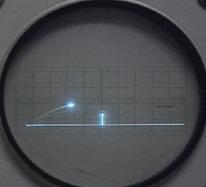
Figure 1: Tennis for Two
Source: [1]
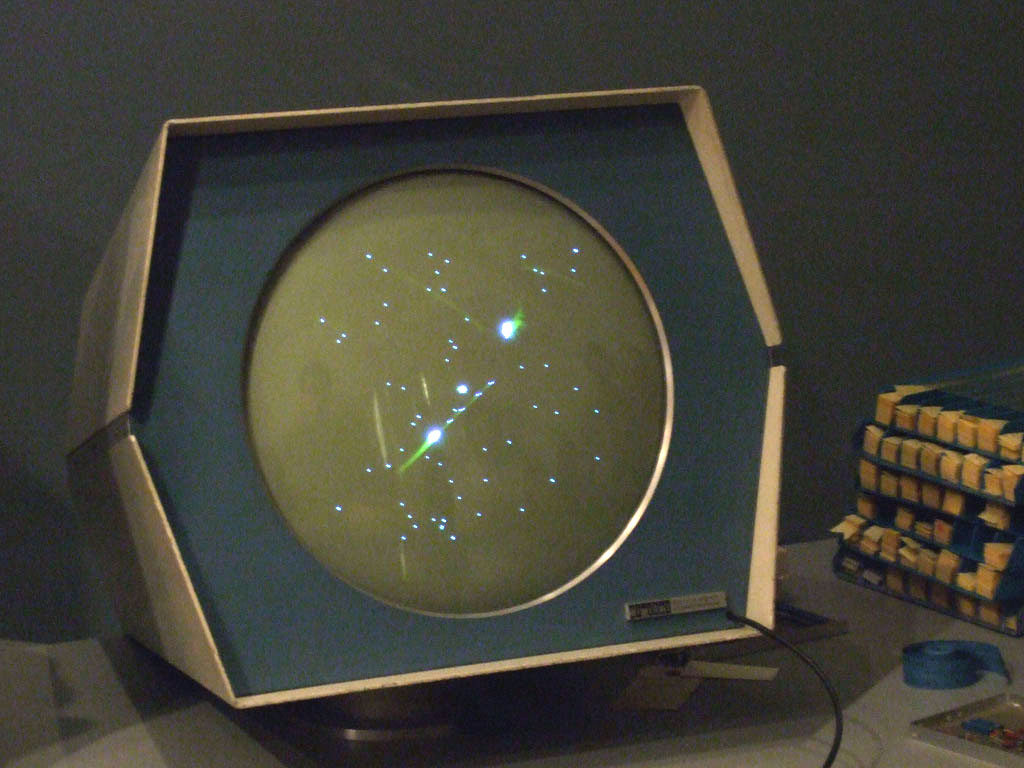
Figure 2: Spacewar!
Source: [2]

Released 14 years before Pong, Tennis for Two was developed by William Higinbotham and it was made using an analogue computer with a oscilloscope screen and two separate controllers [3]. I found a recreation of it you can play in your browser here, which shows well how limited the interaction elements were, namely a pair of dials/control knobs and buttons.

This video also talks about Tennis for Two as the first video game and shows the control scheme

Tennis for Two shows that the way people interact with video games has always involved input devices. These input devices provide the point of interaction between the human and machine. However, some sources argue that it isn’t the first video game because it wasn’t displayed on a video screen, which is a technicality [3]. Other sources argue that “While this appears to be the first interactive game, it is an isolated instance” [4], claiming that the creator of the upcoming game I will mention didn’t know of it’s existence.

Released a few years after Tennis for Two, Spacewar! was developed by Steve Russel and it was made using a PDP-1 computer [4]. This made it the first computer game, originally using toggle switches built into the computer, but eventually getting dedicated remote controllers developed. Spacewar! is widely considered the first video game, showing a very similar interaction principle albeit with more complex controls.

At 13:45 you can see Spacewar! being played

While Tennis for Two had one adjustable knob and one button for aiming and throwing, Spacewar! had much more complex controls with the objective was for each player to maneuver a spaceship and score by firing missiles at their opponent [5].

Whats interesting in observing these interfaces is that they have no traditional visual UI elements, such as high scores or menu screens. The game itself doesn’t guide the player intrinsically, but the aspect of two identical controllers suggests that two players can somehow interact with the game.

The Elements of Hostile Design

Hostile design is design meant to prevent various kinds of usage/interaction with objects, usually by vulnerable groups of people (Rosenberger, 2023). It is perhaps most commonly discussed about designs that prevent the usage of benches etc by the homeless. Robert Rosenberger (2023) presents a classification scheme which talks about the different types of Hostile Design one might come across. 

  1. Physical Imposition

When a design physically prevents certain interactions or engagements with an object. A common example in relation to Hostile Design against homelessness is creating barriers on benches to prevent anyone from laying down on the bench (Rosenberger, 2023), it can be “seats” where one lean against the seat rather than fully sit down, and so on. 

  1. Sensory Interference

Sensory interference includes the use of generating sensory stimuli that is annoying or unpleasant, for example through various usage of light and/or sound. Rosenberger (2023) comes with examples such as playing annoying sounds or loud music in parks and other public spaces have been used to drive away the unhoused. He also writes about the usage of unflattering lights, in the context of driving young people away from underpasses. However, I can also imagine lighting being used to create uncomfortable public spaces to take shelter at. 

  1. Concealment

This is when a certain usage or amenity is available in the public space, just that it is concealed in such a way one must know where it is or how to use it. Rosenberger (2023) brings up the example with public toilets being placed in unusual places and/or having no signage to guide the public to its location. 

  1. Confederacy

This includes the control of a public space, usually through the usage of security guards, police officers, cameras, or others placed to control a public space. For example some public spaces might have a receptionist and a sign in sheet in order to use the space (Rosenberger, 2023), or public rest rooms may have on-site staff controlling the payment gates to enter and exit the rest rooms. Rosenberger (2023) reflects on how the unhoused might not appreciate the monitoring where one needs to sign themselves into the public space, and how camera monitoring can trigger a fear of attracting attention to the authorities.

  1. Self-coercion

Self-coercion is when design makes the public themselves avoid certain behaviour in a public space or refrain from a certain usage of an object. The most straightforward example is signage targeted at certain groups, for example signs that says “No Camping” targets the unhoused to try and prevent them from taking shelter in the area of said sign. Rosenberger (2023) also gives the examples of spikes on surfaces where one perhaps could lie, which is not only a physical imposition, but also an example of self-coercion. It shows the unhoused that they are not welcomed here, which could perhaps lead them away from the area.

  1. Absence

Hostile design in the form of absence is that instead of simply limiting usage in the other ways mentioned, one removes the object altogether. This impacts the unhoused in the ways of leaving no place to rest once benches are fully removed, or lack of public restrooms in public areas (Rosenberger, 2023).

How these hostile designs could be turned to the more positive is something that could be researched further in the next post.

 
Source

Rosenberger, R. (2023). A classification scheme for hostile design. Philosophy of the City Journal, 1(1), 49-70. https://doi.org/10.21827/potcj.1.1.40323

Design Activism and Socially Responsible Design (Part 2)

One of the reasons, why I am only now writing my second blog entry is, because I did not have a lot of time lately and another one is the difficulty to find scientific and other usable sources for a master’s thesis from a design topic. Since the design world does not seem to focus as much on science as other fields it proves to be extremely difficult to do good research on specific design-based topics. Maybe this is just my own feeling, but has anyone else experienced this? Or am I just going about it in the wrong way? Anyways, here are some sources I have recently found and want to check out (if I am in any way able to get my hands on any of these):

Bieling, Tom (ed.): Design (&) Activism: Perspectives on design as activism and activism as design. Hythe: Mimesis International 2019.
Coker, Coleman and Gamble, Sarah: Environmental Activism by Design. California: ar+d publishing 2023.
Erlhoff, Michael and Rezai, Maziar (eds.): Design & Democracy: Activist Thoughts and Examples for Political Empowerment. Basel: Birkhäuser Verlag GmbH 2021.
Fuad-Luke, Alistair: design activism: beautiful strangeness for a sustainable world. London: Earthscan 2009.
Meharry, Jessica (ed.): Design as Acitivsm. September 13-14, 2024. Symposium Proceedings. Institute of
Design at Illinois Tech. California: ORO Editions 2024.
Place, Alison: Feminist Designer: On the Personal and the Political in Design. Massachusetts: MIT Press 2023.
Shea, Andrew: Designing for social change: Strategies for community-based graphic design. New York City: Princeton Architectural Press 2012.

In my last post, I have compared design activism to socially responsible design and I have tried to find clear definitions for each of the topics, which proved to be extremely difficult. This is why I came to the conclusion that depending on the context both areas differ slightly. Where design activism focuses on longer lasting change, socially responsible design usually refers to more current topics and usually shows immediate change that does not last as long.

I have the feeling that there are either several more similar approaches going around or different names are used for socially responsible design, which makes it more difficult for me to really understand what is included in this field of design. To completely discern the differences between these two approaches I will try to find more resources on socially responsible design, if possible. I hope that I will be able to get more access on important resources on my topic and I’m looking forward to share more findings in my next blog posts with you.

Biophilia and Technological Nature: How Technology tries to Fill the Gap

When we talk about biophilia, we refer to the definition proposed by the Biophilic Society:

“Biophilia refers to the innate human affinity for the natural world – a love of life. It emphasizes the importance of integrating natural elements and patterns into our built environment to enhance physical, emotional, and psychological well-being.” [1]

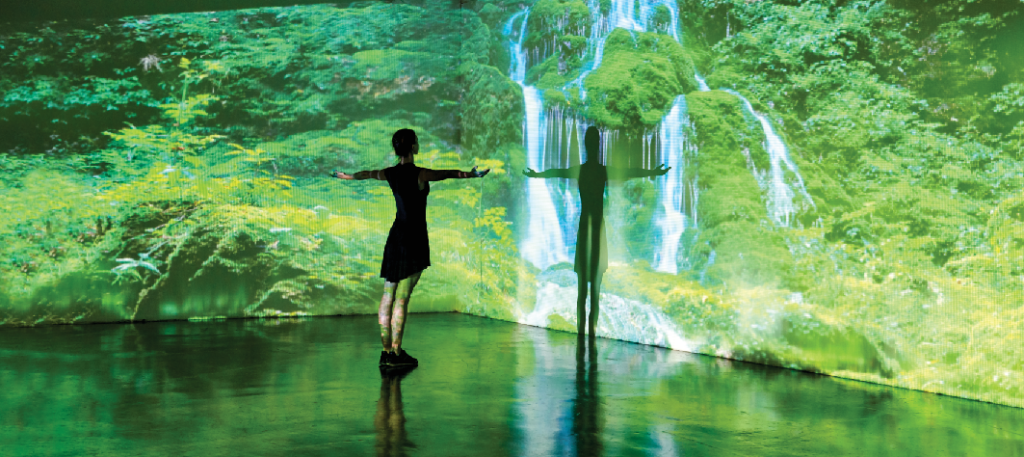
However, recent technological advances, such as virtual and augmented reality, can offer benefits that are similar to those gained from direct contact with nature. The technologies that mediate, simulate, or enhance our experience of nature are commonly called technological nature. Virtual reality, for example, can help people experience nature when access to real natural environments is limited. Recent studies show that older adults who used VR nature experiences felt less socially isolated, had a better mood, and reported improved overall well-being.

This raises an important question:

to what extent can technological nature truly satisfy our need for nature?

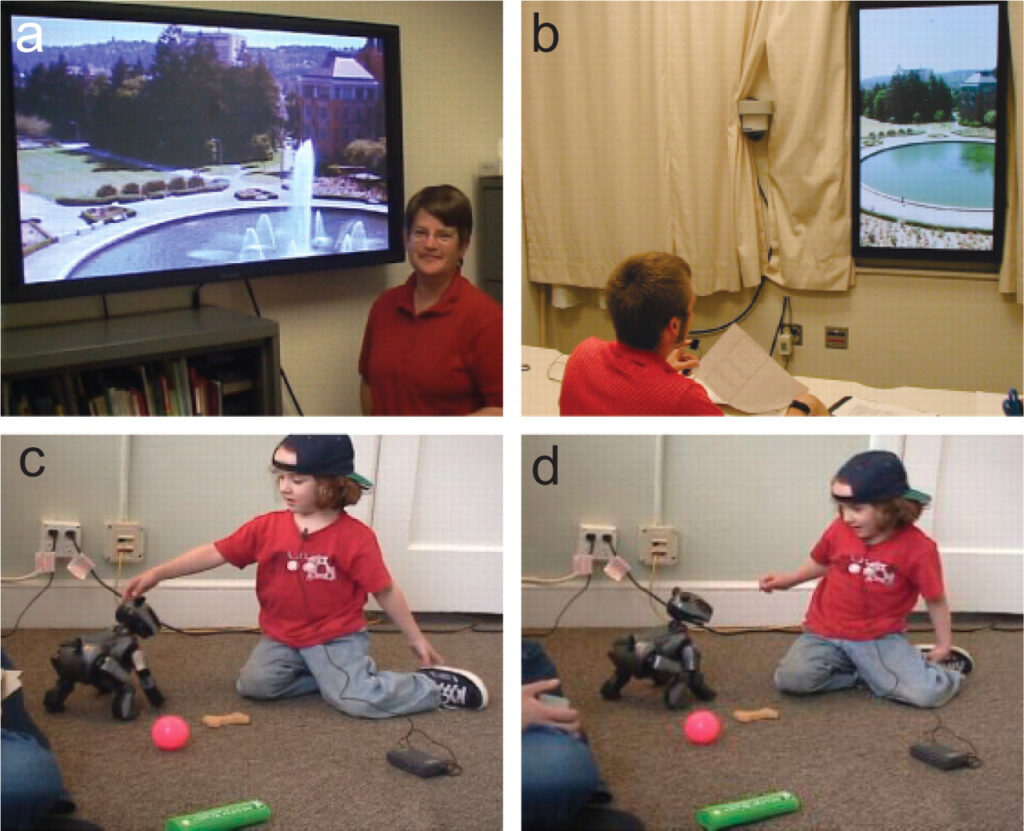
Important insights into both the strengths and limits of technological nature come from research by Peter Kahn and his colleagues. In one study, large plasma screens showing real-time natural scenes were placed in windowless university offices. Over 16 weeks, participants reported better psychological well-being, improved cognitive performance, and a stronger sense of connection to nature. This suggests that a digital view of nature can be better than having no nature at all.

However, a second study revealed clear limitations. When researchers compared a real window with a nature view, a digital window showing the same scene, and a blank wall, only the real window helped people recover from stress more quickly. The digital window did not perform better than the blank wall. Overall, these results show that technological nature can be helpful when nature is absent, but it is not as restorative as real nature [5].

Further research confirms that technological nature cannot fully replace direct contact with the natural world. Without physical and multisensory experiences—such as wind, temperature, and natural smells—these digital experiences can become repetitive over time. Easy access to technological nature may also reduce people’s attention to real nature and lead to a simplified idea of what “nature” is [3].

This is important because current VR nature experiences cannot provide all the benefits of real nature. Some of these benefits depend on natural biochemical processes that technology cannot recreate. Relying too much on technological nature may also reduce spontaneous social interactions in natural spaces, which are important for well-being and social connection.

Technological nature is a useful resource in a world where access to real nature is often limited or uneven. However, research shows that it cannot replace real, living nature. Instead of asking whether technological nature can take the place of real nature, we should focus on how it can work together with it and support it.

[1]  “Technological Nature,” UW HINTS Lab, https://sites.uw.edu/hints/research/technological-nature/ (accessed Dec. 9, 2025).

[2]  “The Biophilic Society is born,” Living Future Europe, https://living-future.eu/the-biophilic-society-is-born/ (accessed Dec. 9, 2025).

[3]. Kellert, S. R. in Children and Nature: Psychological, Sociocultural, and Evolutionary Investigations (eds Kahn, P. H. & Kellert, S. R.) 117–151 (MIT Press, 2002)

[4] Lin, X. C., Lee, C., Lally, D. & Coughlin, J. F. in Human Aspects of IT for the Aged Population (Applications in Health, Assistance, and Entertainment, 10927) (eds. Zhou, J. & Salvendy, G.) 89–100 (Springer, 2018).

[5]P. H. Kahn Jr., R. L. Severson, and J. H. Ruckert, “The Human Relation With Nature and Technological Nature,” Current Directions in Psychological Science, vol. 18, no. 1, pp. 37–42, 2009

Did you know the Schau auf Graz app?

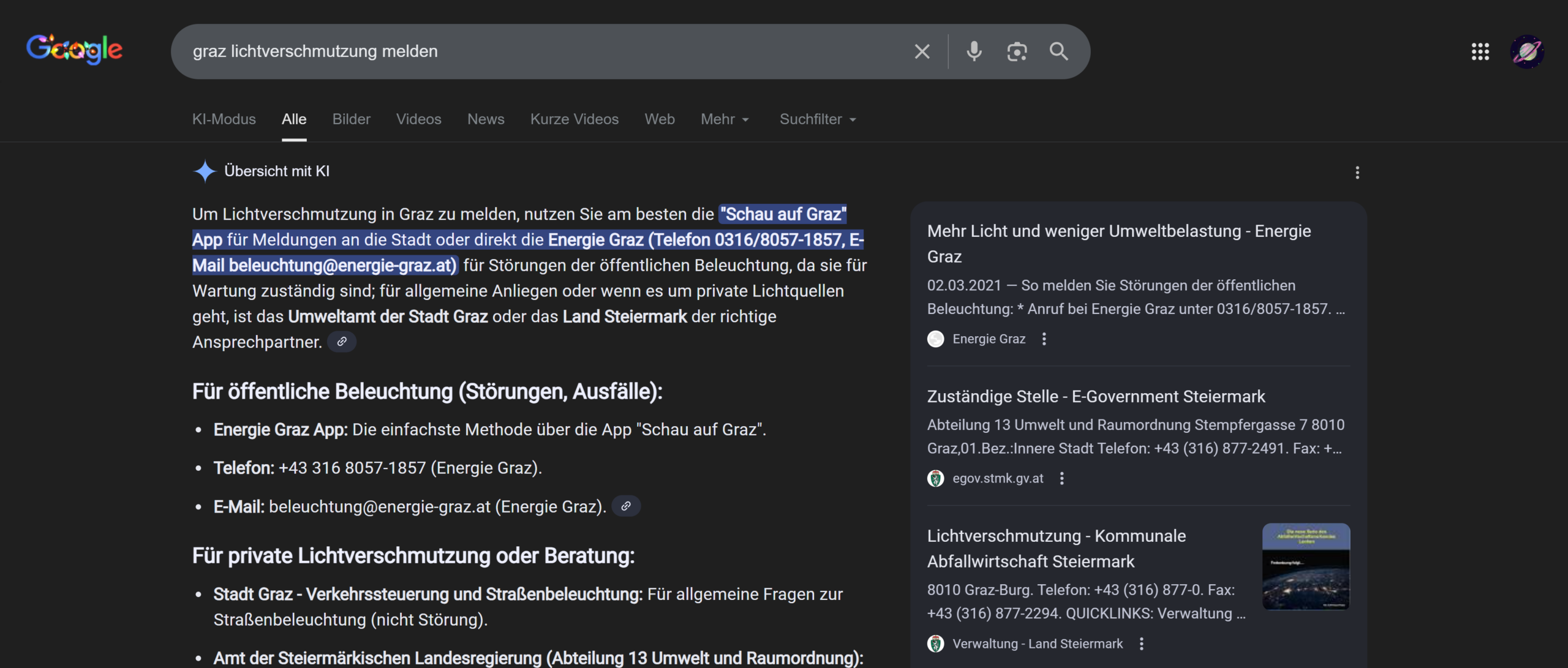
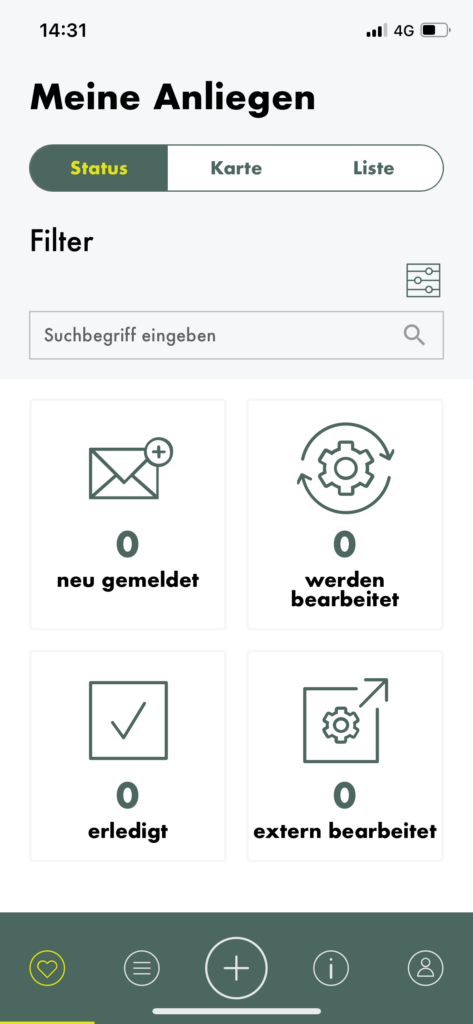
This week I researched ways to report faults in public lighting in Graz. First I used Google’s AI overview and then checked the information on various websites. The AI overview already gives a complete answer to the question: you can either contact Energie Graz, which manages the public lights in the city, or use the app Schau auf Graz (“look after Graz”).

Schau auf Graz is an Internet service that allows citizens to report problems and suggest improvements about public property, and there is also a section about lighting.

have been living in Graz for almost 3 months, but I had never heard of it and I wanted to know if I am the only one. I asked my colleagues from the Communication, Media, Sound and Interaction Design course how familiar they were with it. Out of the almost 30 people who answered, only 4 people from Graz/Styria knew it, the rest had never heard of it, including 2 people from Graz and surroundings. None of the people who are new in Graz knew the app. I reckon that it is a great way to improve public areas and think that it is a pity that it is not very common. I have never seen an ad about it, but I found it quite well hidden on the Stadt Graz website, under “apps of the city of Graz”.

I downloaded the app to see how it works and pretended I wanted to report a defect light in public space. I found the service to be quite easy to use and efficient, but some improvements could be introduced.

First of all, it is not easily accessible for foreigners living in Graz, because it is only available in German

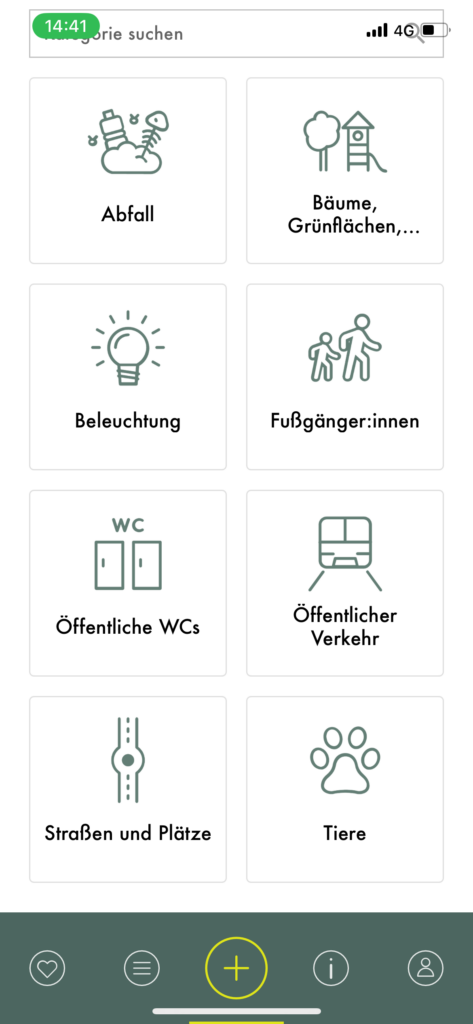
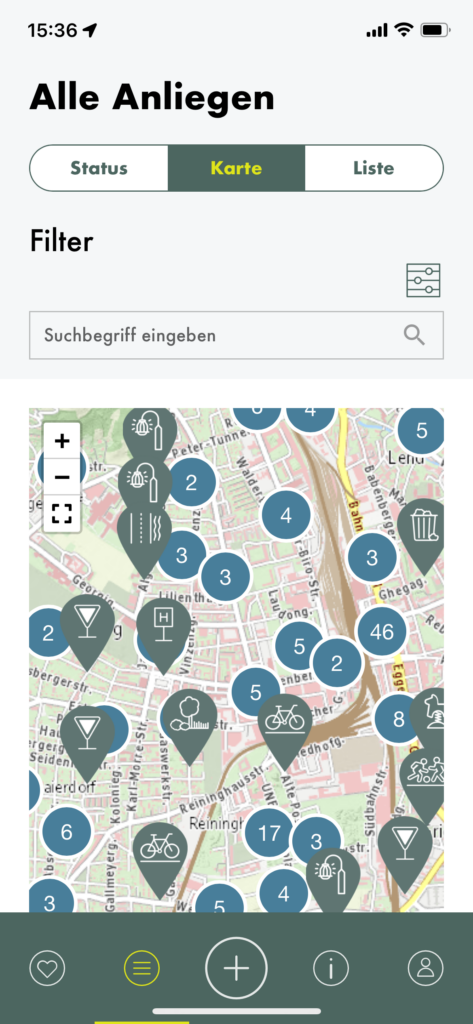
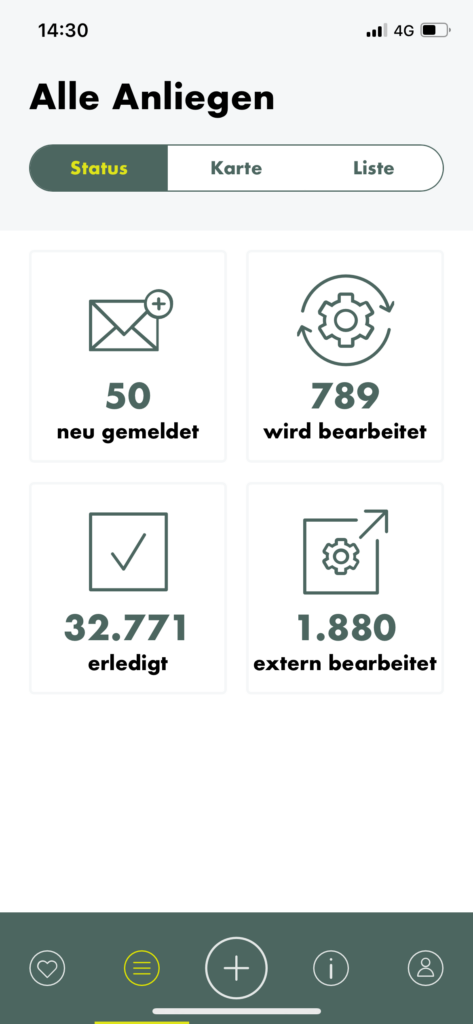
The navigation bar at the bottom creates 5 different sections, from left to right: my concerns, all concerns, new concern (the biggest and most important button), information and profile.

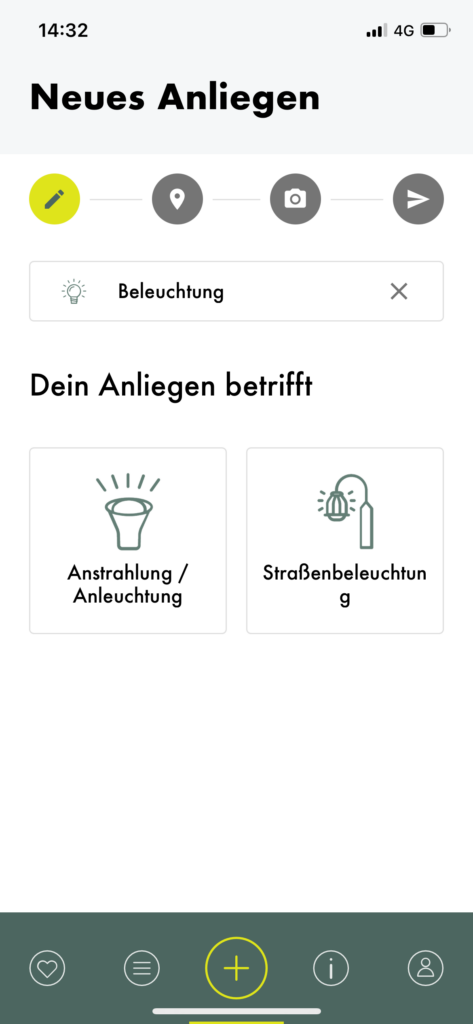
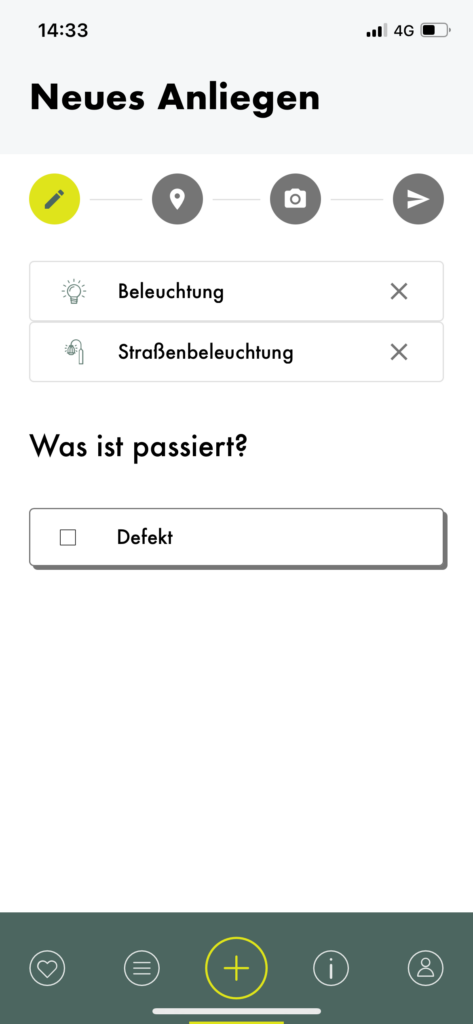
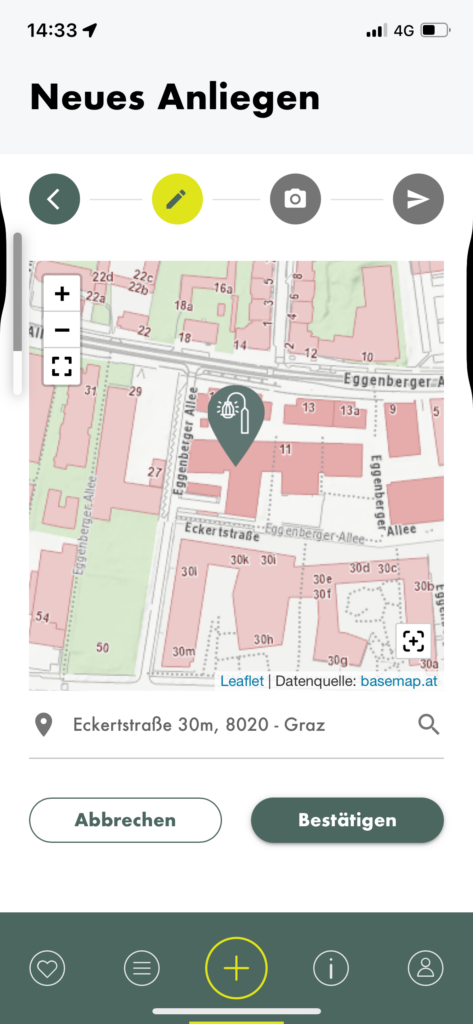
When creating a new concern, you can choose from various categories, one of which is “Beleuchtung” (lighting). I tapped on it and was then asked to choose what kind of lighting I wanted to report. I was confused about the difference between the two options, but a quick google search and a closer look at the icons made me realise that the option on the left regards lights that illuminate façades and the other one concerns lampposts, which illuminate the streets. After selecting one, I was asked to choose what I wanted to report, and “fault” was the only option to choose from. A status bar and some sort of breadcrumbs menu allows you to track the progress and go back if needed. The second step is choosing the location of the fault, then you are asked to submit a picture. After that the report is ready to be sent.

You can then check the progress of your query on the “my concerns” page. I also took a look at other queries and found it convenient that you can choose if you want to see their status, their position on the map or a list.

Case Study Review: Digital Products That Already Practice Slowness 5/10

How do Ubiquitous Computing and Calm Technology relate to the field of User Experience Design?

In my last blog post, I introduced the idea of calm technology. But what actually makes a technology feel calm? In their 1996 paper, Mark Weiser and John Seely Brown suggest that technology becomes calming when it:

  1. Places information in the periphery, letting us stay aware without being overloaded.
  2. Allows smooth movement from the periphery to the center of attention, giving us control when action or response is needed.

This balance increases awareness while keeping users in control, rather than dominating their attention. Designing for the periphery is therefore a key part of creating calm technology that genuinely supports people.

Weiser and Brown define calm technology through three characteristics:

  1. Smooth transitions between the center of attention and the periphery
  2. Expansion or Enhancement of peripheral perception and awareness
  3. “Locatedness”, which creates calm by fostering a connection to the environment enabling to act confidently within it

Technology feels calm when it works with, rather than against, the way human attention naturally functions. It empowers our periphery by quietly supporting awareness, giving more context and control without demanding attention. This creates a feeling of comfort, familiarity, and “being at home” in our environment. Technology achieves this calmness when it blends seamlessly into its surroundings and aligns with our expectations, allowing attention to flow uninterrupted. Just as grammar mistakes pull us out of a text or a rearranged kitchen disrupts the act of cooking, intrusive or poorly aligned technology breaks our focus. When technology preserves our flow of attention, it naturally feels calm.

How is Calm Technology connected to Ubiquitous Computing?

Both concepts are firstly introduced by Mark Weiser (and John Seely Brown). The early research on Ubiquitous computing inevitably led to the concept of calm technology. So both concepts are closely intertwined. Let me explain why:

Ubiquitous computing enables and requires calm technology at the same time. Once computers are everywhere, it will be crucial to consciously design interactions to ensure they do not overwhelm users. Calm technology is the design philosophy that ensures ubiquitous computing remains unobtrusive and supportive. At the same time, the fact that interactions with digital information can now take place anywhere creates an opportunity to design them in a more supportive way.

This means that ubiquitous computing is the technological vision, and calm technology is the human-centered design principle that guides how that vision should interact with people. They are intertwined because one sets the stage, and the other ensures it’s usable and fits with human needs.

How do Ubiquitous Computing and Calm Technology relate to Today’s field of User Experience Design?

Human Computer Interaction has evolved alongside the evolution of computing, which can be summarized in three stages. In the mainframe stage, computers were rare, expensive, and shared by multiple users. Interaction during this stage was driven primarily by technological possibilities rather than human capabilities. As computers became more accessible, the personal computing stage emerged, establishing one-to-one relationships between individuals and their machines. This shift brought technology closer to people and made user experience a central concern, moving the focus of interaction from the technology itself to the user.

In the following ubiquitous computing stage, people interact with numerous embedded computers throughout their daily lives, making calm technology not just desirable but necessary. The Internet has accelerated this evolution, raising questions about how pervasive technology may impact our environment and everyday experiences. In the state we are currently in, technology constantly competes for our attention. New technology is developed in a high speed and to keep up the pace user-tests are often skipped, resulting in bad user experience and usability (Monse-Maell, 2018). In response, many contemporary design trends have emerged, all based on the same underlying concept: Calm Technology. Within the design field, this idea is commonly framed in terms of attention and presence (Calm UXQuiet UXMindful UX), simplicity and reduction (Minimalist UXEffortless UXInvisible Design), spatial and peripheral interaction (Ambient UXPeripheral Interaction), and human well-being and pace (Well-being UXSlow Technology).

Sure you already heard of some of those terms and are familiar with the ideas behind it. They all come down to the same main idea. They take the philosophy of Calm Technology and translate them into concrete design practices. Calm Technology gives designers a philosophical and ethical grounding. The specification into one of those terms usually provides concrete methodologiespatterns, use cases and heuristics. That’s why it makes sense to engage with these fundamental ideas, as they form the basis for current design trends and shape much of today’s interaction design thinking.

Now that we’ve covered these fundamentals, I want to take a closer look at human–computer interaction and what types of interactions we can use to achieve calmer, more effortless technologies. In the next blog entry, I’ll explore how we intuitively understand how to use objects, how information is perceived in our periphery, and what this means for designing interfaces.

References:

AI Assistance Disclaimer:

AI tools were used to improve grammar and phrasing. The ideas, examples, and content remain entirely the author’s own.

Update: Why My Doomscrolling Experiments “Haven’t Worked” (Yet) 

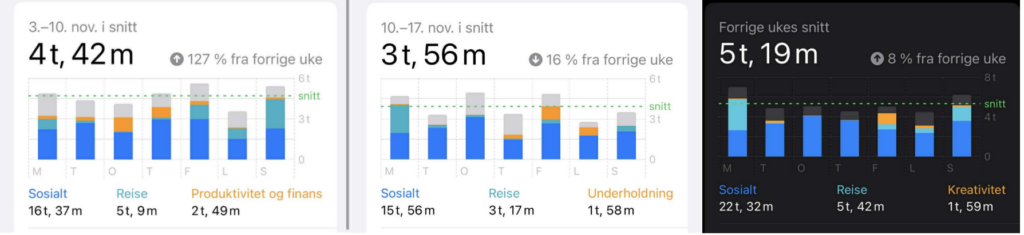
Since my last update, I’ve noticed that my screen time has actually increased during December, even though I’ve still been implementing, staying off my phone in the morning, 30-min dedicated scroll time, and time limits on certain social media apps. At first, this felt frustrating, but looking closer, the increase makes sense when I consider what the past few weeks have looked like. (The picture shows my screentime from the week before i started the experiment, the first week of experiments, and last week)

December has been dominated by exam stress, deadlines, and a heavy workload. Instead of using my phone less, I’ve often been using it more, particularly when I’m supposed to be working. Doomscrolling has become closely tied to procrastination. When schoolwork feels overwhelming, scrolling offers a quick way to avoid the discomfort of starting or continuing a task. The more pressure I feel, the easier it is to reach for my phone. 

Time limit: 

One week after setting time limits on my most-used social media apps, my average screen time initially went down by about 54 minutes. However, that change didn’t last. As stress increased, so did my tendency to ignore the limits. I would hit “ignore,” and keep scrolling, or switch to another entertainment app once I reached my limit. This was also reflected in my screen time categories, where “entertainment” replaced “productivity and finance” in the top three. Instead of reducing screen use, I was simply redirecting it. 

30 min dedicated scroll time:  

The 30-minute scroll time experiment has been especially difficult to follow during this period. When I’m calm and focused, setting boundaries feels manageable. But when I’m stressed or exhausted, doomscrolling shifts from being a habit to being a coping mechanism. In those moments, the goal isn’t entertainment or information, it’s distraction. That’s why the limits feel easy to ignore, the short-term relief of scrolling feels more important than long-term intentions. 

Learnings: 

This has made me realize that doomscrolling gets worse under pressure. Exam stress lowers my ability to regulate my behavior, and procrastination feeds into scrolling, which then increases stress even further. It becomes a cycle: stress leads to doomscrolling, doomscrolling leads to guilt and lost time, and that lost time creates even more stress. 

Although my screen time going up feels like a setback, it has actually helped me understand my behavior and doomscrolling more clearly. These experiments haven’t failed, they’ve shown me that technical solutions like app limits aren’t enough on their own in all cases. To truly reduce doomscrolling, I also need to address the stress and avoidance that push me toward it in the first place. 

I’m still not where I want to be with my screen time, but I’ll continue experimenting and reflecting on what works, especially once the exam period is over and my stress levels are lower. I’ll update again as I keep testing these tools and learning more about doomscrolling habits.