Evaluating survey about migraine

In the last post I created a short survey with the goal to find out more about the different individual experiences of migraine and gather more information about struggles and possible tools and solutions.

Participants

After creating the survey with nine questions on SurveyMonkey I shared it with people I know that also suffer from migraine with or without aura. During the peer review in class a fellow student told me that they could share this survey with a friend as well. So in total, I collected answers from six participants.

Evaluation of results

Visual aura

Half of the participants experience an aura, while one person just experiences it sometimes and one particpant doesn’t.
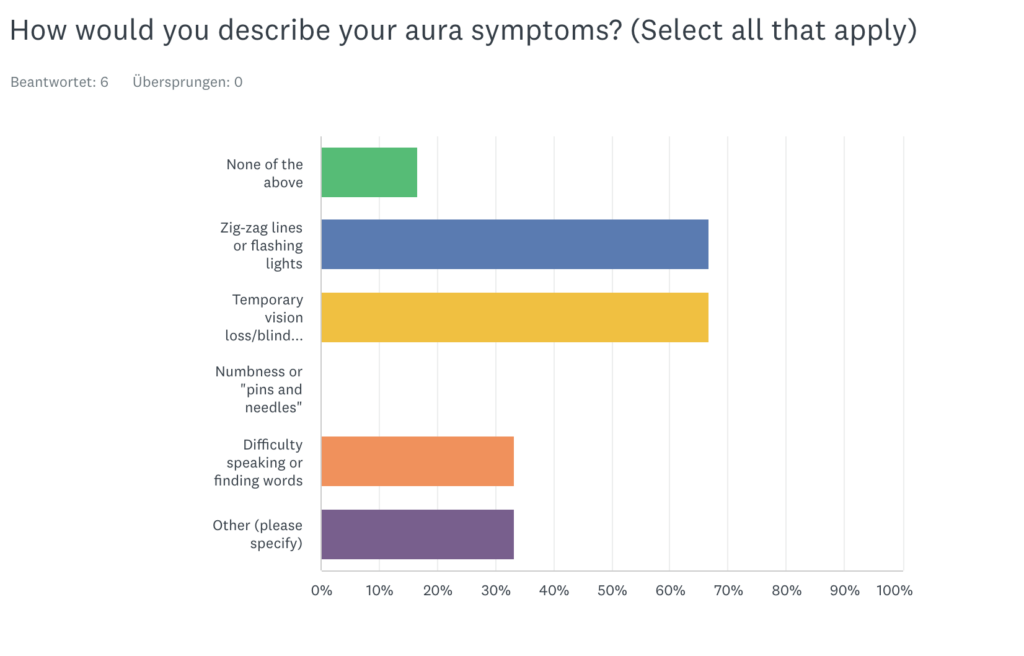
In this survey zig-zag lines or flashing lights and temporary vision loss e.g. blind spots are experienced by 67%. Difficulty speaking or and other symptoms were experienced by 33%. The two people responded with “Other” specified their answer in their own words. One of them mentionend that prior to their migraine led lights have a multiplier effect. If they see them during or after an tattack they see bright colors with something close to the shape of the tiny lights all over the place. Another response was they perceive a change of taste, a weird sensation in the mouth/saliva.

Biggest pain

The answers about the most difficult part of living with migraines show similiar topics. Some contestants stated that not being able to predict or control a migraine attack as the worst. Others mentioned the enduring headache pain or sufferment for two days. While other participants explained that feeling paralysed, uncapable physically and mentally and not being able to speak, think or work is their biggest pain point. One person also wrote that sleep is the only effective “medicine” for them although sleeping during an attack hurts.

Migraine prevention

Two people knew about the importance of regular meals and sleep routines. One person mentioned their diet. Two participants said that they try to drink lots of water and to take it slow and taking enough breaks. One also takes magnesium supplements. Another responded that they avoid strong lights such as cars at night while driving or the light of screens.

One person answered that they don’t do anything to prevent attacks anymore. They used to take pills especially for migraines as soon as they noticed the beginning of a migraine. But this wasn’t a guaranteed help.

Influenced life areas by migraine

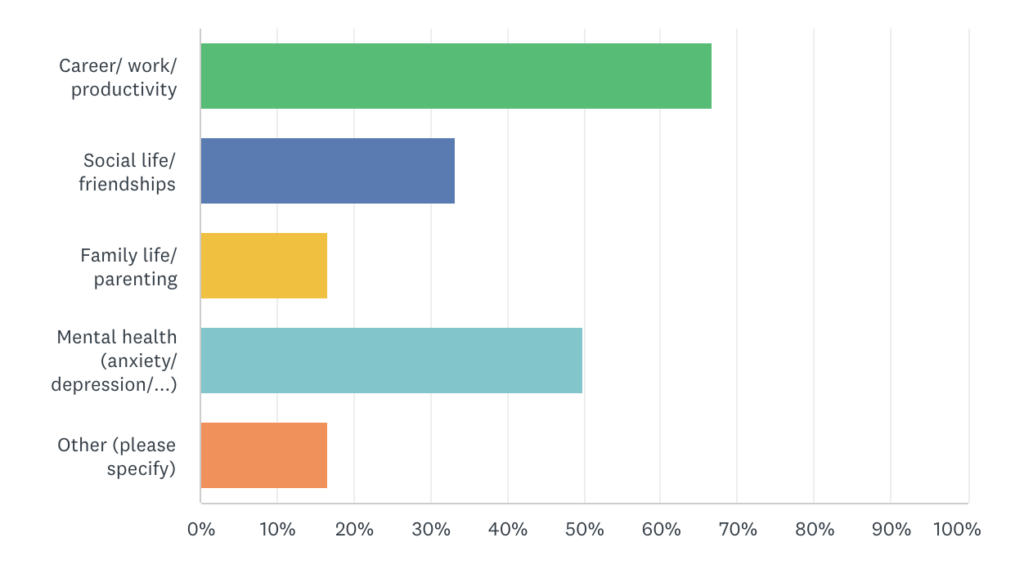
The area that was the majority of 66% of participants voted for is the career/ productivity. On second place is mental health, followed by social life and family life. One person specified their answer with “struggles and stress” although this could be generalized with the mental health area.
Migraine tracking

Four migraine patients don’t track any of their symtoms or pain days. One person answered that they used to but currently doesn’t and only one of the six participants actually uses an App called “Garmin connect”.

Feeling understood by non-migraineurs

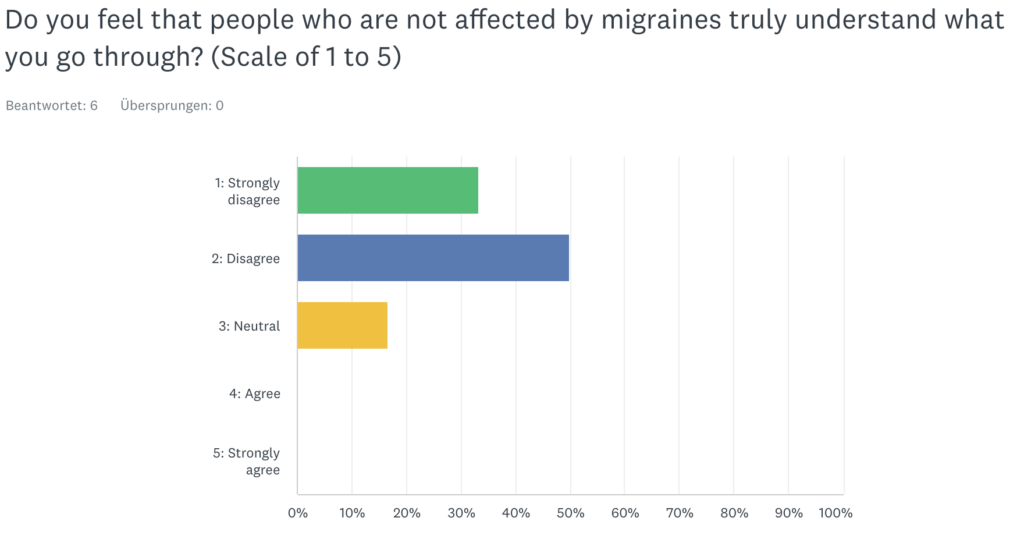
The majority doesn’t feel understood by people who don’t suffer from migraines. 50% answered with “disagree” and 33% with “strongly disagree”. One person gave a neutral rating.
However, 67% “strongly agreed” with the helpfulness of talking to migraineurs and 33% with “agree”. Showing that all of them appreciates sharing or listening to other people with migraine.

Preferred medium for a migraine aura simulation

The majority (83%) prefers an inmersive art installation for a simulation of migraine aura. Followed by VR on second place (50%).
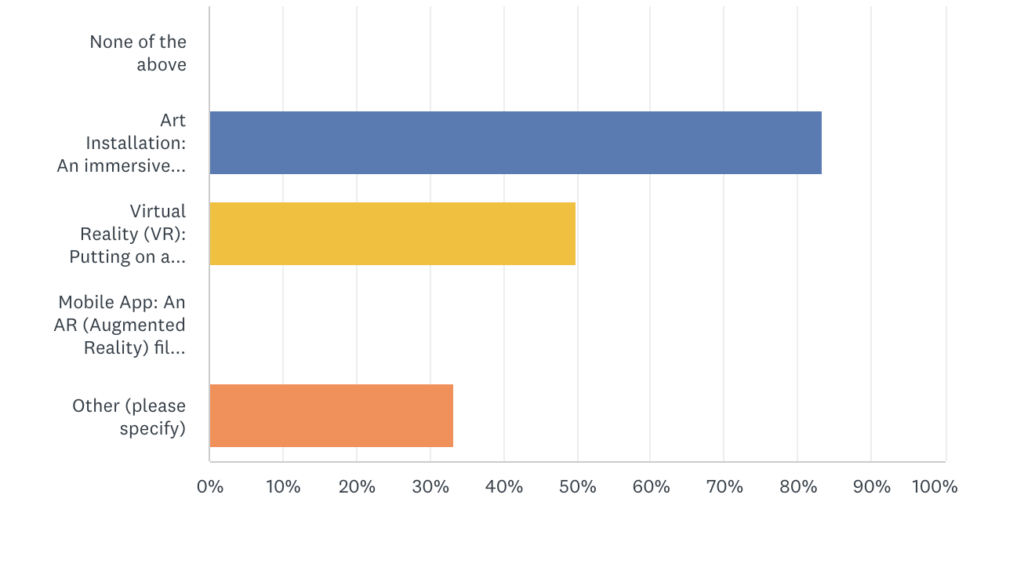
One person added a comment that they think it’s essential that the simulation could be experienced at random, unexpected moments like in a meeting, at school, at university, on a date or at an event.

And one migraine paitient responded that they would be afraid that these simulations would trigger an attack.

Interpretation of the results

The survey results highlight a significant “empathy gap” between migraineurs and society . While participants struggle most with the unpredictability and physical paralysis of attacks, they feel largely misunderstood by those around them who have never had an attack.

Besides, an interesting finding is that tracking methods (apps or Websites) are not used, suggesting a need for more seamless or rewarding monitoring.

All of the participants value peer-to-peer connection which could indicate that community-based solutions could be more effective than isolated self-management.

The high interest in an aura simulation, specifically one that mimics the unexpected timing of an attack, reflects a desire to communicate the loss of control that defines the condition.

Limitation of this survey

For future reserach more participants would have to answer the questions to offer significant quantitative results and to prove the mentioned findings.

Tool

I realized during the creation of the survey that the free version of the SurveyMonkey tool only offered nine questions and no questions with answers in Likert scale format. However, I found a way to work around these limitations and create a short version of my survey.

Die Geschichte darüber, wie ich mich auf die künstlerische Bühne bringen will ._. (Part 10. Fazit)

Im Laufe des Semesters wurde deutlich, dass Self-Branding ein vergleichsweise junges, aber zunehmend relevantes Konzept ist, das stark mit aktuellen gesellschaftlichen, wirtschaftlichen und medialen Entwicklungen verknüpft ist. Besonders im Kontext von Digitalisierung und Social Media hat sich Self-Branding von einer Strategie für Selbstständige und Künstler*innen zu einem allgemeinen Bestandteil beruflicher Positionierung entwickelt.

Zahlreiche Forschungsarbeiten zeigen, dass Self-Branding längst nicht mehr nur für Self-Employed oder Personen in kreativen Berufen von Bedeutung ist. Auch Bewerberinnen im klassischen Angestelltenverhältnis profitieren davon, da Arbeitgeberinnen verstärkt auf persönliche Profile, Online-Präsenzen und individuelle Außenwirkungen achten. Die eigene Darstellung wird somit Teil der beruflichen Qualifikation und kann neue Türen öffnen.

Ein weiterer zentraler Aspekt ist das Vertrauen, das durch Personal Branding aufgebaut werden kann. Menschen neigen dazu, sich stärker mit anderen Menschen als mit anonymen Marken zu identifizieren. Ein klar erkennbares Gesicht, eine konsistente Haltung und eine nachvollziehbare Geschichte schaffen Nähe und Glaubwürdigkeit – besonders dann, wenn ein Produkt, eine Dienstleistung oder eine künstlerische Arbeit vermittelt wird. Self-Branding kann hier als Schnittstelle zwischen Person, Werk und Publikum fungieren.

Gleichzeitig bringt dieses Konzept jedoch auch wesentliche Herausforderungen mit sich. Ein häufig diskutiertes Problem ist die Frage der Authentizität. Die bewusste Inszenierung der eigenen Person birgt die Gefahr, eine konstruierte oder verzerrte Identität zu präsentieren, die nicht (mehr) dem eigenen Selbst entspricht. Die Grenze zwischen strategischer Selbstdarstellung und Selbstverfremdung ist dabei oft fließend. Besonders im digitalen Raum kann der Druck entstehen, Erwartungen zu erfüllen, anstatt sich ehrlich zu positionieren.

Die Analyse der Künstlerin Ellen Sheidlin verdeutlicht diese Dynamiken auf exemplarische Weise. Ihr Werdegang zeigt, wie Self-Branding – ursprünglich über Social Media und einen YouTube-Kanal aufgebaut – als Einstiegspunkt für eine künstlerische Karriere dienen kann. Durch eine starke persönliche Präsenz und Reichweite gelang es ihr, Aufmerksamkeit zu generieren, Kollaborationen einzugehen und schließlich mit Galerien zusammenzuarbeiten. Dieses Beispiel macht sichtbar, wie Self-Branding nicht nur Sichtbarkeit schafft, sondern auch als Brücke zwischen digitaler Selbstinszenierung und professioneller Anerkennung im Kunstfeld fungieren kann.

Zusammenfassend lässt sich festhalten, dass Self-Branding ein ambivalentes, aber wirkungsvolles Instrument ist. Es bietet große Chancen in Bezug auf Sichtbarkeit, Vertrauen und Vernetzung, erfordert jedoch zugleich ein hohes Maß an Reflexion. Besonders im Design- und Kunstkontext stellt sich die zentrale Frage, wie eine authentische Identität kommuniziert werden kann, ohne zur reinen Marke zu werden. Genau in diesem Spannungsfeld liegt das kreative und forschungsrelevante Potenzial von Self-Branding.

See you in SS26! 🤗

[DesRes 1] Agile_x_SelfCheckout No. 10: Next Steps

No. 10: Next steps

After one semester I’m still happy with my chosen topic, or rather say topics (plural). I still believe that my thesis will make sense by combining the agile topic with the use case of cash registers. As one might already tell, simply by looking at blog entries, I had some struggle outlining and combining these two perspectives. Overall I think the working title Agile_x_SelfCheckout is a good approach to sum up what I’m working on.

Dividing the topics more clearly

For the future I have decided to cover each topic separately in my research. So for example in the first half of the next semester I will cover the “agile” perspective, and in the second half it will be all about the findings concerning the cash registers.

Collaboration with REWE Digital

I have started my student job at REWE Digital some weeks ago. I already have a better perspective now on my responsibilities at work. The biggest benefit of collaborating with this company is that I have the access to the test systems and could perform detailed user tests, even including pseudo payments.

Disclosure and sensitive information

As for the blog entries this means that I have to be really careful about what information I am allowed to include in each entry. I have to make sure not to expose disclosed information that is to be kept a secret within the company.

Self Checkout or Served Solutions

So far I have put a lot of focus on self checkout solutions. However, it depends on my specific tasks and goals as an employee of REWE digital, which prototypes I will get to work on.

One things remains: whatever artifact I will be working on, I know that I will have the possibility to cover something relevant to the whole service design process.

Accessibility?

The topic of accessibility remains my biggest concern. I would love to cover it, but once again, due to the possibilities within my employment, it still needs to be decided wether or not, this is a relevant topic or not.

Next Semester

I am looking forward to continuing working on this project and increase my expertise concerning agile project management, as well as getting a better understanding of the struggles users of both served as well as self checkout registers are exposed to.

I will kick off the next semester by adapting my research question to open more possibilities.

[DesRes 1] Agile_x_SelfCheckout No. 9: Mental Models & Informal User Research

Mental Models

Mental Models are a powerful way to describe what is going on inside user’s brains. It gives us more cues about how they perceive certain things so we can empathize with their experiences [1]. Viable cues concerning mental models can be identified via different methods. A popular one is card sorting, it is especially relevant for challenges concerning information architecture. Furthermore, we can get a better understanding of user’s processes by observing how they interact and act in their current environment. Specifically in the grocery and retail context so called “PLU-lists” are a major artifact.

PLU-List

Every customer of a supermarket has already been exposed to this code – wether they know it or not. A PLU number is an international code, that defines products like fruits and vegetables. The PLU code for a banana typically begins with the number 4. Additional information, like country of origin of the product can also be identified through this code. Sometimes employees know this number, or at least specific selected numbers, by heart. In case they have to look it up, they have to take a look at a list – this is also where the name stems from: PLU stands for price-look-up code. [2]

Possibilities for informal user research with high value and impact

I’m aware this might be a bold move, but I believe that a lot of online forums, especially via reddit, can be an interesting way to observe user’s and customer’s behaviour. This works for both – in a market research as well as a design related user research way. While this is obviously an informal way of researching something, I strongly believe it is of high value. It gives you first hand impressions of customers, and possibly even employees.

Subreddit “Target”

Down below I have found a picture, this is an example from Target that I found via Reddit. It was attached to a post, where an employee reached out to the forum in the r/Target subreddit, because they were curious about which codes are popular and commonly used.

Source: Reddit | r/Target | User: csrlrnz

Subreddit “schei**aufnbilla”

While this subreddit has a rather extrem title, it definitely opens a new horizon concerning honest opinions of angry customer’s.

Reviews

In contrast to reddit google reviews covers a larger range of customers. Clicking through various stores on google maps quickly gives you a good overview of different challenges customers and sometimes even employees face. This works efficiently via google maps, because they also give you options to filter the different reviews (e.g. by keywords)


Sources

[1]

M. Chan, “Mental Models and User Experience Design,” Nielsen Norman Group, Jan. 26, 2024. https://www.nngroup.com/articles/mental-models/

[2]

Bayerischer Rundfunk, “Lebensmittel Code entschlüsseln: Was bedeutet der PLU-Code auf Lebensmitteln?,” Www.br.de, Mar. 11, 2024. https://www.br.de/radio/bayern1/lebensmittel-code-entschluesseln-100.html (accessed Jan. 30, 2026).

[DesRes 1] Agile_x_SelfCheckout No. 8: Agile and User Stories

While fonts and color choices are important to take into account, service design puts process and problems into deeper perspectives. Requirements and processes are strategically challenged, to align with business values. Therefore, the problem definition in service design outlines the user experience as well as other perspectives and puts employees, customers and other counterparts into relation.

In a supermarket this means all things from the back office and warehouse to the retail space as well as the cash registers have to be considered.

A powerful tool within the practice of service design is the so called Service Blueprint. I personally would describe a service design map as an extension of a user journey map. The fronst stage processes (1) describe all the steps that the customers can directly observe (e.g. scanning of articles). Back stage actions (2) highlight how the fronst stage steps are interfering and how they relate to what’s happening out of the customer’s sight. The line of invisibility (3) visually divides these two perspectives. Another mentionable part of a service blueprints are so called artifacts (4), also known as physical evidences (e.g. a receipt).


[1]

M. Stickdorn, A. Lawrence, M. Hormess, and J. Schneider, This is service design doing, applying service design thinking in the real world: a practitioners’ handbook. Sebastopol Oreilly & Associates Inc, 2018.

The remembrance of the dead pt.3

Famadihana

The Merina people observe two types of rites of passage: the initial funeral and the famadihana ceremony. The funeral must take place within three days of death and is the responsibility of the local community where the deceased lived. The famadihana, however, occurs at least two years later and involves the dispersed family. The initial funeral is considered less significant than the famadihana, as there is little time to gather money or family members. As a result, only local relatives and neighbors are usually present.

The corpse may be buried in the ancestral tomb or temporarily interred in the ground. Ancestral tombs cannot be opened more than once a year, and those who die from highly contagious diseases cannot be placed in the tomb until their flesh has fully decomposed, hence the need for temporary burial. Additionally, family tombs are more expensive than temporary graves.

When a death occurs, the family immediately prepares the house: the main room is tidied or completely cleared, and clean papyrus mats are laid on the floor. The northeast (the most valued) corner of the room is curtained off with mats to create a small enclosure for the body. After being prepared and wrapped in plain cotton cloth, the body is placed here. These preparations are completed by household members before the death is announced to outsiders. Once the news is shared, women from neighboring villages bring water and firewood to the bereaved household and help prepare the funeral meal.

On the morning of the funeral, the body is placed in a hastily made coffin. It may be taken to a church before being transported to the tanindrazana (family tomb) or buried in the village where the death occurred. The atmosphere of the funeral is somber and quiet, marked by sadness and mourning.

The famadihana ceremony can only take place between July and September, the period of least agricultural activity. Since the date is chosen in advance, families can save money for a larger ceremony and ensure that dispersed relatives can attend. During the famadihana, the body is exhumed and wrapped in finely woven, brightly colored silk sheets known as lamba mena.

Harris, C. C., & Bloch, M. (1972). Placing the Dead: Tombs, Ancestral Villages and Kinship Organization in Madagascar. British Journal of Sociology, 23(4), 500. https://doi.org/10.2307/588339

Obon

Buddhism teaches that the existence of all sentient beings is marked by impermanence. All beings within the six realms of existence are bound to an endless cycle of arising, changing, passing away, and being reborn until they achieve liberation, or Nirvana. This ultimate goal can only be attained by letting go of all attachments and desires and embracing a true understanding of the Buddha’s teachings. Rebirth occurs in one of the six realms, determined by the karma accumulated in previous lives and during one’s current existence.

In Japanese popular belief, the mid-summer harvest season is a time when ancestral spirits return to visit the world of the living. This occasion, known as Obon, is marked by deep respect and elaborate rituals. In many households, decorations made from cucumbers and eggplants are displayed. The cucumber figures resemble swift horses, symbolizing the spirits’ quick arrival, while the eggplant figures depict slowly trotting cows, guiding the spirits back to the netherworld. In coastal or riverside areas, floating lanterns or spirit boats are used to send the ancestral spirits home. If a family member has passed away in the previous year (hatsubon), special care is taken to honor the new spirit with proper rites and attention. Family, friends, and neighbors gather to build a shōrōbune (spirit boat). These boats reflect the individual preferences of the deceased, and modern versions may take the form of buses, carriages, cars, or even rockets instead of traditional sailing ships. Each vehicle bears the name, family crest, and often a photo of the deceased. The sails are typically adorned with images of Amidha Buddha, Kannon, or lotus flowers, expressing the hope that the deceased will avoid Gaki-dō (the realm of hungry ghosts) and instead await rebirth in the Western Paradise or Pure Land.

In early August, on the first day of Obon, graves are cleaned and decorated. At home, a special spirit shelf (bondana) is set up, holding the ancestor’s mortuary tablets (ihai), along with offerings of flowers, fruits, sweets, and vegetables. The shelf is decorated with photographs of the deceased and special lanterns. Seasonal dumplings and sweets are prepared and offered to the visiting spirits. A monk is invited to chant sutras, and preparations for building the shōrōbune begins. On the 12th of the month, fireworks go on sale, and cemetery visitors and spirit ship crews stock up on ammunition for the event. The 13th marks the day the ancestors return home. Cemeteries are visited again, and in Nagasaki, families gather for a lively picnic at the graveside, followed by fireworks in the evening. Many local graveyards are equipped with stone benches to accommodate the assembled family members. The gathering continues at home, where food, drinks, and stories about the deceased are shared in the company of the ancestral spirits (go-senzo-sama). On the 14th, the spirits are served three vegetarian meals, such as Sekihan (red bean rice), Sōmen noodles (thin Japanese wheat noodles), or Inarizushi (sweet tofu pouches). For hatsubon, family and friends complete the spirit boats for the return parade. On the 15th, the spirits depart for the netherworld. At home, extra food and okuri dango (rice dumplings) are laid out as provisions for the spirits, both related and unattached (gakijoro-sama). The parade then begins.

Nagasaki’s hilly terrain makes the parade a physically demanding event, often accompanied by generous amounts of food and drink, including alcohol. As the spirit boats are pushed through the streets, Chinese gongs and bells ring out, and firecrackers (bakuchiku), loud multi-break shells (rangyoku), and fire arrows (yabiya) are set off. The crowd chants “doi doi,” a dialectal abbreviation of the Nembutsu prayer. To minimize traffic disruption, the shōrōnagashi (spirit boat parade) now starts at noon and ends around 11:00 PM, whereas it previously began after midnight and lasted until dawn on the 16th. After the parade, the spirit boats were once left adrift at sea, but today, they are disposed of by the city. Finally, homes and graves are cleaned, remaining fireworks are set off, incense is lit, and farewells are bid until the following year.

MARRA, C. (2023). The two O-bon-festivals in Nagasaki-celebrating the bonds between the living and the dead. In ANNALS OF “DIMITRIE CANTEMIR” CHRISTIAN UNIVERSITY: Vol. XXII

Alles wird beworben. Warum nicht auch der Schulunterricht?

Werbung ist aus unserem Leben nicht mehr wegzudenken. Jede Firma, Institution und jedes Produkt, das etwas auf sich hält, bewirbt sich. Kein Medienkanal ist mehr vor Werbung sicher. Hinter Werbung steckt viel Strategie, geplante Mechanismen, um Aufmerksamkeit zu erhaschen und ganz genaue Recherchearbeit. Eine gute Werbung soll die Zielgruppe nicht bloß auf die Verfügbarkeit eines Produktes oder einer Dienstleistung hinweisen, sondern auch zum Kauf motivieren.

Ich, als Designerin/Lehrerin Hybridwesen, hatte einen Gedankenblitz: Warum setze ich diese aufmerksamkeitserhaschenden Werbestrategien nicht gezielt für den Schulunterricht ein. Nur anstatt zum Kauf, sollen Schüler:innen zum Lernen motiviert werden.

Aufmerksamkeit didaktisch nutzen

Werbung schafft es in Bruchteilen einer Sekunde Aufmerksamkeit zu ziehen, so entsteht auch die Wirkung der Werbung. Möchte man diese Wirkung auch für den Unterricht erzielen, sollte der Einstieg in ein Stoffgebiet so gestaltet werden, dass er aus der Routine heraussticht. Also kein „heute lernen wir über das Thema…“, sondern ein irritierender Impuls, eine provokante Frage, ein starkes Bild. [1]

Wie wäre es, den Unterricht mit einer überraschenden Anekdote zu starten, die scheinbar nicht zum Thema gehört, aber Neugierde auslöst. Oder eine offene Frage, ein Rätsel, ein Mysterium wird in den Raum gestellt und erst am Ende des Kapitels aufgelöst. Diese Form der inszenierten Irritation wird in der Werbung gezielt eingesetzt, um Aufmerksamkeit zu erlangen, bevor der eigentliche Stoffinhalt präsentiert wird. Im Unterricht wird hierdurch ein kurzer Zeitraum geschaffen, in dem alle Schüler:innen wirklich zuhören. Eine Basis für ein vertieftes Lernen wird geschaffen. [1]

AIDA (nicht das Kreuzfahrtschiff oder die Oper von Verdi)

Wer sich schon einmal mit Werbestrategien und Modellen auseinandergesetzt hat, kennt das AIDA-Modell (Attention – Interest – Desire – Action). Es beschreibt, wie Werbung vom ersten Betrachten zur Handlung führt. Das Modell lässt sich in den Unterricht und die Schulliteratur übertragen, in dem diese/r in die vier Phasen geteilt werden. Man fängt also mit einem aufmerksamkeitserhaschenden Start an (siehe oben), vertieft dann das Interesse der Schüler:innen, dann kommt die „Habend wollen“-Phase, und am Ende soll zur Aktivität angeregt werden. [2]

In der Praxis könnte das so aussehen: Ein Thema wird durch einen irritierenden Impuls eingeleitet, sei es nun eine Anekdote, ein Bild oder eine spannende Frage. Dann wird das Thema interessant gemacht, in dem es mit der Lebensrealität der Schüler:innen verknüpft wird. Praxisnahe Beispiele werden genannt, damit sich mit dem Thema identifiziert werden kann. Danach wird erklärt, warum das Thema wichtig ist. Entweder durch ein eigenes Projekt oder eine Debatte. Und am Ende wird zur Handlung aufgerufen. Eine Aufgabe soll erfüllt werden, die Schüler:innen sollen selbst zu Inhalten des Lernkapitels Videos, Poster, Präsentationen etc. gestalten. Die Schullekture bzw. der Unterricht orientiert sich so nicht nur an den Fachinhalten, sondern hat eine eigene Dramaturgie. In der Werbung nennt man das die Kampagnenplanung.

Dramaturgie ist ein guter Stichpunkt…

Wie bereits in meinen anderen Blogartikeln erwähnt, ist Storytelling ein wichtiges Tool, um Aufmerksamkeit der Rezipient:innen zu halten. Inhalte, die in Geschichten verpackt sind, können dadurch emotionale aufgeladen werden und bleiben besser im Gedächtnis hängen. Auch in der Werbung wurde dieses Prinzip bereits erkannt. [3]

Gamification zur Motivation

Ein häufig eingesetztes Element in der Werbung ist Gamification: (Rabatt)Punkte sammeln, Ranglisten, Challenges, Belohnungen. In bestimmten wirtschaftspädagogischen Studiengängen wurden diese spielerischen Elemente bereits verwendet und auf Eignung für den Unterricht geprüft. [4] Es zeigt sich, dass dadurch Motivation zum Lernen durchaus gefördert werden kann. Studien dazu [5] sagen aus, dass Lernende in Hochschulkurses durch Einbeziehung von Gamification erhöhtes Interesse aufweisen. Zudem steigt die Anwesenheitsquote, die Aufmerksamkeit und die Teilnahme an. [5]

Werbe-Mechaniken, wie das Sammeln von Punkten können im Unterricht eingesetzt werden, z.B. durch das fertigstellen von Aufgaben. Diese Spiel-Elemente bieten viele verschiedene Möglichkeiten die Lernenden zu fördern, bieten ihnen Herausforderungen und können vielfach eingesetzt werden. Dabei ist aber darauf zu achten, dass für Schüler:innen nicht der Wettbewerb im Fokus steht. Dieser könnte von den eigentlichen Lerninhalten ablenken. Ziel ist es die Motivation für das Lernen zu fördern, nicht für das Gewinnen. [4]

Aber Achtung: Immer kritisch bleiben!

Werbemechanismen zeigen also gute Strategien, die für die Aufbereitung vom Lernstoff verwendet werden können. Dabei sollten diese Mechanismen jedoch nicht unreflektiert bleiben. Dietrich Röder erklärt in seinem Artikel „Wie funktioniert Werbung im Unterricht“ [2], dass eine Analyse der Werbestrategien als effektive Lernmethode das analytische Denken, sowie die Teamarbeit und die Kommunikationsfähigkeit der Schüler:innen fördern kann. Zusätzlich bietet eine Auseinandersetzung mit dem Thema ganz viel Potential für neue Aufgabenstellungen. In kreativen Projekten könnten Schüler:innen die Werbetheorie in die Praxis umsetzen und Werbebanner, Videos oder Plakate erstellen. [2]

Quellen:

  1. Ad Alliance(2023): Aufmerksamkeit als zentraler Hebel für mehr Werbewirkung. In: Screen Force, https://www.screenforce.de/studie/aufmerksamkeit-als-zentraler-hebel-fuer-mehr-werbewirkung (zuletzt abgerufen am 28.01.2026)
  2. Röder, Dietrich(09.08.2025): Wie funktioniert Werbung im Unterricht? Effektive Methoden für Lehrer. In: matheblatt.de, https://matheblatt.de/wie-funktioniert-werbung-im-unterricht-effektive-methoden-fur-lehrer (zuletzt abgerufen am 28.01.2026)
  3. Lindsberger, Martina/Redaktion CONEDU(25.08.2022): Storytelling als Methode in der digitalen Erwachsenenbildung. In: erwachsenenbildung.at, https://erwachsenenbildung.at/digiprof/neuigkeiten/17215-storytelling-im-bildungskontext-foerdert-die-beteiligung.php (zuletzt abgerufen am 28.01.2026)
  4. Sailer, Sabrina (19.11.2021): Badges, Levels, Leaderboards: Gamification zur Motivation Studierender der Berufs- und Wirtschaftspädagogik in selbstgesteuerten und kollaborativen Lern-Settings. In: bwp@ Berufs- und Wirtschaftspädagogik – online, Ausgabe 40, S. 1-20. https://www.bwpat.de/ausgabe40/sailer_bwpat40.pdf (zuletzt abgerufen am 28.01.2026)
  5. Barata, G./Gama, S./Jorge, J. A. P./ Goncalves, D. (2015): Gamification for smarter learning: tales from the trenches. In: Smart Learning Environments, 2, H. 1, S. 1-23

Final Post: Process reflections & recap

Process reflections

It has been a difficult task to do research and write weekly blog posts. I have previously been more used to a scientific paper based approach to research, where you take your time to lay out a plan first before worrying about producing an output. As I am used to this process taking time, I now felt more rushed to figure out the direction of where I am going, how I would do it etc. each week. This often left me feeling paralyzed, procrastinating, leaving the work to the last minute. I found myself not producing anything helpful, neither for me or others reading the blog posts later. 

Coming from a university with less modules and lectures to focus on also made this shift difficult in balancing and managing the workload of the different modules. This in turn affected the blog post, which often fell at the back of my head. With this in mind I take with me the importance of laying out a temporary plan for what research methods one thinks would be fitting for the topic and focusing on one thing at the time. Swapping topics also led me to having to start all over and it was limited what I was able to do with the short amount of time with each, although I could definitely have dug a little deeper.

I believe I could have done research using more varied methods than simply looking at previous research, surveys, analysing and some of my own thoughts and experiences. For example some interviews, user testing, maybe try to create some user journeys to see where changes could’ve been made. 

Recap

To summarize what the previous blog posts consisted of, we know that EBSN connects people through activities rather than direct matchmaking. This we can see in Meetup, an EBSN that prioritizes events and groups over individual connections and has limited personalization of your profile. With the previously mentioned loneliness epidemic I see EBSN or matchmaking applications being a potential helper in battling this epidemic. However, it feels as if the matchmaking applications are often not encouraging real meetups, but just there to offer another game to play. While the EBSN has a more community and event focus, rather than individual connections. I believe one needs to work on bridging the gap between the offline and online world, and by lowering the stress and tempo of the individual connection to let people connect on a deeper level.