*4 Beispiele von Kinderbüchern zum Thema Beeinträchtigung & Inklusion

Es gibt schon einige tolle Bücher zum Thema Inklusion und Vielfalt und im heutigen Blog möchte ich ein paar davon vorstellen: 

*Lilly gehört dazu

„Lilly gehört dazu“ ist ein Kinderbuch, geschrieben von Irmgard Portman und ist ab vier Jahren. In diesem Buch wird von der kleinen Lili mit Downsyndrom und ihrer großen Schwester erzählt. Das Buch berichtet aus der Sicht der Schwester und schildert, wie schön es ist eine Schwester zu haben. Zudem wird dargestellt, dass Liebe nicht an Können oder Leistung gemessen wird. Dieses Buch ist in einfacher und altersgerechter Sprache verfasst und mit bunten Illustrationen ergänzt. 

*Ich bin Mari 

In dem Buch „ich bin Mari“, geschrieben von Shari und André Dietz erzählt Mari, ein Mädchen mit Angelman-Syndrom, ein Gendefekt, bei dem die Sprache und Bewegung eingeschränkt sind, von ihrem Leben. Es wird ihr Alltag beschrieben, und wie Mari ihre Gedanken und Wünsche mit Gesten, Tablet und Lauten beschreibt. Zudem werden Situationen, wie zur Schule gehen, tanzen, schwimmen und das Einkaufen erzählt, aber auch von ihren Herausforderungen wie den Schmerzen, epileptischen Anfällen oder Blicken von anderen Personen. Dieses Buch thematisiert in einer altersgerechten Sprache Themen wie Schielen, Lautäußerungen oder den Rollstuhl. Mit Illustrationen wird diese Geschichte zum Leben erweckt.  

*Wir sind wunderbar verschiedne

Dieses Buch für Kinder ab fünf Jahren zeigt wie vielfältig das Leben sein kann. Hier lernen sich Kinder in der Schule kennen und entdecken nach und nach die Unterschiede und Gemeinsamkeiten ihrer Freund:innen und deren Familien. Tracy Turner beschreibt hier Themen wie Herkunft, Talente, Träume, Gefühle oder besonderer Beeinträchtigungen und zeigt dass Unterschiede kein Hindernis für Freundschaften sind.  

*Linus liebt Licht 

In diesem Buch wird darüber geschrieben, wie Linus, ein autistisches Kind seinen Alltag lebt und wie sich Stimming bei ihm zeigt. Stimmig ist die Abkürzung für selbststimulierendes Verhalten und beschreibt seine bestimmten Routinen oder Bewegungen, welche ihm dabei helfen sich zu beruhigen oder zu konzentrieren. In diesem Buch wird nicht nur Kindern, sondern auch Erwachsenen auf eine einfühlsame Art und Weise gezeigt, was Stimmig bedeutet und warum das in Linus seinem Alltag eine bedeutende Rolle spielt. Geschrieben wurde das Buch von Anna Mendel und Jasmin Sturm. 

*Momo ist alles zu viel 

In diesem Buch, ebenfalls geschrieben von Anna Mendel und Jasmin Sturm wird erneut das Thema Autismus aufgegriffen. Jedoch erzählt dieses Buch von den Situationen, in denen Momo alles zu viel, zu laut, zu stressig oder zu schmerzhaft wird. Es wird gezeigt, wie Momos Umfeld auf seine Überreizungen reagiert und wie man ihn in solchen Situationen unterstützen kann. Auf eine verständnisvolle Art wird erklärt wie man auf die Bedürfnisse von Autist:innen eingeht.

*Als Ela das All eroberte 

In dem Buch, geschrieben von Adina Hermann und Raul Krauthausen will Ela als Astronautin das All erobern, aber nicht alle glauben dass sie das schaffen wird, weil Ela im Rollstuhl sitzt. Jedoch wird Ela von ihrem besten Freund Ben und Onkel Micha so unterstützt, dass sie lernt an ihre Träume zu glauben und Wege findet wie sie diese wahr werden. Diese Geschichte ab fünf Jahren soll Kinder ermutigen und dazu motivieren dass jeder seine Träume erreichen kann. 

*Wilma Wolkenkopf

In diesem Buch von Saskia Niechzial und Lara Hacker erzählt Wilma von ihren kleinen oder großen Abenteuern aus dem Alltag und dass wir alle besonders sind. Auf einfühlsame Art und Weise wird ADHS in diesem Buch thematisiert.

*Wir gehören alle Zusammen

In diesem Buch geht es um ein tolerantes Miteinander und eine barrierefreie Welt. Das Buch erzählt eine Geschichte von Mira, Kopernikus und MC Pieps die an einem Sommertag einen Igel im Rollstuhl kennenlernen. Auf eine spielerische Art und Weise thematisiert das Buch dass „Normal“ nur ein Wort ist und klärt über ein respektvolles Miteinander auf und darüber, wie Barrieren überwunden werden. 

*Mimis Kunterbunte Welt

„Mimis Kunterbunte Welt“, geschrieben von Ulrike Haas und Nicola Boyne thematisiert in einem detailreichen Wimmelbuch ab einem Jahr eine vielfältige Welt. Mimi zeigt in dem Buch ihre Lieblingsplätze und Freund:innen, wie Toni im Prinzessinnenkleid, Ali von der Feuerwehr oder Freddy mit seinem Papierflieger. Dieses Buch spiegelt die Vielfalt der Gesellschaft wider, wie unterschiedliche Hautfarben, Menschen mit Beeinträchtigung, verschiedene Familienformen, Tattoos, Narben und Schwangerschaftsstreifen. Dadurch soll sich jedes Kind wiederfinden und fördert Empathie.

*Das Mädchen mit den vier Namen

In diesem Bilderbuch geht es darum, wie vielfältig Mutterschaft sein kann. Denn das Mädchen in dem Buch hat vier Mütter: eine Bauchmama, eine Findemama, eine Pflegemama und eine Herzensmama und jede von ihnen hat ihr einen anderen Namen gegeben. Jeder dieser Namen erzählt in dem Buch einen Teil ihrer Lebensgeschichte. 

Annika (2024): Kinderbücher zum Thema Behinderung & Inklusion. In: Räuberfuchs. https://www.raeuberfuchs.de/de-at/blogs/raeuberfuchsblog/kinderbucher-uber-behinderung-inklusion?srsltid=AfmBOorBTJ3e7nX-cw31dYOOxi0C3M7VQOLp1eNKU3D5UoicQwJE8lpZ (zuletzt abgerufen am 2.12.2025)

Walther Kathrin (2022): Anders normal: Die Welt mit Maris Augen. In: Kinderbuch Couch.de. https://www.kinderbuch-couch.de/titel/4416-ich-bin-mari/ (zuletzt abgerufen am 2.12.2025)

Diana Künne (2024): Mendel/Sturm, Linus liebt das Licht. In: Diana Künne. https://dianakuenne.de/p/mendel-sturm-linus-liebt-licht (zuletzt abgerufen am 2.12.2025)

Ulila (o.J.): Mimis Kunterbunte Welt. In: Ulila. https://ulila.de/products/mimis-kunterbunte-welt?srsltid=AfmBOorWmt9eDWGKzsnnUku8yibCaWDo_f19XfpvlAvf170kXXDCsVpX(zuletzt abgerufen am 2.12.2025)

Ulila (o.J.): Mimis Kunterbunte Welt. In: Ulila. https://ulila.de/products/mimis-kunterbunte-welt?srsltid=AfmBOorWmt9eDWGKzsnnUku8yibCaWDo_f19XfpvlAvf170kXXDCsVpX(zuletzt abgerufen am 2.12.2025) 

Kleines ganz groß (o.J.): Wir gehören alle zusammen. In: Kleines ganz groß. https://kleinesganzgross.com/shop/wir-gehoeren-alle-zusammen-buch-von-mira-das-fliegende-haus/#:~:text=Geeignetes Alter für „Wir gehören,auch aufgeteilt werden und bspw. (zuletzt abgerufen am 2.12.2025)

O.V, (o.J.): Unsere Kinderbuchtipps im Überblick. In: Eltern. https://www.eltern.de/familie-urlaub/familienleben/das-maedchen-mit-den-vier-namen_13471504-13391362.html (zuletzt abgerufen am 2.12.2025)
*3 Diversität in Kinderbüchern 

In der Kinderliteratur ist Diversität ein sehr wichtiger Punkt, um die unterschiedlichen Lebensweisen von Menschen zu zeigen. Dazu gehören Geschlechterrollen sowie sexuelle Identität, kulturelle und ethnische Diversität und die Darstellung von Beeinträchtigungen. Diese Geschichten und Bilder helfen Kindern dabei, die Welt besser zu verstehen, Empathie zu entwickeln und soziale Fähigkeiten zu stärken, damit sie unterschiedliche Perspektiven kennenlernen. 

*Kulturelle und ethnische Vielfalt 

Kinderbücher können Kindern Wissen und Verständnis über kulturelle Vielfalt von der Gesellschaft geben. Es ist besonders wichtig, dass eine authentische Darstellung geschaffen wird, weil Kinder dadurch lernen die Lebensweisen anderer Kulturen zu verstehen und zu respektieren. Bücher können hier wie ein „Spiegel“ wirken, in dem Kinder, sich und ihre eigene Welt wiederfinden oder wie ein „Fenster, welches neue Perspektiven auf andere Kulturen eröffnen kann. Vor allem für Kinder aus unterrepräsentierten Gruppen bietet mehr Sichtbarkeit die Möglichkeit, ihr eigenes Selbstbild zu stärken. Zudem fördert der Perspektivenwechsel bei anderen Kindern Empathie und Toleranz.

Viele Kinderbücher greifen weiterhin auf stereotypische Darstellungen zurück, wie beispielsweise auf vereinfachte Merkmale wie Kleidung und Hautfarbe. Dadurch wird das Bild von unterrepräsentierten Gruppen falsch beziehungsweise verzerrt gezeigt und ignoriert die tatsächliche Vielfalt. Außerdem erschwert die geringe Repräsentation von diesen Kindern als Hauptfigur, dass sie sich wiederfinden und kann zu negativen Auswirkungen auf ihr Selbstbild führen. Damit das nicht mehr vorkommt, sollten multiperspektivische Geschichten geschrieben werden, die Kinder dazu ermutigen unterschiedliche Sichtweisen zu verstehen und sich aktiv mit kultureller Vielfalt auseinandersetzen. 

*Geschlechterrollen und sexuelle Identität

Kinderbücher beeinflussen sehr stark, wie Kinder Geschlechterrollen wahrnehmen. Früher wurden Mädchen oft als sehr ruhig und hilfsbereit gezeigt, während Buben als stark und abenteuerlustig beschrieben wurden. Solche stereotypischen Darstellungen zeigen Kinder, wie sie sich zu verhalten haben und übermitteln starke Klischees. Auch heutzutage gibt es noch einige Bücher, vor allem die für 4-6-Jährige, die diese Rollenbilder vermitteln. So lernen Kinder nur eingeschränkte Vorstellungen von Mädchen- und Bubenrolle, was ihr Bewusstsein für Gleichberechtigung beeinflussen kann.

Viele neue Kinderbücher versuchen stark diese Rollenbilder zu brechen und zeigen Kinder mit Eigenschaften, die untypisch für ihr Geschlecht sind, wie zum Beispiel, Julian ist eine Meerjungfrau. Dadurch werden Kinder dazu ermutigt sich zu entscheiden wer sie sein wollen und was sie gerne haben. Auch die Art und Weise wie Geschichten erzählt werden, spielt eine wichtige Rolle. Bücher in denen es keine festen Konflikte zwischen Buben und Mädchen gibt, geben neue Möglichkeiten für Freundschaften. Wenn Wörter und Bilder untypische Eigenschaften zeigen, können Kinder alte Vorstellungen über Geschlechterrollen hinterfragen und erkennen, dass jeder Mensch vielfältig und unterschiedlich sein kann. 

Zudem werden immer mehr Bücher mit queeren Figuren veröffentlicht und auch Transgender Personen werden in Geschichten immer präsenter. Diese Geschichten zeigen verschiedene Lebensweisen, fördern Verständnis und geben Kindern das Gefühl offener zu sein. Die Darstellung von LGBTQ+ Figuren in Kinderbüchern hilft Kindern, Vielfalt in Geschlechtsidentitäten und sexuellen Orientierung kennenzulernen. Queere Charakter ermöglichen es Kindern, alternative Lebensweisen außerhalb traditioneller Normen zu sehen und fördern Empathie und den Abbau von Vorurteilen. Auch heterosexuelle Personen lernen dadurch offen und respektvoll mit verschiedenen Leben umzugehen. Lehrkräfte und Erziehungsberechtigte spielen eine wichtige Rolle in der Vermittlung von queeren Themen. 

*Beeinträchtigungen 

Die Darstellung von unterschiedlichen Formen von Beeinträchtigungen spielt eine wichtige Rolle in der Förderung von Inklusion. Diese Bücher beeinflussen, dass Vielfalt als selbstverständlicher Teil der Gesellschaft gesehen wird und bringen Kindern unterschiedliche Lebensweisen näher. Beeinträchtigungen werden dadurch nicht als ungewöhnlich dargestellt, sondern als normal im alltäglichen Leben. Äußerem hat es für Kinder mit Beeinträchtigungen einen besonders wichtigen Einfluss, da sie sich in der Geschichte wiederfinden und sie das Gefühl bekommen dazu zu gehören. Gleichzeitig lernen Kinder ohne Beeinträchtigungen mehr über deren Alltag.

Hier ist es ebenfalls wichtig eine realistische und respektvolle Darstellung anzustreben. Diese Bücher sollten sich darauf fokussieren vielfältige Figuren zu zeigen, bei denen die Beeinträchtigungen nur ein Teil der Persönlichkeit sind und nicht der Fokus. Vor allem alltägliche Situationen und selbstständiges Handeln sollten hier dargestellt werden. Bilderbücher haben großes Potenzial, Empathie zu fördern und Berührungsängste zu reduzieren. Mit kindergerechten Illustrationen können komplexe Themen abgebildet und Gespräche über Inklusion und Vielfalt angeregt werden.

o.V.: Kinderbücher als Mittel zur Inklusion und Diversität. o.J. S. 36–55

Why Pothos Is the Ideal First Plant: a perfect Feedback Systems

Why is pothos the best plant for starting to care for plants?
And why is pothos a simple and natural example of how good interaction works?
In recent years, more and more people are becoming interested in the world of plants, often living in cities, in small apartments, and with little time to spare. However, caring for a plant isn’t just about adding a decorative element to the home; it’s also about starting to observe how something can change over time.

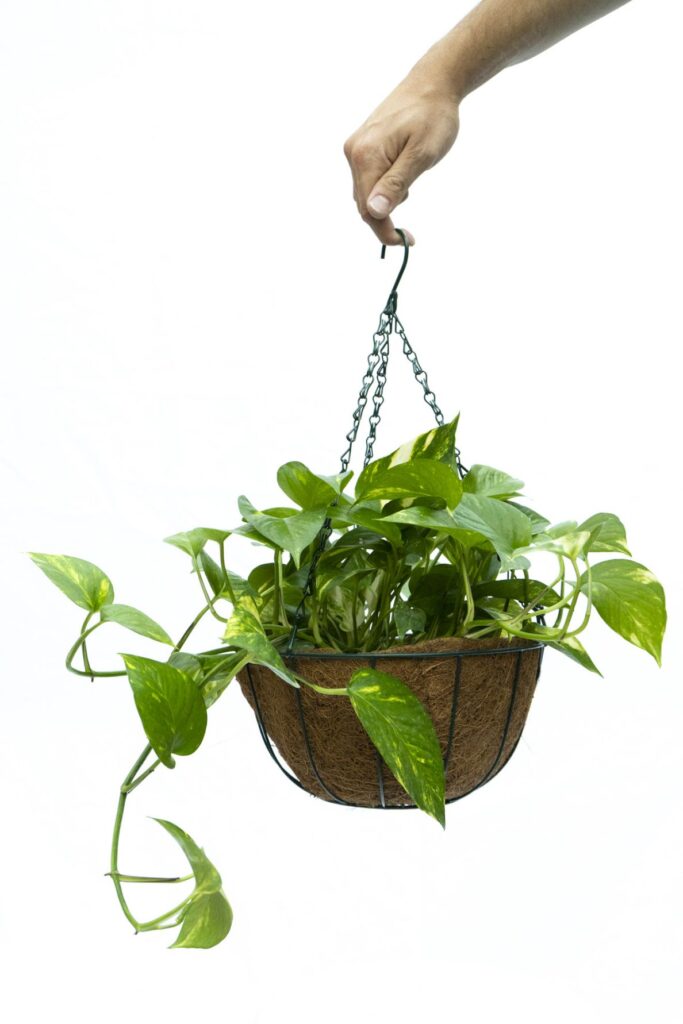
Image1. A pothos plant, from Firah

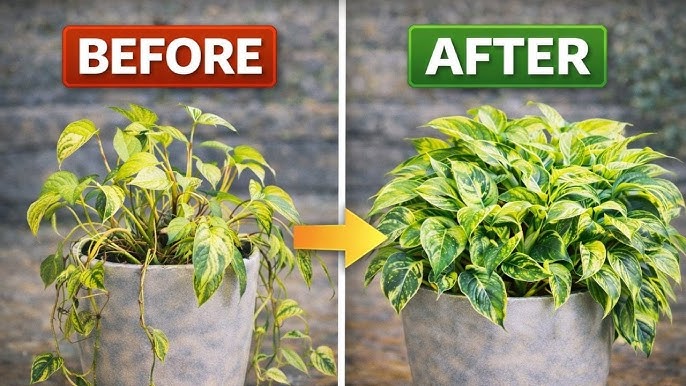
Pothos is a very simple plant to care for, making it ideal for learning. Its changes are easy to notice: the leaves become softer when thirsty, the color changes depending on the light, and growth slows or accelerates. By observing these signals, we begin to understand what the plant needs and how to respond.

This mechanism helps us understand a key principle of interaction design: feedback. Our actions produce a result that modifies a feature of the interface and allows us to understand the next steps to take. In the natural world, feedback arrives slowly, over time. It is not as immediate as a digital interface, but for this very reason it requires attention and observation skills.

Pothos (Epipremnum aureum) is often recommended as a first plant, and for good reason. It is a tropical climbing plant, capable of adapting to a wide range of conditions. It thrives in both bright light and partial shade, requires little watering, and survives even minor care mistakes. [1]

But its real strength is how easy it is to understand its needs.
When thirsty, the leaves lose vigor.
When too much light hits, the color changes.
When healthy, it grows rapidly.

Image 2. Screenshot from the video
Pothos Care Indoors: Yellow Leaves, Brown tips, Watering, Repotting, Pruning, Soil & Growth Tips

Looking at pothos, we learn that good feedback doesn’t have to be complicated. It just needs to be visible and consistent. This form of slow, natural interaction helps us understand how, even in the design of digital interfaces, feedback is essential for building intuitive, accessible, and learning-oriented experiences.

In the field of interaction design, one of the fundamental principles is feedback. An interaction works when the system responds to the user’s actions in a legible and coherent way.
The pothos works exactly like this.
Humans act, the plant responds over time.
This relationship isn’t as immediate as the digital one, but for this very reason, it’s educational. It teaches us to recognize patterns and respect timing.

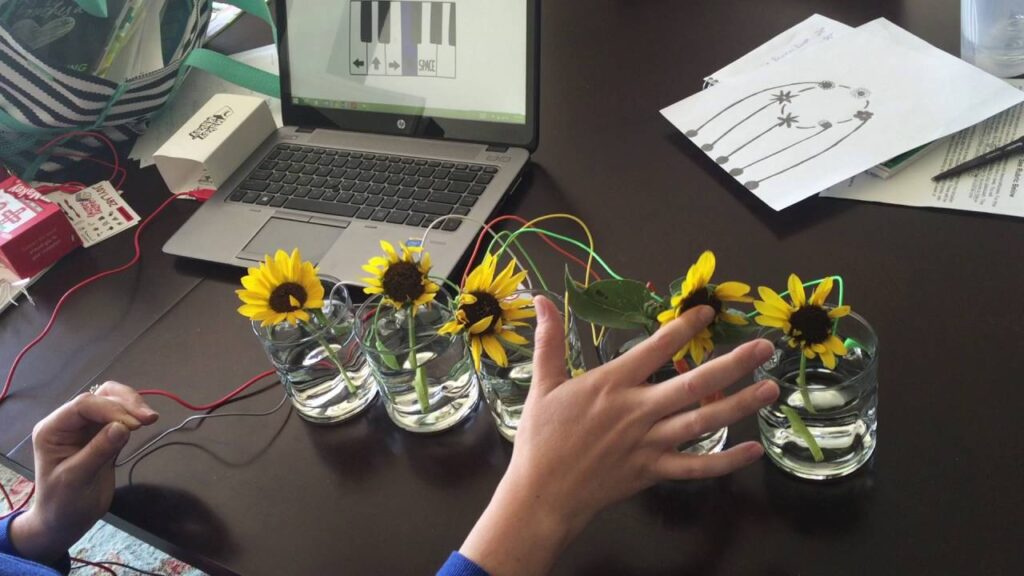
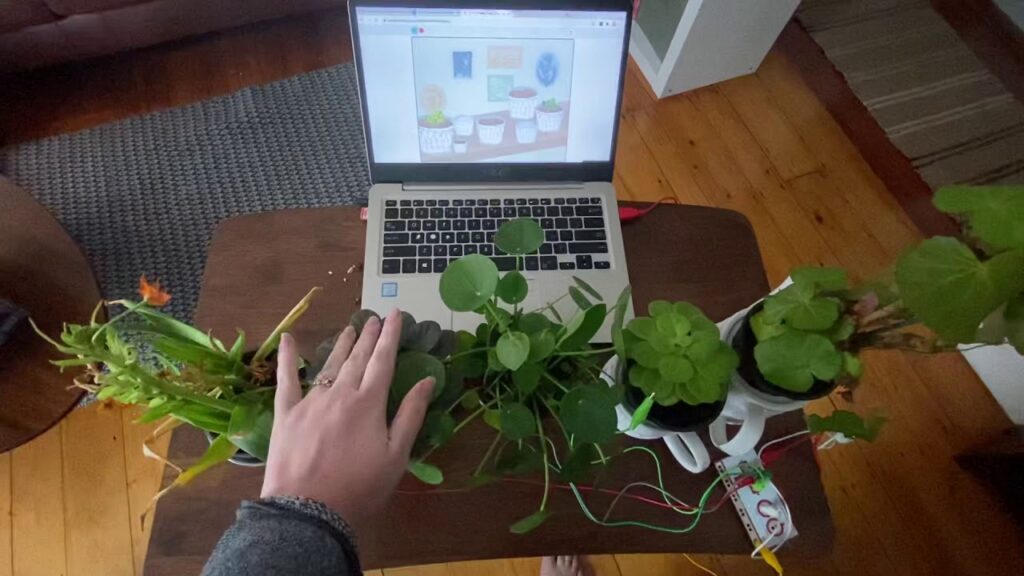
In recent years, interaction design has begun to explore nature-based user interfaces, or interfaces that use natural elements as inputs, outputs, or communication mediums. Among the various examples is Makey Makey—a sensor that, like a keyboard or mouse, can become an input for the computer.
It is a system designed to create tangible interfaces simply and immediately, without the need for programming or building complex circuits. Its unique feature is that it does not require specific technological materials. It can also work with natural elements such as plants, leaves, soil, fruit, or simply the human body. [2]
Sensors, digital models, or nature-based interface platforms can therefore amplify existing signals, without replacing them.

Image 3 & Image 4
Makey makey and scratch plant playgrounds

[1] “Epipremnum aureum,” Wikipedia. [Online]. Available: https://it.wikipedia.org/wiki/Epipremnum_aureum. Accessed: Jan. 21, 2025.

[2] J. Silver, E. Rosenbaum, and D. Shaw, “Makey Makey: Improvising Tangible and Nature-Based User Interfaces,” MIT Media Lab / Beginner’s Mind Collective, Cambridge, MA, USA. [Online]. Available: https://www.firah.org/upload/notices3/2012/makey-makey-improvising-tangible-and-nature-based-user-interfaces-notice-a-mettre-en-ligne.pdf. Accessed: Jan. 21, 2025.

[3] J. Silver, E. Rosenbaum, and D. Shaw, “Makey Makey: Improvising Tangible and Nature-Based User Interfaces,” MIT Media Lab / Beginner’s Mind Collective, Cambridge, MA, USA. [Online]. Available: https://www.firah.org/upload/notices3/2012/makey-makey-improvising-tangible-and-nature-based-user-interfaces-notice-a-mettre-en-ligne.pdf. Accessed: Jan. 21, 2025.

Design Activism (Part 10)

Last, but not least I am going to focus on some more material of activist poster design. Then I will add my next steps for my thesis, so you know what I will be doing in the future and how I will add to my collection of materials and research.

The topic I already focused on in part 6 of my blog posts was global warming and the environment. Therefore, I want to add some more posters here that focus on this exact topic.

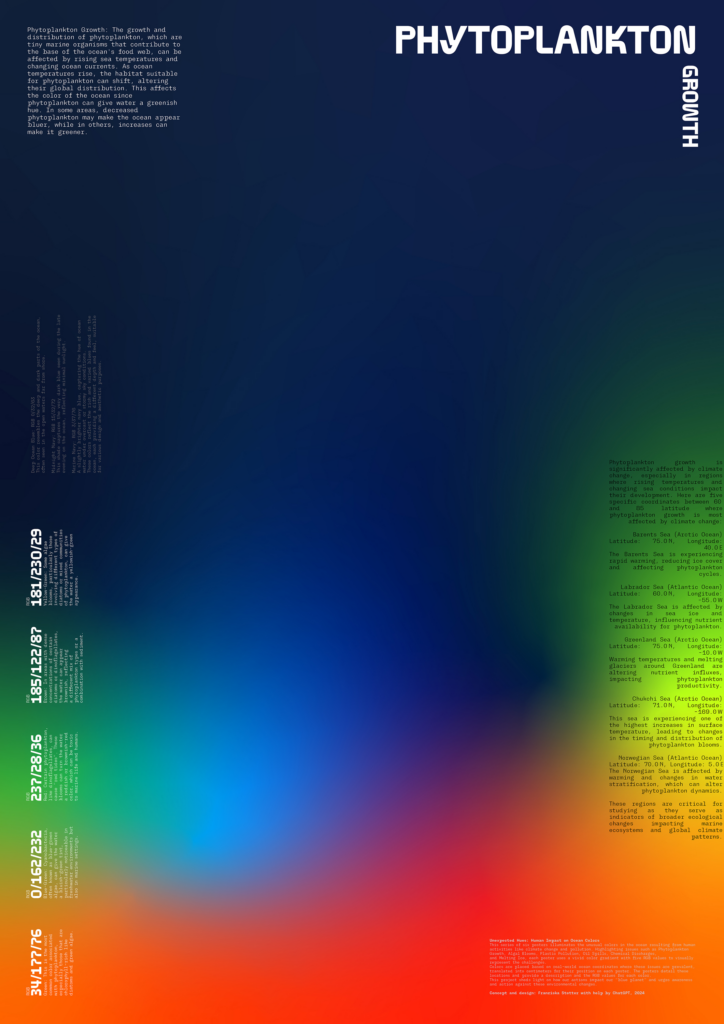
“Unexpected Hues – Human Impact on Ocean Colors” is an interesting poster series by Franziska Stetter. It wants to raise awareness on certain oceanic problems the environment is facing. There are six posters on the topics: “[…] Phytoplankton Growth, Algal Blooms, Plastic Pollution, Oil Spills, Ocean Acidification, and Melting Ice […]” (Stetter, 2026) Each of the posters

“[…] using a vivid gradient of five RGB color values to represent changes in ocean color caused by environmental disruptions. These colors are placed based on real-world coordinates where these issues are prevalent, translated into their position on each poster. Accompanying each visual are detailed descriptions that explain the context, data, and meaning behind the chosen hues, creating a blend of scientific data and visual storytelling.” (Stetter, 2026)

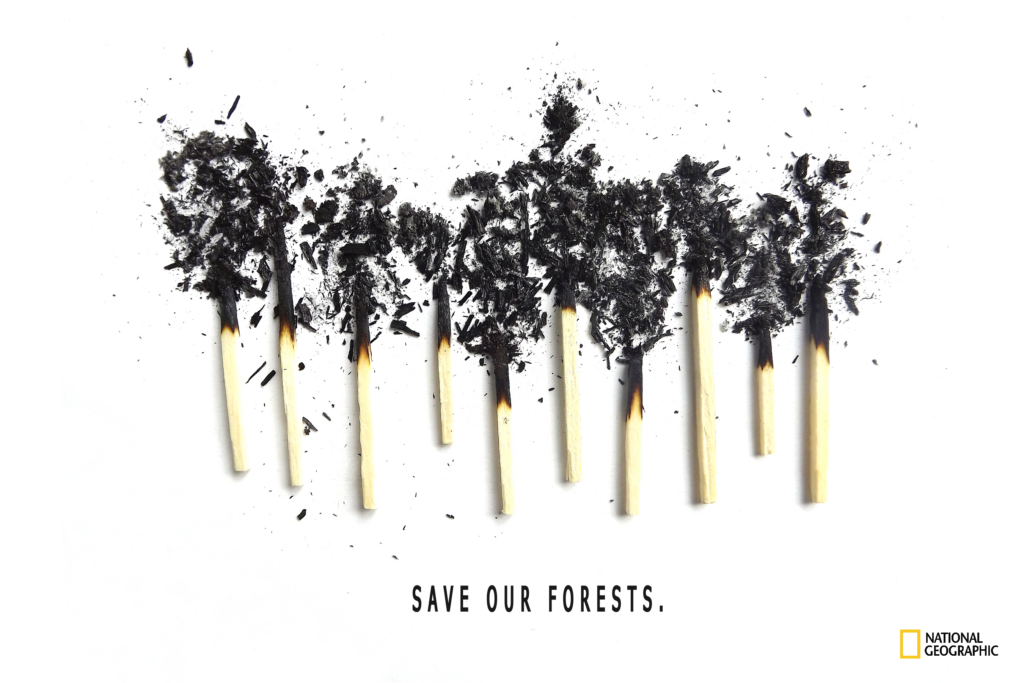
In this poster Brynn Seitzman has focused on one of the effects of global warming. The typography is a call to action and makes us aware that our forests need saving. Through this quote the picture becomes alive, we do not only see burnt out matchsticks anymore, but trees, a whole forest that was burnt down by wildfire, caused by global warming and climate change.

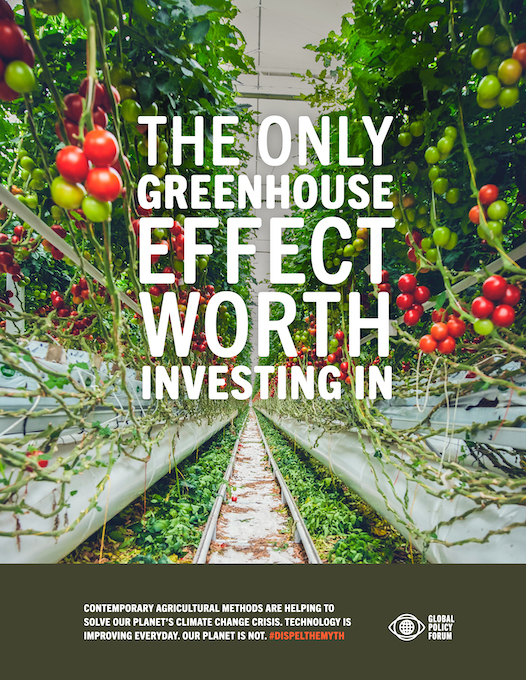
This next poster was created by Jack parker, Evan Hamilton and Gabe Salas, students from the Texas State University. It focuses on showing what can be done against climate change within the field of agriculture through new technology. Since the greenhouse effect is a phenomenon tied to climate change, it is interesting to use this quote to advertise for new agricultural greenhouse solutions that help us live in an environment that is constantly getting hotter.

To summarize, these were some examples of advocating for change in caring more for the environment. The next steps of my thesis will be to synthesize my findings and tie them together more closely, as well as, to find even more examples that help me make choices to create my own design activist works. In the end, I want to apply the results of my research to my own practice as a designer. This will make it easier for me to create alongside my personal values and connect them to my future brand. It will add more value to my work and hopefully steer my portfolio and my future work life into directions I am interested in that make people think twice about their actions.

Thank you all for your interest in my research journey. I have still got quite a way to travel with this, but I’m more sure than ever to start creating on my own, seeing what I can do with all the insights I have gained into this broad and extremely important issue.

Sources:

Parker, Jack; Hamilton, Evan and Salas, Gabe: Dispel the Myth. In: Graphis Online, 2020. URL: https://graphis.com/entry/9165a4b3-1837-4ce2-8927-bc7a7d8f8245. Accessed 2026, Jan. 26.
Seitzman, Brynn: “Save Our Forest”. In: Graphis Online, 2015. URL: https://graphis.com/entry/acc0d43f-f96c-417b-bc4e-0fefbb27435d. Accessed 2026, Jan. 26.
Stetter, Franziska: Unexpected Hues – Human Impact on Ocean Colors. In: Graphis Online, 2026. URL: https://graphis.com/entry/80052a8b-1c57-4772-bc12-69183332c9fc. Accessed 2026, Jan. 26.

Design Activism (Part 9)

The focus of my previous post was on the Black Lives Matter Movement and racism. And in Part 6 of my series, I analyzed a poster on US politics, as well as, one on global warming. Therefore, I will add to both of these to have more examples of similar topics.

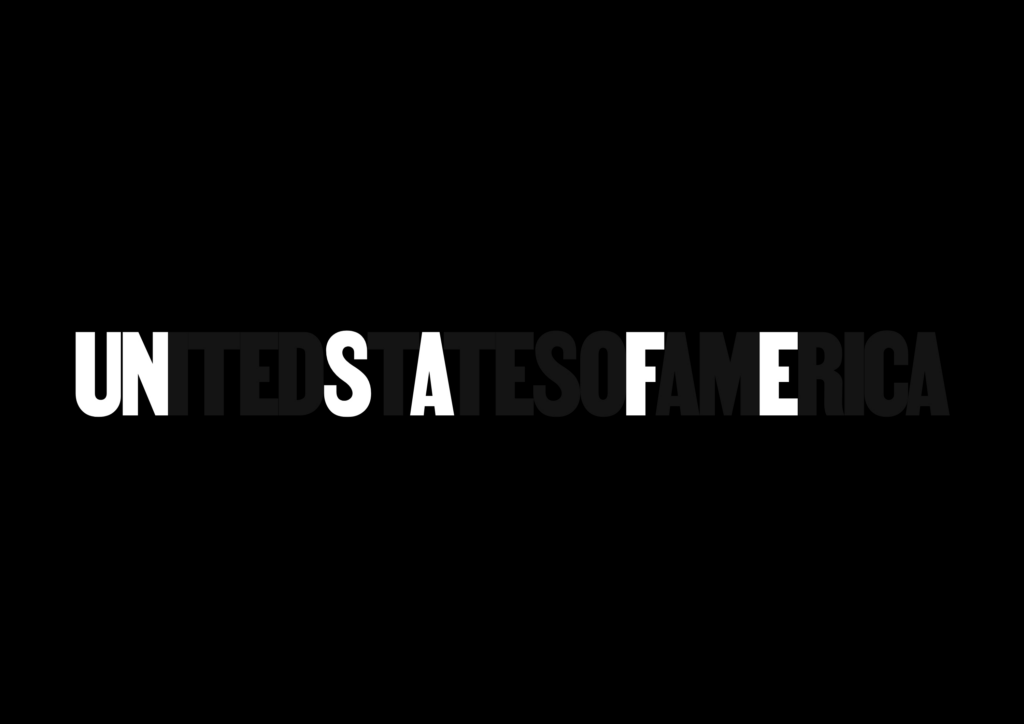
Jean Quarcoopome created this poster to connect US politics and the danger they pose towards Black lives. The background colour is black to show that it is about Black people and death. In the background a transparent typography shows ‘UNITEDSTATESOFAMERICA’. Within these words some letters are emphasized in white colour, that makes one read the word unsafe. This shows that america is an unsafe place for Black people. The intention behind using the font Martin by VOCAL Type Co, was to hint towards “lettering used on placards and posters during a Memphis sanitation strike, organized by Black people protesting against unsafe working conditions in the 1960s.” (Quarcoopome, 2021)

Coco Cerrella focused on a more graphical approach to depict one big problem going on around the world, which is also strongly emphasized in the US. Namely, immigrant’s rights. The passports of different nations are cemented into a wall. They look like bricks holding society together, but walls can eventually crumble. Cerrella states that “[t]he passport that serves as the entry key for many people is at the same time a wall for migrant minorities, in a world increasingly closed.” (Cerrella, 2021) This poster is also a nod to building walls between nations, which again is a link to Trump building a wall towards Mexico, for instance.

This poster by Karen Crawford also merges topics. It combines the famous last words by George Floyd that fuelled the Black Lives Matter Movement with a face mask, marking the COVID19-pandemic. The words form a mask and are also situated exactly on mouth and nose, where the breath of the Black person shown as a silhouette should be, but is not anymore. It also shows the struggles of the pandemic that many people said they cannot breathe under their masks. But using a mask and struggling to breathe because one is being killed are two entirely different things. This shows that many struggles of mainly white people do not translate similarly to the struggles of Black people. Surely, the Black people that have died would have preffered to wear a mask instead.

To summarize, these examples combine different topics that I have already focused on in previous posts. In my next and last post I am going to show some final examples of design activist posters and then elaborate my next steps for my thesis. Thank you to everyone that has read until here.

Sources:

Cerrella, Coco: Immigrant Wall. In: Graphis Online, 2021. URL: https://graphis.com/entry/5eb64068-528e-47d5-a430-495ec7f8a52a. Accessed 2026, Jan. 26.
Crawford, Karen: I CAN’T BREATHE. In: Graphis Online, 2021. URL: https://graphis.com/entry/65a5d705-6cd2-4f26-8b42-47644cbfb1e4. Accessed 2026, Jan. 26.
Quarcoopome, Jean: UNSAFE/United States of America. In: Graphis Online, 2021. URL: https://graphis.com/entry/4438657f-06dc-44e1-a6a4-363d559384ef. Accessed 2026, Jan. 26.

Design Activism (Part 8)

In my last post I have analyzed some mainly typographic posters about war. In this post I will be focusing on racism and the black lives matter movement, since there are still so many different topics out there that add to the variety and diversity of activist topics.

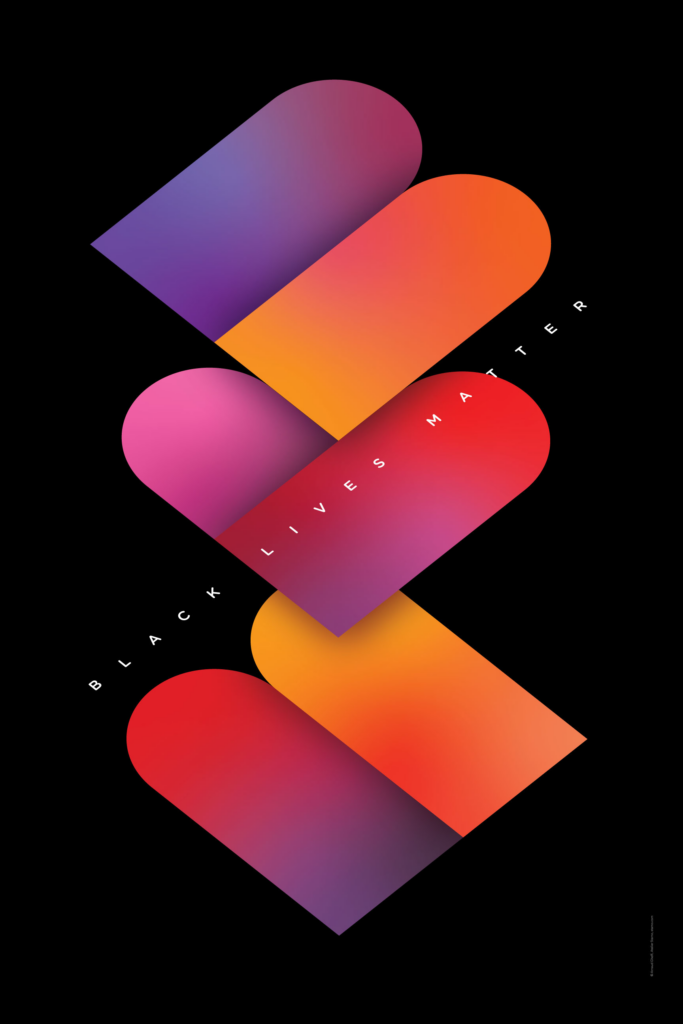
This poster by Arnaud Ghelfi was created for the Black Lives Matter Movement. The structure of the letters BLM is especially round, which creates the illusion that the ‘L’ is a heart. The colours help this notion, because the ‘L’ is mostly red and pink, the typical colours associated with graphics of hearts. The black background adds to the fact that this is about Black people. To add to that the shapes of the three letters seem to be built out of the same two components. The colour gradients within the type show that Black people are diverse as well and this diversity adds flavour to society, which is why they are as important as everyone else. (cf. Ghelfi, 2021)

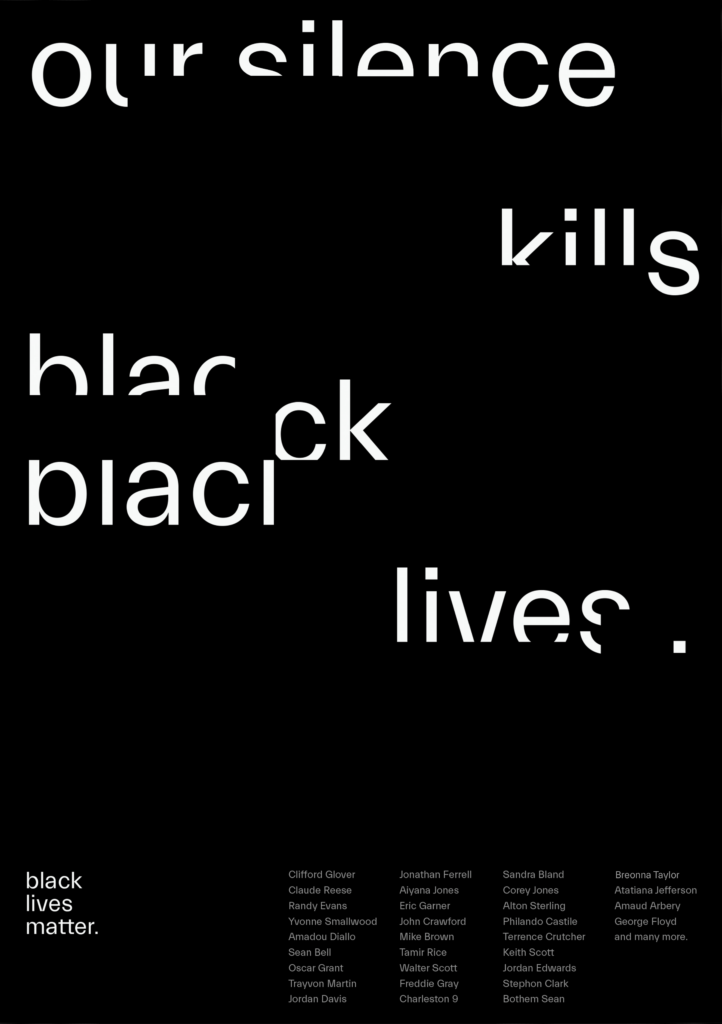
In this second poster about the Black Lives Matter Movement Anna Sera Garcia shows how white space can be used to show reactions of people. The typography is cut out by empty space to show that when white people (that are the majority group) do not speak up about injustice, their silence makes them complicit in the killing of Black people, since they have the power, but do not do anything about these injustices. Other than the whole sentence the word ‘black’ gets not only erased, but torn apart as well, this shows the brutality Black people have to face, by being killed without doing anything wrong. To add to that the sentence ends with a single point, this shows that it is a fact and also emphasizes the finality of the statement. At the bottom of the page the names of Black people that have been killed during this time are listed to not let them be forgotten and show that it is not just an individual case, but a pattern.

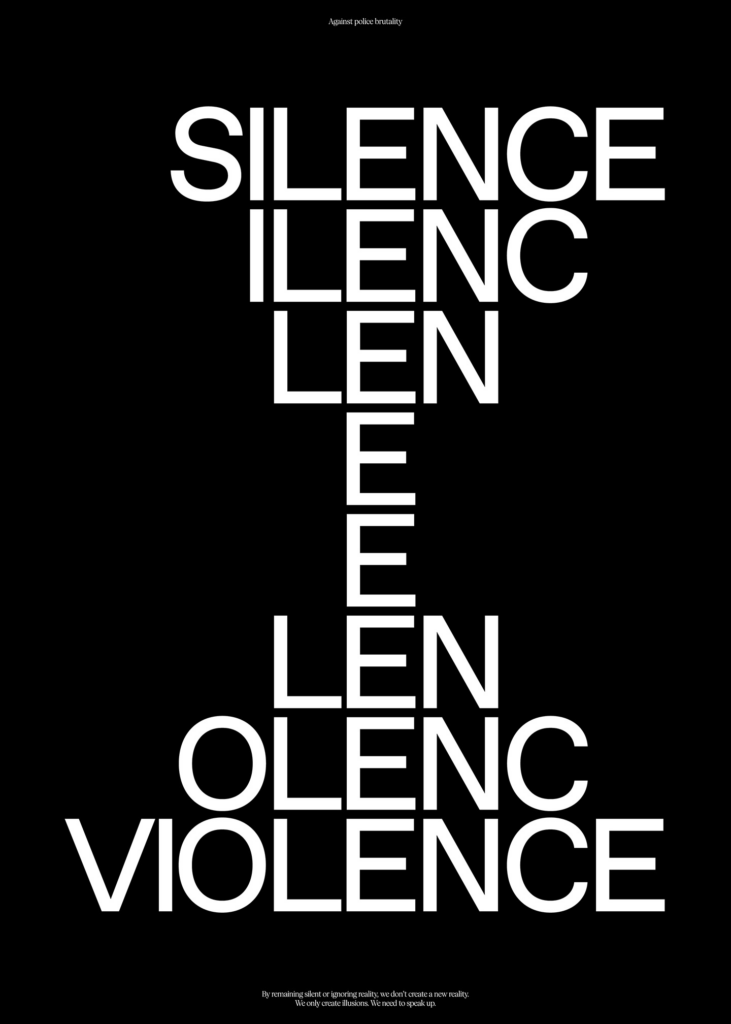
This poster by Underline Studio shows the same problem that the previous one did. The two words ‘silence’ and ‘violence’ are merged, by showing their similarities. The whole construct shows the visual of an hourglass, making evident that each second of silence adds to the violence that is happening.

Last but not least, Selcuk Ozis has created a typographic poster showing again that racism kills. The letter ‘i’ stands for black people as can easily be seen. This shows that racism as a construct is fueled by white people, one white person seems to be killing the Black person as is depicted by the ‘s’ that seems to be kneeling on top. The other white people ‘r’, ‘a’, ‘c’, ‘m’ just seem to be watching or are probably silent as they see the scenario unfold. The three colours used remind us of the Nazi flag and show that racism is timeless and, therefore, has to be fought by the roots.

In this blog post I have analyzed some posters about racism, focusing especially on the Black Lives Matter Movement. This shows again how much is possible using just typography.

Sources:

Ghelfi, Arnaud: Black Lives Matter. In: Graphis Online, 2021. URL: https://graphis.com/entry/7815cc37-e773-4e6b-937a-52ac9de4d663. Accessed 2026, Jan. 26.
Ozis, Selcuk: Racism. In: Graphis Online, 2021. URL: https://graphis.com/entry/a9aa38c8-850b-45b6-a1d3-3252fee54a43. Accessed 2026, Jan. 26.
Sera Garcia, Anna: Our Silence Kills Black Lives. In: Graphis Online, 2021. URL: https://graphis.com/entry/caa83c12-41bb-4709-91b4-c99515a11718. Accessed 2026, Jan. 26.
Underline Studio: Silence is Violence. In: Graphis Online, 2021. URL: https://graphis.com/entry/a5b2b40c-9f0d-484a-8cf8-162682ffffbc. Accessed 2026, Jan. 26.

Trying to set SMART goals

To achieve a big project, it must be separated into little, actionable steps. This blog entry refines my intention with the project further and talks more about the specific goals.

The core purpose of my project remains unchanged: I want to explore how sound design can function as a storytelling tool within a musical composition. At the center of this exploration is an element that is ever-present in pop music, yet rarely analyzed in depth: ear candy. I want to understand how these sonic details can create meaning and support a narrative—and how I can use this knowledge purposefully in my own productions.

In short: I want to treat sound design not as a technical afterthought, but as a dramaturgical element that actively shapes a song’s story.

Goals and subtasks

Using the SMART criteria for goal setting (meaning a goal needs to be specific, measurable, achievable, relevant, and time-bound) I am setting the following goals for the running and upcoming semesters:

Winter Semester 2025: Literature Review and analysis of two pop songs

Specific Literature review
·  Collect academic articles on sound design, music production, and related terminology·  Collect non-academic sources (YouTube tutorials, blogs, producer breakdowns)
·  Explore psychoacoustics, synesthesia, and musical chills 
Analyze the terminology
·  Gather definitions, synonyms, and varying understandings of “ear candy.”
·  Identify recurring themes: purpose, emotional impact, sonic characteristics 
Analyze two pop songs
·  Look for elements that stand out and describe why they stand out
·  Analyze which effects were used and what purpose they served in the songs 
Start the adjective collection (ongoing across all semesters)
·  Note adjectives encountered in literature, interviews, and analyses
·  Categorize them (e.g., emotional, spatial, timbral, narrative)
·  Record preliminary meanings, examples, and contexts 
Optional: Hold an interview with a pop music producer
·  Find an interview partner (Research local or online producers experienced with ear candy and evaluate their relevance to the project (genre experience, professional background))
·  Organize the interview
·  Prepare the interview questions (e.g. How do they incorporate ear candy in their work? What techniques do they use? Topics to cover: personal definition of ear candy, creative process, sound sourcing and recording, editing methods, dramaturgical intentions, best-practice examples)
·  Conduct the interview
·  Transcribe (parts of the) interview
Measurable Literature Review:
Finish the expose at the end of the semester and present my results 
Analyze terminology:
Present a definition that matches the way ear candy is described in the research 
Analyze two pop songs: Present a summary of the findings 
Interview (optional): Hold the interview and summarize the findings
AchievableTasks rely on available resources (literature, online material, accessible industry contacts).
RelevantDefining the term is relevant for further semesters, to have a shared understanding what the project is all about.
Time-BoundFinish the literature review before New Years. Finish the presentation of the results when it is due in January of 2026.

Summer Semester 2026: Apply ear candy concepts to an original song

Specific 1. Develop the base composition
Create a song structure (intro, verse, pre-chorus, chorus, bridge).
Produce the foundational arrangement:
– chords / harmonic progression
– melody or topline
– percussion
– bass
– vocals
Create a clean production without any ear candy, to serve as Version A.
2. Design & integrate ear candy elements
Based on Semester 1 findings, design ear candy that:
– supports the song’s story
– enhances emotional impact
– reinforces transitions or dynamic shifts
– adds subtle textural detail
Create Version B (extensive ear candy) using the full palette of techniques.
3. Listener perception study (Optional but valuable)
Conduct a small informal test with listeners (friends, classmates, musicians)
Ask participants to compare Versions A and B.
Collect data on:
– perceived narrative clarity
– emotional response
– sense of depth and
– detail memorability
Document results for inclusion in your final report.
5. Continue expanding the adjective list
Add descriptors derived from the production process. Start grouping words into categories.
Measurable One full song production in two versions (with and without ear candy).
Achievable Uses skills developed from research and accessible production tools.
Relevant Demonstrates the practical value of the theoretical framework.
Time-BoundTo be completed by the end of Summer Semester 2026.

It is not completely clear to me what I will do in the third semester. I assume that producing the songs might be a process that also extends into the third semester. Nevertheless, at the end of the project I want to have achieved the following:

Specific: Compile results, finalize the adjective list, evaluate the production outcomes, and prepare final documentation

Measurable: Final project portfolio including written thesis chapter, song versions, diagrams, and terminology list

Achievable: Builds on completed work from previous semesters

Relevant: Completes the research cycle and demonstrates academic + artistic learning outcomes

Time-bound: End of Winter Semester 2026/27

Ear candy & storytelling with Sound Design

I want to explore Sound Design as a storytelling tool within a musical composition. The focus of this project is on musical details that are added to a song to make it more interesting. “Ear candy“ is a vague term used to describe sound effects, extra layers, rhythmic variations and other techniques which are supposed to make a song more interesting for the listeners. They can help to shape the soundscape and character of a song.

This project is not only about adding details to a song, but also about building a vocabulary for describing sound characteristics. The practical part of this project aims to combine songwriting and sound editing. The goal is the concept of a song that is enhanced with sound design elements.

Examples of ear candy

  1. The vocals in the song “Who let the dogs out” by Baha Men imitate the sound of a dog barking.
  2. Billie Eilish and her music producer Finneas O’Connell include sounds they recorded in real life as samples in their songs. One song by them features the drill of a dentist’s equipment, another one includes the sound of an Accessible Pedestrian Signal (APS). (APS are devices which are designed to help pedestrians who are blind or have low vision by providing non-visual cues like sounds and vibrations to indicate when it is safe to cross the road.)

Purpose of the project

The core purpose of my project is to analyze sounds, develop a vocabulary for my future sound design work and explore different ways to use sound design elements in musical compositions. Instead of treating sound design as a decorative or purely technical layer, I intend to explore it as a meaning-bearing, dramaturgical element.

Ultimately, the goal is not simply to produce a song but to research and articulate a method for using sound design as narrative strategy in music.

I want to
… compose a musical piece in which sound design shapes the narrative structure.
… create ear candy elements that contribute not only sonically but symbolically.
… develop a vocabulary to describe sound qualities and emotional functions in production.
… connect theory and practice when it comes to musical storytelling, sound design and sound editing.

Although the outcome is a standalone piece, the underlying methodology has broader applications:
·  Artistic practice: designing sonic narratives, creating atmosphere and emotional depth in music.
·  Music production: helping artists articulate a “sound world”.
·  Education & analysis: building tools for describing sound qualities and production strategies.

Possible techniques & methods

To narrow down the project, I might draw from several categories of methods. I hereby note that these categories were suggested to me by the LLM ChatGPT after several prompts telling the model which areas of Sound Design I would like to explore more.

A. Analytical Techniques
·  Harmonic analysis of emotion-driven chord progressions
·  Textural and spectral analysis of reference tracks
·  Identification of “Ear Candy” categories (e.g. foley events, sound effects etc.)
·  Development of descriptive vocabulary for sound qualities

B. Sound Design Techniques
·  Foley-based sampling (recording small sound events)
·  Textural layering
·  Creative vocal processing (pitch, formant, spatial modulation)
·  Unusual chord voicings or progression loops
·  Spatial mixing techniques for headphones (binaural cues, intimate panning)

C. Production & Composition Methods
·  Writing a narrative arc for the song
·  Mapping sound events to emotional or symbolic moments
·  Iterative prototyping: composing → sound-designing → analyzing → refining
·  Mixing for headphone emphasis
·  Evaluating how well each sound supports the story

Questions that will most likely occur during this project

·  How much Foley work is necessary to support the story of a song?
·  Which sound design elements risk becoming too literal or distracting?
·  How can I balance songwriting and sound design so that neither overwhelms the other?

Loving Vincent – how the style of an animated movie tells and supports the story

With movies such as “Spiderman: a new universe” a push towards a more hand painted style in the animation industry could be felt. Arcane pushed the combination of hand painted looks of 3D animation even further. However, these styles are always in combination with computer animation. What if a movie is not only hand drawn but hand painted?

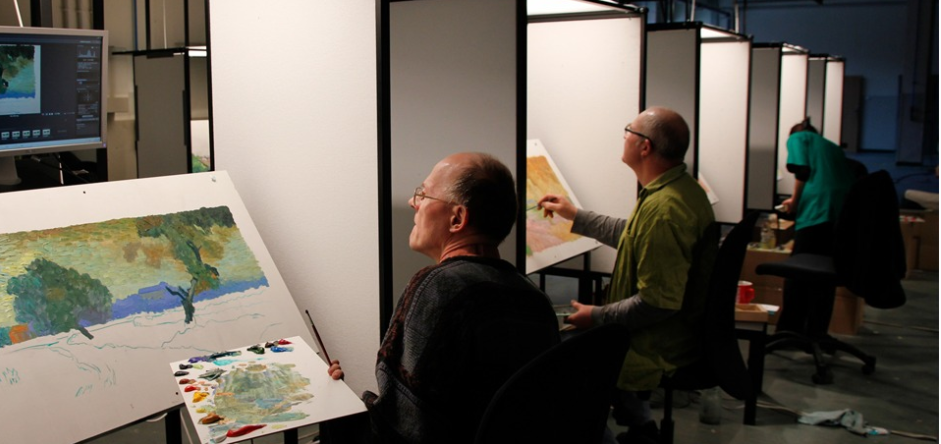
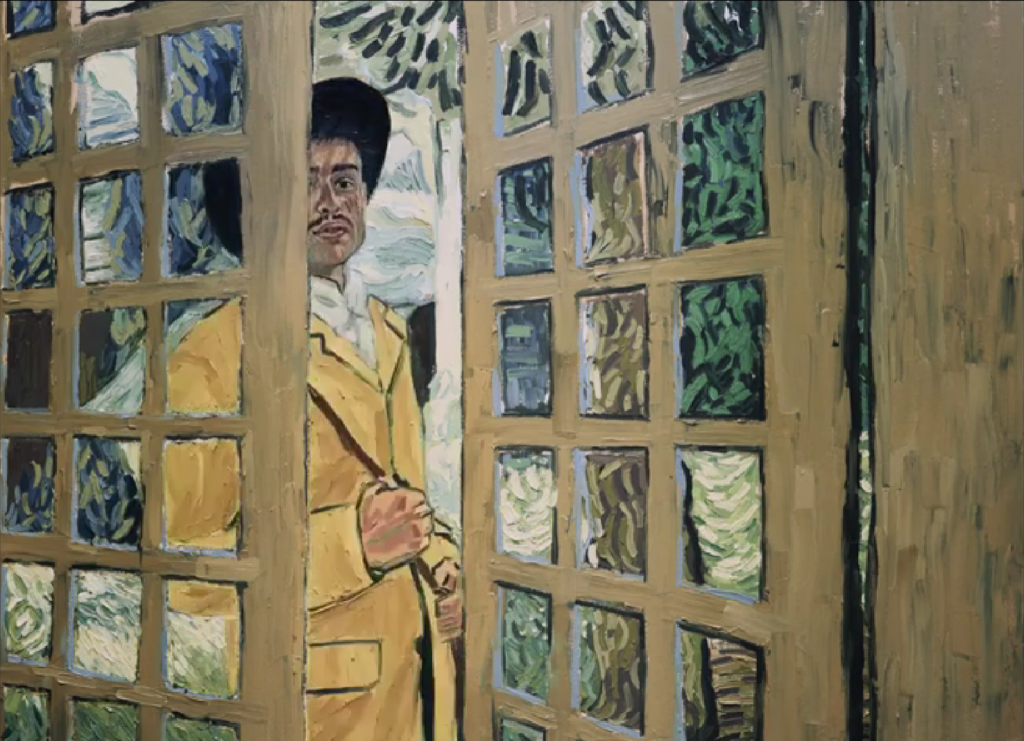
Loving Vincent is an animation film published 2017, written and directed by Dorota Kobiela & Hugh Welchman. It is the first feature length painted movie. In 1 hour and 35 minutes all of the 66 960 frames are hand painted oil paintings created by 125 professional oil painters. As reference real actors and actresses were filmed in front of a green screen or sets designed to look close to the paintings.

As a concept for the movie 94 paintings of Vincent can Gogh were reimagined, reframed and strung together to create a story. For flashbacks photos of the time and van Gogh were added in a black and white to create a contrast to the colorful painting world.

Following the death of Vincent van Gogh Armand gets the task to deliver van Goghs final letter to some worthy recipient. While searching for the recipient Armand finds himself in a village with many people close to van Gogh or people who modeled for his paintings. Questions about van Goghs life as well as death were asked but left open for interpretation just like his paintings.

Loving Vincent is a special case in many aspects. The animation style is woven into the concept of the movie itself. It doesn’t just enhance the narration. It takes over the narration. The goal is to be sucked into the paintings of van Gogh, and the movie succeeds in it. Sometimes the style can be confusing and overloading due to the many moving brush strokes, however, it doesn’t take away from the impressiveness. It is an ode to van Goghs works and completely driven by the style. With a different approach the movie would lose a big part of the story. While not all viewers may understand all the references and nods given to the paintings, they will recognize van Goghs painting style even if they only know one painting of his. In a different style this connection may be lost.

Loving Vincent is not a typical movie about a famous figure. It does not feature the painter as the main character. It shows what he left behind with a new perspective.

https://lovingvincent.com

The animation of infographics

Animation is a broad field with varying requirements depending on the medium in which it is used for. Whether it is 2D, 3D, or stop-motion animation, there are clear differences between animations created for television and those produced for film. Television series typically feature less expressive animation, and in 3D animation, shaders are kept simpler to reduce render times. Infographics represent a form of animation that is generally the simplest in terms of complexity.

Infographics are predominantly used to simplify complex or abstract themes. The core of infographics is often a presentation. It includes facts and data. Without any animation the information is skimmed over without much of an impact on the viewer. Meanwhile, adding animation while dissecting a theme into small portions as well as adding comparison and a storyline the information is more likely to be remembered. While animation is an important part of infographics, it should not overshadow the information itself. The animation should enhance the information rather than distract from it.

There are various ways to create an animated infographic. Due to budget limitations, many projects share a similar visual style. Often Stock vector graphics are used as a base for the animation In these cases, the designer or animator focuses mainly on animating pre-existing elements instead of designing each asset from scratch. This approach significantly reduces production time and cost. For higher-budget projects, vector graphics may be custom-designed specifically for the infographic, allowing for a more unique and tailored visual identity that closely matches the topic and target audience.

A different approach is the so-called white board animation. Here elements get pinned or stuck on a whiteboard according to the desired story. The elements are hand drawn figures and objects giving it a personal note. Sometimes elements are drawn in addition. The hand of the, in this case, animator is shown and interacts directly with the infographic. The desired outcome is the feeling of someone explaining the topic directly to the viewer.

Ultimately, the most important factor for infographic animation is efficiency. The goal is to convey information and tell a story in the quickest and clearest way possible For this reason, characters—if they are used at all—do not need to be complex or highly detailed. If a storyline only requires a character to perform a simple action, such as raising a hand, there is no need for an advanced or intricate animation rig in software like After Effects. Simplicity often leads to clarity, which is the true strength of effective infographic animation.

Infographics found their way into YouTube as well. Many explain videos use them to create content without having to create complicate animations or invest into expansive real-life footage. They reach a large audience for example a video about “Crazy Things Science Still Can’t Explain” has over 1.2 million views over just 4 months.

Overall, animated infographics demonstrate how simplicity, clarity, and purposeful motion can effectively communicate complex information to a wide audience while remaining efficient in both production and storytelling.

https://explainvisually.co/en/animated-infographics/

https://absolute.agency/articles/blogs/five-essential-items-for-an-animated-infographic

https://www.nobledesktop.com/blog/tips-for-creating-effective-animated-infographics