Last time I showed my concepts for Producers and Primary Consumers in the oceans of Europa, today we move on the Secondary and Tertiary Consumers.
Secondary Consumers
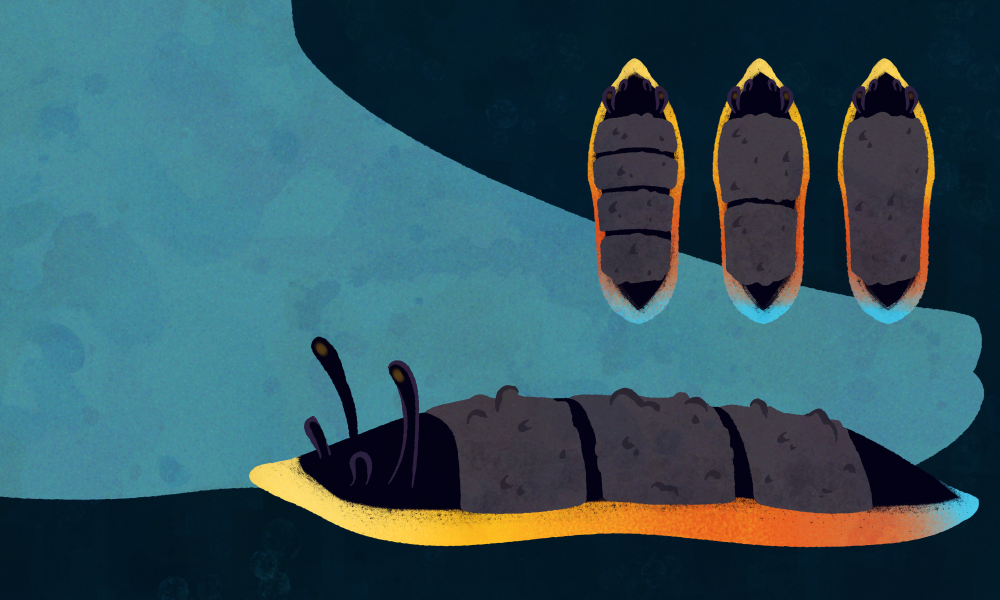
Volcanic Slugs are part of the same phylum as Iron Beaks, the Laminaferrea, though they belong to a wholly different class – the Saxumlucidum, a strange case of convergent evolution leading to class of animals similar to gastropods on Earth. Though unlike the gastropods we are familiar with they have developed a kind of scales on their back. It’s not clear yet what the purpose of these is, though it might be a way to protect themselves from other members of their species, as they often show cannibalistic tendencies.
Volcanic Slugs are commonly found in the shallow zones, though there are around 2.000 species we know of so far that can be found even in depths of around 70km. Volcanic Slugs are exclusively carnivores mainly predating on Antennae Trees, whose chemical-laden bodies they are not only able to process, but also turn into a strong toxin that deters predators. This might also be the reason for their bright colour.
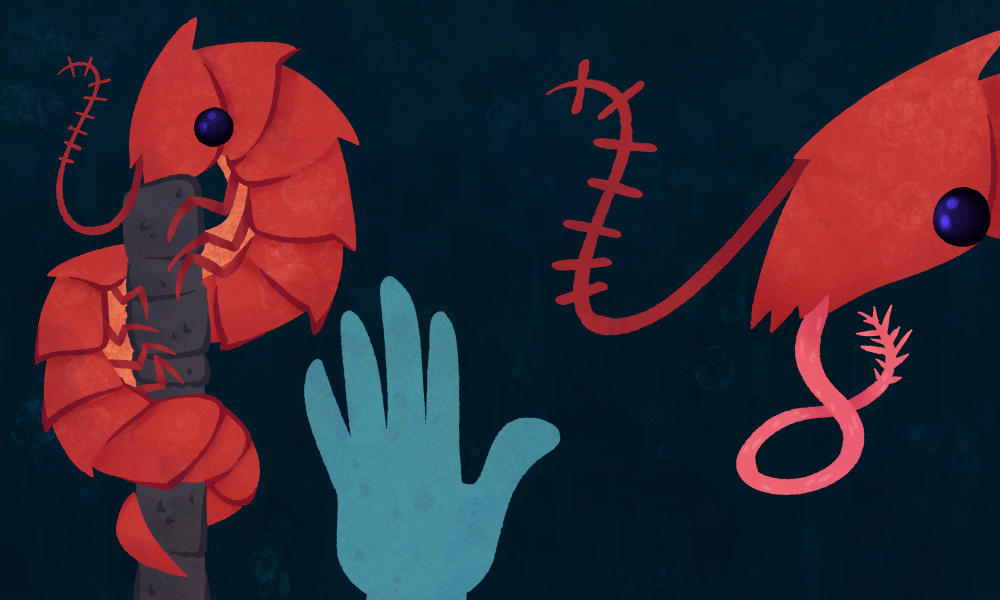
The Pipe Cleaner Crab is another member of the Reptator order and has evolved to be monophagous, meaning they exclusively eat one type of prey. As the name might suggest, this prey is the Pipe Worm. The Pipe Cleaner Crab will crawl up their shell-structures and shove their heads into the openings. With their long, barbed tongue they will impale the worm and pull it out in pieces to be devoured. Due to their rapid metabolism, they spend a majority of their time eating, devouring about 40%-50% of their own body weight each day.
Sea Nymphs are part of the Cancernatans order, which represents members of the Armaturatus phylum that have evolved away from being ground-dwellers and instead developed their appendages into fins, allowing them to swim in the open ocean. Sea Nymphs grow to be around 1.7m, and predate on any Armaturatus, that’s small enough to fit into their claws. These claws have a very similar shape to a crab cracker tool and serve the same purpose – crushing their prey’s shell so they can get to its soft insides.
Sea Nymphs can be found anywhere in shallow to mid-level oceans. Though they are technically free-swimming, they live very close to the ocean floor and will crawl around quite frequently given that their legs haven’t atrophied as is very common for other members of their order.
Tertiary Consumers
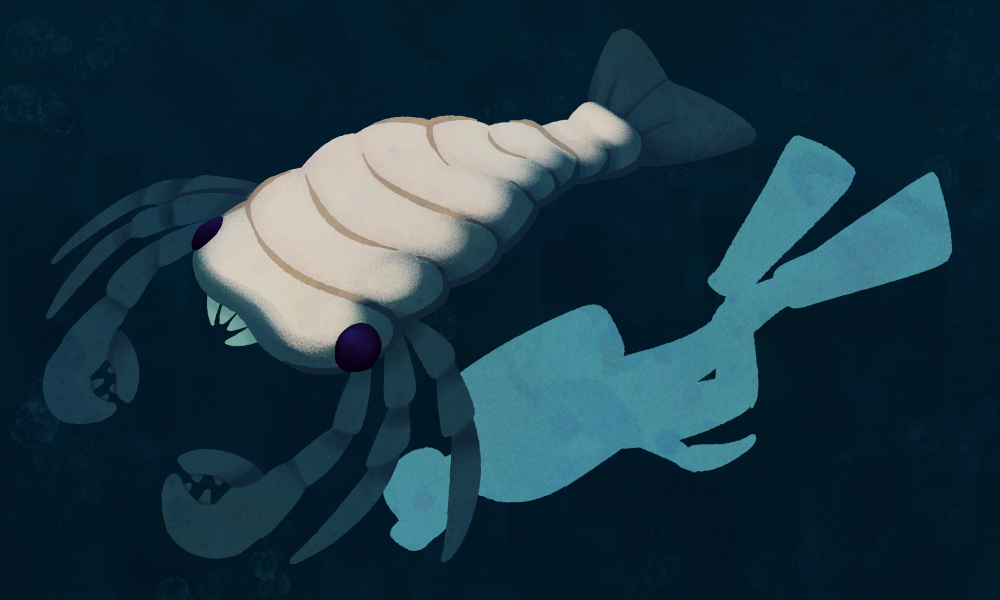
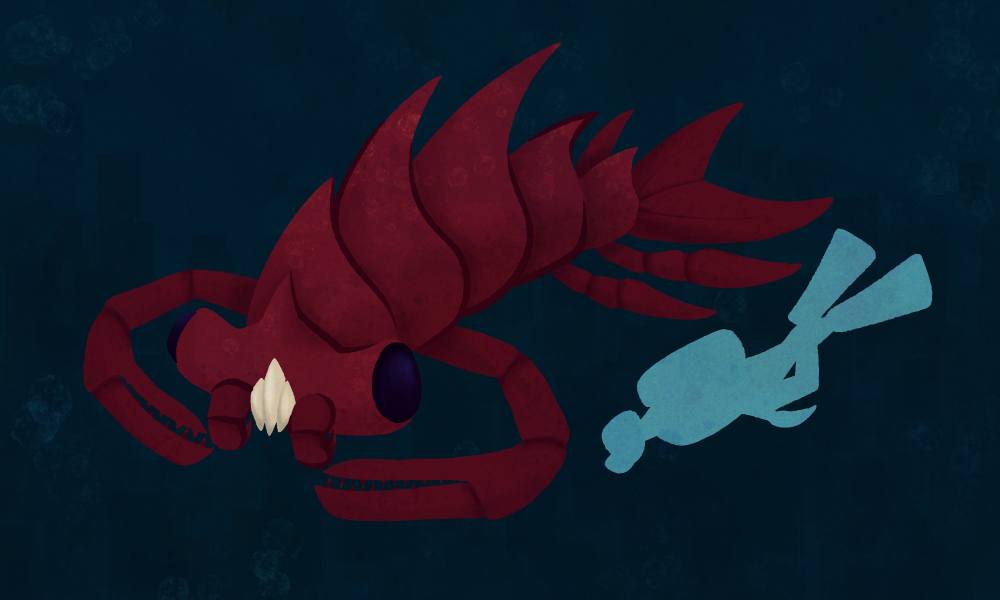
Shell-Breakers are one of the most feared predators in the oceans of Europa. They’re the largest member of the Cancernatans order, growing up to be around 2.8m long. They’re pursuit predators and hunt solitary – they usually prey on Sea Nymphs and other large members of the Armaturatus phylum that they hunt down to exhaustion. They have articulated “fangs” that allow them to not only capture their prey, but also crush it apart in order to get through its shell.
Shell-Breakers reach burst speeds up to 55 -58km/h and never stop moving, even if they sleep. Instead they enter a state of unihemispheric slow-wave sleep, where only one half of their brain rests at a time. This evolved as a way to protect them from predators, as well as allow them to travel great distances to hunt food, given the steady diet needed to support their large size. They live primarily in mid-level oceans, though they often need to travel deeper due to competition for food with other members of their species.
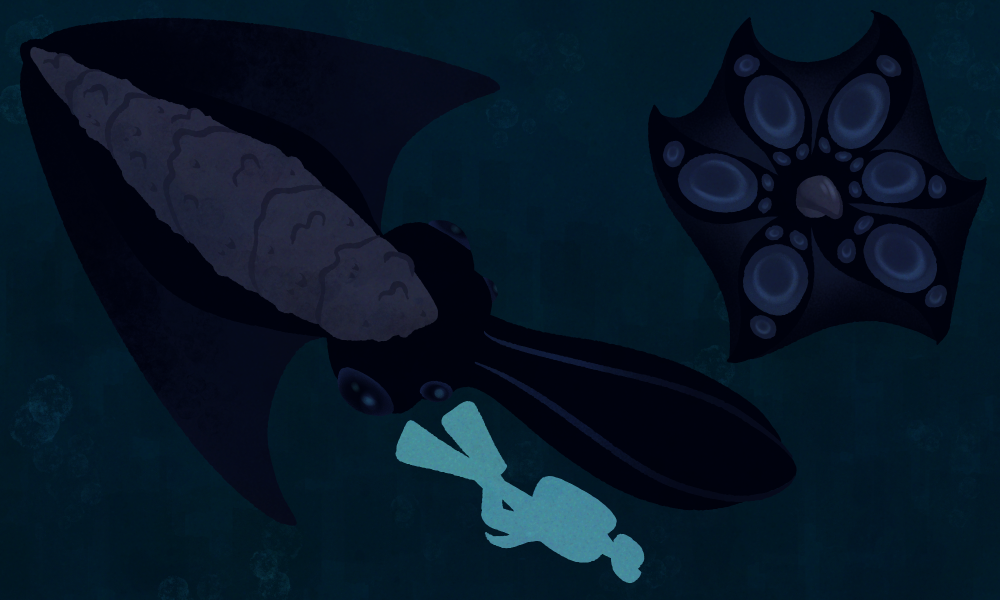
Black Phantoms are the second largest members of the phylum Laminaferrea, class Multibracchia, growing up to around 5.7m. Multibracchia are a squid-like group of animals. They commonly have six arms, though these aren’t slender and pointy like tentacles but rather spoon-shaped with suckers only in the middle of them.
Black Phantoms have webbing between their arms, resembling a cloak, that they use to rapidly engulf their prey and thus stun it before it realizes what’s happened to them. The plating on their heads is a left-over from their common ancestor with other Laminaferrea, though it does seem to play a part in territorial disputes, being used to bash against each other in order to show dominance. The “wings” on the sides of their head are used for locomotion by being flapped up and down, allowing them to reach speeds of up to 15km/h. While Black Phantoms might not be the fastest, they are highly intelligent – frequently employing ambush tactics in order to capture their prey, blending in with the darkness of the abyssal oceans that they reside in. They often lie in wait for hours in order to catch their prey, these being primarily Shell-Breakers, but also most other large marine animals.