In an industry obsessed with the artist’s face, personal life, and constant social media exposure, total anonymity is a radical communication strategy. But what happens when you erase the physical protagonist from the narrative ecosystem? The space left empty must be filled by a world. A prime example of this dynamic is the Italian musical phenomenon Liberato. Since his debut in 2017, the artist has achieved massive mainstream success and sold out stadiums without ever revealing his identity.
From a communication design perspective, Liberato is not a person; he is a rigorously controlled visual and narrative system. Because the artist has no face, the core of this ecosystem shifts to a specific geography: the city of Naples. The physical absence of the frontman forces the city itself to become the protagonist.
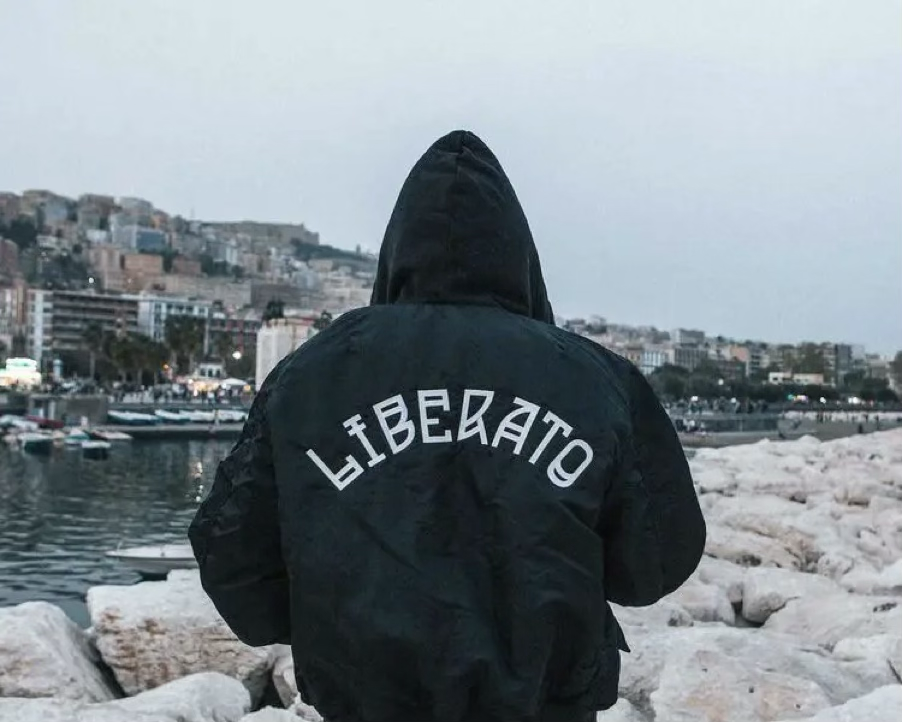
The communication design behind this project relies on a minimal but maniacally consistent set of symbols: a black bomber jacket with bold, unbranded white typography, the stylized graphic of a rose, and the use of the Neapolitan dialect treated almost as a distinct typographic and sonic texture. These elements function as a uniform and a logo, completely replacing the traditional artist photoshoot.
This world is then expanded into a cinematic universe, primarily through music videos directed by filmmaker Francesco Lettieri. Rather than standard promotional clips, these videos are serialized short films with recurring characters and intersecting storylines, framing the city through a specific, highly aestheticized lens. The audience does not follow a celebrity; they follow a carefully designed mythology.
What this case study demonstrates is a significant shift in the objective of communication design. The strategic goal here is not to build an idol, but to design a hyper-local myth. By translating a geographical and cultural identity into a precise, reproducible visual framework, the designer creates an iconography strong enough to sustain a massive commercial project entirely without a human face.
