In the current music industry, dominated by the dematerialization of streaming and the algorithmic logic of social media, the paradigm for emerging artists has radically changed. In a hyper-saturated market where the barrier to entry for releasing a track is practically non-existent, competition is no longer based exclusively on the sonic component. The real challenge for an independent artist, lacking the financial backing and support of a major record label, is managing to stand out in the endless user feed.
The solution to this positioning problem is not purely musical, but profoundly design-oriented. The answer lies in worldbuilding—the ability to construct a visual and narrative ecosystem around one’s music. To break through, artists must become their own art directors. When massive promotional budgets are absent, a rigorous, recognizable, and hyper-coherent visual infrastructure becomes the primary driver of value. Design is no longer a decorative embellishment added at the end of the musical process; it is a strategic architecture conceived alongside the track itself.
An emblematic case study in the recent Italian scene that illustrates this dynamic is the trajectory of Sayf. Even before achieving top-tier institutional positioning—culminating in his appearance at the Sanremo Music Festival, Italy’s premier televised musical event—Sayf built his entire fanbase by leveraging Instagram with surgical precision.
His emergence strategy did not rely on the compulsive release of songs, but rather on the seriality of a highly precise visual format. Sayf began by posting short freestyle videos on social media, all bound by strict and immutable design rules. Analyzing his pre-success content reveals a very clear design grid:
- Color Grading: A recognizable and constant color palette in every video, giving his feed a cinematic atmosphere that instantly set him apart from other emerging rappers.
- Framing and Composition: A personal and intimate shooting technique, designed not to mimic a high-budget music video, but to create a sense of visual proximity with the smartphone user.
- Typographic Format: The use of a subtitle system that was always identical in font, size, and placement. In a context where social media content is often consumed “sound-off,” this typographic grid became a crucial visual anchor.
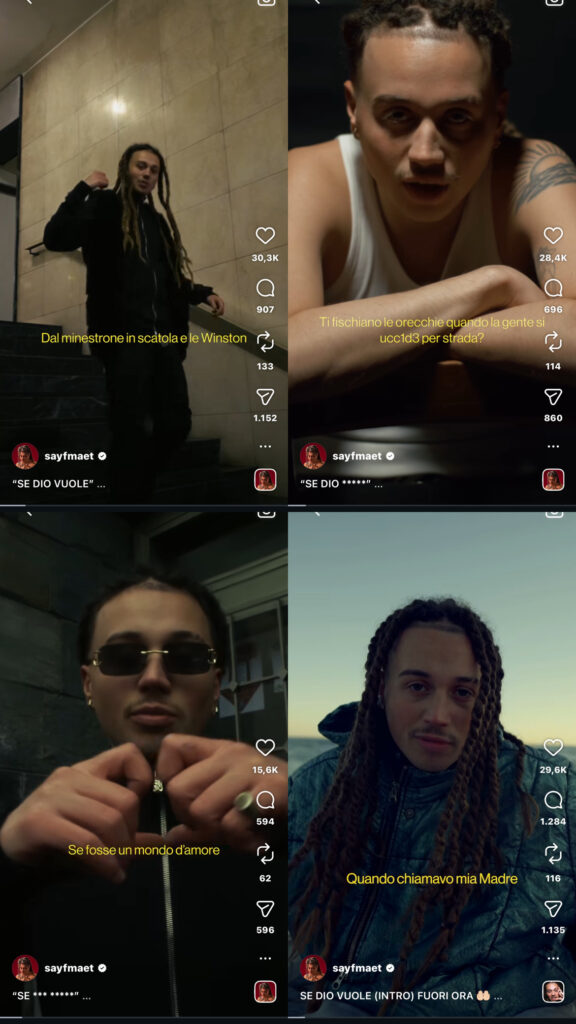
The hyper-coherence of this setup allowed Sayf to transform simple Instagram videos into a proprietary format. Users scrolling through their feeds—even before turning on the audio and hearing the lyrics—could recognize the colors, the framing, and the font, instantly associating them with his narrative world.
The Sayf case demonstrates a fundamental principle of modern music marketing: the coherence and solidity of a visual project can effectively compensate for the lack of a large production entourage. Designing sharp aesthetic boundaries does not limit the artist’s creativity; on the contrary, it generates the recognizability needed to turn a newcomer into a cultural brand capable of climbing the charts.
