Before diving into the core of this reflection, a special acknowledgment is necessary. This specific analysis is the direct result of academic networking, and I want to thank Didi for connecting me with Franzi, a fellow researcher currently based in Seoul. Her insights into the South Korean design and marketing landscape completely opened my eyes to a market I knew nothing about, allowing me to push my research far beyond its initial Western-centric focus.
When we analyze Communication Design in the contemporary music industry, we often focus on how artists construct visual architectures around their releases. However, building a “narrative world” is only half the job. According to the principles of Transmedia Storytelling, a worldbuilding strategy can only be considered successful when the audience actively inhabits it. The ultimate metric of a working design is the fandom. If fans decode the visual rules, engage with the ecosystem, and build a sense of community around it, the design has fulfilled its purpose.
While Western artists are experimenting with these concepts, the Korean music market (K-Pop) is lightyears ahead. In South Korea, the creation of a fandom is not left to chance; it is a highly engineered process where design, marketing, and cutting-edge technology merge. Specifically, the Korean industry has embraced Generative AI far more aggressively than the European market, using it as a structural tool to design these complex narrative worlds.
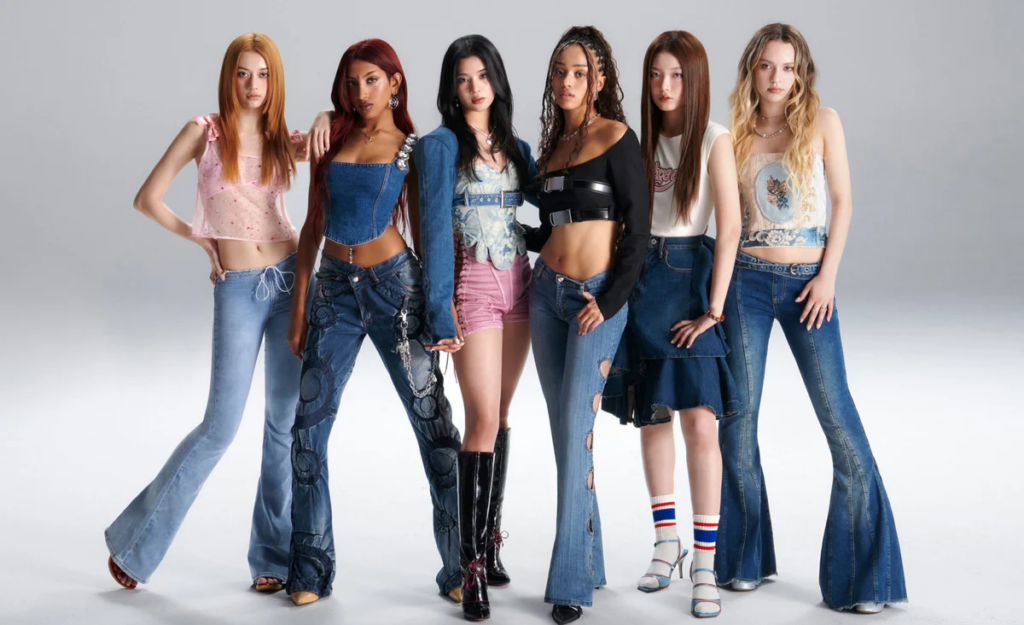
A perfect case study of this phenomenon is the group Katseye. Formed through a crossover collaboration between an American and a Korean label, they represent a fascinating hybrid: a global girl group designed for the international market, but entirely built using K-marketing strategies. From the meticulous curation of their visual codes to the heavy integration of AI in their promotional ecosystem, Katseye exemplifies how to systematically trigger community engagement.
Their visual branding isn’t just about looking good; it’s about creating shared feelings of belonging among millions of fans across the globe. Thanks to this new perspective, it becomes clear that the future of music marketing lies precisely in this intersection: using advanced technological workflows to design visual worlds that fans actually want to live in.