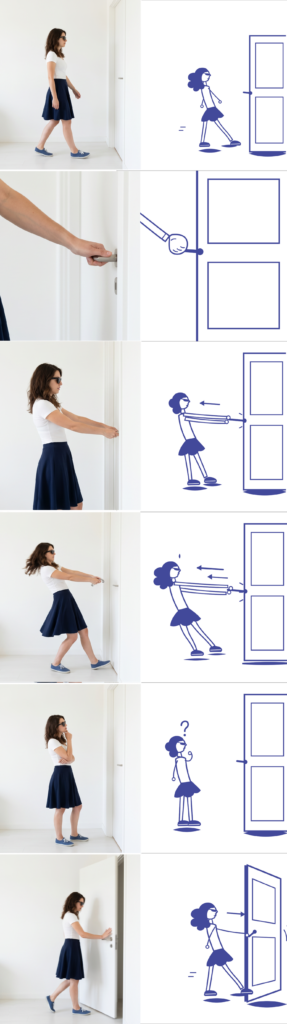
Both versions of the door story are now made. Both are AI: the illustration as vector code, the photographs from Firefly, which I kept generating and curating until they held together as one set instead of drifting frame to frame. Are they exactly the same quality? I am honestly not sure, and I have decided not to pretend otherwise. That uncertainty is part of the question now, which is why one of the questions below asks the viewer about it directly, so the data can speak instead of me claiming the sets were equal.
The story
The first of the three stories is the door, the most banal thing imaginable, which is exactly why it works. A woman walks up to a closed door. She grips the handle and pulls. It does not open. She pulls harder, leaning back with real effort, and still nothing. She stops, confused. Then she pushes instead, and the door swings open. The small joke underneath is something everyone has done: when a door does not work, we blame ourselves and pull harder, instead of trying the other direction.
Both versions tell this in six frames. The illustration uses its own language: arrows for the pulling direction, small marks for effort, a question mark for the pause. The photograph uses its own equivalents: the strain in the body, the hair caught in motion, the door actually swinging. Same story, same six beats, two visual languages.
How people will see it
This time everyone sees both versions, not one. But the order is split. One group sees the illustration first, then the photograph. The other group sees the photograph first, then the illustration. The reason for the swap is simple: whichever version you see first can bias how you judge the second, so flipping the order between the two groups balances that out.
The form has two phases. First the solo phase: you see one version and answer about it before the other version ever appears. Those first answers are a clean reaction to that medium on its own. Then the comparison phase: both versions are shown together, and now the comparing questions are easy to answer honestly, because both are right in front of you. So one form captures two things at once, how each medium works alone, and how the two feel side by side.
The questions
Solo phase, asked about the first version before the second is shown. Comprehension always comes first, so the form does not give away the answer.
- In one sentence, what is happening in this story? Open text, no hints. The most important question.
- How clear was each step? 1 to 5.
- At what moment did you understand the door had to be pushed, not pulled? This checks whether the joke landed.
- Which words fit the mood? A fixed list, the same for everyone: funny, serious, warm, cold, friendly, technical, calm, frustrating.
- How much does this feel like something you would actually follow? 1 to 5.
- Did this set feel consistent and finished? 1 to 5. This is the quality check.
Comparison phase, both versions now visible.
- Which version was clearer? Which felt warmer or friendlier? Which would you trust more as a real instruction?
- Which one stayed in your head more, and why?
The same questions go to both groups, only the order of the two versions swapped. Two forms, spread as evenly as I can, and then the real work begins, which is reading what the two groups did differently. The next block is the shower and the phone, built the same way, and after that the results.