So…this chaper has been a struggle start to end. I need a character design to model it in 3D. But I can’t affort to put all the time to create a perfect design. So I want to be okay with a “mediocre” design, but I don’t want to be insensitive to different culture and fall into bad stereotypes. The first design I did was exactly that thogh.
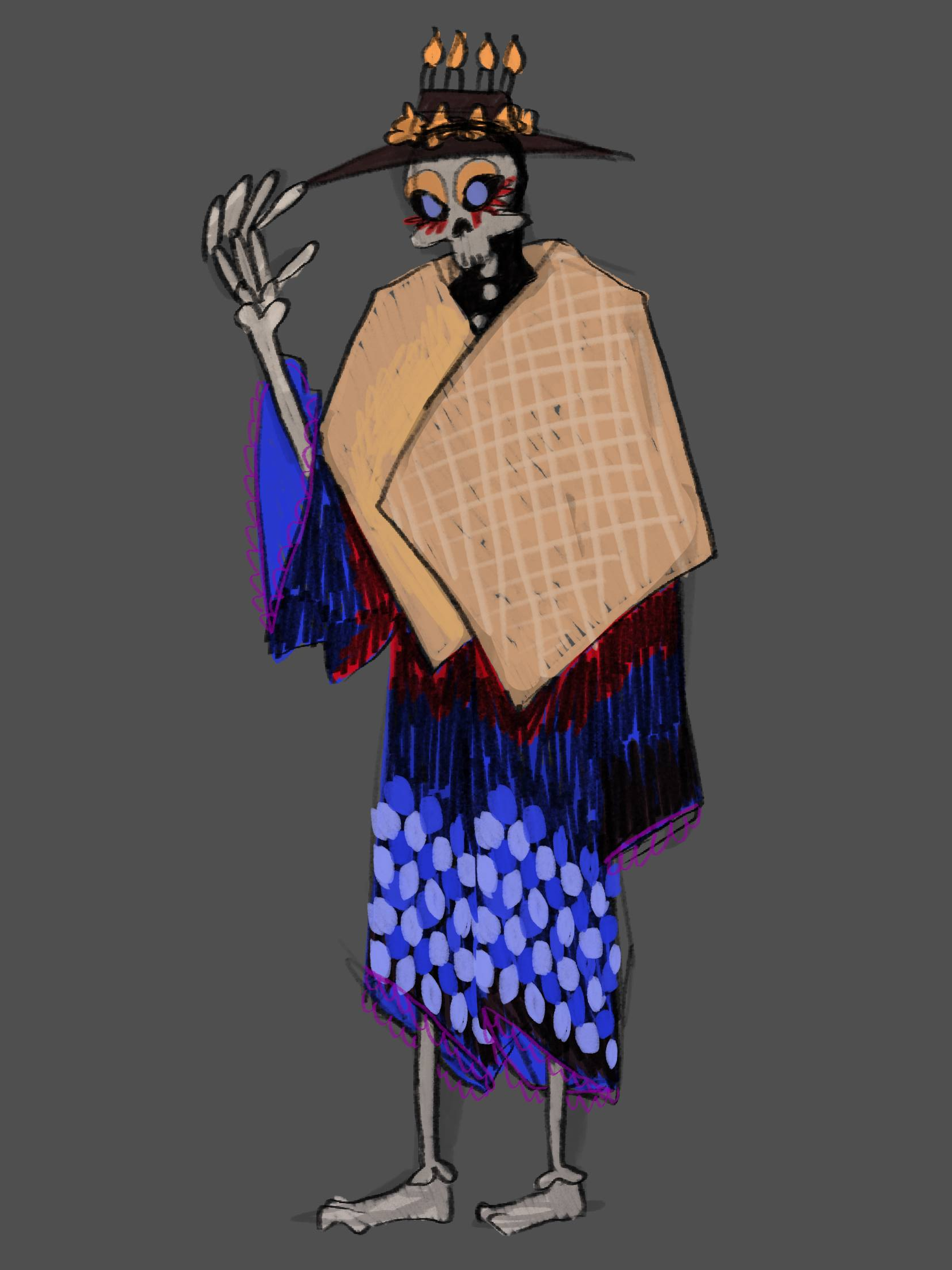
The beige cloth represents Famadihana. It’s the plain cotton cloth the corpse gets wrapped in.
The skeleton and shape of the clothes are from the grim reaper. However the make-up and colors are inspired by Día de los Muertos and Día de los Difuntos.
The hat is also inspired by Día de los Muertos and All Saints day, as it has Cempasúchil (marigold) and candles on it.
I got input from Elizabeth Treviño as a “representative” for Día de los Muertos (thanks again!) and she said that this design feels a bit uncanny, because there is aspects from it but not really. Her feedback was that it would be better that I design a character for each culture and put my own spin to it because the designs are never the same anyway. I’m just worried about the fact, that those things already exist, so why do I even do it. However as for the time constrains I’ll put that thought on ice and design my character for Día de los Muertos (as I have someone from this culture on hand).
So I looked more into Día de los Muertos and especially La Catrina. Here are some inspo photos I found from other representations.
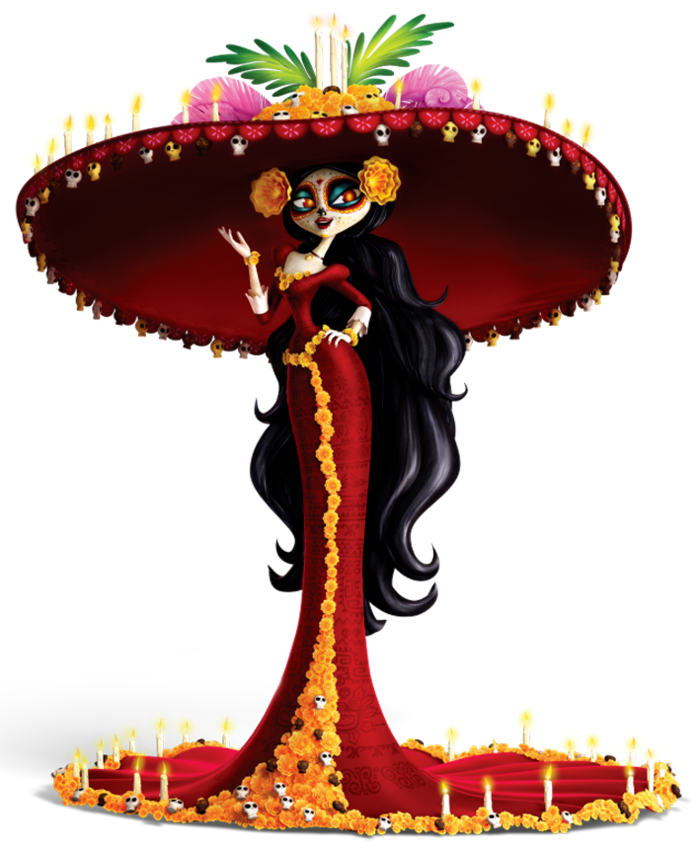
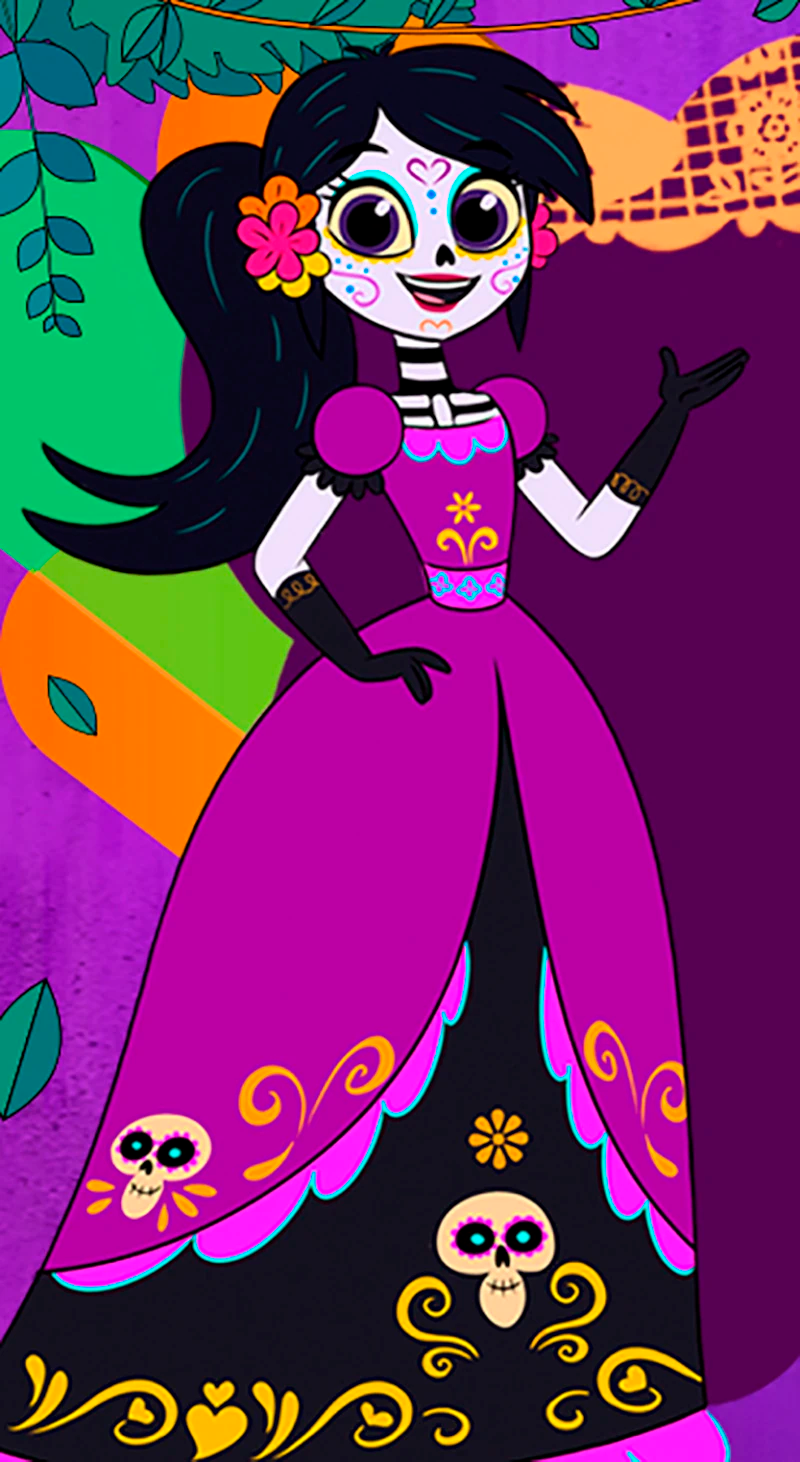
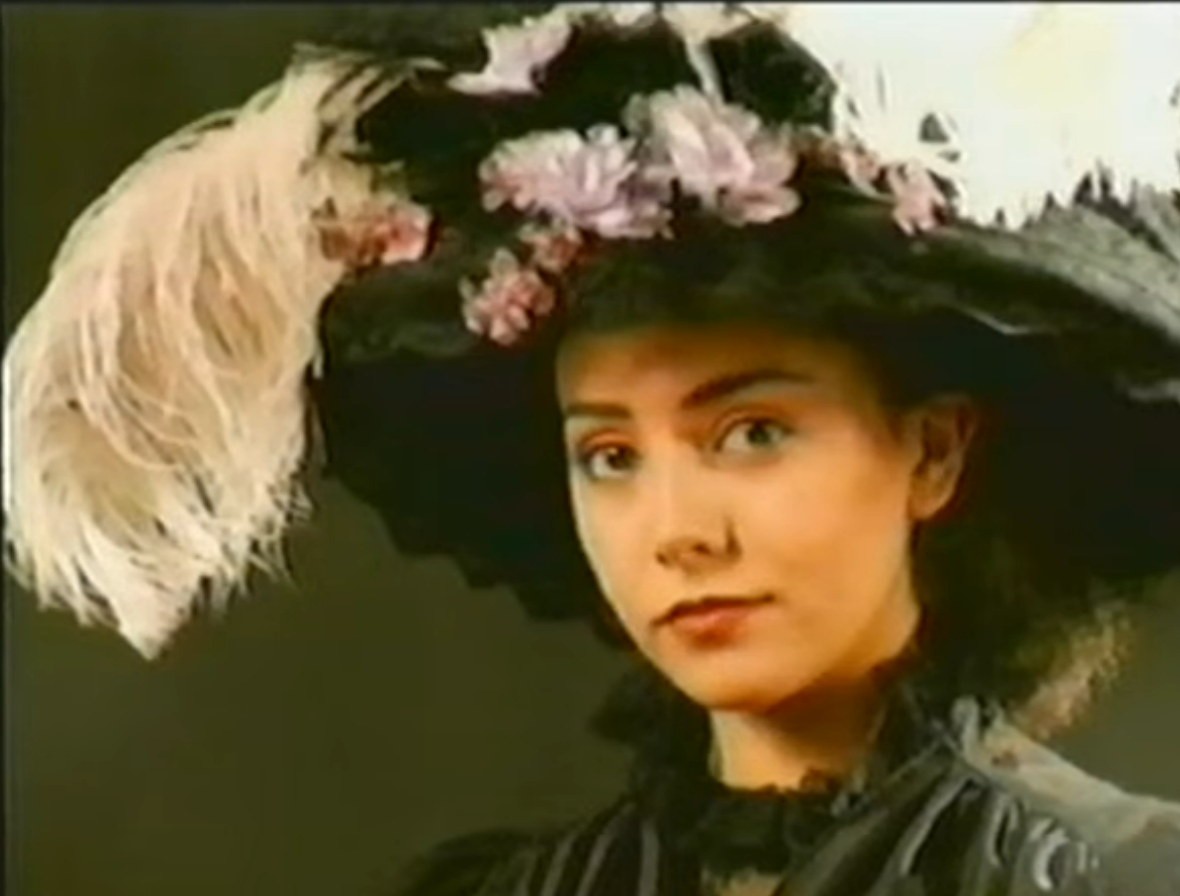
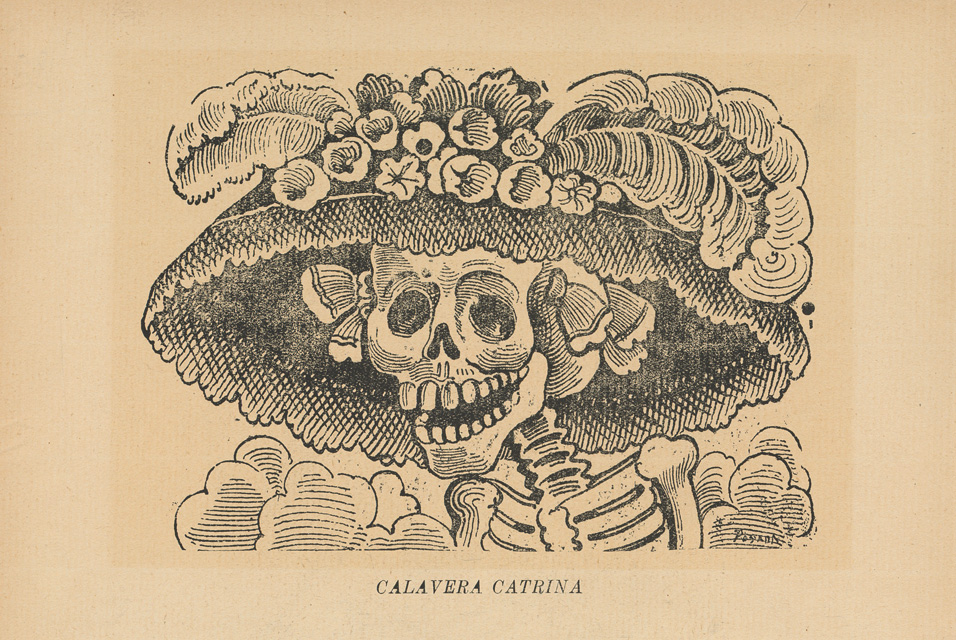
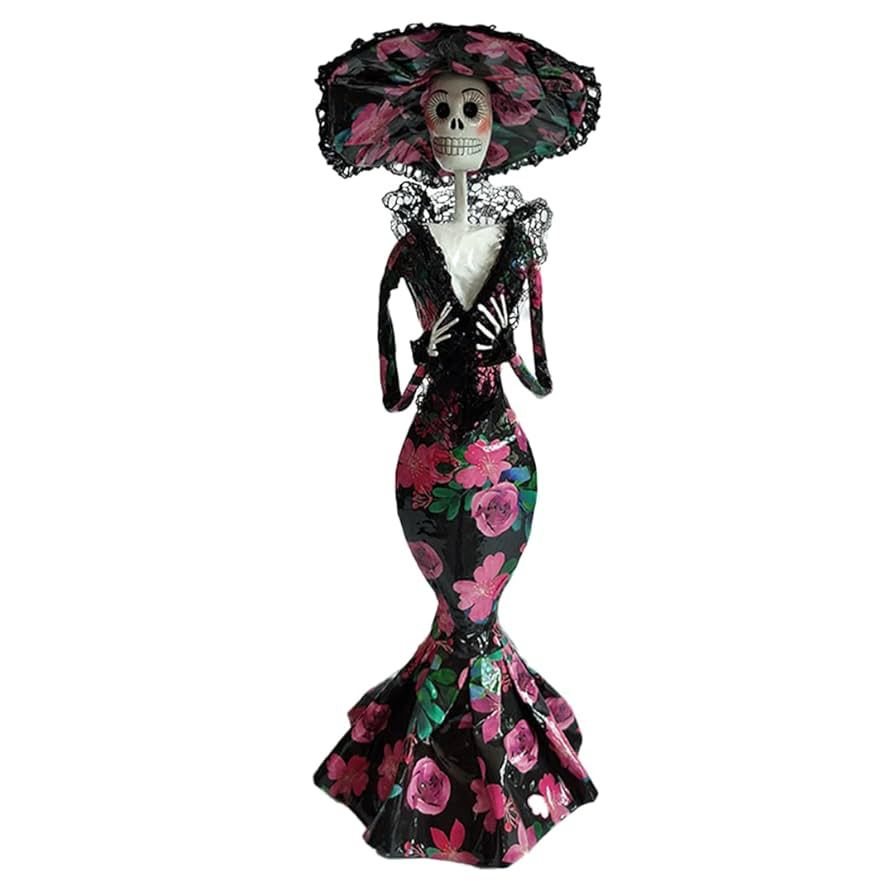
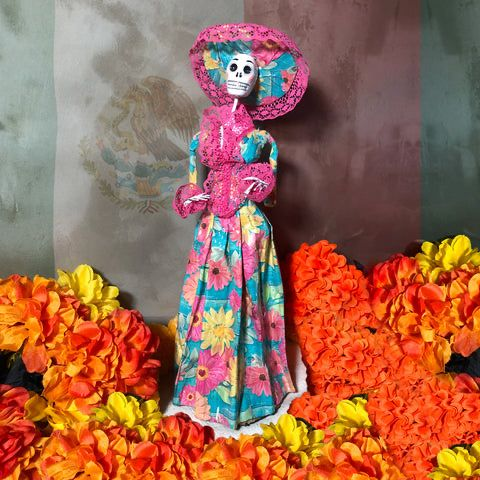
I then came up with this design and sent it to Eli again.
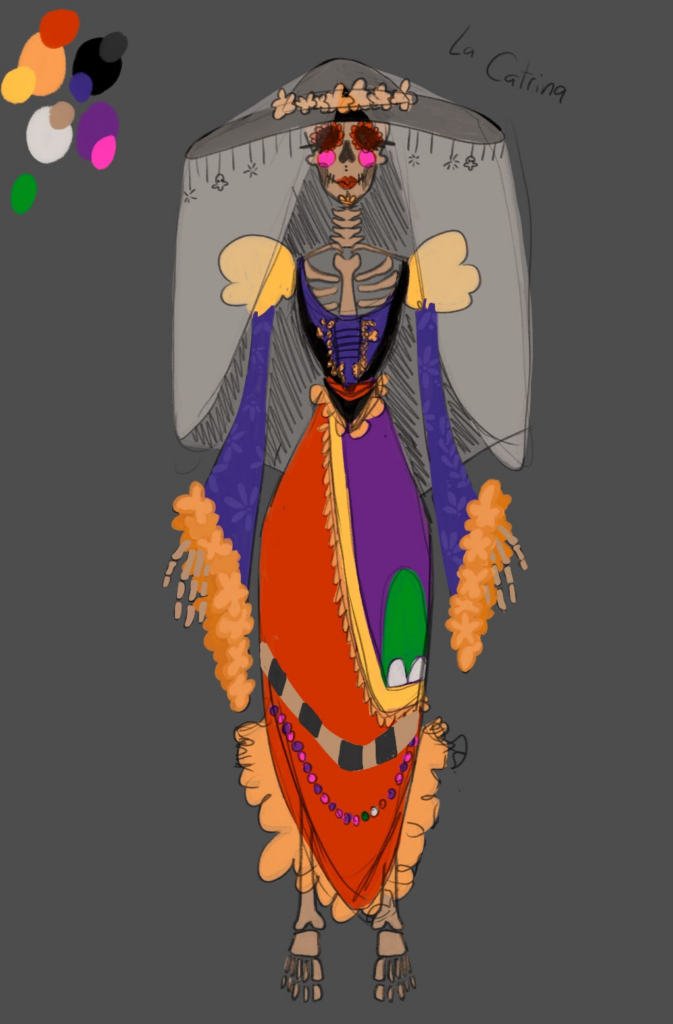
Combined with the questions I asked her she confronted me with the question “Do you even researched Día de los Muertos?”, which made me (embarassingly) realise that I didn’t do that enough.
So here is my (still too little but I ) research on specifically La Catrina.
Día de los Muertos and La Catrina…wait what?
“Día de los Muertos has its roots in Pre-Columbian cultures and beliefs. Before the Spanish arrived in what is today Mexico, the Aztec gave offerings to their deceased ancestors as part of their death rituals. After the Spanish came, the celebration morphed to incorporate Catholic beliefs and practices, creating this deeply religious, syncretic tradition. The tradition has been largely associated with the Mexican working class, but the country’s middle class has rediscovered it in recent years for two major reasons: The celebration’s appearance in pop culture, and it’s popularity in the U.S.”
Dobrin, I. (2017, November 2). Día de los Muertos comes to life across the mexican diaspora. NPR. https://www.npr.org/2017/11/02/561527322/mexicos-celebrated-d-a-de-los-muertos-evolves-in-the-u-s
“Santa Muerte is generally portrayed as a skeleton wearing a Fanciscan monk’s cape, in a standing posture, or sometimes seated at a throne, with a scythe in her right hand and the earth or the scale in her left. She can also carry a candle, a book, or a spade, and is often accompanied by an owl, by seeds, and by coins. Variations to her outfit include a Virgin Mary-like robe and veil, a girl’s first communion dress, or bride’s gown, an “Aztec” Santa Muerte, and a seven- colored one, among others, depending on the occasion and petition. On some images, her scythe is portrayed in the form of a human spine. Offerings to Santa Muerte include veladoras (votive candles), statuettes, flowers, incense, fruits, sweets, smoking cigars and cigarettes, as well as alcohol. he colors are red for love, passion, and relationships, white–for purification, black—for and against black magic, the elimination of negativity and total protection, violet—for health and transmutation, gold or yellow—for money and prosperity, blue—for spiritual concentration and studies, and green—for legal problems and justice.”
Oleszkiewicz-Peralba, M. (2013). Representations of Death in Mexico: La Santa Muerte. The University of Houston Libraries, 1(1). https://uh-ir.tdl.org/handle/10657/3007
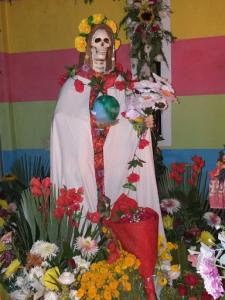
“Included in these fall festivals are two familiar faces whose skeletal visages afford them special attention during the season, despite the fact that neither one is historically connected to these holidays. Santa Muerte is a Mexican folk saint who personifies death in the form of a female skeleton. Whether as a gold medallion, or statuette, or votive candle she is typically depicted as a Grim Reapress, wielding the same scythe and wearing a shroud similar to that of the Grim Reaper, her male forebear. Unlike canonized Catholics, folk saints are believed to be spirits of deceased Latin American women and men considered holy for their miracle working powers. What really distinguishes the White Girl (another popular sobriquet), however, from other regional folk saints is that for most devotees she is the personification of death itself and not of a real woman that lived and died on Mexican soil. La Catrina, the Skeleton Dame, is often confused by the unfamiliar with the Skeleton Saint, Santa Muerte, but they are very different figures. While the former issued from a satirical drawing, the latter is a figure of spiritual reverence. La Catrina originated in 1910, from the pen of José Guadalupe Posada who is considered the father of Mexican print-making. La Catrina was one of thousands of sketches of skeletons garbed in European finery that derided the vanity and opulent lifestyles of the upper classes whose extravagances were at the expense of the suffering lower classes. The message Posada was conveying was that no matter one’s wealth or status, no one escapes death and indeed the phrase “todos somos calaveras” (we are all skeletons) is often attributed to the illustrator. In this manner, la Catrina resembles Santa Muerte in that she serves as a reminder of the inevitability of death, however beyond this there are no further similarities apart from that both are female skeletons.”
Chesnut, A. (2021, October). Representations of Death in Mexico: La Santa MuerteMeet the Mexican Death Trinity – Day of the Dead, Catrina Calavera and Santa Muerte [Online forum post]. The Global Catholic Review. Retrieved June 27, 2026, from https://www.patheos.com/blogs/theglobalcatholicreview/2021/10/meet-the-mexican-death-trinity-day-of-the-dead-catrina-calavera-and-santa-muerte/
My learnings
I learned that Santa Muerte…exists and is more the character I’d like to design. So in my next blog post I will design Santa Muerte, not La Catrina or any mixture of characters. I found lots of input about what colors to use and how it should look like in general.
I hope the fact that I was so unknowledgable at first and haven’t offended anyone. If I did or got anything wrong – please do contact me.
