The term Design Fiction was first introduced by Bruce Sterling in Shaping Things (2005) to describe a practice that occupies a space between design and science fiction. While science fiction is often driven by narrative and imagination, Design Fiction remains more directly connected to design practice and to the possibility that what is imagined might one day become real. It is less concerned with predicting the future than with creating believable scenarios through which future possibilities can be explored. Today, Design Fiction is generally understood as a convergence of scientific inquiry, storytelling, and design. Like Speculative Design, it relies on speculation as a way of thinking about alternative futures, but it places particular emphasis on plausibility. The challenge is not simply to imagine a different world, but to make that world feel convincing enough to be taken seriously. This is why so much attention is given to diegetic prototypes: objects, products, and technologies that do not exist, yet appear within a narrative as though they already belong to it. They are far more than props or visual details. By giving material form to an imagined future, they help transform abstract speculation into something tangible and relatable.
This marks one of the key differences between Design Fiction and Speculative Design. Speculative Design often begins with an object, using it as a catalyst for questions, discussions, and critical reflection. Design Fiction, on the other hand, tends to begin with a story. The narrative establishes the world, and the objects are designed to support it, enrich it, and make it believable. Storytelling therefore becomes the primary vehicle through which ideas are explored and futures are experienced. Audiovisual media such as film, animation, sound, and digital environments are frequently used to deepen immersion, allowing audiences to engage with fictional worlds not as distant possibilities but as lived experiences. As Julian Bleecker writes, «Design objects are totems through which a larger story can be told, imagined or expressed. They are like artefacts from elsewhere, telling stories of other worlds» (Bleecker, 2009).
From this perspective, Design Fiction occupies a territory somewhere between empirical science and science fiction. Science defines what is possible through evidence, observation, and established principles. Design Fiction deliberately steps beyond those boundaries, creating space for possibilities that may appear unlikely, unattainable, or even impossible. Its value lies not in proving that a future will happen, but in exploring what that future might reveal about the present. Although Design Fiction has not yet achieved formal recognition as an independent discipline, it has become an increasingly important tool for designers, researchers, and futurists. As Gabriele Ferri argues, it enables the exploration of (im)possible scenarios capable of offering «a provocative contrast with our current society». Yet imagining alternative worlds is only part of the challenge. Making those worlds believable requires careful construction. As Jerry Jenkins observes, fictional worlds need their own rules, environments, populations, and cultures. These elements must be developed with enough coherence to allow audiences to engage with them without constantly questioning their logic. What often makes a speculative world compelling is not its distance from reality, but the balance it establishes between familiarity and novelty. We recognize something of our own world within it, while simultaneously encountering something unexpected.
James Auger explores this issue in greater depth in Beyond Speculative Design: Past – Present – Future (2021), where he identifies several strategies for making speculative narratives more engaging and credible. The Ecological Approachplaces unfamiliar or speculative technologies within ordinary contexts, allowing the strange to coexist with the familiar. The Uncanny operates through emotional resonance, drawing on themes such as death, loneliness, desire, and pain to create a sense of unease that lingers beyond the experience itself. Familiarities work by embedding everyday details into fictional worlds, reducing the distance between the audience and the scenario being presented. Finally, Alternative Presents shift attention away from distant futures by imagining parallel realities that branch from actual historical events. Rather than asking what the future might become, they ask how the present might look if history had unfolded differently.
What Auger’s framework makes clear is that credibility in speculative narratives rarely depends on technical sophistication alone. More often, it emerges from emotional and experiential proximity. The closer a fictional world feels to things we already know, recognise, or experience, the easier it becomes to step inside it and temporarily accept its logic. This principle sits at the heart of fictional design. The goal is not simply to invent objects or technologies, but to create worlds that audiences can inhabit, even if only briefly. The artefacts themselves do not necessarily need to function; they need to feel coherent within the reality they belong to. Fictional design does not simply describe a future. It stages it, materialises it, and allows people to experience it.
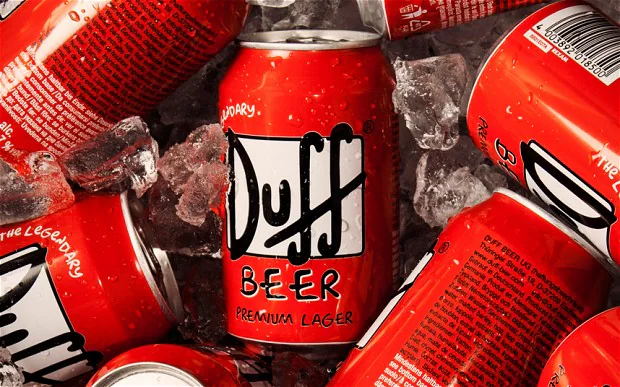
Fictional brands provide a particularly revealing example of this process. Some products that began as inventions within fictional worlds have eventually crossed into reality. Duff Beer, originally created for The Simpsons, was later produced and sold. Nuka-Cola, from the Fallout series, has appeared in limited-edition releases aimed at fans. Even Brawndo, the fictional energy drink from Idiocracy, was eventually transformed into a real product. These cases demonstrate how a well-constructed narrative can generate tangible outcomes, creating emotional connections that persist long after the fiction itself has ended.
For this reason, the distinction between Speculative Design and Design Fiction is often less rigid than it first appears. In Speculative Design, an artefact may become the starting point from which a narrative emerges; in Design Fiction, a narrative may provide the framework from which objects are developed (Neeley, 2024). In practice, however, these processes frequently overlap. Objects inspire stories, stories shape objects, and both contribute to the construction of alternative worlds. The boundary between the two remains deliberately porous, and it is precisely within this overlap that some of the most interesting possibilities for design begin to emerge.
