Discussions of the grid typically focus on pages, screens, or magazines. However, there is a considerably larger version of the grid that people navigate daily without necessarily recognizing it: the city street grid. A city’s layout follows several of the same psychological principles as a page layout, simply applied at a much greater scale.
Manhattan provides a clear illustration. In 1811, city planners introduced the Commissioners’ Plan, which divided most of Manhattan into a strict grid of straight streets and avenues. Before this plan, cities typically developed in a more organic, irregular manner, with streets shaped by existing paths, rivers, or agricultural boundaries. The Manhattan grid represented a departure from this pattern: it was designed in advance, on paper, in a way comparable to a designer planning a page layout before the actual content, in this case buildings and people, existed.
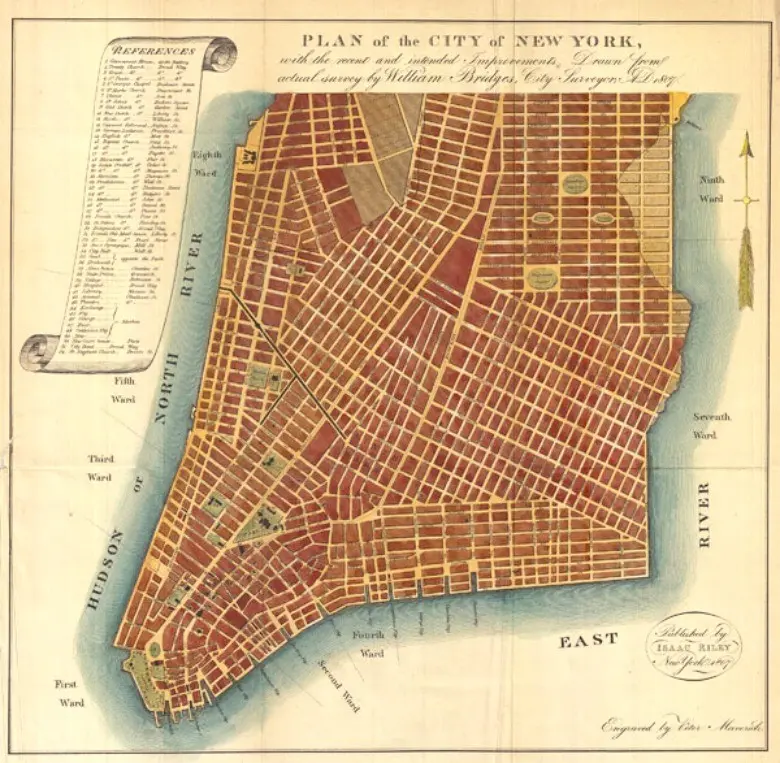
This grid offered practical advantages similar to those found in a page grid. It simplified the division of land into equal blocks, facilitated construction, and made navigation considerably easier. Knowing that streets run in one direction and avenues in another allows a person to estimate their location even in an unfamiliar part of the city. This is comparable to how a reader can anticipate the position of the next paragraph on a well-structured page, based on an understanding of the underlying system rather than conscious analysis.
Architecture extends this principle further. Le Corbusier developed the Modulor system during the twentieth century, a set of measurements based on human body proportions, intended for use in building and furniture design. This bears a notable resemblance to the baseline grid used in typography, where every text element aligns to a consistent unit derived from what is visually comfortable for the human eye. In both cases, the underlying goal is the same: to create a system based on human proportions, producing spaces that feel naturally comfortable rather than arbitrary.
This connection between architecture and typography does not appear to be coincidental. Humans appear to have a consistent psychological need for spatial orientation, whether reading a page or navigating a street. When space follows a predictable pattern, the brain expends less effort determining location or direction. This reduces stress and contributes to a sense of safety, even when the underlying structure is not consciously perceived.
Not every city follows a strict grid, just as not every page does. Many European cities, including Rome and Paris, developed gradually over centuries, with streets shaped by historical circumstance rather than deliberate planning. Such cities can feel atmospheric or distinctive to navigate, but can also feel disorienting, particularly to unfamiliar visitors. This parallels the distinction discussed earlier between a strict Swiss-style layout and a more decorative, complex one. Neither approach is inherently superior; each produces a distinct experience for the person moving through it.
Grid-based cities often face a criticism similar to that directed at grid-based page design, namely that they can feel rigid or impersonal. Critics have noted that an overly strict grid can disregard natural landscape features such as hills, rivers, or coastlines, much as a strict page grid can occasionally feel disconnected from the content it organizes. This may explain why many contemporary urban planners now combine grid structures with more flexible, organic elements, an approach comparable to how modern web designers integrate strict grids with intentional departures from them for visual interest.
In conclusion, whether the subject is a city block or a magazine page, the underlying psychological requirement appears consistent: sufficient structure to provide a sense of orientation and safety, balanced against sufficient flexibility to avoid a sense of confinement. The grid, understood this way, is not merely a design convention but one of the oldest tools used by humans to organize space, whether that space spans a single sentence or an entire city.
