Last month, the sound designers and exhibition designers of FH Joanneum jointly participated in an excursion to the Ars Electronica Center in Linz. The center is a museum that focuses on new media art and is most renowned for its annual festival, the Ars Electronica Festival, which critics have praised as a pivotal exhibition in the digital arts. It is widely considered one of the best known creative arts festivals in Austria. Over the years, the people behind the center have been praised for their unique integration of technology into the creative field. They also have a dedicated inhouse research facility called the Futurelab, which focuses on modern technological advancements, particularly artificial intelligence.
There were a lot of engaging exhibits. Some memorable ones included the fascinating “tardigrade” under a microscope, as it made its way through its tiny surroundings. These remarkable creatures are incredibly resilient, capable of withstanding extreme temperatures and are known to be some of the only organisms able to survive in outer space. Another interesting part of the excursion was the Deep Space 8K experience, which drew us into a world of 3D visuals. We heard various soundscapes, ranging from the planets of our solar system to our oceans, and even the unique art of yodelling.
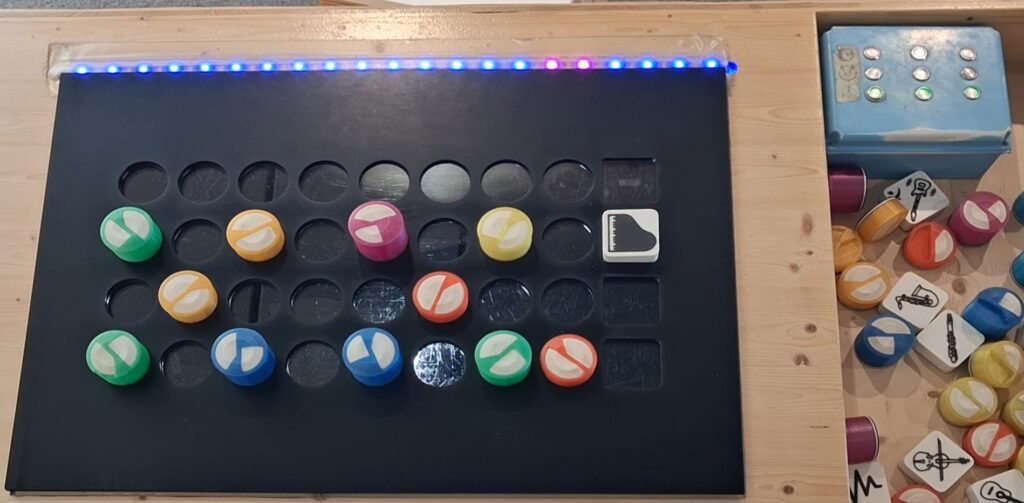
The exhibit I would like to speak about in detail is the simple sequencer, which was located in the Kids Research Lab on the first floor of the building. I really enjoyed the sequencer and felt like a kid again while playing around with it for some time. It was a really nice setup, especially for children who are curious about music and sound in general. It was a simple concept, but one that was very much fun to use due to the various patterns you could recreate.
The sequencer was off by default, so you had to place blocks (or tiles) representing a particular instrument onto the vacant slots to produce sounds. On the left hand side of the instrument block was the fill pattern, consisting of 8 distinct beats that the user could customize to recreate a unique rhythm. There was an LED strip on the top edge of the sequencer, which indicated the beat being played at the time. The beat blocks came in different colours and sizes. Some were taller than the others and had unique shapes on the top facing size. However, I was not able to decipher exactly what these could have stood for. This may have possibly been a measure used for quarter or half notes, but I am not entirely sure. The instrument blocks included an acoustic guitar, a piano, an electric bass and even a saxophone.
The sequencer could only accommodate 4 instruments at a time as there were only 4 slots available. Apart from this, there was also a small blue box on the right side of the sequencer with buttons featuring images of snares, cymbals and kick drums. I do not recall if these sounds played in sync with the sequencer but pressing them did produce the sounds of the instruments I just described.
Overall, I really enjoyed the visit and gained valuable insights from the unique exhibits. From the way they were presented to the overall setup of the installations, it was a good trip to explore and brainstorm ideas for our own installations at Klanglicht later this year.