This time I have taken a deep dive into a source from Arbeiterkammer once again. The report “PendlerInnenverflechtungen in der Ostregion” displays the different commuting streams happening in Lower Austria, Vienna as well as Burgenland. These three regions have a total of 1,3 Million employees of which only 18% live and work in the same commune (p. 1, Weninger, A. et al., 2021). I find this source especially enlightening since it covers a wide spectrum of mobility behaviors and needs from urban to rural.
Mapping commuting streams
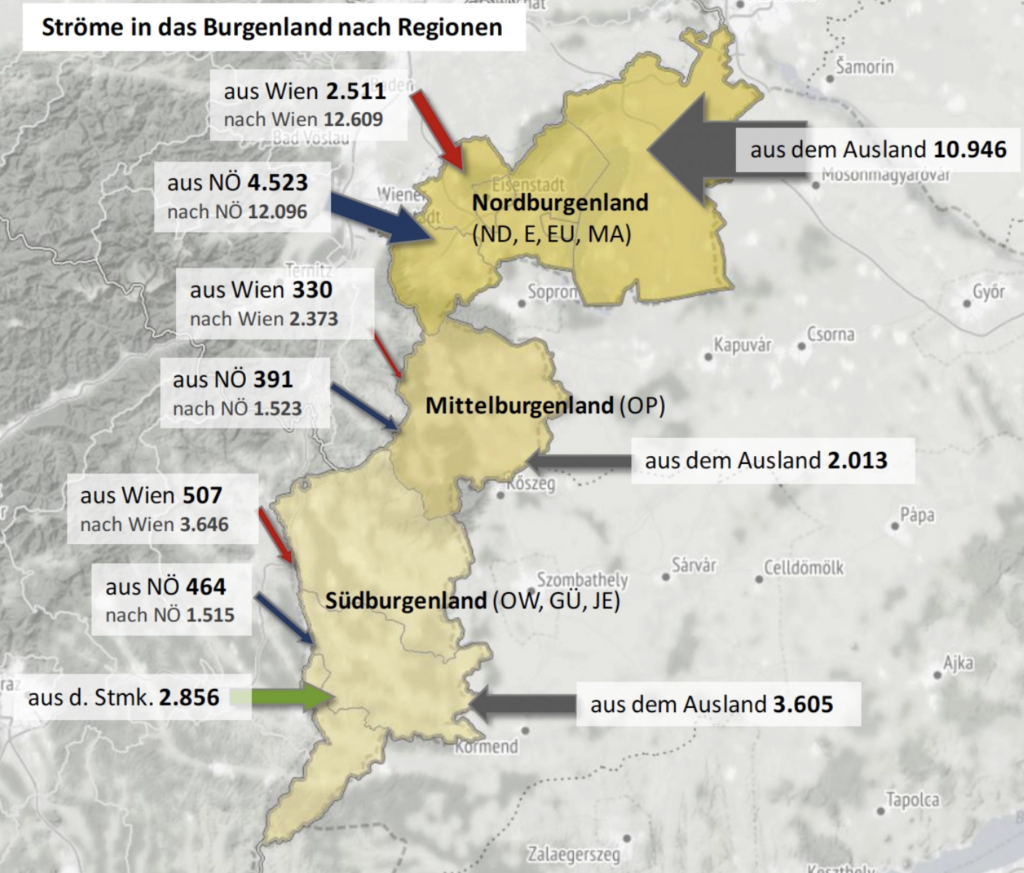
Image: Arbeiterkammer
This extraction for example showcases the commuting streams from as well as to the region of Burgenland. What’s especially notable is the behavior that can be observed in northern Burgenland. Due to it being close to two country borders the10.000 employees working in Burgenland but not living in Austria are off no surprise. However, it is notable that it’s even more – 24.000 employees living in Burgenland – that commute outside of their region to either Vienna or Lower Austria. (p. 18, Weninger, A. et al., 2021)
Commuting to school
While various challenges and needs of working commuters are pointed out the report additionally highlights that students commuting at the same time as workers can add lots of friction. Alongside considering alternatives for school starting times in the morning the concept of “Schulische Mobilitätsmanagement” (Mobility Strategy for Schools) is being proposed (p. 54, Weninger, A. et al., 2021).
This perfectly aligns with my vision for my prototype, as I am planning on testing it with high school students and not just workers.
Nudging as motivation
Alongside many other obstacles a lot of commuters seek to avoid overcrowded coaches. While trying to identify possible drivers to push commuters to adapt to public transit the report highlights the “Travel Smart Programme” introduced in Singapore, which is a reward system for which you can receive bonus points if you use less crowded coaches at an earlier or later time instead. The more points you have collected the cheaper your future tickets get (p. 67ff, Weninger, A. et al., 2021).
While I appreciate the effort of communicating the demand of different trains, I personally view the point based system as critical from an ethical standpoint. In my opinion the simple act of showcasing this demand without a reward system should be enough to “nudge” commuters. The bonus point system seems like a capitalistic extension that puts more pressure on users than relieving them from.
Picture credits: Bayrischer Rundfunk
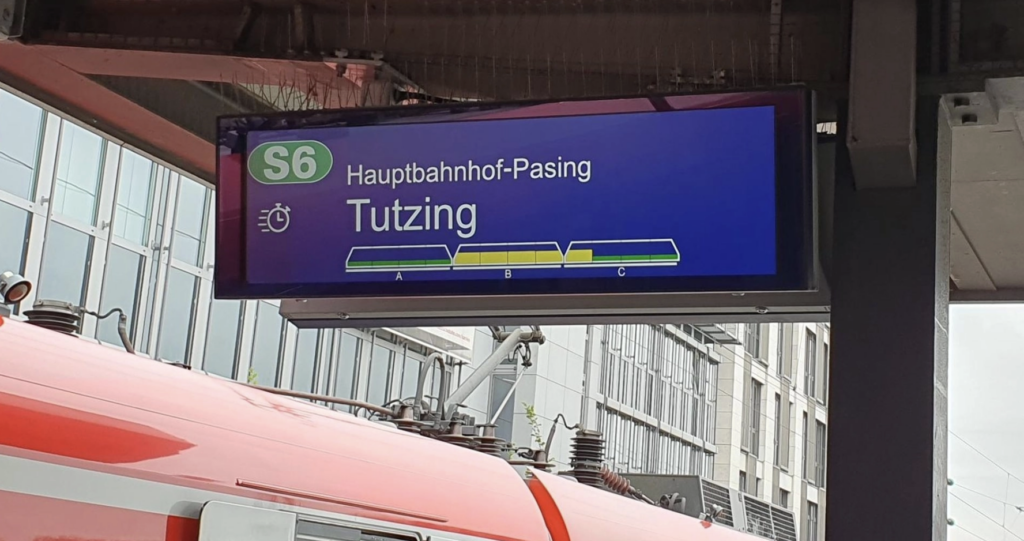
This is an example I’m familiar with from the S-Bahn in Munich. The display tells you how crowded the different coaches of the train are and allows you to strategically position yourself on the platform before entering the train.
