Furthermore, the type of movement has a direct influence on these phases. Creeping keeps both feet anchored to the ground longer, reducing friction and sound generation. Running increases efficiency but slams more explosive force into the ground. Walking sits exactly in the middle, creating a pendulum movement where energy transforms into gravitational motion, resulting in a predictable rhythmic pressure pattern.
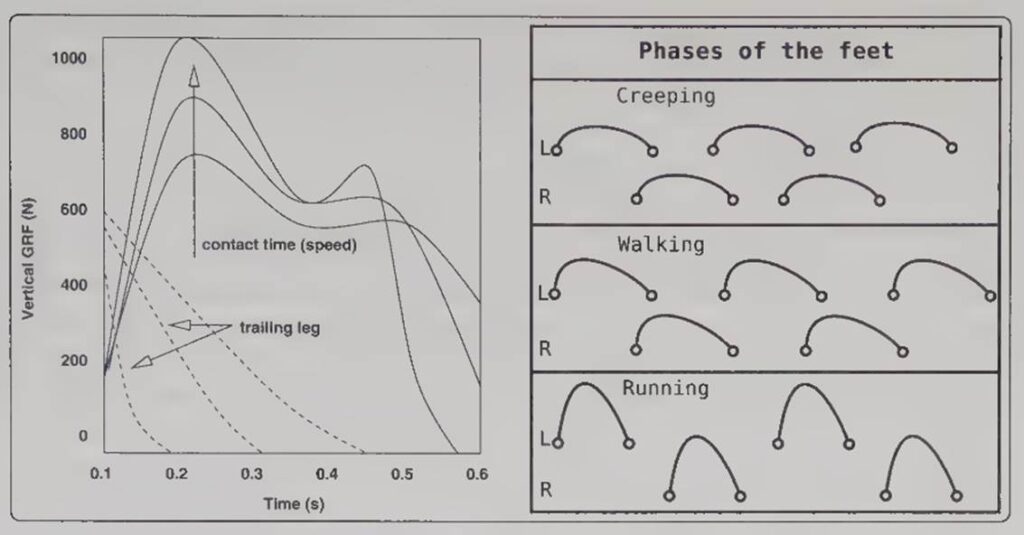
Foot phase changes with actor speed. Farnell 2010, 549
Foley artists must also think about the materials and textures of their shoes and the ground surfaces. Ground textures generally fall into four acoustic categories: solid floors known for stiffness, aggregate floors characterized by granularity and friction, liquid surfaces defined by viscosity, and hybrid materials that combine multiple traits. When you combine these surface textures with the structural makeup of a shoe, such as sole hardness, squeaky materials, or metallic buckles, you get an incredibly complex acoustic signature.
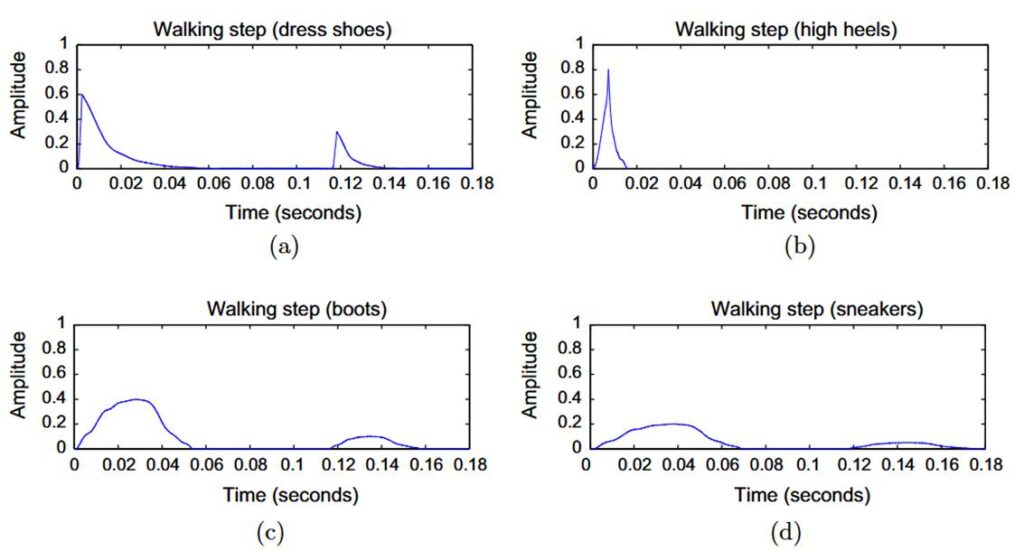
Comparison amplitude envelope for shoe types. Turchet 2016, 51
Farnell, Andy. Designing Sound. Cambridge: The MIT Press, 2010.
Turchet, Luca. “Footstep sounds synthesis: Design, implementation, and evaluation.” Applied Acoustics 107, 2016: 46-68.
