[DesRes 2 @KaterinaSedlackova] Change & Impact 2/3 – DesRes 2
After one semester I’m still happy with my chosen topic, or rather say topics (plural). I still believe that my thesis will make sense by combining the agile topic with the use case of cash registers. As one might already tell, simply by looking at blog entries, I had some struggle outlining and combining these two perspectives. Overall I think the working title Agile_x_SelfCheckout is a good approach to sum up what I’m working on.
For the future I have decided to cover each topic separately in my research. So for example in the first half of the next semester I will cover the “agile” perspective, and in the second half it will be all about the findings concerning the cash registers.
I have started my student job at REWE Digital some weeks ago. I already have a better perspective now on my responsibilities at work. The biggest benefit of collaborating with this company is that I have the access to the test systems and could perform detailed user tests, even including pseudo payments.
As for the blog entries this means that I have to be really careful about what information I am allowed to include in each entry. I have to make sure not to expose disclosed information that is to be kept a secret within the company.
So far I have put a lot of focus on self checkout solutions. However, it depends on my specific tasks and goals as an employee of REWE digital, which prototypes I will get to work on.
One things remains: whatever artifact I will be working on, I know that I will have the possibility to cover something relevant to the whole service design process.
The topic of accessibility remains my biggest concern. I would love to cover it, but once again, due to the possibilities within my employment, it still needs to be decided wether or not, this is a relevant topic or not.
I am looking forward to continuing working on this project and increase my expertise concerning agile project management, as well as getting a better understanding of the struggles users of both served as well as self checkout registers are exposed to.
I will kick off the next semester by adapting my research question to open more possibilities.

Mental Models are a powerful way to describe what is going on inside user’s brains. It gives us more cues about how they perceive certain things so we can empathize with their experiences [1]. Viable cues concerning mental models can be identified via different methods. A popular one is card sorting, it is especially relevant for challenges concerning information architecture. Furthermore, we can get a better understanding of user’s processes by observing how they interact and act in their current environment. Specifically in the grocery and retail context so called “PLU-lists” are a major artifact.
Every customer of a supermarket has already been exposed to this code – wether they know it or not. A PLU number is an international code, that defines products like fruits and vegetables. The PLU code for a banana typically begins with the number 4. Additional information, like country of origin of the product can also be identified through this code. Sometimes employees know this number, or at least specific selected numbers, by heart. In case they have to look it up, they have to take a look at a list – this is also where the name stems from: PLU stands for price-look-up code. [2]
I’m aware this might be a bold move, but I believe that a lot of online forums, especially via reddit, can be an interesting way to observe user’s and customer’s behaviour. This works for both – in a market research as well as a design related user research way. While this is obviously an informal way of researching something, I strongly believe it is of high value. It gives you first hand impressions of customers, and possibly even employees.
Down below I have found a picture, this is an example from Target that I found via Reddit. It was attached to a post, where an employee reached out to the forum in the r/Target subreddit, because they were curious about which codes are popular and commonly used.

Source: Reddit | r/Target | User: csrlrnz
While this subreddit has a rather extrem title, it definitely opens a new horizon concerning honest opinions of angry customer’s.

In contrast to reddit google reviews covers a larger range of customers. Clicking through various stores on google maps quickly gives you a good overview of different challenges customers and sometimes even employees face. This works efficiently via google maps, because they also give you options to filter the different reviews (e.g. by keywords)

[1]
M. Chan, “Mental Models and User Experience Design,” Nielsen Norman Group, Jan. 26, 2024. https://www.nngroup.com/articles/mental-models/
[2]
Bayerischer Rundfunk, “Lebensmittel Code entschlüsseln: Was bedeutet der PLU-Code auf Lebensmitteln?,” Www.br.de, Mar. 11, 2024. https://www.br.de/radio/bayern1/lebensmittel-code-entschluesseln-100.html (accessed Jan. 30, 2026).
While fonts and color choices are important to take into account, service design puts process and problems into deeper perspectives. Requirements and processes are strategically challenged, to align with business values. Therefore, the problem definition in service design outlines the user experience as well as other perspectives and puts employees, customers and other counterparts into relation.
In a supermarket this means all things from the back office and warehouse to the retail space as well as the cash registers have to be considered.
A powerful tool within the practice of service design is the so called Service Blueprint. I personally would describe a service design map as an extension of a user journey map. The fronst stage processes (1) describe all the steps that the customers can directly observe (e.g. scanning of articles). Back stage actions (2) highlight how the fronst stage steps are interfering and how they relate to what’s happening out of the customer’s sight. The line of invisibility (3) visually divides these two perspectives. Another mentionable part of a service blueprints are so called artifacts (4), also known as physical evidences (e.g. a receipt).

[1]
M. Stickdorn, A. Lawrence, M. Hormess, and J. Schneider, This is service design doing, applying service design thinking in the real world: a practitioners’ handbook. Sebastopol Oreilly & Associates Inc, 2018.
While the last few blog entries were focused on supermarkets and the overall topic of cash registers this time I would like to once again talk about the other aspect of my research topic: How to balance design ideas with IT and business goals.
One focal point I would like to discuss today is agile management. Agile is the opposite of the waterfall method. In waterfall requirements are defined and the design happens before the development of any code. As the term waterfall already promotes: there’s no going back. Once the requirements are set there’s no possibility of exploring new ones. However, especially in the human centered context new pain points of a product could be discovered in various stages of the research and design process. In contrast agile makes early involvement with the dev team possible. Small teams are working on a project and the objectives are being discussed in smaller steps and iterated within so called Design Sprints. [1]
A major tool teams are using to enable agile work and collaboration is Jira, developed by Atlassian. This tool has a wide range of possibilities. For the sake of this blog entry I will keep it short and simple and outline how one specific aspect within Jira works: User Stories.[2]
As a [function of the person] I want to [goal/perform an action] so that [benefit/value]
Example:
As the design team, we want to create a prototype for the MVP supermarketchain #1 so that we can gather feedback from potential users.
A user story consists of a simple statements that outlines the goals to be reached – It has to be mentioned that user stories are the smallest unit of work within a sprint.
The largest units are initiatives, these represent the overall goals over a long time span. Initiatives are commonly defined over periods such as a year. Epics are the next smaller unit and usually define the goals for quarter of a year.

According to Jon Yablonski, who looks at different psychological practices from a designers point of view, users can easier digest information once it’s broken down into smaller “chunks”, as he calls them.[3] If we keep this in mind I think that managing tasks via user stories is a powerful tool to keep everyone in a project team focused on their tasks.
[1]
E. Kavlakoglu, “Agile vs. Waterfall: What’s the Difference? | IBM,” www.ibm.com, Jul. 25, 2024. https://www.ibm.com/think/topics/agile-vs-waterfall
[2]
M. Rehkopf, “User Stories,” Atlassian, 2019. https://www.atlassian.com/agile/project-management/user-stories
[3]
J. Yablonski, “Chunking | Laws of UX,” Laws of UX, 2024. https://lawsofux.com/chunking/
I kenn mi net aus mit der Neumodischen Einkauferei – S’verwirrt mich, man kann niemanden was fragen. Ollas muss man erst studieren.
(ORF, 1962)
Translated: “I’m overwhelmed with this modern way of shopping. It confuses me, there’s nobody I can confront with my questions. I have to study everything [all the products]”
In my last Blog post I discussed the topic of interaction and communication of customers and employees in the supermarket. With WHY do people still appreciate it (e.g. at the “Feinkosttheke”) to have this personal interaction? as my focal research question, I wanted to get a better grasp of my ux research goals.
As recommended by Jakob Nielsen [2] I started out by formulating hypothesis. To keep these as lean as possible I based them on my loose observations in various supermarkets and a few insights I got from informal desktop researches. Additionally, after scanning a paper that empirically analyses consumer’s perception in supermarkets [3] I got a better grasp of the key challenges I would like to objectify.
Currently I have these nine hypothesis. However, I am planing on expanding and adapting them if possible and if necessary.
[1]
“69K views · 613 reactions | Selbstbedienung und Warenvielfalt – in Europa gibt es Supermärkte erst seit den 1950er Jahren. 1962 war der ‘Supermarket’ in Österreich noch etwas Neues. (Telejournal, 1962)
Aktuelle Informationen für Konsumentinnen und Konsumenten gibt es in ‘konkret’ von Montag bis Donnerstag um 18.30 Uhr auf ORF ON (on.ORF.at) & in ORF 2.
#ORFarchiv #abgestaubt #ORFfüralle #ORFON #ORF2 | ORF,” Facebook.com, 2026. https://www.facebook.com/watch/?v=531496385902554 (accessed Jan. 06, 2026).
[2]
W. L. in R.-B. U. Experience, “Understanding Statistical Significance,” Nielsen Norman Group. https://www.nngroup.com/articles/understanding-statistical-significance/
[3]
Soundarraj, Prem & Kumar, K Kiran. (2025). An Empirical Analysis of Consumer Perception towards Supermarket and Online Shopping. European Economics Letters. 15. 2908-2918.
Supermarkets are objects of our everyday lives. They are so invisible almost, that we take them for granted and don’t think about them much, other than doing a quick google search on where the nearest supermarket is. I want to avoid the mistake of skipping the basic and most vital step for my research: putting everything in a bigger picture. To proceed so, I would like to gain a better overview and understanding of supermarkets. In order to do so, I did a quick and informal desktop research on the history of supermarkets. While I still remember the basics (e.g. 1930s USA) from my middle schools geography and economics class I want to get settled on some more details.
Thus I watched a TV documentary, followed by a discussion with a business economist. I also took a quick dive into the current status quo of the supermarket business in Germany and Austria and will also share some personal perspectives at the end of the blog post.
As already mentioned, the concept kicked off in the US in the 30s, in a store called King Kullen. A german pilot store opened in the year 1938 in Northern Germany’s town of Osnabrück. According to the researcher Lydia Langer the main pain points that held business people back from opening supermarkets themselves was, that they were afraid A) there will be less one on one interaction with customers and B) customers might steal products in self service stores.
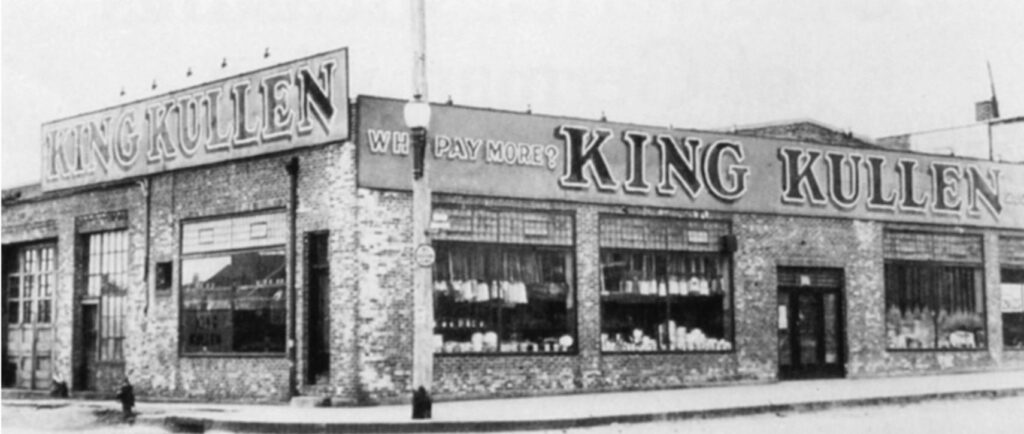
Source: King Kullen
In the early 1950s Germany counts almost 40 stores that have adapted the self service concept. A milestone was reached a few years later when the first supermarket with a retail space of 1700 m2 opened to the public in North Rhine-Westphalia. The landscape of self service grocery shopping drastically changed in the 60s when the Albrecht brothers decided to give it a twist by introducing discounters. They identified high prices as a focal pain point for a lot of customers. By removing certain parts of the typical floor layout – e.g. the meat counter – and by sacrificing the aesthetic of the stores they opened up more possibilities for consumers. The documentary is followed by a discussion with the hosts of a talk show and the business economist where they discuss how the conventional supermarkets managed to backfire – e.g. by also introducing store owned brands. [1]
The fact that a retail space of 1700m2 was noted as revolutionary in the 1950s raised my attention and I got curious about nowadays conventions. For example, a hypermarket store like “INTERSPAR” commonly has something between 2500m2 and 5000m2. [2]
As already mentioned, supermarkets are part of our everyday lives. Having everything in one place is convenient, but can also have downsides. The more products you can find in the store the more space the store requires. According to business economist Alexander Hennig supermarkets first peaked in the 70s when they would be located rather remotely for example in industrial areas of cities. During this time, people also changed their car driving habits. Today however, smaller supermarkets are becoming more and more attracting to customers, especially for those who live in cities and view a supermarket within walking distance as a necessity. [1]
Corporations like Kaufland are aware, that their stores are a focal point of people’s modern lives. In some stores they are currently testing so called “Medical Rooms” to make for example blood sampling possible on spot when grocery shopping [3]. From a personal standpoint however I will admit that I am skeptical towards these plans of the Schwarz-Gruppe. First of all, I fear that the company is rather interested in the profit they might retrieve from this concept, and that these medical check up spots will lack quality instead. Furthermore I am concerned about how this will influence the reduction of so called third spaces.
Why am I mentioning third spaces? As was already pointed out above, supermarkets are places of interaction. This raises the question: WHY do people still appreciate it (e.g. at the “Feinkosttheke”) to have this personal interaction? Düshorn, a village between Hannover and Bremen, has a non-capitalistic approach to grocery shopping. The so called “Dorfladen” in Dushorn originally started out as a compromise to find a solution for the post office, the local bakery and the Sparkasse. It is being operated as a non-profit association (”Genossenschaft”) by residents of the village. On top of buying groceries the aprox. 2.500 people living in Dushorn view the Dorfladen as a possibility to interact and catch up with others.
[1]
M. Janning, “Der Supermarkt – Erfolgsmodell unter Druck,” WDR Nachrichten, Dec. 20, 2022. https://www1.wdr.de/mediathek/video-der-supermarkt–erfolgsmodell-unter-druck-100.html (accessed Jan. 05, 2026).
[2]
copyrightInfo, “EUROSPAR, INTERSPAR & Co» Geschäftstypen | SPAR Österreich,” Spar.at, 2024. https://www.spar.at/unternehmen/geschaeftstypen
[3]
APOTHEKE ADHOC, “Telemedizin: „Medical Room“ im Kaufland | APOTHEKE ADHOC,” APOTHEKE ADHOC, Nov. 07, 2025. https://www.apotheke-adhoc.de/nachrichten/detail/markt/telemedizin-medical-room-im-kaufland/# (accessed Jan. 05, 2026).
This week I have come across a paper by Christina C. Mendat and Christopher B. Mayhorn [1] from the North Carolina State University outlining Human Factors as well as ergonomics in terms of self-checkout registers. Even though the entry discusses the topic within 3 simple pages only I could get more insights and tangible data on the topic that opened new possibilities and perspectives to me. With that being said, I would like to mention that the paper was published in 2007. I’m aware that this was almost twenty years ago. Needless to say, it has to be noted that Self-Checkout Registers gained popularity in American supermarkets, a long time before they did so in Austria.
The most surprising fact that I found out comes from a historic point of view. It turns out that libraries were the first enabler for what we are now referring to as self-checkout registers. It allowed librarians to focus more on e.g. reorganizing the bookshelves instead of making sure the counters are frequently occupied.
Furthermore, the paper discusses the top issues related to self-checkout cash registers, uncovered through a survey. The top two issues are:
*simply judging from what I’ve seen in my personal daily life, there has been a lot of improvement on this topic. Let alone the fact, that certain stores nowadays are known for being so fast, you might not be able to catch up with putting the purchased items into your shopping bag. I’m interested
While these issues, that have already been uncovered, are of course of relevance, my goal is to uncover more insights, specific to Austrian supermarkets and costumers.
I’m planning on doing first observations in different supermarkets. With the Christmas holidays ahead though, I fear that this might not be as easy, as the stores are sometimes packed to the limit.
Furthermore, I will be using the informal gatherings with friends and family during the holidays to open conversations concerning cash registers. I might already conduct a first survey or focus group (at least to test the first draft of questions).
Additionally, I am planning on having a discussion about this topic with an ambulatory wheelchair user to get a first grasp of her challenges.
** this topic is simply interesting for general purposes
[1] Mendat, Christina & Mayhorn, Christopher. (2007). An Evaluation of Self-Checkout Systems. Proceedings of the Human Factors and Ergonomics Society Annual Meeting. 51. 1011-1014. 10.1177/154193120705101703.
As mentioned in my last blog entry I will continue by doing a first literature screening. Today I have focused on the book Management 3.0 [2]. In order to get insights from lots of different types of sources I have also decided to listen to various podcasts every now and then. The first podcast episode I will share my insights of will be NNgroup – Episode Nr. 27. Customer Journey Management. [1]
For now, I have decided not to do an explicit deep dive into the literature. I started out by simply reading the introduction part of the book Management 3.0 and scanning the table of contents.
Jurgen Appelo, the author, points out that management is the number one enabler for successful transformation to an agile culture. There are in total six different perspectives on the concept of management 3.0 that are being explained within the chapters of the book. A significant part of the book is also about the value of leadership.
Furthermore, it has to be mentioned, that the book and the structure behind it are called Management 3.0 for a reason. Management 1.0 in contrast heavily relies on hierarchy in organisations and deals with the arc between the people in top positions and those with less responsibility. By simply adding a few more methods Management 2.0 was defined. Management 3.0 however promises to adapt its concept innovatively. While hierarchies clearly exist within organisations Management 3.0 also points out that networks and the social complexity in organisations must also be considered.
All in all, I have gotten the impression that this book is a trustworthy source I feel confident using. I highly appreciate the way the author combines theory and reality. A topic is usually combined and broken down into two chapters. The first explains everything theoretically and in detail while the follow up chapter displays practical approaches and methods. The authors methods and expertise are often based on what he has found out via an online forum via his blog.
In this podcast the host Therese Fessenden has invited Kim Salazar, a fellow colleague from the Nielsen Norman Group, and Jochem van der Veer, CEO at TheyDo. In the episode the three experts put a lot of emphasize on the reason why Customer Journey Mapping is being done in the first place: to make things tangible and therefore visible. It is a powerful tool to detect, communicate and most of all set the status quo on user interactions. This is the case not just when working in a team but especially when working within the whole business context. It’s an effective way to attract stakeholders’ attention and drive their understanding of certain topics and issues. What I have found interesting is how all of them shared a common opinion of how important it is to view Customer Journey Maps within a larger context. A user experience isn’t necessarily linear and might be influenced by a lot of outside factors. Especially considering the fact that a lot of these experiences are happening on smartphones nowadays. While someone might buy a ticket for a concert while reading a book at home they might receive the notification reminder via email during their working hours in the office.
On that account it is essential to manage different journey maps and similar artefacts accordingly. In this context the host and her guests also discussed that the way teams are organized plays a significant role in this exchange of data. Last but not least, the importance of building bonds with allies in the company (most likely stakeholder’s and other decision makers) was emphasized by the guests.
Although I only check out this specific episode of the podcast because I wanted to gain more perspectives on Customer Journey Mapping the host and the guests often mentioned how and why this tool is being integrated in company workflows. This gives me approval that I am conducting my research efficiently.
References:
[1]
NNgroup, “27. Customer Journey Management (ft. Kim Salazar and Jochem van der Veer),” YouTube, Oct. 02, 2023. https://www.youtube.com/watch?v=LN6DtdSu8sc (accessed Dec. 08, 2025).
[2]
Jurgen Appelo, Management 3.0. Pearson Education, 2010.