Design & Research II – System, Impact, and Inclusion

Design & Research 2 | For: Katerina Sedlackova

Following my prototypes, I am now looking at how my project fits into the bigger world. I have broken this down into three parts: the system, the change it creates, and who can actually use it.

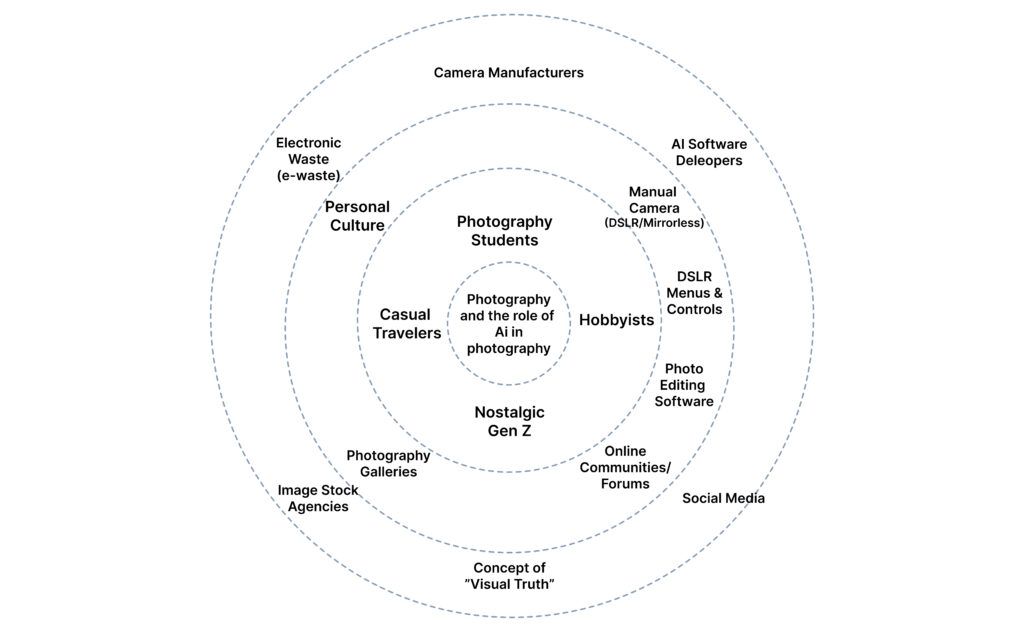
This diagram illustrates the broader ecosystem surrounding my camera-AI guidance system. I have mapped it from the core outwards to show how the project connects to the world.

The Core: The interaction between the Photographer and the Manual Camera.
Direct User Context: Students, hobbyists, and “Nostalgic Gen Z” looking for a creative rhythm.
External Ecology: The heavy hitters—Nikon/Sony (Hardware), Adobe/Midjourney (AI), and Instagram (Social). I also included E-waste, as the sustainability of our gear is part of the system.

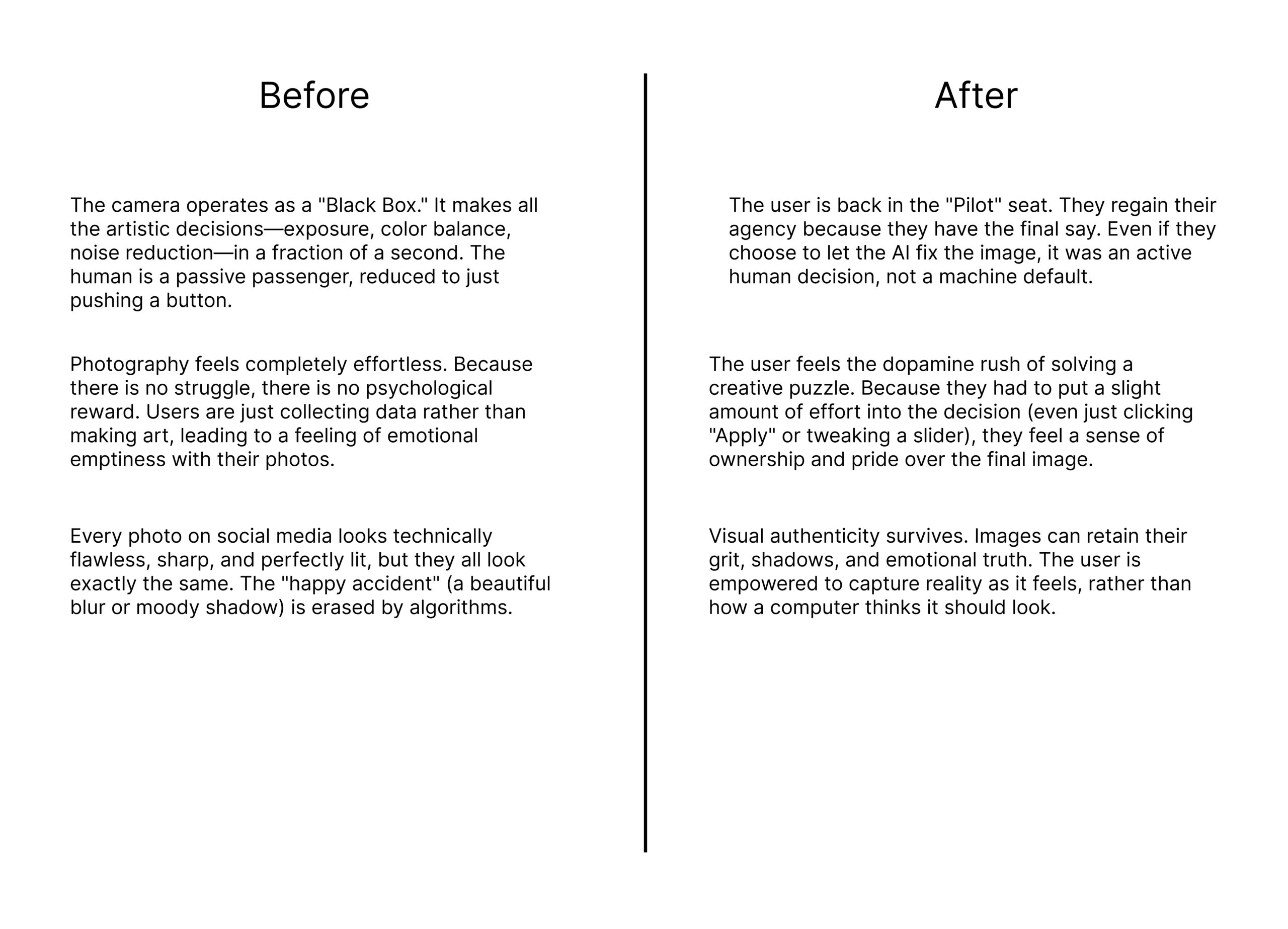
This comparison highlights the shift from automation-first snapping to learning-aware photography.

The Goal: The goal is to move the user from being a passive passenger of an automated process to an active “Pilot” who understands their tools.

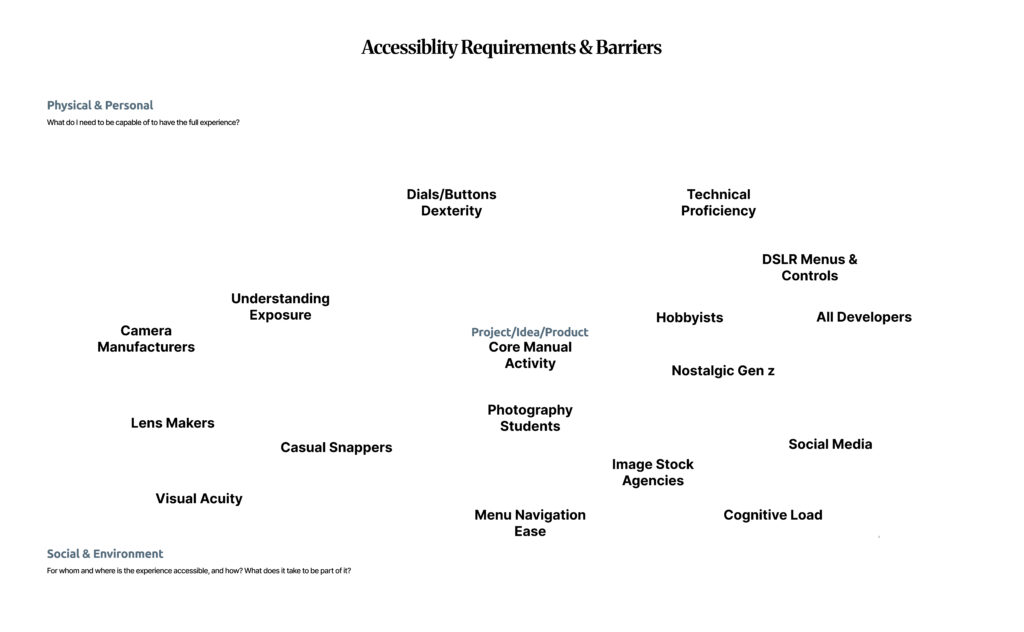
Accessibility in photography is not just about “talent”; it is a systemic issue. Using the floating barrier map, I identified the physical and cognitive hurdles that stop people from mastering manual photography.

Design & Research II – Lo-Fi Prototypes 1/6

Following my research on “Automation in Photography,” I have spent this week diving deeper into my project by creating three different prototype scenarios. Even though I haven’t tested these with real users yet, the act of making them helped me see points I was missing and gave me a better direction for my Master’s thesis.

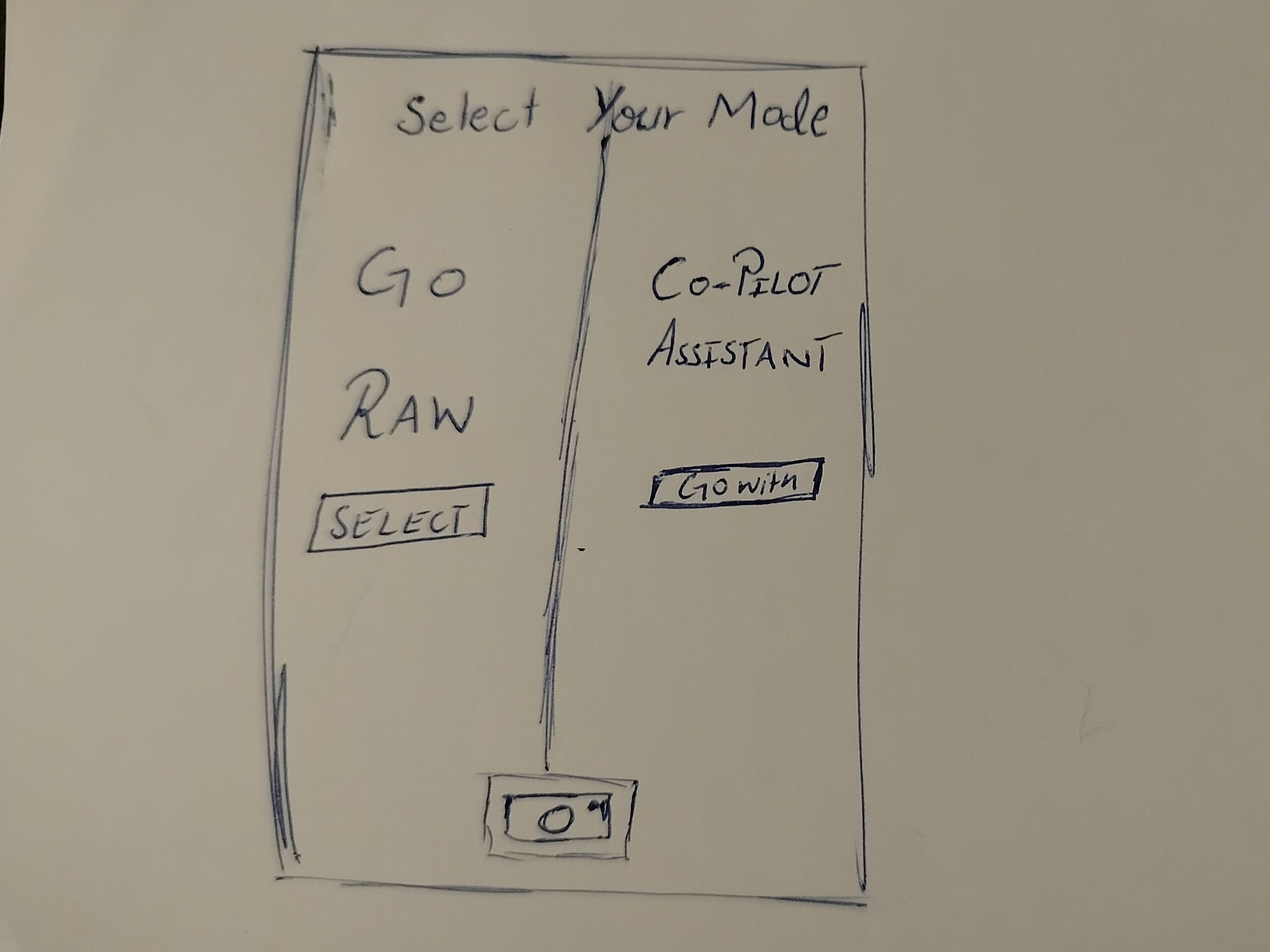
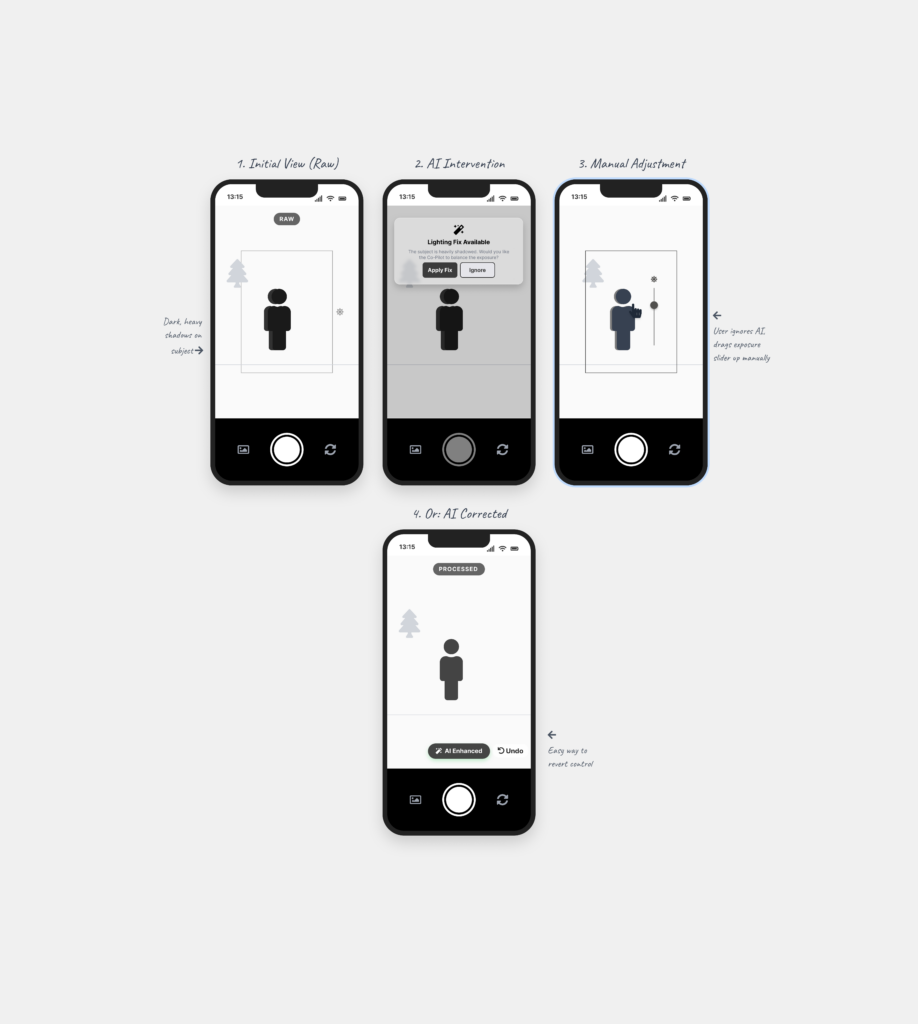
In this one, when the user opens the camera, they have to choose between two options. One is a Raw Mode where the user has all the control, and the other is an AI Automation mode.

The Goal: To see if forcing the user to pick a mode at the start makes them more intentional about how they want to take the photo.

This is a digital assistant that pops up on the screen while you are shooting. It explains what is happening based on the scene. For example, it might say “increase shutter speed because you are shooting action” or “reduce ISO because there is too much light.”

The Goal: To see if giving the user a “why” helps them stay in control instead of the camera just fixing the settings automatically.

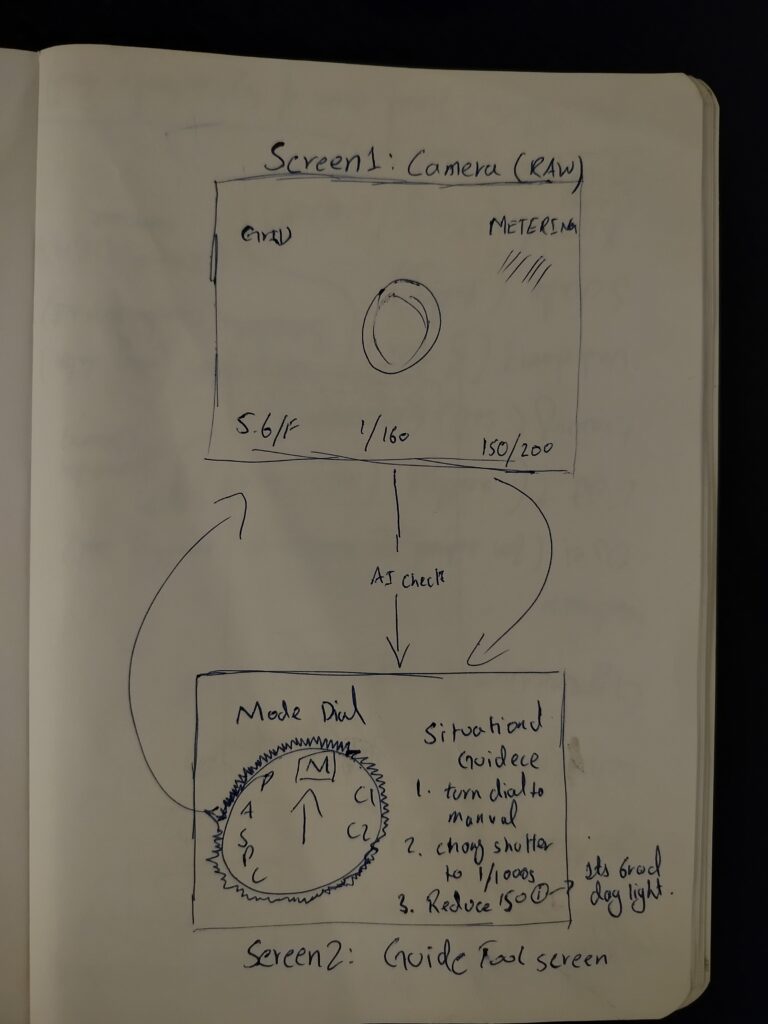
This is for professional cameras. A separate device (like a phone) is attached to the camera to guide the user. It shows suggestions on which physical dials to turn to get the right settings.

The Goal: To see if the AI can act as a teacher that helps the user learn how to use the manual settings on their professional camera.

Creating these scenarios helped me see which directions I might follow, but it also left me with a big question about the design process. I understand that if you have a clear vision, prototyping early can save a lot of time. But when you are still in the early stages of defining and understanding the problem, I found it extremely difficult.

To be honest, it doesn’t make total sense to me to build a solution when I haven’t even fully decided what the actual problem is yet. While I know it is supposed to be beneficial, I personally didn’t find it that helpful at this stage. It felt a bit like guessing. However, the exercise did at least show me which side of the camera-AI idea has the most potential, even if the final direction is still a bit blurry.

D&R2 SED – D2

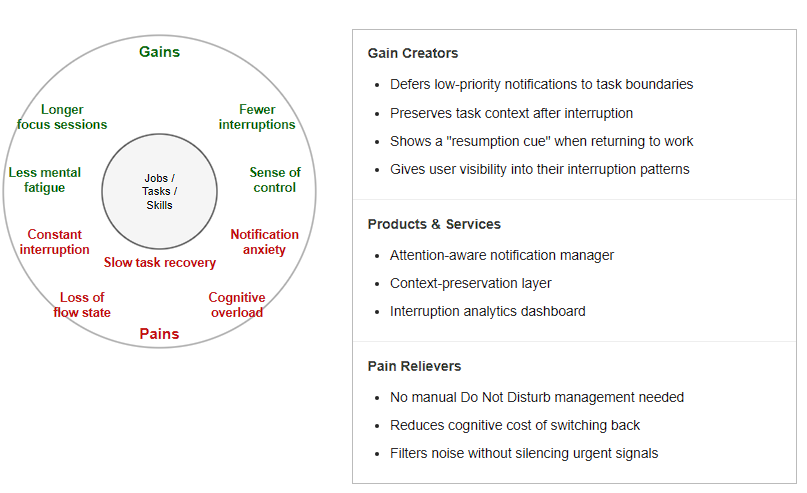
Customer Profile & Value Proposition Map

Persona I – The Deep Worker

A knowledge worker or student who needs extended periods of uninterrupted focus to do their best work. They are productive in flow states but regularly pulled out of them by notifications, messages, and contextual switches. They need a system that protects their attention without requiring constant manual management.

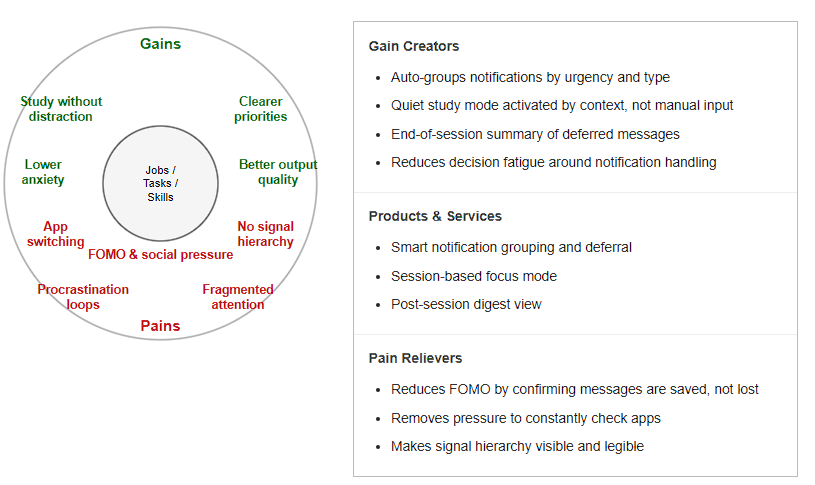
Persona II – The Overloaded Student

A university student juggling coursework, communication apps, and social media across the same device. They struggle to distinguish between urgent and non-urgent signals, and often spend more time managing notifications than doing the actual work. They need a system that reduces the noise without them having to think about it.

Business Idea

What problem are you solving?

Digital interfaces are built to deliver information as fast as possible: but human attention does not work that way. Every interruption carries a cognitive recovery cost that current systems completely ignore. The result is a generation of users who are constantly reactive, chronically distracted, and unable to reach the deep focus states where their best thinking happens. There is no mainstream product that treats attention as a resource worth protecting at the system level.

Why should we care about it?

Attention is not just a productivity concern, it is a mental health issue. Sustained notification overload is linked to higher cortisol levels, reduced working memory performance, and increased anxiety. At the same time, the economic cost of fragmented attention in knowledge work is measurable: studies estimate billions in lost productive hours annually due to interruption-driven task switching. The problem affects every person who works or studies with a digital device which is effectively everyone.

What is the solution? How does it work?

An attention-aware notification layer that sits between the operating system and the user’s apps. It uses behavioral signals: typing rhythm, app dwell time, task duration, time of day, to infer whether the user is in a focused state. When focus is detected, non-urgent notifications are held and batched for delivery at a natural task boundary. When an interruption does occur, the system provides a resumption cue, a lightweight context snapshot that helps the user return to their previous task faster. No manual configuration required; the system learns the user’s patterns over time.

Who is the target audience / customer?

The primary users are knowledge workers and students: anyone whose productivity depends on sustained focus. The paying customers are organizations: companies that want to reduce burnout and increase deep work capacity among employees, educational institutions looking to support student focus, and productivity software companies that want to integrate attention-awareness into their existing tools as a premium feature.

What is going to happen? (Change & Impact)

We move from a model where every moment is equally interruptible to one where digital systems respect the rhythm of human cognition. Interruptions do not disappear, they are timed better. Users reclaim extended focus periods without having to fight their devices to do it. Over time, this reduces the normalization of fragmented attention and establishes a new expectation: that technology should protect focus, not just compete for it.

D&R2 SED – D1

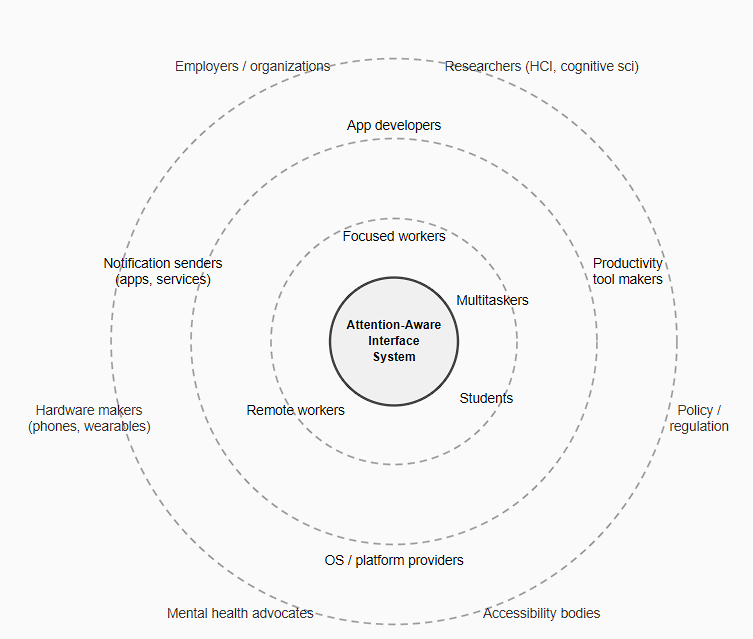
System Map

At the center is the Attention-Aware Interface System, a framework designed to make digital environments sensitive to a user’s attentional state before delivering interruptions, rather than eliminating them entirely. The inner ring holds the direct users: knowledge workers, students, remote workers, and multitaskers, each experiencing interruptions differently based on task type and cognitive load. Surrounding them are the groups that shape interruption conditions: app developers, OS providers, and notification senders and at the outer edge, the institutional forces of employers, researchers, hardware makers, and policy bodies. Together, these layers show that attention is not just a personal resource, it is a systemic one.

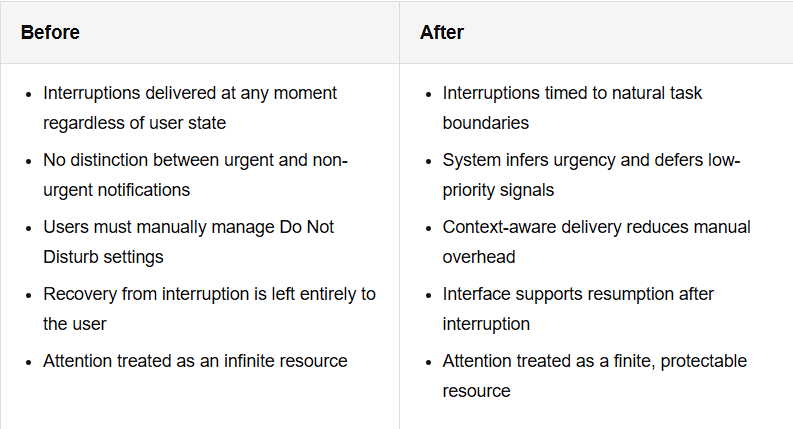
Change and Impact

This comparison highlights the shift from interruption-blind digital systems to attention-aware design. Current notification architectures are built around the sender’s intent, not the receiver’s cognitive state. A message is delivered the moment it is sent, regardless of whether the recipient is mid-task, in a flow state, or already cognitively overloaded. The result is a system optimized for immediacy at the cost of sustained focus.

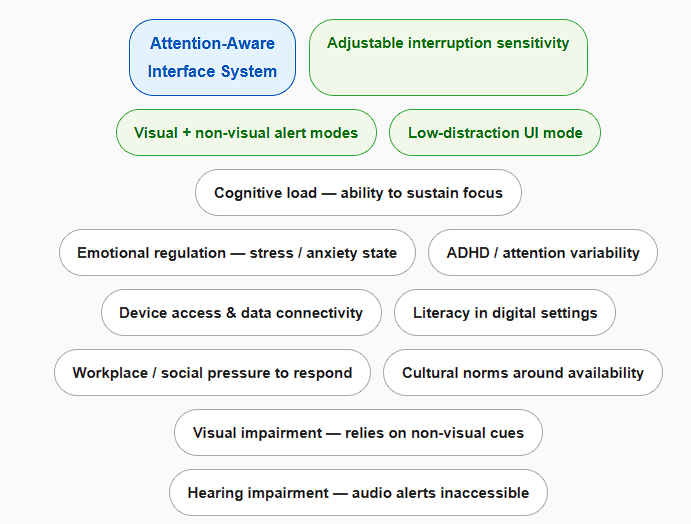
Inclusion & Accessibility

Access to an attention-aware system is not uniform. The ability to benefit from interruption management depends on a range of cognitive, physical, and social factors that are unevenly distributed across users. Some barriers are internal: a person with ADHD may experience interruption recovery very differently from a neurotypical user: for them, even a brief disruption can cascade into a much longer loss of focus. Users in high-stress or high-anxiety states are more vulnerable to the compounding effects of notification overload. Inclusion here is about cognitive and emotional accessibility, not just physical or perceptual access.

D&R2 01 – LoFi Prototyping

New semester, new researches and new problems…Moving from theoretical research into lo-fi prototyping forced me to confront something I had been putting off: my topic is hard to make it physical. Research on attention, interruption and cognitive recovery does not translate naturally into a clickable mockup or a paper sketch. The phenomenon I am studying is internal and time-dependent. You cannot see it on a screen.

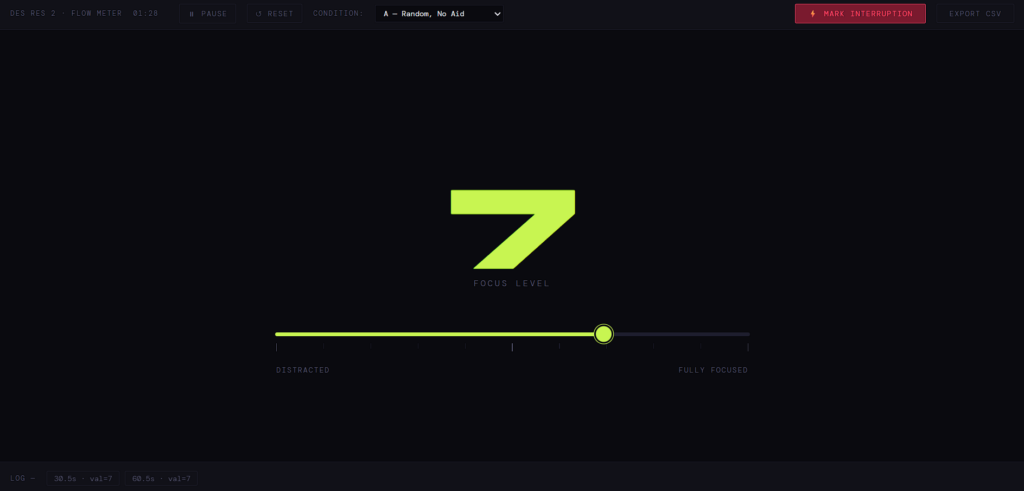
The approach I took was a simple behavioural task. A participant reads a short text and corrects errors in it while thinking aloud. I interrupt them once with a spoken question, then observe how they return to the task. To capture focus levels over time, I built a small browser tool; a slider the participant adjusts continuously, which logs their self-reported focus every thirty seconds and marks the exact moment of the interruption. At the end of the session it exports a CSV, so it is easier to track the data. It is low-tech, but it produces real data grounded directly in the literature.


The first test format was a speed dating exercise: five-minute exchanges rotating between participants. The idea is to get fast, varied feedback, and it works well for many types of prototypes. For mine, it was harder to make useful. Five minutes is not long enough for a person to actually get into the task before the interruption happens. Most of the time was spent explaining the setup rather than experiencing it, so the feedback reflected how clearly I could describe the concept more than how the prototype itself worked.

The most consistent piece of feedback was about the setup: having the task on one device and the focus slider on another felt fragmented. Several people pointed out that if I am studying attention, adding friction between two separate tools is counterproductive. It is a fair observation and one I plan to address, consolidating everything into a single interface makes more sense both practically and conceptually.

The session was useful in a different way than I expected. It did not tell me much about interruption and recovery, but it did clarify the limits of the current prototype as a communication tool. My research sits closer to the theoretical end of the spectrum for now, and that makes it genuinely difficult to prototype in a format that works for quick explanation to someone unfamiliar with the underlying psychology.

The plan is to run the full session individually, without the time pressure, in a setting where the participant can actually reach a state of focus before the interruption lands. I also want to think about whether a behavioural experiment alone is the right form, or whether the research needs a more designed artefact alongside it, something that makes the concept visible rather than just measurable.

D&R2 My passion

Giving used clothes/material new life

For many years now I have loved using old materials and creating new things with it. I use old materials from things like clothes, beddings or curtains, and I create stuff I need/want like purses, bags, new clothing items, wallets, or even shoes. The picture is a collage of some of my creations from a denim recyceling project i am doing.

Last year, I wrote a research paper about the fashion industrys impact on the environment and explored different approaches to addressing overconsumption. One of my key findings was that being involved in making, customizing, or personalizing clothing makes it much more likely that people will keep and care for their garments over a longer period of time. I also found that while buying second hand or thrifted clothing is better than purchasing new items, it is not necessarily as sustainable as it may seem. If people switch to second hand shopping but continue to consume at the same high rate, they still contribute to the ongoing demand for fast fashion on a larger scale. Ultimately, the most effective way to reduce the fashion industrys environmental impact is to lower overall consumption. This can be achieved by keeping clothes for longer and taking better care of them.

I love how sustainable this practice is, and how the things I make are customized perfectly to me and my needs. I also feel more grateful and attached to the things I make myself because I put time and effort into it. For me, doing these crafts give me some time off from real life, where I can sit and sew for example and suddenly 5 hours have gone by without me even noticing or checking my phone once. I would like to be able to find a way to influence and share this feeling with others.  

In design and research 1 I worked with the topic doomscrolling. Researching how social media platforms draw you in and keep you trapped consuming content. I realized that what helps me most of all to stay offline and enjoy the real world are these kinds of physical projects. Therefore, I think a natural continuation into design and research 2 is to explore how i can try to share this hobby with others it might be able to have the same effect on.  

My friends and family often ask me if I can please make them something too or teach them how I did it after I show my projects. Maybe there is a way to show, help, and teach this to everyone?  

My current idea is to create a website people can use to get help on how they can recycle their own old materials into something new.

Possible features of the website: 

  • Patterns for upgrades and remakes 
  • Sewing tutorials 
  • AI that generates patterns customized to your measurements. (maybe a paid subscription?) 
  • Search filters for things like : tools, skill level, time, fabric available  
  • Community forum?  

[DesRes 2 @BirgitBachler] Entry 01: Employee and Consumer Protection

New semester – new me. More or less, at least. While I was extremely confident about my chosen research topic last semester “Creating User-Centered Strategies that align with Business and IT Goals in an innovative Agile Environment. Use Case: Self Checkout Terminals in Supermarkets” the tables have turned.

Rewind – initial idea

Reason No. 1: I initially chose this topic because ever since my internship at Bosch last year I’ve realized how important it is to keep all three feasibility, viability and desirability in mind .

Reason No. 2: The specific use cases of Self Checkout terminals in supermarket seemed like a reasonable extension to the topic, since it aligns with my tasks at my student job. On top, my company would’ve be interested in a collaboration for the thesis.

Long story short: I have gotten to realize that theses matters are already researched through and through.

Motivation – Focusing on employees and/or consumer protection

Instead I would like to contribute something that’s actually innovative and has a social and ethical impact on top. Over the past few years topics such as protection of employees and consumer protection have been on my mind frequently.

Possible idea + 1st Prototype

About two years ago I had the opportunity to participate in an interdisciplinary project called Legal Design Sprint endorsed by the Chambor of Labour Vienna. The project of my team (topic “Mobility”) was even awarded by a team of experts.


Topic Mobility – How do people commute to work?

To guarantee a sustainable future this must change. There is a set of alternatives, such as riding the bike to work or using public transport. Nevertheless, these options are limited and raise a few pain points:

  • How much responsibility should be carried upon employers?
  • Which obstacles are people on the countryside facing?
  • How do we convince car drivers to let go of their habits?
  • Are possible alternatives tangible?

Our Solution

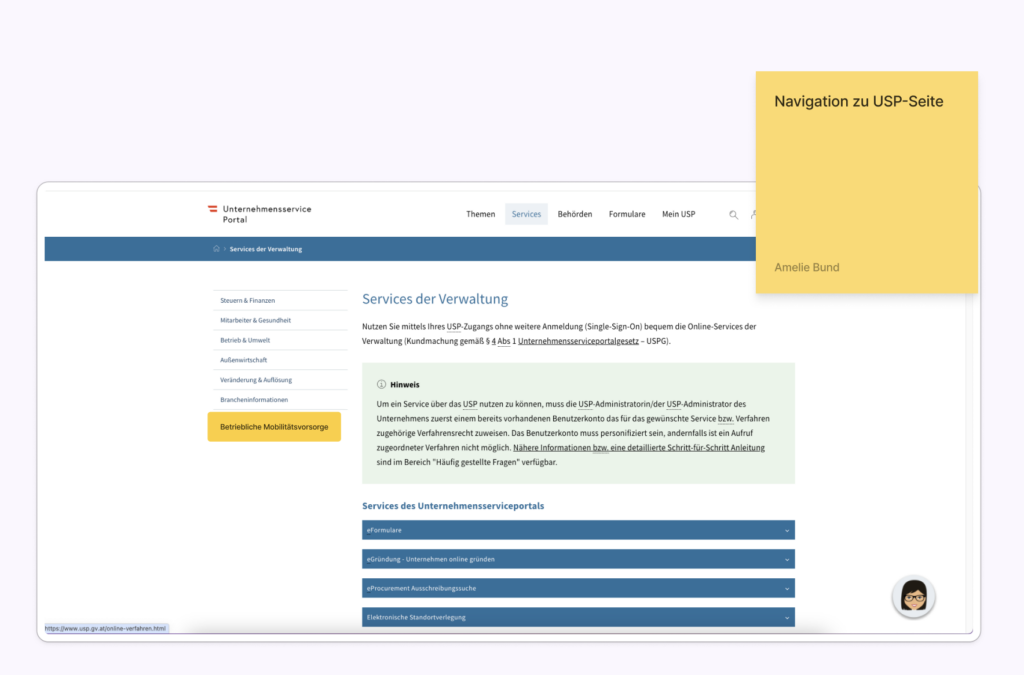
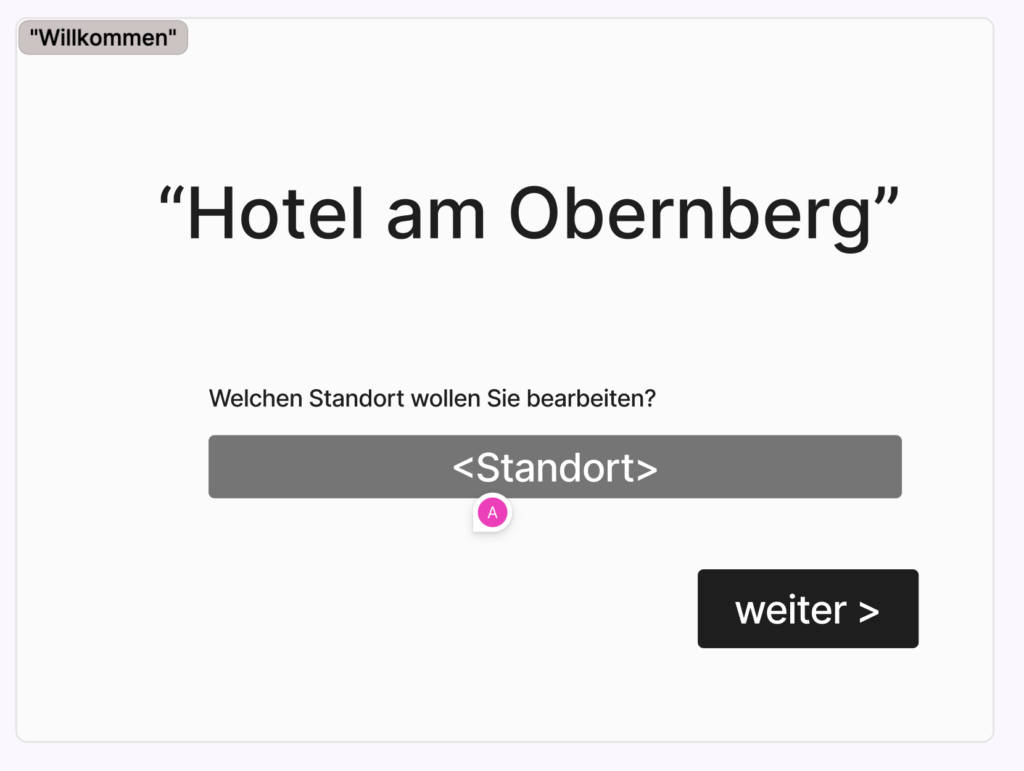
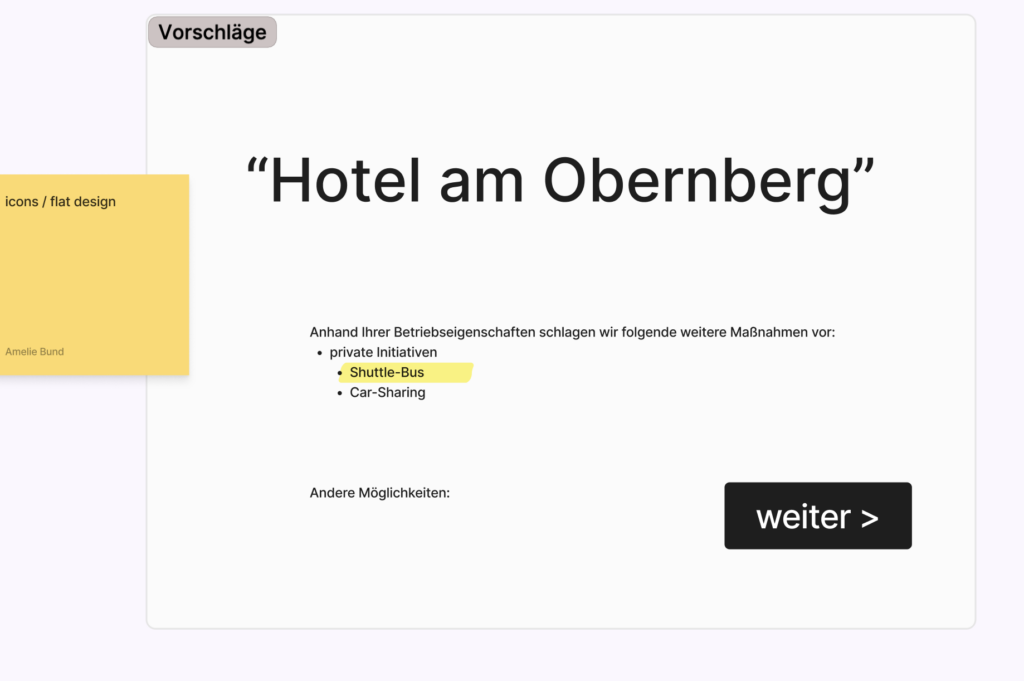
With our concept “Business Mobility Strategy” employers must be made responsible for the possibilities of commute that are being offered to their employees. To do this a dialog between both sides – employers and employees – needs to happen.

  1. Interface: The service will be implemented in the “USP – Unternehmensserviceportal” (= the major online service for Austrian businesses).
  2. Data collection: Employers must enter data such as the distance to the nearest bus station or the amount of parking space available for employees.
  3. Less Red Tape: Business owners are constantly exposed to endless and redundant paperwork. Usability Tests will assure a seamless and viable end-to-end experience.
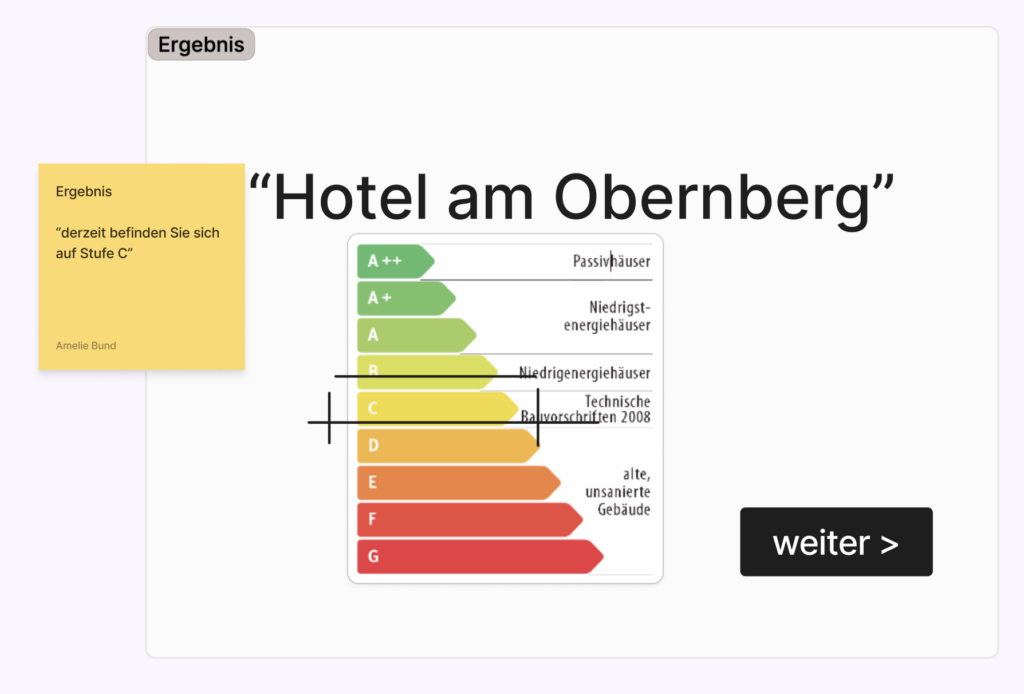
  4. Data Evaluation: Once all the information is submitted the businesses approach and actions towards sustainability in mobility will be graded. This assessment scheme will be defined by experts to guarantee transparency.
  5. Recommended Actions: The evaluation also provides businesses with an answer on how to improve in the topic of sustainable mobility.‍ Employers can set these recommendations as goals to improve rating and help their employees with commuting to work.
  6. Spot Checks: An independent institution will make sure the businesses have submitted their mobility data correctly.

Alternative options:

  • dark patterns in fast fashion e-commerce (e.g. SHEIN)
  • user centered interaction of the “Arbeitnehmer:innenveranlagung”


Reference

[1] G. Kovacic, Cristian Andronic, and S. Kirchmayr-Novak, ÖV-Erreichbarkeit großer Arbeitsplatzstandorte in Österreich. 2022.

PROTOTYPING – Design & Research II (Birgit) – 1/6

Product/Business Idea

What Problem are you solving?

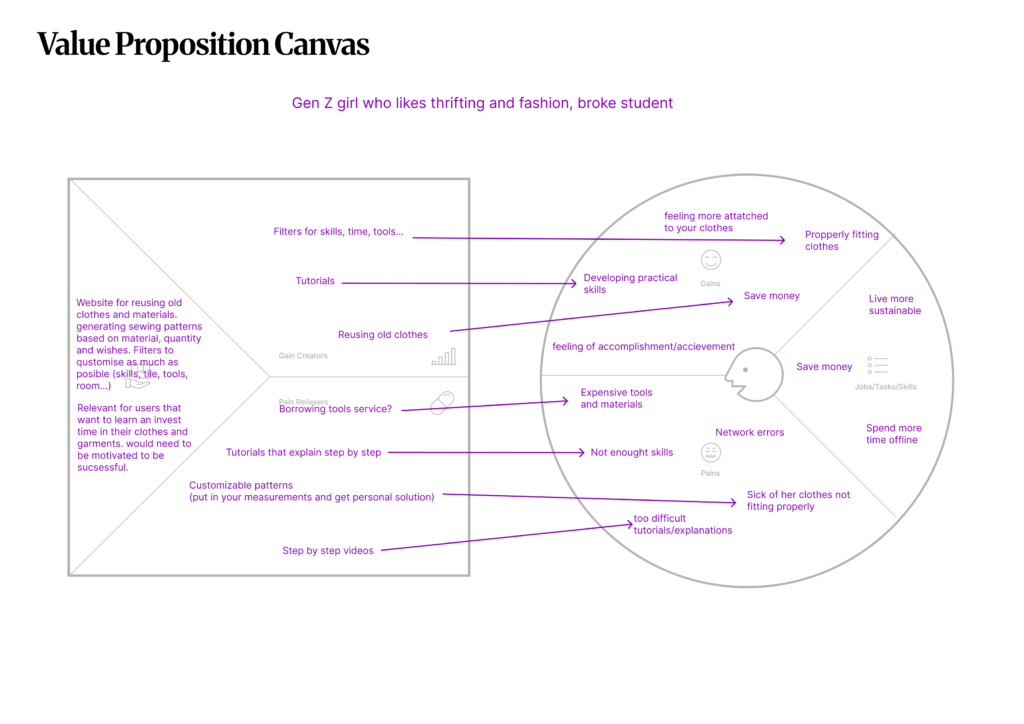
I want to promote sustainable clothing consumption. I want to show people that it really can be quite easy to repair, tailor, and even make your own clothes. Studies show that taking part in the making and maintenance of your clothes makes you feel more attached to them, resulting in you taking better care of them and keeping the clothes longer.

Why should we care about it?

The fashion industry is one of the most environmentally harmful industries in the world. Fast fashion generates enormous amounts of waste, uses large quantities of water, and is one of the most exploitative businesses when it comes to labor rights.

What is the solution you are offering? How does it work?

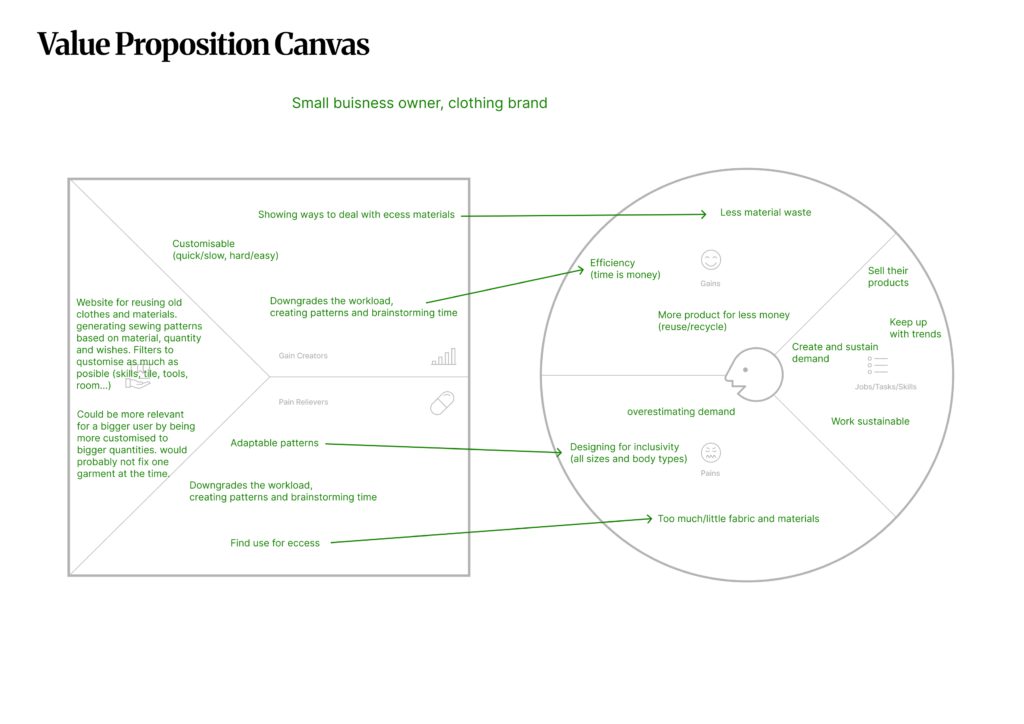
Right now, my idea is a website for reusing old clothes and materials. It can generate sewing patterns based on the materials available, their quantity, and the user’s preferences. The user can customize the experience as much as possible by using filters to reflect factors such as their skill level, available time, tools, and workspace.

Who is the target audience? Who is the customer?

I would say my target audience would be young people that are interested in living more sustainably and are motivated to keep their clothing consumpion down.

Key words for my main taget group: thrifters, crafty, prctical, motivated, hobbies, sewing

What is going to happen? (Change & Impact)

People will realize how easy it is to take care of and customize their clothes. Early users will influence others, and hopefully the rest of society will follow their lead. This will decrease fast fashion demand and, in the long run, have a positive effect on the environment. 🙂