Printing, in its many forms, is the process of transferring visual information from a digital or physical template onto a physical and tactile medium. Despite its long history, printing continues to evolve. Central to most modern printing systems is the CMYK colour model: cyan, magenta, yellow, and key (black), which defines how printers mix coloured inks to reproduce full-colour images.
Inkjet Printing
Inkjet printers are among the most common and versatile printing devices used today. Their operation relies on microscopic precision. At the heart of an inkjet printer is the print head, which contains thousands of nozzles capable of ejecting microscopic droplets of ink at high speed. As the print head moves horizontally across the paper, it deposits ink in precise locations determined by the digital file. The paper advances incrementally after each pass, allowing the printer to build the image line by line.
Each nozzle is responsible for a specific colour, usually cyan, magenta, yellow, and black, which are combined through dithering and layering to create a full spectrum of tones and hues. The ink used is typically water-based or pigment-based, optimized to absorb quickly into the paper without excessive bleeding. The result is a continuous-tone image that appears smooth to the human eye, despite being composed of countless microdroplets. This technology allows for high-resolution photographic prints, text documents, and even fine art reproductions.
Risograph Printing
In contrast, Risograph printing, often called “RISO”, is a more tactile and analogue method, though it also incorporates digital preparation. Originating in Japan in the 1980s, the Risograph functions similarly to a screen printer. The process begins with converting an artwork into a stencil: the image is burned onto a master sheet, which is then wrapped around a rotating drum filled with soy-based ink of a specific colour. When the machine operates, the drum spins and pushes ink through the stencil onto the paper beneath it.
To create multi-coloured prints, different colour drums must be inserted sequentially, with new stencils for each colour layer. The paper passes through the machine multiple times for each colour, resulting in unique overlaps, misregistration, and textures that give RISO prints their distinctive charm. Because the inks are semi-transparent, layering them naturally mimics the subtractive colour process of CMYK, producing vibrant and sometimes unexpected colour interactions.
Unlike the precision of inkjet printing, Risograph embraces imperfection. Its handmade quality, uneven textures, and slight misalignments contribute to its growing popularity among designers and artists seeking an organic aesthetic.
(Filament) 3D Printing
A radically different form of printing is three-dimensional (3D) printing, which builds physical objects rather than flat images. Most consumer-grade 3D printers use a technique called material extrusion, which operates in principle like a glue gun. Plastic filament is heated until it liquifies, then extruded through a nozzle that moves along generated paths. The printer interprets digital files such as STL or FBX by slicing them into thin two-dimensional layers. Each layer is printed sequentially as the platform lowers or the print head rises, allowing the object to gradually take shape.
Although primarily used for prototyping and fabrication, 3D printing also intersects with traditional printing ideas, especially regarding layering and texture. Some printers are capable of multi-material or multi-colour printing, hinting at a convergence between CMYK colour theory and volumetric fabrication.
Gedankenspiel: Mixing Printing Techniques Digitally and Physically
The boundaries between digital and physical printing processes are increasingly blurred. Artists and designers have begun experimenting with cross-media approaches that combine principles from multiple technologies.
Lithophane
This technique involves creating multi-coloured 3D prints using multiple nozzles loaded with CMYK filaments. The print appears as a plain white relief when unlit, but when illuminated from behind, variations in thickness reveal a hidden colour image. The light passes through the translucent material in different intensities, producing tonal gradations akin to photographic printing.
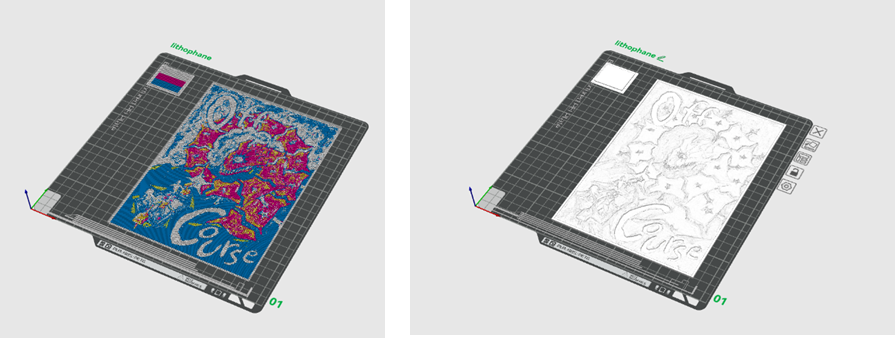
See: https://wiki.bambulab.com/en/knowledge-sharing/CMYK-color-lithophane-printing-instructions
Replicating RISO digitally
To digitally mimic RISO aesthetics, an image can be split into CMYK channels, each converted to grayscale and then processed through a halftone screen at distinct angles. When recombined in RGB mode, with colours reassigned to each layer and slight misalignments introduced, the result replicates the layered and imperfect charm of real Risograph printing. Adding a paper texture enhances the illusion of ink absorption and grain.
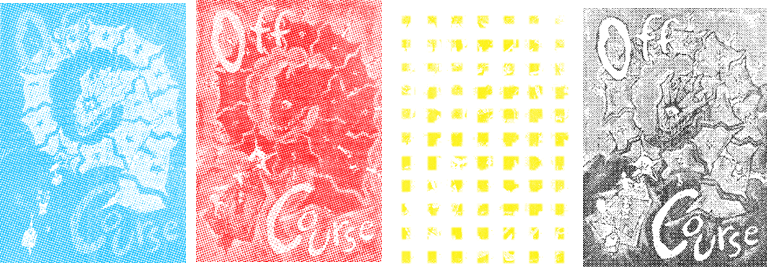
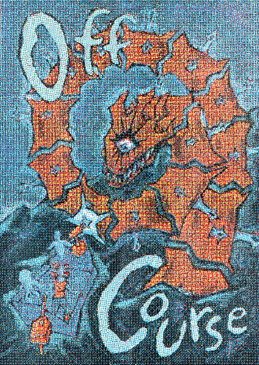
See: https://www.liznugentdraws.com/blog/3221
RISO compositor in 3D
Artists have begun creating RISO compositors in 3D software such as Blender with the same principle as the digital RISO.
