Adding onto my previous post, I will continue to analyze some design activist posters to show that there are different topics out there and what the consensus is about interesting and impactful activist posters.
This poster shows a clever usage of typography. Barbara Galinska wants to inspire action against war. The message is clear: Stop war! The continuos outlines fusing the message together shows that one of the words cannot be without the other. The red and black colours make an aggressive combination to show the importance of the message and refer to the topic of war the explosions, burning, blood as well as, death and darkness that comes with war. The sharp edges of the outlines leave no room for doubt, this is a serious matter. The end of the ‘S’ and the space between the ‘P’ and the exclamation mark seem to have extremely sharp ends, similar to scalpels. This design has not only been used as a poster, but also as a base for murals and demonstration signs.
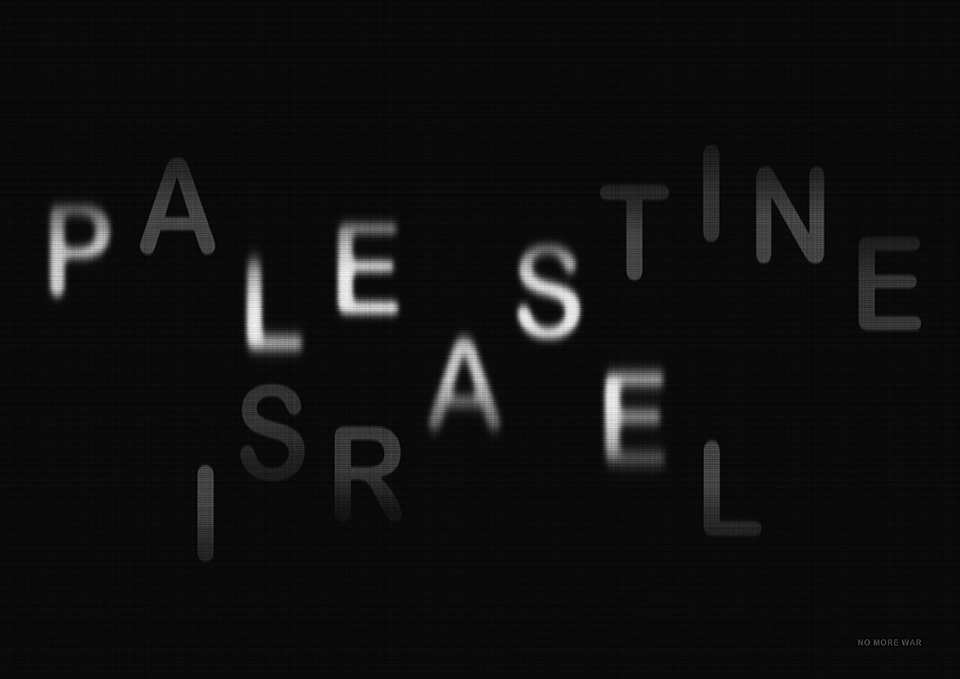
This poster shows a similar approach, also just through typography, but focuses on the war between Israel and Palestine. It shows that both names together create the word please and very small in the right hand corner the small print states “NO MORE WAR”. This already clearly transports the plea of designer Hoon-Dong Chung. To be able to read both the names Palestine and Israel, as well as, the word ‘please’ the transparency effect has been used. While the first two are transported into a second layer by being barely visible, the word please is highlighted by having more opacity. Therefore, the first thing one reads is ‘please’. Afterwards the words Palestine and Israel come into focus and if the message is not clear enough already, then only when analyzing the poster closely the rest of the message becomes visible.
In this poster the main message also comes from typography. This time the text can be interpreted in several ways. The message is: “war does not determine who is right only who is left”. In this case one can either interpret it in the way that during war it can be seen, which people advocate for right parties and which for left ones. Or you can see that, even though someone might be ‘right’ in war (meaning to have the correct opinion), the only thing that matters in the end is who is left after the war (so who is still here in the end). Interestingly, the background shows clouds and a sunny day and the last row of text becomes slightly transparent, showing that not much is left after the war. This poster was designed by Emerson, Wajdowicz Studios.
These three posters summarize well that there does not have to be a lot going on in a design to get a message across. Usually typography is enough if it is applied in a creative way, by combining different words and meanings to get the point across.
Documentaries, especially ones about history, use often a combination of scenes with actors and actresses, interviews with experts and animation. The further back in time the historical topic of the documentary plays, the less actual footage of the time period will exist. For example, when portraying the life of dinosaurs or showing a depiction of the big bang there is no way around some form of animation. 3D animation of dinosaurs is necessary to portray a realistic interpretation of scientist findings about their life. These animations are expansive and time consuming which is why the same scenes may be played multiple times. As soon as the historical period includes humans scenes with actors or actresses are used more often. Animation becomes less important, however, it is still used.
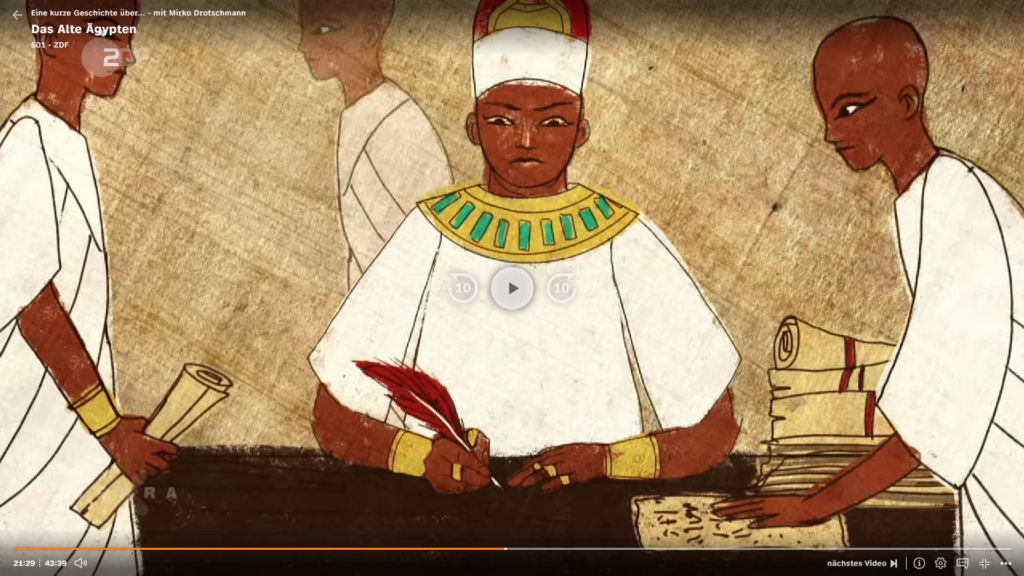
As an example in an TerraX episode called “Eine kurze Geschichte über … – mit Mirko Drotschmann – Das Alte Ägypten” produced by ZDF all three styles are combined. There is a section with actors and actresses, one with the reporter and experts as well as short animated sequences. The animated sequences are kept close to the style of the drawings of ancient Egypt if not used directly as reference. The animation is kept simple and does not have complicated movements or effects. It is in 2D and only a few elements are moved. The most important factor is the information they convey to the viewer in combination with the narration. In one scene some legends as well as gods are described with their powers shown. In this simple animation style this can be shown instead of simply told. While the usage of actors and actresses would be possible, using VFX or SFX would be more expansive and time consuming. Meanwhile getting the information from an interview section would be less impactful.
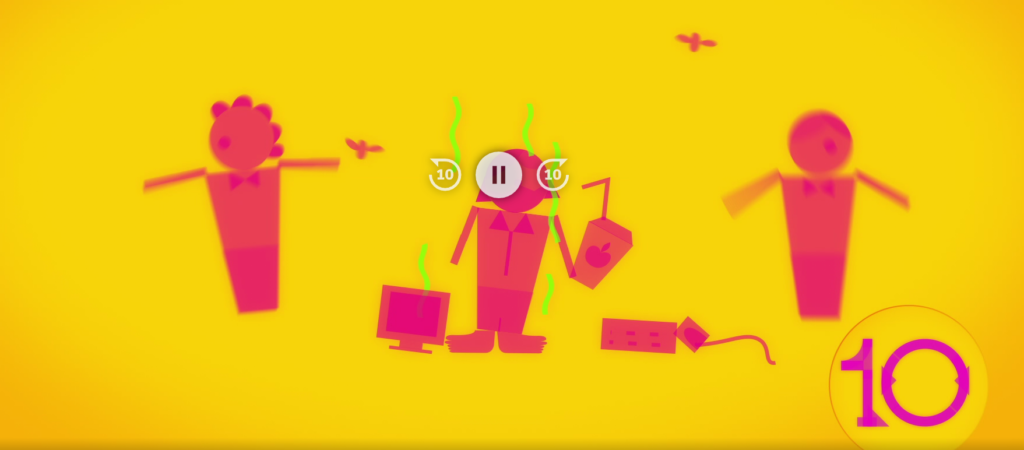
In another ZDF production “Die glorreichen 10“ 10 historical facts are put together in a top 10 video. They use footage from other ZDF productions in combination with their own animation. In this case characters of this animation consist of base shapes like circles and rectangles, resembling pictograms. With simple movements a humorous fact is being told to the viewer. The art style enhances comedy with help of exaggeration and fun sound effects. With these sections and the humorous approach to the story telling overall it catches a different target group, while still telling historical facts.
“Die Sendung mit der Maus“ is a TV show for children. They always have some sort of documentary included in the program between different animations. If it is a longer section about the production of for example ski, the documentary is interrupted by a short animation of their mascot the orange mouse. The mouse will often interact with something similar to the subject, for example skiing in a little skit. The theme therefore is not fully dropped, yet there is a pause from the fact and explanation.
Overall animation can enhance a documentary with a visual and tonal change. Dry facts can be broken down into digestible animated portions.
Hi, my name is Melina and I grew up in a village, which is a little fun fact about me that will become important later.
Let’s get through the rather boring stuff first, so we have that out of the way.
I did my A-Levels at HLW Mureck, back when the school focused on gastronomy and economics. After working as a waitress, I switched industries and worked at an IT company in customer support for four and a half years. I wanted to achieve bigger things, so I applied for a study program at university. Thanks to the Austrian self-supporter scholarship I was able to study my dream at FH Joanneum. When I started to study Information Design, my dream was to be an UX/UI designer (that is somebody that thinks about how interface elements of websites and apps are positioned and styled in a way that people can use the website/app/service and have a good time doing so). However, my goal changed over time.
Long before I even applied at FH Joanneum, I discovered my love for Sound Design without knowing it was Sound Design. Growing up, I was always interested in (listening to) music. In 2009, Adam Young caught my attention with his electronic/alternative music project Owl City. Apart from his most famous song Fireflies, the song Vanilla Twilight had a lasting impact on me. I loved the way his vocals were tuned, the ear candy melodies, how the lyrics fit into the rhythm of the song and so forth. Unfortunately, when you are a teenager in a village, your everyday, real-life music opportunities are limited to a brass band or a church choir. But participating in those wasn’t my thing; I was into video games and singing along to the pop songs on the radio.
This attitude made me miss the train to music education town, figuratively speaking. To this day I can’t sight read and my theoretical music knowledge is limited.
In my early teenage years, I was faced with a huge emotional challenge. I was not able to talk about my struggles with anyone and couldn’t quite find a song that described how I was feeling. Out of the need for comfort I picked up a guitar and just started playing some random notes. Exploring what sounds good distracted me from the pain I was going through while it simultaneously offered me a way to express myself without talking. I was used to writing poems or diary entries, but songs? Unimaginable at first, but it soon happened naturally. Exploring and documenting my life by improvising melodies and lyrics over chord progressions has become my favorite thing in the world. In the past 12 years of my life, I’ve written over 300 songs (some better than others, none of them released yet).
When I moved to Graz in 2018 I bought my first own keyboard, which happened to be a MIDI-keyboard. Since a MIDI-keyboard is just a controller and not a standalone instrument, I had to install a DAW to play on it. That’s when everything changed. I was stunned by the fact there is an application that can help me make music on my computer, just like my idol Adam Young!! 😀
Moving to Graz also brought other possibilities into my life. I found some music-loving individuals and we formed an a cappella group. Unfortunately, Covid-19 made it impossible to practice, so the group split up again.
In 2021 a friend sent me a link to an open mic event. Since I mostly write sad, calm Indie-Folk songs, I took the opportunity and started to perform my songs live at that monthly event. I still perform there whenever I get the chance to, usually accompanying myself on the guitar, piano or playing together with an instrumentalist.
During my Information Design studies, I felt the most joy when experimenting with sounds. One of my favorite projects was for the Klanglicht-Festival in 2023: I had the honor to compose a jingle for their audio guide.
I believe that the skills I learn through Sound Design can help me be a better, more expressive artist. The Sound Design master’s program is my chance to take my time to deep dive into some aspects of shaping sounds.
In an ideal world I am not only shaping sounds, but also shaping experiences that let people interact or enjoy sound in an immersive way. I want to create something that lets them shut down the world around them. I would love to participate in a sound installation in a museum, or at the Klanglicht-Festival. Since I want to improve my music production skills, producing an EP would also be a project I would love to do. From an information/graphic designer perspective, enhancing (or manipulating) visuals with sounds would be interesting as well. So far my work has only contained short and simple projects, like jingles, ringtones and sound experiments. My portfolio page covers most of the projects I have done so far: https://www.melinatrummer.com/
I must consider that I have neither a usual music background, nor a technical one. So, I might not be able to do a crazy coding project or compose a 12-track album just yet. Sound Design is quite a challenge for me, but I am looking forward to learning a lot about this discipline in the next two years and onward.
All I know now is that I would love to make a project that provides people with the same level of comfort that music has brought to me all my life.
In the previous post, the focus was on ways to design (design, co-design, collaborative design), as well as, language. How do we interpret words such as activism and activist? What feelings can they evoke when used in a design context? How do we want to design?
Now, I want to focus on the more practical side a bit and see what activist design projects are out there (focusing more on the field of communication design). What topics are designers especially fond of using to inspire action? And how do they integrate design elements?
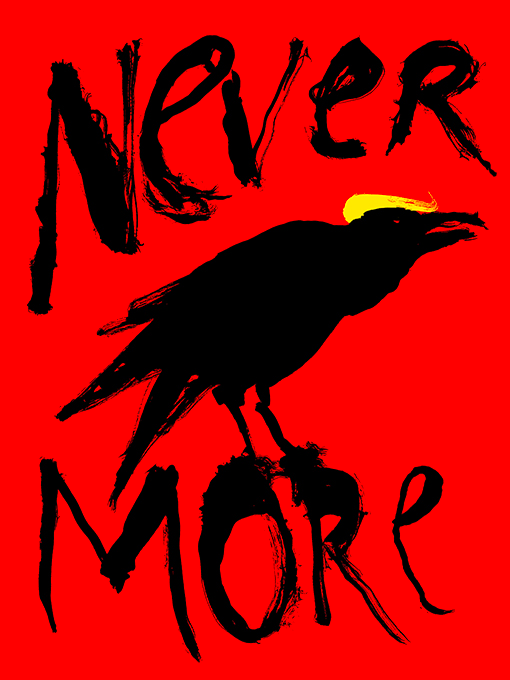
One poster I found that won gold at the UNMUTED poster award, is by Jan Šabach. It shows a raven with a blonde wig and scrawled on top and on the bottom of the page is the word “nevermore”. It is a political poster that refers to a famous poem by Edgar Allan Poe called “The Raven”, which is a gloomy poem where the narrator is slowly drifting into madness. Therefore, it makes sense that the raven on the poster looks like it has come straight out of a nightmare. The word “nevermore” is used quite a few times to depict the finality and hopelessness of the loss the narrator is facing (namely the death of his beloved Lenore). Jan uses this already famous depiction to mention Donald Trump’s politics. He manages to give the raven Trump’s personality with just one yellow brushstroke to create a wig that looks like his hair. This time the word “nevermore” has a slightly different meaning and refers to somehow ending Trump’s career as a politician at least. With this gothic poem reference, the whole poster becomes a gloomy and dark background. Also the seemingly imperfect brushstrokes add to this feeling. The colour red in the background functions as a signal of warning, showing that there is some kind of danger, but with the red the whole raven image also seems show more anger.
The next poster I am going to analyze is on a different topic, namely, climate change and global warming. This shows how diverse the field of design activism can be, designers can inspire action for topics that are important to themselves and should be to society, from their point of view at least.
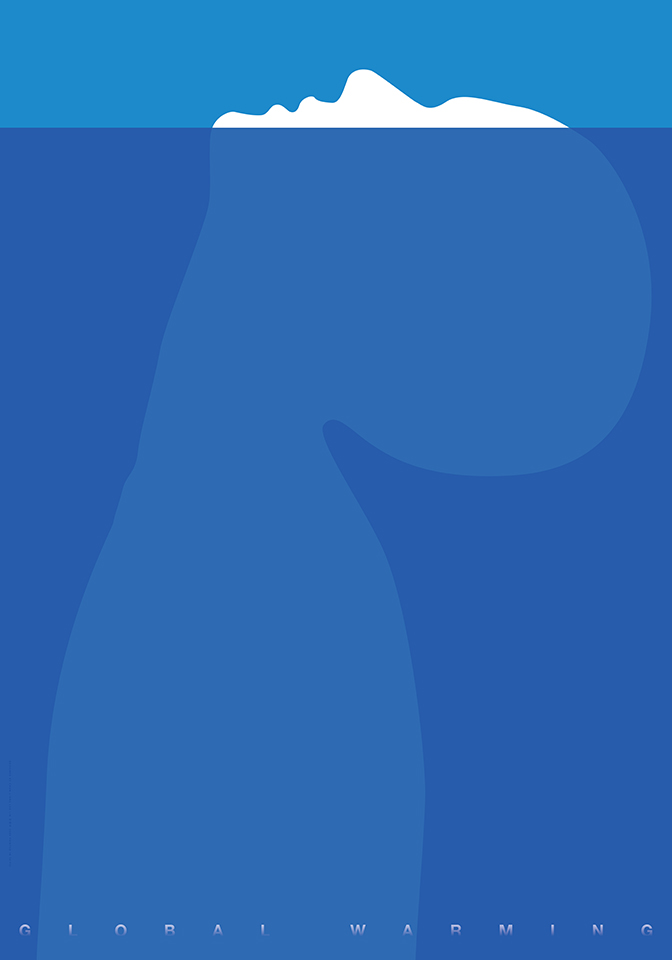
In this case the poster uses Hemingway’s iceberg theory as a reference. This theory was originally created for the new prose, showing that on the surface everything seems to be really simple, while there are hidden depths to the story. This theory was later applied to many different ideas as well. (cf. Johnston, 1984) The poster was created by Leo Lin and as one can see on the bottom it is on the topic of global warming. Even the typography looks as though it is melting. Instead of an iceberg it shows a white human body close to drowning. Similar to the iceberg theory, as well as, the accident of the Titanic, we know that icebergs are usually much bigger underwater than they are on top of the water surface. This is exactly what happens in the image on one hand the iceberg seems to be melting, as can be seen by the rounded edges and only a very small amount of the face being above water. On the other hand the depths of the iceberg still seem to be unknown and unclear since no end can be seen. Therefore, it relates to global warming. The poster was already created in 2009 and is still true today with the global warming, the ice is melting and someday the humans will probably be drowning because of it.
To conclude, these posters have several implied meanings and are extremely interesting to analyze, in my next posts I will focus on searching a few more examples, since it is important to find some common ground within ideas for design activist work.
Sources:
Johnston, Kenneth G.: Hemingway and Freud: The Tip of the Iceberg. In: The Journal of Narrative Technique, vol. 14, no. 1, 1984, pp. 68-73. URL: http://www.jstor.org/stable/30225083. Accessed 26 Jan. 2026. Lin, Leo: Global Warming. In: Graphis Online, 2009. URL: https://graphis.com/entry/05855441-8b20-4131-bb6a-a4e0cefc1832. Accessed 26 Jan. 2026. Šabach, Jan: Never More. In: Graphis Online, 2019. URL: https://graphis.com/entry/8795f518-2b51-4ca5-b9aa-3c769d34bcb6. Accessed 26 Jan. 2026.
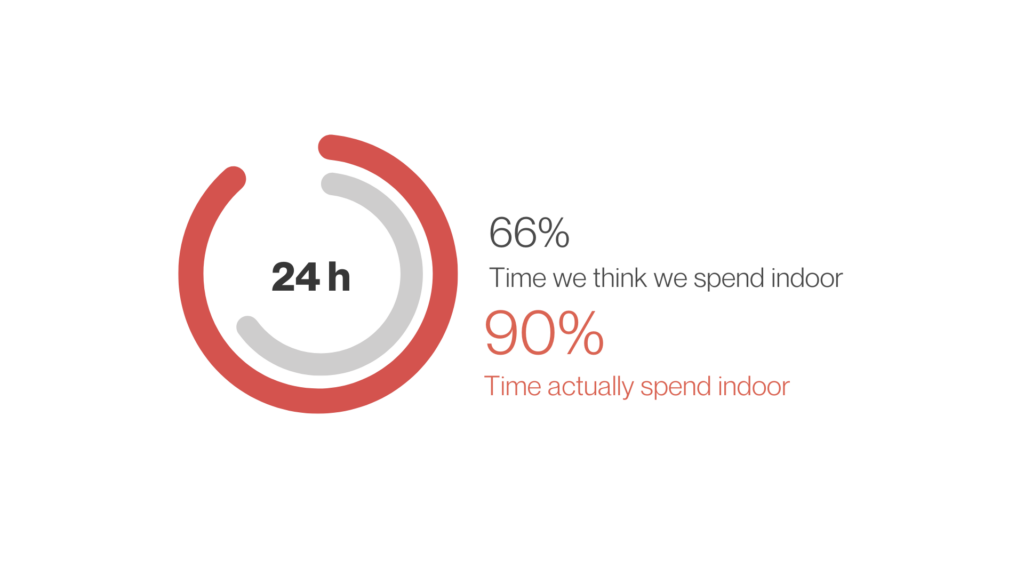
We have become an indoor generation. We spend most of our lives inside buildings, on public transportation, and in enclosed spaces. Home, school, office, gym, and shops: we rarely spend time outdoors, even though we often think otherwise. Recent studies show that people believe they spend about 60–70% of their time indoors, but the reality is very different: on average, we spend up to 90% of our day indoors. This change has occurred in a very short time compared to the history of human evolution, which has seen us live outdoors for hundreds of thousands of years, following the natural cycles of light and dark. This distance from nature affects the body, the mind, and the way we relate to the environment. In this context, caring for plants becomes a simple yet meaningful gesture, especially for certain generations more sensitive to these issues.
The Physical and Mental Effects of an Indoor Lifestyle
Living primarily indoors has concrete consequences. Indoor air is often more polluted than outdoor air, even in cities. Building materials, furniture, cleaning products, and simple daily activities like cooking or breathing increase levels of CO₂ and harmful substances. The lack of natural light also has a significant impact. Our bodies use daylight to regulate our sleep-wake cycles. Spending little time outdoors can cause sleep problems, fatigue, difficulty concentrating, and mood swings. In many cases, it also contributes to stress, anxiety, and seasonal depression. Despite this, we’re often unaware of how little contact we have with nature. This creates a gap between perception and reality that makes it difficult to change habits.
Image 2. Graph showing average time spent indoors over 24 hours – from Bauenmitholz
Why Millennials and Gen Z Are More Drawn to Plant Care
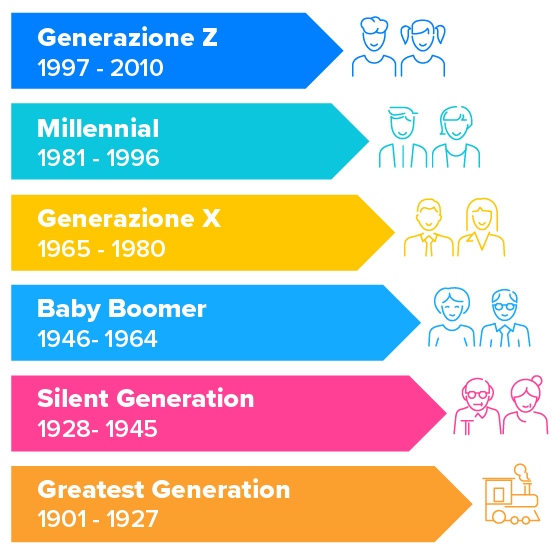
Image 3. Graph with the different generations divided by age group- from Fineco Bank
Research shows that millennials and Gen Z are currently the generations most involved in caring for indoor plants. This doesn’t mean they have more plants than other generations, but they purchase and care for them more frequently and with greater attention. There are several reasons:
They more often live in apartments without gardens
They have a strong connection to mental well-being
They are more sensitive to environmental issues
They use plants as a form of self-care For many young adults, caring for a plant isn’t just a hobby, but a way to slow down, take responsibility, and reconnect with something alive. It’s no coincidence that a large percentage of millennials say that plants make them happier and more optimistic about the future.
Indoor Plants as a Response to Disconnection from Nature
Indoor plants can mitigate some typical problems of indoor living:
They improve the perception of air quality
They introduce natural variations into the space
They make the passage of time visible
They promote routine and attention Even when the biological impact is limited, the psychological effect is strong. A plant changes, grows, and reacts. It’s the opposite of a screen that’s always the same. This opens up an interesting space for interaction design.
Nature-Based Interaction Design: From Screens to Living Interfaces
We are the indoor generation, but that doesn’t mean we have to give up contact with nature. Younger generations, accustomed to complex digital interfaces, seem to increasingly appreciate simple, natural interactions. Plants offer just that: interaction based on observation, time, and slow feedback. For interaction design, this means rethinking the role of interfaces:
fewer screens
more living objects
more relationships, less control Nature-based user interfaces can help rebuild a connection with the environment, especially for those who mostly live indoors.
[2] A. Author et al., “Article title,” International Journal of Environmental Research and Public Health, vol. 19, no. 12, Art. no. 7454, 2022. [Online]. Available: https://www.mdpi.com/1660-4601/19/12/7454
[5] P. Ahmmadi, M. Rahimian, and R. G. Movahed, “Theory of planned behavior to predict consumer behavior in using products irrigated with purified wastewater in Iran,” Journal of Cleaner Production, vol. 296, 2021, Art. no. 126359, doi: 10.1016/j.jclepro.2021.126359.
[6] P. T. Thuy, N. T. Hue, and L. Q. Dat, “Households’ willingness-to-pay for mangrove environmental services: Evidence from Phu Long, Northeast Vietnam,” Trees, Forests and People, vol. 15, Art. no. 100474, 2024, doi: 10.1016/j.tfp.2023.100474.
[7] C. J. Armitage and M. Conner, “Efficacy of the theory of planned behaviour: A meta-analytic review,” British Journal of Social Psychology, vol. 49, no. 3, pp. 471–499, 2010.
[8] X. Liu, H. Lindhjem, K. Grimsrud, E. Leknes, and E. Tvinnereim, “Is there a generational shift in preferences for forest carbon sequestration versus preservation of agricultural landscapes?” Climatic Change, vol. 176, no. 9, 2023, doi: 10.1007/s10584-023-03588-z.
[9] B. Satinover, J. Nichols, and J. W. Holt, “A comparison of sustainability attitudes and intentions across generations and gender: A perspective from U.S. consumers,” Cuadernos de Gestión, vol. 23, no. 1, pp. 51–62, 2023, doi: 10.5295/cdg.211647bs.
[10] X. Li, J. Dai, X. Zhu, J. Li, J. He, Y. Huang, X. Liu, and Q. Shen, “Mechanism of attitude, subjective norms, and perceived behavioral control influence the green development behavior of construction enterprises,” Humanities and Social Sciences Communications, vol. 10, no. 1, p. 266, 2023.
[11] W. J. Fisk, “Health and productivity gains from better indoor environments and their relationship with building energy efficiency,” Annual Review of Energy and the Environment, vol. 25, pp. 537–566, 2000. [Online]. Available: https://www.annualreviews.org/doi/pdf/10.1146/annurev.energy.25.1.537
We have reached the end of this research phase. Over the last few months, through nine distinct blocks, I have dissected the role of storyboarding in Communication Design. But as I look at the collected data, this feels less like a conclusion and more like the starting point for a new standard in design methodology. To wrap up DesRes 1, here is the synthesis of what storyboarding actually is, what it definitely is not, and where it is going.
We started by moving the definition away from “cinema sketches.” Storyboarding in our field is Strategic Pre-visualization. It is the anatomy of an idea. As explored in my earlier posts, a storyboard is a structural map that uses a specific syntax—frames, arrows, and time indicators—to engineer the logic of a communication piece before a single pixel is polished. It is not about how it looks; it is about how it works.
The true value of this tool lies in its utility. It acts as our cheapest form of error detection through its diagnostic power. By forcing a concept into a sequence, we expose the gaps in user flow and narrative logic, allowing us to troubleshoot complex interactions while the cost of change is still low. Furthermore, a storyboard is not a private diary; it is a public document. It functions as a shared language between designers, developers, and clients, ensuring that the “vision” is an actionable plan, not just a vague feeling.
Perhaps the most critical distinction I found is identifying what a storyboard is not. It is not a comic strip, which exists to entertain, nor is it art, which exists to be admired. It is a disposable instruction manual meant to be discarded once the final product is built. If the viewer is looking at the drawing quality rather than the technical instruction, the storyboard has failed.
But the method is evolving. We are no longer limited to 16:9 rectangles. As design moves into VR, AR, and non-linear apps, the form of the storyboard is breaking “Beyond Convention” to map spatial and interactive experiences. The influence of AI is also undeniable, shifting our role from “drawers” to “curators.” While AI offers the potential for rapid iteration, it brings the danger of bypassing the thinking process. The potential of the future lies in using AI to speed up the visualization without losing the strategic intent.
So, is this the end? No. It is the beginning of a more targeted approach. I am not suggesting that storyboarding is necessary for every single design task. As I explored in the “Investment” block, it is a calculation. The next step is to define when this tool is essential. It is a proposal specifically for complex, flow-based projects where the risk of confusion is high. My vision is to establish a “grammar” for these moments, so we have a shared system ready for the projects that actually demand it, without overcomplicating the simple ones.
We are not just designing screens, books, and spaces; we are designing time, flow, and logic to create an experience. And for the projects where that matters, it can start with a storyboard.
By now, one thing should be undeniable: politics rarely announces itself clearly. It doesn’t always arrive as a policy proposal or a campaign speech. More often, it slips in quietly – through visuals, voices, aesthetics, platforms and vibes. It disguises itself as lifestyle, taste, entertainment or common sense.
That’s exactly why questioning matters.
Especially for creatives.
If you can identify branding tactics, you can identify persuasion. If you understand visual language, tone and emotional framing, you can see how power is communicated – and how it is normalised. Political movements rely on design to simplify complex realities, mobilise emotion and create belonging. Sometimes this is empowering. Sometimes it’s manipulative. Often, it’s both.
Questioning doesn’t mean disengaging. It means becoming literate in the systems shaping perception. Asking who benefits from a particular visual language. Whose voices are amplified. Whose experiences are aestheticised. And whose realities remain invisible.
This is where creative skill becomes political responsibility.
Design, media, communication and storytelling are not neutral tools. They structure what is seen, what is felt and what is remembered. As branding logic increasingly dominates political communication, the ability to recognise it becomes a form of power. To see branding is to see strategy. To see strategy is to slow it down.
And slowing down matters.
Because political branding thrives on immediacy. On emotional shortcuts. On recognition before reflection. Questioning interrupts that flow. It creates distance. It makes space for complexity.
This brings us full circle – back to where this series began.
Politics doesn’t start at the ballot box. It starts earlier. Smaller. Quieter. With a repost. A purchase. A design choice. A silence. A black or white shirt at H&M.
Everything is political – not because everything is dramatic, but because everything participates. Every choice exists within systems of power, culture and meaning, whether we acknowledge them or not.
The real question isn’t whether you’re involved.
It’s whether you’re looking closely enough, at how involved you actually are.
Sources: • Foucault, M. (1980). Power/Knowledge. Pantheon Books. • Hall, S. (1997). Representation: Cultural Representations and Signifying Practices. Sage. • Couldry, N. (2012). Media, Society, World. Polity Press.
If politics truly permeates everything – and by now it should be clear that it does – then lifestyle is where it settles most comfortably. Not loudly, not dramatically, but quietly. In routines. In habits. In choices that don’t feel political until someone points out that they are.
What we eat, wear, watch, share and buy increasingly functions as political expression. Ethical consumption, sustainability, boycott culture, conscious branding, “voting with your wallet” – these practices allow individuals to align ideology with daily life. Politics becomes something you do without necessarily noticing you’re doing it.
This shift reflects a broader transformation in how political identity is constructed. Rather than being expressed primarily through formal participation – voting, party membership, protest – politics is increasingly embedded in personal identity and self-presentation. Being political is no longer just about what you argue for, but about how you live.
Sociologist Pierre Bourdieu famously argued that taste is never neutral. Our preferences in food, clothing, art and media reflect social positioning, cultural capital and power relations (Bourdieu, 1984). In contemporary culture, taste has become explicitly political. Aesthetic choices signal values. Consumption communicates alignment. Lifestyle becomes ideology, translated into everyday practice.
This is precisely why branding plays such a central role in modern political movements. For a cause to last, it must integrate seamlessly into daily routines. It must be wearable, shareable and repeatable. When politics becomes habitual, it becomes resilient. A movement that fits into everyday life is harder to abandon than one that only exists in moments of crisis.
But lifestyle politics also exposes deep contradictions.
Who gets to participate in ethical consumption? Who can afford sustainable fashion, organic food, or locally produced goods? When political engagement is tied to purchasing power, participation becomes uneven. What presents itself as moral choice can quickly slide into exclusion.
There is also the question of effectiveness. Critics argue that lifestyle politics risks reducing systemic issues to individual responsibility. Buying the “right” products may soothe personal conscience without challenging structural inequalities. Political action becomes symbolic rather than transformative.
And yet, dismissing lifestyle politics entirely misses its cultural power. Everyday practices shape norms. Norms shape expectations. Expectations shape politics. What feels normal today was often radical yesterday.
Lifestyle politics operates in the slow lane of change. It doesn’t replace institutional reform or collective struggle – but it does influence how those struggles are understood, supported and sustained. It turns abstract values into visible behaviour.
Politics doesn’t only live in institutions or protests. It lives in habits.
And habits, once formed, are hard to break.
Sources: • Bourdieu, P. (1984). Distinction: A Social Critique of the Judgement of Taste. Harvard University Press. • Giddens, A. (1991). Modernity and Self-Identity. Polity Press. • Micheletti, M. (2003). Political Virtue and Shopping. Palgrave Macmillan.
Social media dominates contemporary discussions of political activism – but focusing exclusively on feeds, algorithms and platforms obscures a crucial reality. Modern political movements are multi-channel by necessity. They operate across digital and physical spaces simultaneously, adapting their messages to different media logics.
Street posters, stickers, murals, banners and wheat-pasted flyers remain powerful political tools precisely because they resist digital ephemerality. You don’t scroll past them. You encounter them. Public space becomes a medium, and a battleground.
Cultural theorist Henri Lefebvre famously argued that public space is never neutral, it is produced through power relations, regulation and resistance (Lefebvre, 1991). Protest media that occupies physical space interrupts everyday routines and asserts political presence without requiring consent or algorithmic approval.
Zines and independent print publications function in a similar way. Historically rooted in feminist, queer, punk and anti-capitalist movements, zines prioritise depth, intimacy and community over reach. Their aesthetics – imperfect, handmade, intentionally “unpolished” – reject corporate design standards while still operating within recognisable visual languages.
Community radio also plays a vital role, particularly outside metropolitan centres. It sustains local political discourse, amplifies marginalised voices and maintains continuity between moments of heightened protest visibility. Unlike social media, it is less driven by virality and more by presence.
Even fashion operates as a political media channel. Clothing transforms bodies into mobile communication surfaces. Slogan T-shirts, pins, patches and colour-coded accessories allow individuals to signal political alignment in everyday life. Once again, branding logic reappears: visibility, recognisability, repetition.
What unites these channels is not nostalgia, but strategy. Modern movements do not choose between online and offline media. They occupy all of it. Each channel fulfils a different function – mobilisation, education, identity-building, memory.
The feed is loud. But the street still speaks.
Sources: • Lefebvre, H. (1991). The Production of Space. Blackwell. • Duncombe, S. (2008). Notes from Underground: Zines and the Politics of Alternative Culture. Microcosm Publishing. • Couldry, N. (2012). Media, Society, World. Polity Press.
Podcasting doesn’t look like protest – and that’s precisely why it has become so politically powerful.
There are no marches, no placards, no visually striking crowds filling public squares. Instead, there is a voice. Sometimes just one. Conversational and opinionated. “So here’s the thing…” And suddenly, politics unfolds in your headphones while you’re cooking dinner or commuting to uni.
Podcasting has emerged as one of the most influential – and underestimated – political media forms of the 21st century. Unlike social media platforms that reward speed, outrage and brevity, podcasts thrive on slowness. They offer time, continuity and deeper narratives. In an attention economy built on fragmentation, this temporal commitment is, in a way, radical.
Media scholars argue that podcasts foster strong forms of parasocial interaction – one-sided relationships in which listeners feel emotionally connected to hosts (Llinares, Fox & Berry, 2018). This perceived intimacy generates trust, loyalty and long-term engagement. From a political perspective, this is an incredibly powerful mechanism.
Political podcasts do not simply distribute information. They construct ideological worlds. Over time, listeners adopt not just the host’s language, but also references and interpretive frameworks. The podcast becomes more than content – it becomes a brand, a community and a shared worldview. Intro music functions like a logo. Catchphrases become insider language. Live shows and merchandise transform listening into belonging.
Unlike traditional broadcast media, podcasting bypasses institutional gatekeepers almost entirely. Anyone with a microphone and internet access can participate. This accessibility has allowed marginalised voices to build substantial audiences without relying on mainstream media approval. At the same time, it has enabled the formation of highly insulated ideological spaces.
Podcasting mirrors protest branding in an unexpected way: it replaces visual symbolism with sonic identity. Tone of voice, rhythm, pacing and repetition become political tools. Where protest movements rely on imagery in public space, podcasts occupy private space – directly inside people’s heads.
This private consumption does not make podcast politics passive. On the contrary, it often deepens ideological commitment. Listening is sustained, habitual and intimate. Political ideas are not encountered accidentally, they are chosen, returned to and internalised.
Political change does not always shout. Sometimes, it whispers – consistently, convincingly, and every single week.
Sources: • Llinares, D., Fox, N., & Berry, R. (2018). Podcasting: New Aural Cultures and Digital Media. Palgrave. • Spinelli, M., & Dann, L. (2019). Podcasting: The Audio Media Revolution. Bloomsbury.