Production – Equipment und Logistik

Topic: Green Filming

Zwei wichtige Eckpfeiler einer Green Production, die Einschränkung der Transportwege und der effiziente Einsatz von Strom, wurden bereits im vorherigen Beitrag zum Thema Nachhaltigkeit während der Preproduction besprochen.  Um diese beiden Eckpfeiler noch passend abzurunden, folgen nun noch zwei Nachträge.

In Bezug auf die Mobilität sollten sich alle Mitwirkenden während der Drehzeit bevorzugt mit Öffentlichen Verkehrsmitteln fortbewegen. Die Anreise mit Bus oder Zug hilft dabei, unnötige Emissionen einzudämmen. Vor allem bei Kurzstrecken sollten diese Fortbewegungsmittel dem Flugzeug vorgezogen werden. Am Drehort selbst werden die Unterkünfte der Mitwirkenden im Besten Fall vorab so gewählt, dass die Entfernung zu den Locations so gering wie möglich ist. Auf diese Weise können die Mitwirkenden Personen die öffentlichen Verkehrsmittel nutzen, oder noch besser, mit dem Fahrrad oder zu Fuß zu den Drehorten gelangen. Ist dies nicht möglich, ist es ratsam, Fahrgemeinschaften zu bilden. (vgl. BMLUK 2025, S. 15)

Auch zum Thema Strom gibt es noch einen Nachtrag. Können gewisse Maßnahmen zur Verbesserung der Stromeffizienz nicht eingehalten werden, so müssen die ausgestoßenen CO2 Emissionen, die beispielsweise durch Stromaggregate entstehen, kompensiert werden. (vgl. BMLUK 2025, S. 17) Der Gedanke dahinter ist, dass durch die finanzielle Unterstützung von nachhaltigen Projekten, wie etwa das Pflanzen von Bäumen, die bereits erzeugten Schadstoffe ausgeglichen werden können. Diese Praxis des sogenannten Offsettings ist in „umweltbewussten“ Produktionen gang und gebe. Dennoch ist die Verhinderung der Schadstoffentstehung dem Offsetting vorzuziehen. (vgl. Keilbach/Loist 2023)

Equipment und Technik

Diese Schadstoffvermeidung kann neben der Verbesserung der Stromeffizienz und der Transportwege auch durch die richtige Wahl und dem sorgsamen Umgang mit dem Equipment erzielt werden. Sowohl beim Licht als auch bei Kamera und der Sonstigen Technik können wertvolle Maßnahmen getroffen werden, um den Prinzipien der Green Production gerecht zu werden.

Licht

Der Einsatz von energiesparenden Leuchtmitteln, wie etwa LED, RGB-Licht, oder diversen Reflektorensystemen, hilft beispielsweise bei der Stromeinsparung. (vgl. BMLUK 2025, S. 19) In diesem Zusammenhang ist es auch wichtig, nicht verwendete Leuchtmittel mithilfe von ein- und ausschaltbaren Steckleisten vom Stromnetz zu trennen. Grund dafür ist der stetige Stromverbrauch, der auch stattfindet, wenn sich die Geräte im Standby-Modus befinden. (vgl. Blynk o.D.) 

Bei der Erzeugung von Lichteffekten sollten die verwendeten Materialien auch gut hinterfragt werden. Werden Styropor oder Farbfolien verwendet, so sollten diese auch in weiteren Produktionen Verwendung finden und nicht direkt im Abfall landen. Im Besten Fall wird jedoch vollkommen auf Farbfolien verzichtet und die gewünschten Lichteffekte direkt mithilfe passender Leuchtmittel erzeugt. (vgl. Blynk o.D.) 

So, wie es generell bei allen verwendeten Elementen der Fall ist, müssen die Lampen außerdem bei Beschädigungen oder nach Ablauf ihrer Lebensdauer ordnungsgemäß entsorgt werden. (vgl. MFG Baden-Württemberg 2018, S. 17)

Kamera und sonstige Technik

Auch bei der Wahl der Kamera und der sonstigen Technik ist es notwendig, energieeffiziente Geräte zu bevorzugen. (vgl. BMLUK 2025, S.19) Oft macht es auch Sinn, die benötigten Geräte bei lokalen Verleihunternehmen zu beschaffen, anstatt diese neu zu kaufen. (vgl. MFG Baden-Württemberg 2018, S.17) Sind spektakuläre Luftaufnahmen geplant, so muss auf die Verwendung von Hubschraubern verzichtet werden, da diese einen hohen Emissionsausstoß vorweisen. Als Alternative kann auf Kameradrohnen zurückgegriffen werden, die heutzutage ohnehin bereits vorwiegend bei Luftaufnahmen eingesetzt werden. (vgl. BMLUK 2025, S. 19) 

Wird an kälteren Tagen, oder Nachts gefilmt, so werden oft Wärmepilze benötigt, um die Mitwirkenden warm zu halten. Diese sollten durch UV-Strahler, oder im besten Fall durch Wolldecken ausgetauscht werden. (vgl. Blynk o.D.)  Ein weiterer Weg, um energiesparender zu arbeiten, ist die Verringerung der dauerhaft zu speichernden Datenmengen. Das Löschen von nicht notwendigen Footage verringert nicht nur den Energieaufwand, sondern hilft auch dabei, die Dokumentation und Aufbewahrung übersichtlicher zu gestalten. (vgl. BMLUK 2025, S. 19)

Verbrauchsmaterialien und Abfallwirtschaft

Während der gesamten Produktion sollte das Prinzip des „minimalen Ressourcenaufwands“ gelten. Das bedeutet, dass nur wirklich notwendige Elemente verwendet werden. Dazu zählt etwa die Verringerung des Papierverbrauchs durch das Umsteigen auf digitale Optionen. Ist dies nicht möglich, so sollte nur die zwingend notwendige Menge an Papier bedruckt werden. Hierbei sollte außerdem auf das Druckformat, das verwendete Papier und den beidseitigen Druck geachtet werden. (vgl. BMLUK 2025, S. 18)

Auch der Einsatz von Verbrauchsmaterialien, wie etwa Leuchtmittel, Gurte und Seile sollten verringert werden. Dabei dürfen jedoch keineswegs die Sicherheitsstandards verringert werden. (vgl. MFG Baden-Württemberg 2018, S. 17)

In Bezug auf die Abfallwirtschaft sollte die Müllerzeugung so gut wie möglich vermieden werden. Der nicht vermeidbare Abfall muss ordentlich getrennt und korrekt entsorgt werden. Auch „versteckte“ Elemente müssen bei der Abfallvermeidung berücksichtigt werden. So muss beispielsweise etwa das für den Dreh am Drehort angebrachte Leitsystem, wenn möglich, wiederverwendbar sein. (vgl. BMLUK 2025, S.20) 

Besonders wichtig ist es außerdem, dass „keine umweltschädlichen Flüssigkeiten in Kontakt mit dem Boden kommen.“ (BMLUK 2025, S. 18) Dies ist vor allem im Zusammenhang mit Stromgeneratoren zu berücksichtigen. 

Conclusio

Durch die bedachte und sorgsame Auswahl des verwendeten Equipments und der Verbrauchsmaterialien können viele umweltschädliche Faktoren eingeschränkt werden. Von den CO2 Ausstößen der Kamerahubschrauber, über die energiefressenden Lampen bis hin zu unnötiger Papierverschwendung, gibt es viele Verbesserungsmöglichkeiten. Auch wenn es nicht immer möglich ist, alle diese Elemente auf einmal in Angriff zu nehmen, hilft dennoch jede einzelne Tat dabei, eine nachhaltigere Filmproduktion auf die Beine zu stellen.

Literaturverzeichnis

Blynk o.D.Blynk (o.D.): Green Production. SO geht nachhaltige Filmproduktion. In: Blynk, https://blynk.de/green-production/ (zuletzt aufgerufen am 03.01.2026)
BMLUK 2025Bundesministerium für Land- und Forstwirtschaft, Klima- und Umweltschutz, Regionen und Wasserwirtschaft (BMLUK) (01.01.2025): Green Producing: Neue Anforderungen an Film- und TV-Produktionen. In: Österreichisches Umweltzeichen, https://www.umweltzeichen.at/de/kultur/filmproduktion/green-producing-neue-anforderungen-an-film-und-tv-produktionen# (zuletzt aufgerufen am 05.10.2025)
Keilbach/Loist 2023Keilbach, Judith/Loist,Skadi (11.05.2023): Green Media. Von Green Production zu nachhaltiger Medienwissenschaft. In: Nach dem Film, https://nachdemfilm.de/issues/text/green-media (zuletzt aufgerufen am 10.01.206)
MFG Baden-Württemberg 2018MFG Baden-Württemberg (01.06.2018): Green Shooting Handlungsleitfaden für Filmproduktionen. In: Green Culture Anlaufstelle, https://www.greenculture.info/wissen/green-shooting-handlungsleitfaden-fuer-filmproduktionen/ (zuletzt aufgerufen am 04.01.2026)

Green Preproduction – Wie gute Planung großes bewirken kann

Topic: Green Filming

Gut geplant ist halb gewonnen. Dieses bekannte Sprichwort beschreibt eine Sichtweise, die in der Filmproduktion von großer Wichtigkeit ist. Ob ein Film erfolgreich produziert wird, entscheidet sich lange bevor die ersten Schauspieler:innen vor der Kamera stehen, das Art Department das Szenenbild aufbaut und die Regisseur:innen ihre Anweisungen am Set geben. 

Während der Preproduction werden Skripte verfasst, Drehpläne geschrieben, Locations gesucht und vieles mehr. Diese Phase ist wegweisend für jede Film- und Videoproduktion, doch besonders im Zusammenhang mit Green Production spielt eine akribische Planungsphase eine essenzielle Rolle, um die Umweltbelastung durch die Produktion so gering wie möglich zu halten. In diesem Blogbeitrag wird daher ein Fokus auf die Verbesserungsmöglichkeiten der Nachhaltigkeit während der Preproduction gelegt.

Die Beaufsichtigung der Green Production

Sobald bei einem Filmprojekt feststeht, dass es sich hierbei um eine Green Production handeln soll, wird ein:e qualifizierte:r Green Producing Zuständige:r angestellt beziehungsweise festgelegt. Diese:r muss die nötigen Qualifikationen im Bereich der Nachhaltigkeit vorweisen können, beispielsweise durch eine einschlägige Ausbildung. (vgl. BMLUK 2025, S.14) 

Diese:r Nachhaltigkeitsbeauftragte ist während der Produktion des Filmes für die Einhaltung der Umweltstandards und der Green-Producing-Maßnahmen verantwortlich. Das bedeutet, dass diese Person mit der Aufgabe betreut wird, sowohl das gesamte Filmteam als auch gegebenenfalls Partnerbetriebe (Bsp. Catering oder Geräteverleih) über die geltenden Standards und Maßnahmen für die Produktion zu informieren und als Ansprechpartner:in bei Fragen bereitzustehen. (vgl. BMLUK 2025, S.14)

Vor allem während der Planungsphase ist die Expertise der für das Green Producing zuständigen Person essenziell, da hier mögliche Probleme im Bereich der Nachhaltigkeit frühzeitig festgestellt, angesprochen und gemeinsam mit dem Team vorab gelöst werden können. Auf diese Weise kann von Anfang an eine umweltfreundlichere Produktion sichergestellt werden. (vgl. MFG Baden-Württemberg 2018, S.7)

Abgesehen davon ist die/der Nachhaltigkeitsbeauftragte während der gesamten Produktion für die Dokumentation der durchgeführten und eingehaltenen Maßnahmen zuständig. (vgl. MFG Baden-Württemberg 2018,S.7) Dies ist besonders wichtig, wenn eine Zertifizierung mit Auszeichnungen, wie etwa dem Österreichischen Umweltzeichen, angestrebt wird.

Preproduction

Aber welche Aspekte der Preproduction können und müssen nun abgewandelt werden, um den Ansprüchen einer Green Production gerecht zu werden? Um diese Frage zu beantworten muss zu Beginn der Produktion ein Nachhaltigkeitskonzept erstellt werden, in dem alle Maßnahmen festgelegt werden, die während des gesamten Projektes eingehalten werden müssen. Wie bereits zuvor erwähnt ist es die Aufgabe der/des Green Producing Zuständigen diese Maßnahmen mit dem gesamten Team zu teilen, besprechen und die Einhaltung zu beaufsichtigen. (vgl. Rientjes o.D.)

Diese Maßnahmen umfassen eine Vielzahl an Verbesserungsmöglichkeiten, die sich von der Wahl der Drehorte, über die Einsparung von Strom bis hin zur Planung des Caterings erstreckt. Während der Preproduction geht es vor allem darum, bereits während der Planungsphase umweltfreundlichere Entscheidungen zu treffen. Bei der Wahl der Locations wird beispielsweise darauf geachtet, dass diese strategisch clever ausgewählt werden, um die Transportwege so gering wie möglich zu halten. Dazu gehört auch eine bedachte Einteilung der Drehtage, damit im besten Fall alle Szenen an einer Location abgedreht werden, bevor die Zelte abgeschlagen und am nächsten Drehort erneut aufgebaut werden. Auf diese Art und Weise können unnötige Transportwege, sowohl von Equipment und Utensilien als auch von den mitwirkenden Personen, vermieden werden.  (vgl. MFG Baden-Württemberg 2018, S.13)

Ein weiterer Weg, um sowohl Transportwege klein zu halten als auch die Nachhaltigkeit der verwendeten Produkte und Dienstleistungen steuern zu können, ist die genaue Begutachtung möglicher Dienstleister und Produktionspartner. Bevor diese engagiert werden, sollte hinterfragt werden, inwiefern die Arbeit und Einstellung dieser Unternehmen mit der Nachhaltigkeitspolitik der Filmproduktion zusammenpasst. Außerdem sollten Unternehmen aus der näheren Umgebung vorgezogen werden, um Transportwege möglichst gering zu halten. Im Zuge der Anfrage an die Unternehmen macht es Sinn, sich explizit nach nachhaltigen Alternativen zu erkundigen. Während dieser Planung sollte besonders auf eine reibungslose Kommunikation zwischen den einzelnen Filmdepartments geachtet werden, um gemeinsame Services und Transporte gut koordinieren zu können. (vgl. Rientjes o.D.)

Wurden die Drehorte festgelegt, muss auch die Stromversorgung gut durchdacht werden. Dies ist sehr wichtig, da Filmproduktionen allein durch den notwendigen Einsatz von Leuchtmitteln einen hohen Energieverbrauch aufweisen. In diesem Zusammenhang sind, wenn möglich, Baustromanschlüsse von Ökostromanbietern dem Einsatz von betriebsintensiven Generatoren vorzuziehen. (vgl. MFG Baden-Württemberg 2018, S. 13)

Um den generellen Einsatz von Leuchtmitteln so gering wie möglich zu halten, sollte außerdem während der Planung der Drehtage stromeffizient gedacht werden und so viele Szenen wie möglich bei Tageslicht eingeplant werden. Generell sollte die gesamte Produktion dem Ziel der Stromeffizienz folgen.  (vgl. Rientjes o.D.)

Es macht außerdem Sinn, bereits während der Preproduction an die Postproduction zu denken. Dies bedeutet, bereits vorab zu überlegen, welche Dinge besser während des Drehs gemacht werden und welche einfacher und nachhaltiger in der Postproduction umgesetzt werden können. Dies betrifft beispielsweise die Einbindung von Special Effects oder Virtual Effects. (vgl. Rientjes o.D.)

Conclusio

Obwohl hier nur ein paar der Verbesserungsmöglichkeiten für die  Preproduction vorgestellt wurden, zeigen diese Beispiele, dass bereits, wenn nicht sogar vor allem während der Preproduction ein Großteil der umweltfreundlichen Entscheidungen getroffen werden können. Unabhängig davon, ob es sich hierbei um die Wahl der Location handelt, oder um die Mülltrennungsstrategie. Jede scheinbar noch so kleine Entscheidung trägt dazu bei, eine nachhaltigere Filmproduktion auf die Beine zu stellen. Es liegt an den Filmemacher:innen und ihren Teams, hier die richtigen Entscheidungen zu treffen. 

Literaturverzeichnis

BMLUK 2025Bundesministerium für Land- und Forstwirtschaft, Klima- und Umweltschutz, Regionen und Wasserwirtschaft (BMLUK) (01.01.2025): Green Producing: Neue Anforderungen an Film- und TV-Produktionen. In: Österreichisches Umweltzeichen, https://www.umweltzeichen.at/de/kultur/filmproduktion/green-producing-neue-anforderungen-an-film-und-tv-produktionen# (zuletzt aufgerufen am 05.10.2025)
MFG Baden-Württemberg 2018MFG Baden-Württemberg (01.06.2018): Green Shooting Handlungsleitfaden für Filmproduktionen. In: Green Culture Anlaufstelle, https://www.greenculture.info/wissen/green-shooting-handlungsleitfaden-fuer-filmproduktionen/ (zuletzt aufgerufen am 04.01.2026)
Rientjes o.D.Rientjes, Els (o.D.): Toolkit. Production. In: Green Film Making, https://greenfilmmaking.com/toolkit/production/ (zuletzt aufgerufen am 03.01.2026)

PBR: Physically Based Rendering on the Web

Physically Based Rendering (PBR) has become the standard for modern 3D graphics because it produces materials that look believable under any lighting conditions. Unlike older empirical models like Phong or Lambert, PBR follows real-world physical principles, ensuring that metal reflects like metal and plastic looks like plastic, regardless of environment. In web based 3D engines like Three.js and Babylon.js, PBR is implemented as a complete pipeline from texture authoring to shader evaluation.

Textures

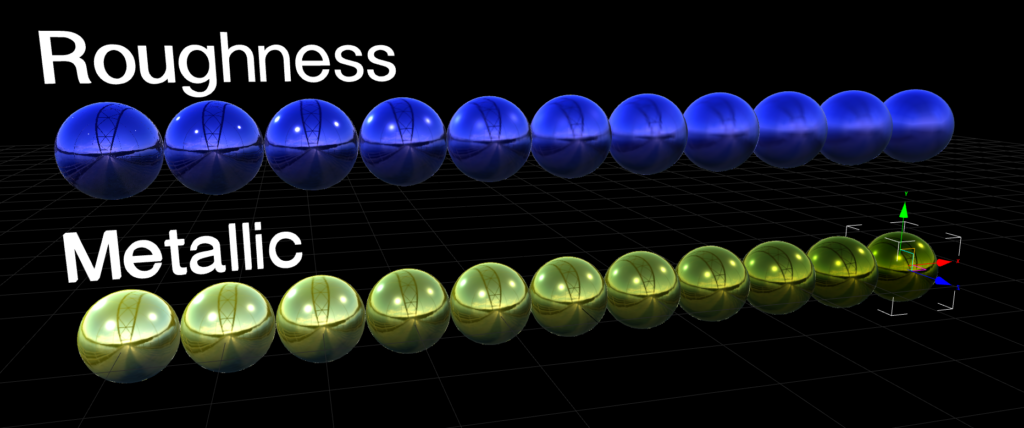
At the heart of PBR are a set of core input textures that describe material properties. They are base color (also known as albedo), metallic, roughness, normal, ambient occlusion (AO) and emission. The base color map provides the color without any light interaction. The metallic map determines whether a surface behaves like metal or not, using a value ranging from 0 to 1. Roughness controls the surface roughness, where a low value would represent a shiny pool ball with reflections and a high value a very dusty rock where light is evenly spread with no visible reflections. Normal maps add fine surface detail that doesn’t need to be modeled such as tiny cracks or even small bolts. Ambient occlusion darkens crevices and simulates indirect shadow. Finally, emissive maps make parts of the surface glow independently of lights.

These input textures are fed into a Bidirectional Reflectance Distribution Function (BRDF) also most commonly known as the microfacet model. Microfacets assume the surface is made of tiny mirror-like facets oriented randomly according to a normal distribution function (NDF), typically GGX. The BRDF combines three terms, the Fresnel effect (view-dependent reflectivity), the geometry term (microfacet shadowing and masking) and the NDF (facet distribution based on roughness).
For metals, the diffuse component is near zero and the specular uses the base color as a tinted mirror, changing the tint of the metal. For non-metals, specular is achromatic white and diffuse uses the base color. This energy-conserving model ensures no more light is reflected than hits the surface.

IBL

To get convincing reflections and indirect light, PBR usually relies on Image-Based Lighting. IBL uses HDRIs to represent light coming from all directions around the object. These maps are prefiltered into different levels of blur so that rough materials sample a more blurred version of the environment. Combined with the BRDF, this allows metals and glossy plastics to respond realistically to their surroundings without the need for many real-time lights in the scene.

Authoring

Authoring PBR textures for the web demands discipline to avoid common pitfalls. Tools like Substance Painter can generate these maps, but exporting them the wrong way can ruin the look. The base color needs to be in sRGB color space, metallic, roughness, normal and AO need to be in a linear color space (non-color data). Roughness should range from around 0.05 for a mirror to 0.9 for matte materials, avoiding the extremes that could look jarring. Metallic usually only uses binary, so either 0 or 1, no in between. There are some exceptions though for materials like metallic paint. Normal maps have to match the tangent space that is expected by the engine. Overly bright HDRIs can wash out scenes and mismatched roughness scales between tools can lead to reflections looking wrong.

Performance Considerations

Performance is a key consideration because PBR shaders are more complex than simple Blinn-Phong (a simple lighting model). Each fragment requires multiple texture lookups, Fresnel calculations, and environment sampling, which can bottleneck on limited devices. Web engines approximate where it is possible. Three.js for example uses a simplified BRDF without full multiple scattering, while Babylon.js’ PBRMaterial supports advanced features like clearcoat but allows disabling reflections or IBL for speed. Optimizations include reducing texture resolution, baking some maps into others such as AO into roughness, and using lower-resolution maps for mobile.

The strength of PBR on the web is portability. Materials authored once look consistent across engines and devices. By mastering the input textures, microfacet BRDF and IBL pipeline, developers can create production quality visuals without proprietary tools. The cost is higher shader complexity but targeted optimizations keep it viable even on modest hardware.

SOURCES

1: https://learnopengl.com/PBR/Theory
2: https://www.cg.tuwien.ac.at/research/publications/2017/OPPITZ-2017-3DM/OPPITZ-2017-3DM-report.pdf
3: https://archdesignmart.in/the-ultimate-guide-to-pbr-materials-understanding-physically-based-rendering/
4: https://www.mathematik.uni-marburg.de/~thormae/lectures/graphics1/code/WebGLShaderMicrofacetBrdf/ShaderMicrofacetBrdf.html
5: https://sbcode.net/threejs/environment-maps/

Morphing Skeletons: Animation Systems for Web

Animation brings 3D scenes to life, turning static models into characters. In web-based 3D, animation is much more than just playing back keyframes. It involves careful management of geometry updates, skinning computations and blending logic to maintain smooth performance. Modern engines like Three.js and Babylon.js support several systems for this, primarily through the glTF format. Each of these systems comes with distinct costs and use cases so it is important for developers to know about them.

Animation Techniques

Skeletal Animation

The most common technique for character animation is skeletal animation, also known as skinning. Here, a model is bound to an armature of bones that define how parts of the mesh move relative to one another. Each vertex is assigned to one or more bones with a weight totaling a value of 1.0 per vertex. When the skeleton is posed, for example by rotating an arm bone, the vertex positions are computed by blending the transforms from all influencing bones according to their set weights. This skinning can happen on the CPU or GPU, although GPU is preferred for web as it can be very performance heavy.

In practice, skeletal animation performs well for characters or articulated objects, but the cost scales with vertex count and bone influence count. A character with 10.000 vertices skinned to 4 bones per vertex is manageable, but with 50.000 vertices and 8 influencing bones, it can lead to a strain on mobile GPUs. Engines mitigate this by limiting influence counts during exports and reusing skeletal data whenever possible.

Morph Target

For deformations that do not fit a skeletal rig, such as organic shape changes or a muscle flexing, morph target animation is ideal. Morph target animation, also known as blend shapes, store multiple vertex position sets representing different shapes of the same topology. An example for facial animations would be a blend shape for a neutral face, one for a smile and one with an angry frown. Animation is then achieved by blending between these morph targets. This is computationally simpler than skinning as it is just a weighted sum of vertex positions with no hierarchy involved.

Morph targets shine for localized deformations but become expensive with a high vertex count, since every target must be stored in memory and blended per vertex. They are perfect for faces or props like inflating balloons, but less suited for full body animation. In glTF exports from Blender, shape keys become morph targets and Three.js can load them directly for playback.

The Cost of Animation

Both of these two systems rely on keyframe data. Animation clips store tracks of changes, such as rotations and influences, sampled at specific points in time. Playing back these poses involves interpolation between keyframes using mathematical curves. The performance cost is generated by updating the skeleton or morph influences every frame and re-skinning the mesh. For smoother playback, engines like Three.js use an “AnimationMixer” that handles time scaling, looping and pausing. Another way to increase performance is to reduce the keyframe density during exports to cut down memory.

Optimizing animations for the web emphasizes reuse and simplification. Reusing rigs and skeletons across characters, baking simple animations to morph targets or to geometry if they do not need blending. Update rates can also be adjusted to increase performance based on the importance of the animation. Similar to LODs, animation can be reduced when it becomes less important or further away, switching from a 60Hz to a 30Hz update rate at higher distances.

Interactivity

Interactive animation adds a whole new world of challenges such as physics integration or procedural posing / animations. Full inverse kinematics for example are very expensive compared to simple bone manipulations via uniforms. Physics based interactive animations such as cloth simulations are so performance heavy that they should only be used for key objects of a scene.

SOURCES

1: https://github.com/akash-coded/mern/discussions/217
2: https://www.tutorialspoint.com/babylonjs/babylonjs_animations.htm
3: https://doc.babylonjs.com/features/featuresDeepDive/mesh/bonesSkeletons
4: https://firxworx.com/blog/code/creating-an-animated-3d-ecard-using-webgl-react-three-fiber-gltf-models-with-animations/
5: https://dev.to/derrickrichard/unlocking-the-web-in-3d-an-introduction-to-threejs-57dn

Lighting and Shadows in the Browser

Lighting is one of the most important tools for making 3D scenes feel believable. A simple model can look convincing with well-designed lighting, while a high-resolution asset can appear flat without it. In web-based 3D this is no different, but lighting comes with a big caveat, a possibly big hit to performance.
Every extra light and reflection typically translates into additional calculations in shaders, so understanding how lighting is implemented helps developers decide where to spend the performance budget.

Types of Lights

Most real time engines for the web support several types of lights. Directional lights, point lights, spot lights and ambient lights among others. Directional lights represent the most common light source – the sun, with light rays moving parallel to one another. They are often used to define a main light direction for outdoor scenes. Point lights emit light equally in all directions starting from a single point, similar to a light bulb. Spot lights on the other hand emit light in the form of a cone, similar to stage lights. Ambient lights emit lights evenly everywhere, providing a base level of brightness so that shadows are not 100% black. Additionally there are HDRI maps that can be used to simulate real lighting scenarios without the use of a single “physical” light. HDRI maps are most important for reflections and physically based rendering.

How do Lights light?

Lights are implemented in shaders as mathematical models. The vertex or fragment shader takes the light positions, directions and colors, combines them with surface normals and material properties, and computes a lighting contribution at each pixel. For directional lights, this often involves a simple dot product between the light direction and the surface normal. Point and spot lights add distance-based falloff, which are more expensive on performance because of the additional equations. Environment lighting relies on a preprocessed environment texture, which is more costly that a single directional light but can dramatically increase realism.

To add shadows, the renderer needs to determine which parts of the scene are blocked from the light. The most common real-time technique is shadow mapping. In a shadow map pass, the scene is rendered from the light’s point of view into a depth texture, which stores how far each visible point is from the light. Then this map is transformed into the light’s coordinate space and compared do the depth value. If the fragment is farther away then the stored depth, it is considered occluded and rendered in shadow. This technique is widely used in WebGL and other real time APIs as it works with any geometry and doesn’t require a special kind of processing.

For global illumination, many modern engines use Image-Based Lighting (IBL). IBL relies on environment maps (HDRI) that represent the lighting of a full 360 degree environment. For web development, these HDR maps are often converted into specular and diffuse textures that can be applied to the environment to provide both reflections and indirect light.

Because lighting affects performance so much, many real-time pipelines use a mix of baked and dynamic techniques. Baked lighting is a precomputed light interaction that is stored in lightmap textures. These lightmaps are then sampled at runtime, with shaders performing minimal calculations. Dynamic lighting on the other hand, is computed every frame and is necessary for moving objects or lights. A common strategy is to use baked lightmaps for static indirect light and large-scale ambient effects while reserving the performance heavy real-time shadows for characters, moving props or user-driven interactions. Baked lightmaps consume some texture memory but almost no runtime completion, making them a good fit for low end devices such as mobile.

Good lighting design for the web starts with restraint. Often, a single directional light with shadows and an environment map can provide enough richness for product visualization. More complex setups should be justified by clear visual needs, such as interactive environments or game-like experiences. When targeting a wide range of devices, it is wise to provide different lighting tiers depending on the available hardware.

SOURCES

1: https://webglfundamentals.org/webgl/lessons/webgl-shadows.html
2: https://sbcode.net/threejs/environment-maps/
3: https://dev.to/joseph7f/tutorial-building-a-simple-pbr-scene-with-shadows-and-fps-controls-in-threejs-19oj
4: https://star.global/posts/introduction-to-webgl/
5: https://www.chinedufn.com/webgl-shadow-mapping-tutorial/
6: https://pingpoli.de/sparrow-9-shadows
7: https://docs.godotengine.org/en/stable/tutorials/3d/global_illumination/using_lightmap_gi.html

GPU Buffers: How 3D Data Reaches the Screen

When working with WebGL or WebGPU through engines like Three.js or Babylon.js, it is easy to think of models as abstract objects that just make the scenes “appear” on screen. Underneath the hood of these engines, there is however a very concrete flow of data from JavaScript into GPU memory. Understanding how buffers, attributes and uniforms work, helps explain why certain operations are cheap and others can quickly lead to performance issues, especially in complex 3D scenes.

What are Buffers

At the core of GPU data flow are buffer objects, which is a block of memory on the GPU that stores raw data such as vertex positions, normals, texture coordinates or indices. Instead of sending vertex data for every frame, WebGL and WebGPU allow developers to upload this data into a buffer and then reference it many times during rendering. This is critical for performance because communicating with the GPU from JavaScript is pretty expensive compared to the GPU reading data that is already on it.

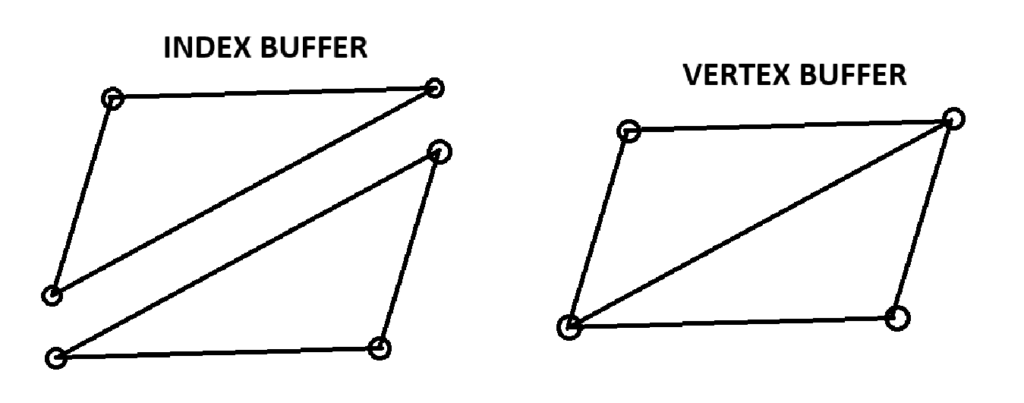
Most meshes rely on two main types of buffers, vertex buffers and index buffers. A vertex buffer holds attributes for each vertex, such as 3D position, surface normal and UV coordinates. An index buffer holds integer indices that reference those vertices in a specific order, allowing the GPU to reuse vertex data when constructing triangles. For example, a rectangle drawn with two triangles can use four unique vertices but six indices, avoiding duplication in the vertex buffer and reducing memory usage.

Using index buffers becomes increasingly important as meshes grow more complex. Without indices, every triangle must define all three of its vertices independently, even if those vertices are shared with neighboring triangles. With the help of indices, a vertex that belongs to multiple triangles can be stored once inside of a vertex buffer and referenced multiple times from the index buffer.

It also matters how the data is laid out inside of the buffers. Attributes can be stored in an interleaved fashion or in separate buffers. Interleaved buffers pack normal and UV data together for each vertex individually, which often reduces state changes because the GPU can fetch all attributes for a vertex in one swoop. Separate buffers can be beneficial when different passes only need a subset of data or if some attributes change more frequently than others, but they might lead to a larger overhead.

Blocks and UBOs

On top of vertex data, the GPU also needs per-draw and per-material parameters. These include transformation matrices, colors and light properties and are provided through uniforms. Uniforms represent constant values across all vertices or fragments in a single draw call. For example, the model-view-projection matrix, a base color, and a light direction might be sent as uniforms and then read in both the vertex and fragment shaders. As scenes become more and more complex, managing dozens of individual uniforms across multiple shaders can also become a bottleneck. This is where uniform blocks and UBOs (Uniform Buffer Objects) enter the picture. Instead of setting a large number of uniforms one by one, a UBO allows developers to pack related uniform data (for example all lighting parameters) into a dedicated buffer on the GPU. Then, multiple programs can then share that UBO which drastically reduces the number of calls needed to update data each frame. WebGL and WebGPU both support this pattern, and real-world projects use it to centralize camera and lighting information for many draw calls.

Attribute layouts, strides and offsets control how the GPU interprets data inside of a vertex buffer. When setting up attributes, the number of components each attribute has, the stride between consecutive vertices and the offset of each attribute within the vertex structure is determined. This is vital as a single mistake in stride or offset can produce corrupted geometry. Once attribute bindings are configured, they are often stored in Vertex Array Objects (VAO), making it possible to re-bind all attribute and index changes with a single draw call.

Static and Dynamic Data

From a performance standpoint, the important distinction for data is between static and dynamic data. Static geometry, such as the environment, should be uploaded once and reused across frames, with buffers created with specific notations for a static element. Dynamic geometry on the other hand, such as particle systems, may require buffer updates every frame, which is more expensive. In these cases, careful strategies like updating only parts of a buffer or offloading some updates to the GPU with compute or transform feedback can help keep performance in check.

SOURCES

1: https://learnwebgl.brown37.net/rendering/buffer_object_primer.html
2: https://www.geeksforgeeks.org/javascript/how-to-create-and-use-buffers-in-webgl/
3: https://www.siltutorials.com/opentkbasics/4
4: https://webgpufundamentals.org/webgpu/lessons/webgpu-vertex-buffers.html
5: https://webgl2fundamentals.org/webgl/lessons/webgl2-whats-new.html
6: https://webglfundamentals.org/webgl/lessons/webgl-how-it-works.html

Individual Colours in a Cultural Comparison: The colour PURPLE

Purple is distinguished as one of the rarest and most royal colours throughout human history. Its challenging production process rendered it a symbol of wealth, power, and mystery. Its placement between the passionate red and serene blue imbues it with emotional depth. The colour purple can bring to mind royalty, spirituality, creativity, or decadence. This post follows the significance of purple across history, religion, daily culture, and cultural differences between Europe/USA, East Asia, and other areas.

History

The story of Purple starts with a lack of resources. In ancient times, a single garment dyed with Tyrian purple from murex sea snails required thousands of these mollusks, making it the most expensive substance in antiquity due to Phoenician traders. Around 1200 BCE, this colour became the only hue associated with Mesopotamian kings and Egyptian pharaohs, representing divine power and eternal life. It is well known that Cleopatra took baths in purple-dyed linen.

In Classical Greece and Rome, the colour purple was designated for emperors and magistrates. Roman senators sported togas with purple borders, while emperors wore the entirely purple trabea triumphalism during victory parades. Due to financial laws that prohibited commoners from putting it on, purple became a visible symbol of class and authority.

Europe in the Middle Ages maintained this exclusivity. Complex emperors put on garments of purple silk, dyed with sources that were even more rare, while European nobility imported it at overpriced prices. The extravagant and grand nature of Renaissance literature was mirrored in its “purple prose.” In the 19th century, synthetic mauveine made the colour purple accessible to all, awakening a fashion revolution of bright aniline dyes.

In Asia, the colour purple manifested in more understated ways. In ancient Chinese cosmology, purple was linked to the centre and was used carefully in imperial robes and star maps, as seen in the “Purple Forbidden City,” named after a nebula. In Heian court dress, Japanese wisteria purple represented nobility, whereas in Indian textiles it was combined with gold for wedding magnificence.

Religion

Purple holds deep spiritual meaning across religions, frequently connecting earthly authority and divine mystery.
In the Christian tradition, purple represents penance, preparation, and royalty. During Advent and Lent, bishops don purple garments, whereas cardinals wear red-trimmed purple as “Princes of the Church.” In Passion scenes, Christ’s purple robe ridicules the idea of kingship in the presence of true divinity. Purple garments strike a balance between mourning and the anticipation of resurrection.

In Judaism, purple is used in contexts that are holy. The curtains of the Tabernacle and the garments worn by priests included blue-purple wool, which represented holiness and a connection to the divine. Contemporary prayer shawls sometimes include purple threads that reflect Temple traditions.
In the context of Buddhism and Hinduism, purple is associated with higher chakras and enlightenment. The violet colour of the crown chakra signifies spiritual connection, and in Tibetan Buddhism, purple is linked to wisdom gods. Kali’s sporadic portrayals in purple blend annihilation and transcendence.

In ancient mystery religions, purple was elevated in a mystical way. Dionysus donned purple robes representing thrilled transformation, a link that Roman triumphators made to divine favour following battle.

Everyday Culture

In the West, purple is regarded as both playful and prestigious in everyday life. It is utilized for tolerance and creativity by luxury brands such as Cadbury chocolate and Hallmark cards. Purple hearts recognize bravery in the military, whereas “purple patches” commend outstanding writing. Fashion presents purple as a daring form of self-expression, with violet accessories being favoured in the printemps collections.
However, stereotypes persist: “purple prose” refers to language that is exaggerated, while purple faces indicate anger or effort. Since the rainbow flag’s beginning in the 1970s, purple has been embraced by LGBTQ+ culture for pride and diversity.

In East Asia, purple’s subtleness is favoured. Chinese purple ink is used for imperial seals, whereas Japanese murasaki (wisteria purple) is found in elegant textiles and tea ceremony items. The colour purple is used in the Korean hanbok to symbolize maturity and wisdom. While Western vibrancy is marked by a lively quality, Asian purple embodies a quiet elegance.
In Middle Eastern cultures, purple is blended practically. Persian rugs showcase purple-saffron motifs representing wealth, whereas Moroccan kaftans employ it for festivity. Deep purple saris adorned with gold are favoured in Indian weddings, symbolizing prosperity.

Contrast to Europe/USA

Europe and the USA define luxury, creativity, and bold individuality as code purple. The Tyrian heritage elevates it to premium status – Cadbury purple signifies tolerance, whereas violet packaging represents artistry. The emotional tone combines playfulness and sophistication, but excessive use may lead to flashiness or cliché.
In East Asian contexts, purple is associated with refined wisdom and cosmic centrality. Chinese purple embodies imperial gravity rather than a casual flair, as seen in official seals and scholarly robes. Japanese purple embodies the elegance of the Heian court and the beauty of seasonal wisteria, emphasizing subtlety rather than Western drama. In contrast to the “fun” purple accents of Europe, Asian uses convey a sense of maturity and restraint.

Middle Eastern customs contribute to celebratory prosperity. The combination of purple and gold in wedding textiles and jewellery symbolizes joy and abundance, creating a contrast between the communal festivity and Western luxury coding.
These splits have practical significance. While Western designers choose for a lively shade of purple to represent youthful creativity, Chinese audiences interpret it as a symbol of imperial seriousness. In the context of Asia’s refinement, a playful purple product package appears playful, whereas in the Middle Eastern markets it is expected to convey celebratory richness. Filmmakers encounter similar options: purple lighting indicating Western corruption could evoke notions of Asian spiritual depth or Middle Eastern celebration for viewers worldwide.

Conclusion

Purple’s transition from a rare sea-snail product to a synthetic abundance showcases its lasting charm. It was once set aside for deities and royalty, but now it strikes a balance between modern inventiveness and royal custom. For global creators, purple requires cultural sensitivity: Western boldness contrasts with Asian restraint, and celebratory abundance tempers the exclusivity of luxury. Blunders risk a lack of taste or unwanted seriousness. Expertise opens the door to refined emotional resonance that transcends borders.

Quelle:
Color Psychology. Purple: Meaning, psychology & cultural significance. https://www.colorpsychology.org/purple/
Nicholas Wells. The symbolism of purple. https://nicholaswells.com/blogs/blog/colour-symbolism-purple
SpectraLore. Tyrian Purple: The colour of royalty. https://spectralore.com/spectra-in-culture-history/tyrianpurple/
SpiritualMarker. Purple color meaning: spiritual meaning, symbolism & psychology. https://www.spiritualmarker.com/color-purple-spiritual-meaning-symbolism-psychology/
YAOT. Purple color meaning. https://www.yaot.io/colors/purple-color-meaning

Individual Colours in a Cultural Comparison: The colour BLACK

In human culture, black is one of the most potent and paradoxical colours. It can embody supreme authority, profound mystery, intense sorrow, or stark simplicity. Like the absence of light, black absorbs every wavelength, forming a void that causes both fear and fascination. This post investigates the concept of black across various domains, including history, religion, and daily culture, as well as examining significant cultural differences between Europe/USA, East Asia, and other areas.

History

Black’s journey starts with fundamental materials: charcoal, soot, and burnt ivory formed some of the earliest pigments used by humans in Palaeolithic cave art dating back to around 30,000 BCE. In ancient Egypt, the colour black represented the fertile soil of the Nile and resurrection; Osiris, the underworld god, was depicted with black skin as a symbol of renewed life. Black kohl eyeliner was employed by pharaohs for safeguarding and to gain the favour of the divine.

During the classical periods of Greece and Rome, the colour black came to have two meanings. Philosophers put on black coats as symbols of wisdom and detachment, whereas Roman magistrates wore black togas in mourning. In medieval Europe, the colour black was raised as a symbol of power: nobles and priesthood wore luxurious fabrics made from velvet and silk that were dyed with expensive gallnut and iron, resulting in deep, enduring blacks. During the Renaissance, black emerged as the peak of fashion – it was put on by Spanish nobility and Italian traders to signify wealth, moderation, and refinement.

In Asia, the colour black took various directions. In the context of Five Elements theory in imperial China, black symbolized water and was linked to the north, winter, and the potency of the unknown. Warrior attire and ceremonial robes often incorporated black to symbolize strength and mystery. Black polished armour was highly valued by Japanese samurai, as it was associated with resilience and the void of Zen philosophy.

Due to Victorian mourning customs, black became the universal grief colour in the West, and in the 20th century, the “little black dress” turned it into a symbol of timeless elegance. Today, the colour black is prevalent in minimalist design, technology branding, and high fashion.

Religion

Black is filled with significant spiritual significance in various traditions, frequently associated with mystery, judgment, and transformation.
In Christian symbolism, the colour black represents death, sin, and penitence. During funerals and on Good Friday, priests put on black attire, while demons and hellfire are portrayed against black backdrops in medieval art. But black also signifies humility, as monastic robes highlight a separation from worldly vanity.

In the context of Islam, the colour black has a multifaceted meaning. The Kiswah, a black silk cloth embroidered with gold, drapes the Kaaba in Mecca and symbolizes the divine mystery and unity of God. A sacred relic is the Black Stone set into its corner. Nevertheless, certain extremist parties have also employed black flags, resulting in unfavourable contemporary associations.
In the context of East Asian Buddhism, black is associated with developing emptiness and ultimate wisdom. The black robes worn by Zen monks symbolize the void from which enlightenment arises. In Chinese folk religion, black paper offerings serve as guides for spirits during ancestral rites, connecting the world of the living with the afterlife.

In Hinduism, the colour black is linked to Kali, the ferocious mother goddess of time, destruction, and regeneration. Her black skin signifies the absorption of all colours into herself, embodying both fear and ultimate protection.

Everyday Culture

Daily life in the West embraces the flexibility of black. It occurs in professional dress – black suits convey authority, competence, and self-control in business environments. Fashion positions black as always in style: the “LBD” continues to be a wardrobe essential. While black coffee embodies raw power, black smartphones and cars are symbols of polished modernity.
However, black also brings to mind fear. Terms such as “black magic,” “blacklist,” and “black market” have evil meanings. Threats that lurk in horror films are represented by black shadows, which strengthens their connection to the unknown.

In East Asia, the colour black represents authority and cleverness. In Chinese business culture, black suits and pens are preferred for meetings, as they are linked to dignity and the depth of water. Japanese fashion enhances the colour black with iro-iro (subtle dark tones) found in kimonos and streetwear. Calligraphy is dominated by black ink, representing a disciplined mastery.

Contrast to Europe/USA

In Europe and the USA, black is mainly associated with sophistication, authority, and mourning. Black suits are dominant at weddings, funerals, and in boardrooms, combining a sense of formality with emotional detachment. The culture surrounding the “little black dress”, praises its elegant versatility and slimming effect. However, widespread negative expressions such as “black mood” and “black day” link it to disaster and depression.
In East Asian contexts, the colour black is associated with strength, depth, and philosophical significance. In China, the colour black represents a strong power and mystery, being used in luxury brands and official uniforms rather than in everyday attire. Japanese black embodies Zen restraint, as seen in calligraphy, ink wash paintings and formal attire, where disciplined simplicity is favoured over Western loudness. Black steers clear of potent grief connections and concentrate on resilience instead.

Islamic cultures contribute a sacred mystery. The Kaaba’s black cloth raises it above associations with mourning, symbolizing divine unity. Western designers may choose for matte black in a minimalist style, not realizing that it evokes associations with sacred architecture for certain observers.
These differences pose actual dangers. While a Western brand’s elegant black packaging carries premium quality worldwide, it may come off as excessively serious or evocative of a funeral in informal Asian settings. For Western viewers expecting villainy, a Chinese film that employs black shadows to convey heroic weight may come across as a sinister menace. Filmmakers have to manage these layers: while black’s universal absorption gives it emotional weight, it is also culturally specific.

Conclusion

Black goes beyond basic classifications – absence or strength, sorrow or sophistication, wrongdoing or knowledge. It has embraced the most thoughtful contradictions of humanity, ranging from prehistoric coal to contemporary minimalism. For designers and filmmakers worldwide, black requires precision: Western restraint meets Asian depth, while sacred unity tempers ominous shadows. Misuse can lead to a chilling aloofness or accidental despondency, while mastery reveals an authoritative presence that transcends borders. Grasping the multiplicity of black culture changes its role from that of a standard setting to that of an intentional emotional power.

Quelle:​​
Color Psychology. Black: Meaning and emotional impact. https://www.colorpsychology.org/black/
ReligionFacts. Black in world religions. https://religionfacts.com/black
Kokoon Silks. Cultural color symbolism in Asia. https://www.kokoonsilks.com/blogs/news/cultural-color-symbolism-in-asia-the-meaning-behind-timeless-shades
Adobe. Sind Schwarz und Weiß Farben? https://www.adobe.com/at/creativecloud/design/discover/is-black-a-color.html
Britannica. Black colour: symbolism and cultural meaning. https://www.britannica.com/art/black-color

Individual Colours in a Cultural Comparison: The colour GREEN

Green is among the most complicated colours across global cultures. It can represent life, healing, and hope, but also poison, envy, or something creepy. Positioned between warm yellow and cool blue, it can feel natural and calming in some situations, while appearing artificial or unsettling in others. This text examines the concept of green throughout history, religious contexts, and daily culture, focusing on the distinctions between Europe and the USA, East Asia, and the Islamic world.

History

Since ancient times, green has been associated with nature and growth. In ancient Egypt and Mesopotamia, green minerals like malachite adorned jewellery, cosmetics, and wall paintings, symbolizing fertility, rebirth, and the life-giving forces of rivers and agriculture. In ancient Rome, the colour green was linked to youth, love, and Venus, as well as to chariot racing factions, imbuing it with meanings of vitality, competition, and social identity.

During the Middle Ages in Europe, green was a favoured colour, although it was hard to create. As stable green dyes and pigments were uncommon, fabrics and paintings frequently faded or changed over time. Green symbolized spring, love, youth, and changeability, as well as the supernatural. In medieval literature, figures clad in green could embody romance, mischief, or danger, illustrating the colour’s association with both safety and risk. During the 18th and 19th centuries, synthetic greens like Scheele’s green and Paris green became popular, yet many were highly toxic because of their arsenic content. The legacy of “beautiful but dangerous” continues today with the use of yellow green to indicate poison or radiation.

In the 20th century, the meaning of green changed due to safer pigments and growing environmental awareness. It turned into a visual shorthand for nature, ecology, and sustainability. Green was adopted by parks, recycling symbols, organic food labels, and environmental movements to suggest harmony with the natural world. Branding and graphic design increasingly turned to green as a symbol of freshness, health, and ethical responsibility.

Religion

Religion imbues the colour green with a robust spiritual significance, although interpretations differ greatly.
In Christianity, the colour green is used during “Ordinary Time” in the liturgical calendar, representing growth, hope, and gradual spiritual development rather than dramatic change. To suggest tranquillity, divine guardianship, and the notion of a renewed Eden, Christian art frequently situates biblical depictions within verdant settings.

Green is particularly esteemed in Islam. Paradise is depicted in the Qur’an as a realm of verdant gardens, green cushions and garments, with subsequent traditions associating this colour with the Prophet Muhammad. Consequently, the colour green is often seen in flags, mosque adornments, and religious calligraphy. In numerous cultures where Muslims are the majority, green is imbued with sacredness or deep respect and cannot be considered a neutral design option.

In East Asia, green and blue often share linguistic boundaries, but the symbolism of green is distinct. Within the framework of Chinese Five Elements theory, the colour green blue is associated with wood and springtime, symbolizing growth, energy, and renewal. Subtle greens dominate gardens, tea ceremonies, and traditional arts in Japan, symbolizing calmness, humility, and respect for natural cycles and impermanence.

Everyday Culture

In the context of Western daily culture, green is seen as very adaptable. On the positive side, it is linked with health, sustainability, and nature. Brands of organic foods, outdoor products, and green energy companies – as well as environmental political movements – depend on the colour green to signify naturalness and accountability. Traffic lights emphasize green as a symbol of permission and progression, whereas darker greens in fashion and interior design evoke feelings of stability, tradition, and subtle sophistication.

Nevertheless, Western idioms convey negative connotations. Expressions such as “green with envy” or “greenhorn” connect the colour to jealousy and lack of experience. In horror and science-fiction films, games, and visual effects, sickly yellow greens are commonly employed to imply poison, disease, or contamination. Neon green illumination is often a sign of something unnatural, toxic, or extraterrestrial.

In East Asia, green is deeply associated with food, health, and refinement. Green tea, matcha, and leafy vegetables contribute to its association with balance and well-being, leading many food and cosmetic brands to use green as a sign of gentle, natural advantages. Muted, desaturated greens are favoured in traditional arts over bright tones. However, certain symbols hold significance: in Chinese culture, a “green hat” suggests that a man’s partner is cheating on him, rendering it a strong social taboo despite the generally positive connotations of green.

In the Middle East and North Africa, green is frequently seen in flags, textiles, and shop signage. It often encompasses the meanings of national identity, prosperity, hope, and religious devotion. Combining deep greens with gold or red can evoke sensations of both the earthly and the spiritual. Green can lend an air of dignity or solemnity to everyday designs due to its religious connotations.

Contrast to Europe/USA

In Europe and the USA, green is mainly associated with nature, health, and environmental responsibility. “Going green” suggests ethical advancement and sustainability. However, certain shades can still imply feelings of jealousy, lack of maturity, or harmfulness, particularly in visual narratives.
In Islamic contexts, the same shade of green may hold sacred or political significance, evoking notions of paradise, religious history, or national pride. Designers who regard green as a purely neutral eco-colour may unintentionally evoke deeper associations.
In East Asia, the colour green is more often associated with notions of refined health, renewal, and cultivated taste than with overt environmental activism. Nonetheless, symbols that are specific to a culture can transform its meaning completely. A design decision that seems innocuous to Western audiences may embody humour, shame, or taboo in other contexts.
These contrasts play a crucial role in global design, branding, and film. The meaning of green varies across cultural contexts, rendering it one of the colours most sensitive to emotion and symbolism.

Conclusion

Green represents much more than just the hue of vegetation. Throughout history, it has symbolized fertility, renewal, and hope, as well as poison, jealousy, and danger. While religions imbue it with concepts of paradise, progress, and divine approval, daily cultures exploit it for a wide range of things, from healthful tea to radioactive slime. For filmmakers and designers, green is a potent yet double-edged tool. When used with care, it conveys a sense of balance, healing, and renewal; however, when used carelessly, it can imply illness, envy, or unintended religious connotations. By comprehending these layers, green can communicate clearly and respectfully with a variety of audiences.

Quelle:
Wikipedia Contributors. Green. Wikimedia Foundation. https://en.wikipedia.org/wiki/Green​​
Pravossoudovitch, K., Cury, F., & Young, S. G. (2014). Is green the colour of good health? Frontiers in Psychology, 5, Article 1237. https://pmc.ncbi.nlm.nih.gov/articles/PMC4123920/​​
Color Psychology. Green: Meaning, symbolism & branding tips. https://www.colorpsychology.org/green/
Semiology.net. Green – Colors and Symbolism. https://semiology.net/colors/green/
Soho in China. What Does the Color Green Symbolize in Chinese Culture? https://www.sohoinchina.com/what-does-the-color-green-symbolize-in-chinese-culture/

Individual Colours in a Cultural Comparison: The colour BLUE

History:

In the past, blue was one of the rarest natural pigments and thus a luxury colour that represented scarcity and divinity. Around 2600 BCE in ancient Egypt, Egyptian blue – made from copper and silica – was reserved for pharaohs and deities on temple walls and sarcophagi, symbolizing the heavens and the life-giving waters of the Nile. This synthetic dye made its way to Mesopotamia, where it decorated royal palaces and established blue as a symbol of authority and celestial order.

During the Middle Ages in Europe, ultramarine, sourced from Afghan lapis lazuli, was more expensive than gold and was used for the Virgin Mary’s robes in religious artwork to symbolize purity and divine favour. Masters of the Renaissance, such as Titian, spent vast amounts on it, raising blue from an earthly dye to the status of a sacred treasure. Meanwhile, in China during the Song dynasty (10th–13th centuries), blue took on a different evolution, with cobalt-based porcelain glazes representing immortality and the expansive sky, impacting the global ceramics trade through the Silk Road.

From the 13th century onward, artisans from Persia and the Ottoman Empire in the Islamic world refined turquoise blues for mosque tiles, associating the hue with paradise gardens and spiritual safeguarding from malevolent forces. The historical threads of rarity in the West and harmony with nature in the East establish blue’s dual path as both elite and eternal.

Religion:

The colour blue bears deep spiritual significance in various religions, frequently connecting the earthly and heavenly domains.
In Christian iconography of Mary, blue predominates, as seen in the Virgin Mary’s cloak of deep ultramarine, which represents her celestial purity and status as queen of heaven. Blue-tinted glass in Gothic cathedrals is meant to represent heavenly light coming through the heavens, bolstering faith and transcendence.

In Islam, blue is exalted as the colour of paradise, as reflected in the tiles of the Dome of the Rock and the robes of Sufi whirling dervishes, symbolizing boundless divine wisdom and safeguarding. The blue beads known as the “evil eye” (nazar) repel jealousy, merging elements of folk religion with Quranic principles of humility before Allah.

In both Hinduism and Buddhism, blue represents the infinite. Krishna’s blue skin represents his godly and all-encompassing essence, whereas in Tibetan Buddhism, the Medicine Buddha’s lapis lazuli form embodies healing through compassion. In Japanese Shinto, blue symbolizes purity and is linked to the sea kami; it is employed in shrine architecture to evoke a sacred calm.

These applications underscore blue’s global significance in evoking the transcendent, although the Western focus tends to favour maternal sanctity, in contrast to Eastern perspectives of cosmic boundlessness.

Everyday Culture:

In the West, blue is regarded as a fundamental element of trust and calm in everyday life. It is used for logos by corporate giants such as IBM and Facebook, capitalizing on connections to reliability and professionalism. Originating in 19th-century America, blue jeans embody a sense of casual freedom, while blue skies and oceans give rise to expressions such as “feeling blue,” which denotes mild sadness.

In East Asia, blue represents intellect and calmness while avoiding excess. In Chinese culture, it is associated with the wood element and spring, manifesting in contemporary fashion and technology (such as Huawei blues) to symbolize harmony. The Japanese term “ao” (blue-green) brings together the sky and sea in haiku, as well as in uniforms, fostering concentration in tea ceremonies and workplaces.

The practicality characteristic of the Middle East comes to the fore: turquoise robes and buildings reflect sunlight and evoke a sense of protection. In hot climates ranging from Morocco to India, homes painted blue remain cool, serving both practical and spiritual protection purposes. In Egypt, blue faience is employed in jewellery symbolizing eternal life, reflecting pharaonic heritage.

Contrast to Europe/USA:

In Europe and the USA, blue is seen through a lens of calm rationality and corporate security: skies signal freedom and oceans depth, but overuse suggests cold detachment or melancholy, as in blue-collar worker stereotypes or “blue laws” limiting vice. In advertising, cool blues are used for technology and finance to foster trust; however, a saturated navy can come across as authoritarian, reminiscent of police uniforms.

East Asian interpretations slightly reverse this to focus on vitality and protection. In China, blue ties to immortality and exams (success in scholarly pursuits) are seen in auspicious pairings with red rather than dominating alone. In Japanese culture, “deep blue” is esteemed for its unwavering strength, akin to samurai legends, while Western ideals juxtapose emotional detachment with disciplined determination.

The Middle East and North Africa infuse mystical defence: blue nazar amulets abound to ward off misfortune, while vibrant turquoise markets thrum with vitality, in contrast to the subdued corporate blues of Europe. Western designers find a calming blue interface to be globally pleasing, but it may come off as impersonal in Asian contexts centred on relationships or excessively spiritual in Islamic markets. While a Chinese movie may envelop its heroes in azure for their heroic fate, Hollywood drains the blue from shadows to evoke noir suspicion—showcasing how a single colour can represent protection, wisdom, and seclusion.

Conclusion:

Blue’s evolution from an expensive pigment to a widely recognized symbol showcases its chameleon-like qualities: in the West, it embodies heavenly luxury; in the East, protective infinity; and in Islamic traditions, practical spirituality. Designers have to work their way through these layers: Western blues provide rational comfort, Asian blues energize in a subtle way, and Middle Eastern blues offer a vibrant protection. Errors such as all-blue wedding invitations could dampen European celebrations or conflict with the joyful Chinese reds. When creators respect the context, blue transforms from a backdrop into an emotional bridge, resonating across cultures without causing an unintended chill.

Quelle:
Arts Artists Artwork. “History of the Colour Blue in Art.” ArtsArtistsArtwork.com. https://artsartistsartwork.com/history-of-the-colour-blue-in-art/.​
Interaction Design Foundation: Color Theory Basics – https://www.interaction-design.org/literature/topics/color-theory
Nicholas Wells: Colour Symbolism Blue – https://nicholaswells.com/blogs/blog/colour-symbolism-blue
Color Meanings: Blue in Different Cultures – https://www.color-meanings.com/blue-color-symbolism/
Spiritual Marker. Blue: Meaning, symbolism & psychology. https://www.spiritualmarker.com/color-blue-spiritual-meaning-symbolism-psychology/