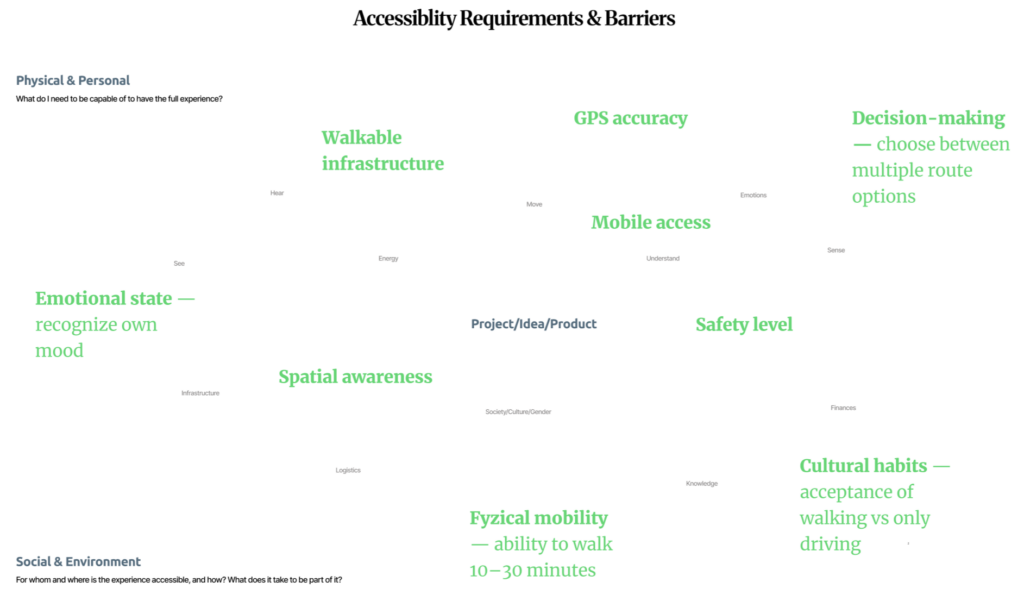
These factors highlight that access to slow navigation is not the same for everyone. The experience depends on physical abilities, emotional awareness, and cognitive skills—such as the ability to walk, recognize one’s mood, and make decisions about the route. It also requires a certain level of spatial awareness, which is not always equally developed or maintained.
At the same time, accessibility is shaped by external conditions: pedestrian infrastructure, GPS accuracy, access to mobile devices, safety, and cultural habits of movement. This shows that slow navigation is not just a matter of design, but a systemic issue influenced by the environment, technology, and the social context in which the user finds themselves.
