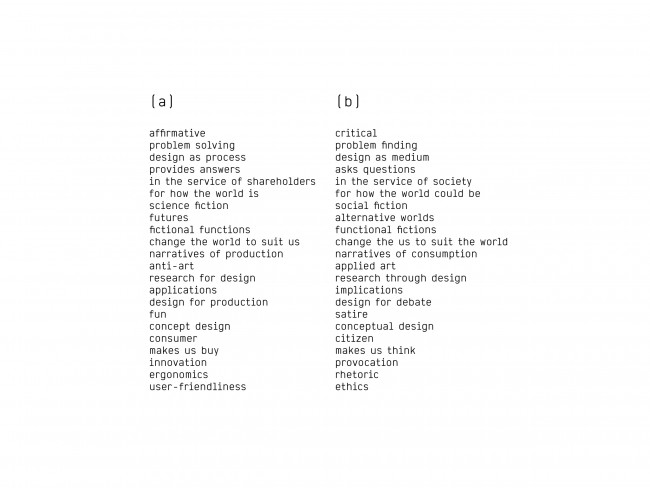
Through prototypes, narratives and fictional artefacts, Speculative Design does not set out to provide answers; instead, it encourages collective reflection. In Speculative Everything (2013), Anthony Dunne and Fiona Raby outline what can be understood as a manifesto for this approach, framing it through a direct comparison between two ways of thinking about design.
They present this comparison as a set of paired concepts: on one side, those associated with traditional design (A), and on the other, those that define Speculative Design (B). The aim is not to replace one with the other, but to open up an alternative perspective, a parallel lens through which to reflect on design and better grasp its critical potential.
Expanding on this framework, Leon Karlsen Johannessen from the Norwegian University of Science and Technology revisits the so-called “A/B Manifesto” in The Young Designer’s Guide to Speculative and Critical Design (2017). He suggests that the two sets of concepts should not be read as strict opposites, but as complementary viewpoints. Rather than excluding each other, they operate in tension: each element in “column A” is mirrored by one in “column B”, creating a contrast that helps clarify what Speculative Design is, and, just as importantly, what it is not.