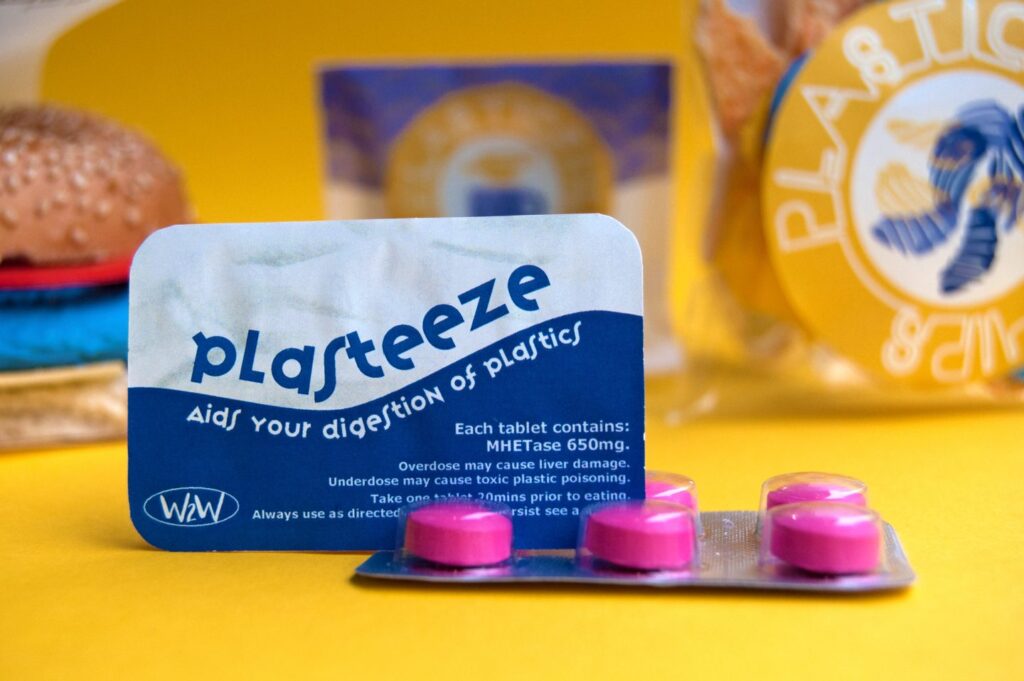
One project that clearly shows how design can engage with social issues is Plasticful Foods, developed by an interdisciplinary team from the University of Amsterdam and the Amsterdam University of Applied Sciences. Rather than simply informing people about plastic pollution, the project tries to unsettle them, disrupting familiar assumptions about waste and consumption just enough to trigger a shift in perspective. It does this by blending real data on plastic pollution with humor and marketing strategies borrowed from commercial advertising. The result is a near-future scenario in which plastic has become so widespread that it ends up in our daily diet. From this premise comes the deliberately provocative idea of Plasticful Foods: a line of “food products” made with recycled plastic, supposedly made digestible through a fictional enzyme called Plasteeze, styled like a dietary supplement.
The logic behind it is intentionally extreme: if microplastic consumption keeps increasing and waste management doesn’t improve, we might eventually have to adapt, not by reducing plastic, but by learning to digest it. It’s a disturbing thought, but that’s exactly the point. It pushes us to ask a simple question: Is this really the future we want? In this sense, the project moves beyond provocation and becomes a tool for critical reflection, asking us to confront the consequences of what we’re doing, or not doing, today.
Moving away from sustainability but staying within the same speculative framework, technological development offers another rich area for exploration. As digital technologies become more pervasive, they are reshaping not only how we interact with the world, but how we perceive reality itself.
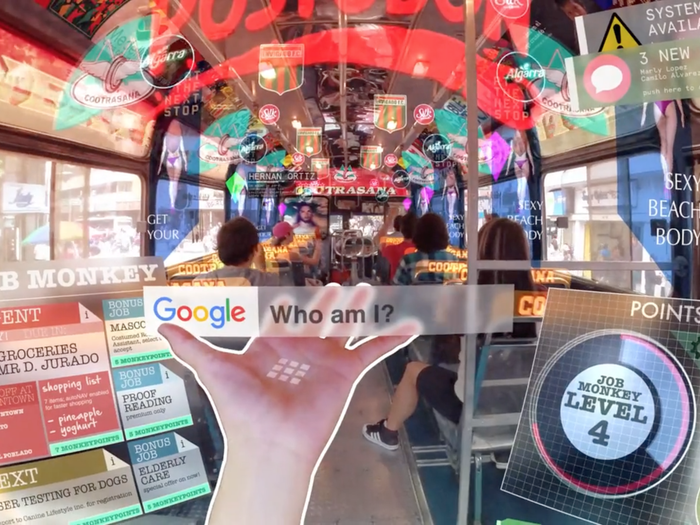
This is where Hyper-Reality comes in, a short conceptual film by Keiichi Matsuda that explores a future in which the boundary between physical and digital has completely collapsed. In this hyper-mediated everyday life, augmented reality, wearable devices, and constant streams of information create an environment saturated with digital stimuli. The result is both fascinating and overwhelming: a world full of possibilities, but also one where perception becomes fragmented and distorted. Matsuda doesn’t offer answers, he opens up a space for reflection, asking us to consider where this trajectory might lead and what it could mean for our sense of identity, control, and freedom.
A similar approach can be found in the work of Anthony Dunne and Fiona Raby, who often construct alternative worlds to explore the social, political, and technological implications of the future.
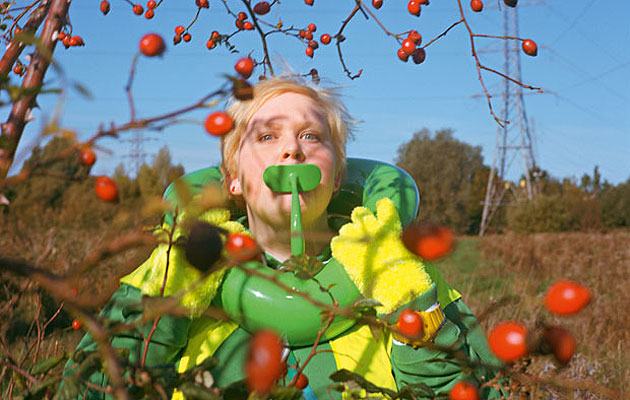
In Foragers, they imagine a scenario shaped by extreme overpopulation and food scarcity. If traditional food systems can no longer sustain the global population, what alternatives might emerge? Their answer takes the form of a speculative community equipped with wearable devices and biotechnological enhancements, capable of extracting and metabolizing nutrients directly from the environment. While the concept is visually striking, its real strength lies in the questions it raises, about adaptation, inequality, and the extent to which we might be willing to alter the human body in response to global crises.
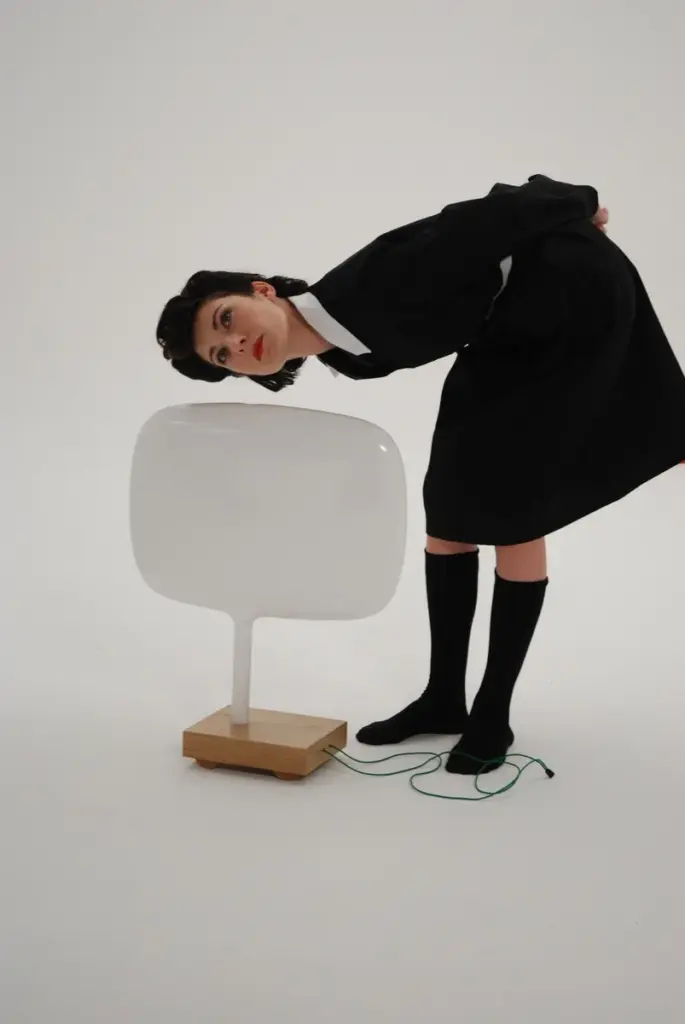
In Needy Robot, Dunne and Raby shift the focus to our relationship with technology, asking what might happen if machines began to exhibit emotions and desires of their own. The robots in the project display subtle but unsettling behaviors: one holds eye contact for too long, another appears anxious when someone gets too close. These small details make the interaction feel strangely human, and slightly uncomfortable. The project doesn’t try to predict the future, but to probe it, inviting us to consider what coexistence with increasingly “human-like” technologies might actually feel like and what kind of relationships we might end up forming.