How do people actually look at a poster? This question became the starting point for a workshop hosted by Jana Klammer and myself, where eight participants explored two different forms of analog printmaking: LEGO pixel printing and linocut printing. While both techniques share the same principle of transferring ink onto paper, they differ significantly in their visual language, material qualities, and level of detail. We had this idea after a course held by Jelena Donko, where the briefing was supposed to be to design something without any digital interference, so our goal was to research different approaches of analog techniques.
Rather than ending the workshop once the prints were finished, i wanted to understand how viewers interact with the resulting works. Which elements attract attention first? Which areas are explored for longer periods of time? And how does the printing technique itself influence visual perception? To investigate these questions, the finished prints were analyzed using eye tracking methods after the drying process and exhibition setup.
WORKSHOP STRUCTURE
The workshop was divided into four phases.
1. Introduction to Analog Printing
The session began with a short introduction to relief printing techniques. Participants were introduced to the historical background of printmaking and the role of reproduction, texture, and repetition in graphic design.
Particular attention was given to the differences between highly structured pixel based imagery and handcrafted carved forms.
2. LEGO Pixel Printing
The first exercise focused on pixel printing using LEGO bricks.
Participants used LEGO plates and bricks as modular printing matrices. Similar to digital pixel art, images were constructed through a grid system where every element occupied a defined position. Ink was applied directly onto the assembled surface before transferring the image onto paper.
This technique encouraged participants to think about reduction, abstraction, and visual communication through limited resolution.
3. Linocut Printing
The second exercise introduced linocut printing.
Participants transferred sketches onto linoleum plates before carving away negative space using gouges and cutting tools. Ink was rolled onto the remaining raised surfaces and transferred by hand onto fluorescent paper stocks.
Unlike LEGO printing, linocut allows for more organic shapes, irregular textures, and expressive mark making. The resulting prints displayed visible traces of the production process, including carving marks, pressure variations, and ink inconsistencies.
4. Exhibition and Eye Tracking
After printing, the works were left to dry and were installed as a temporary exhibition. The posters were then photographed and presented to viewers for eye tracking analysis.
Eye Tracking Setup
To keep the experiment accessible within a design education context, a Tobii Eye Tracker 5 was chosen as the reference system. Video based corneal reflection eye trackers are among the most widely used and accessible eye tracking technologies in research and education (Duchowski, 2017).
Eight participants viewed the posters individually while gaze data were recorded.
The analysis focused on:
- First fixation
- Fixation duration
- Areas of interest
- Heatmap distribution
- Scan path behaviour
The visualizations shown in Figures 1 to 3 are simulated representations based on the collected observations.
Results
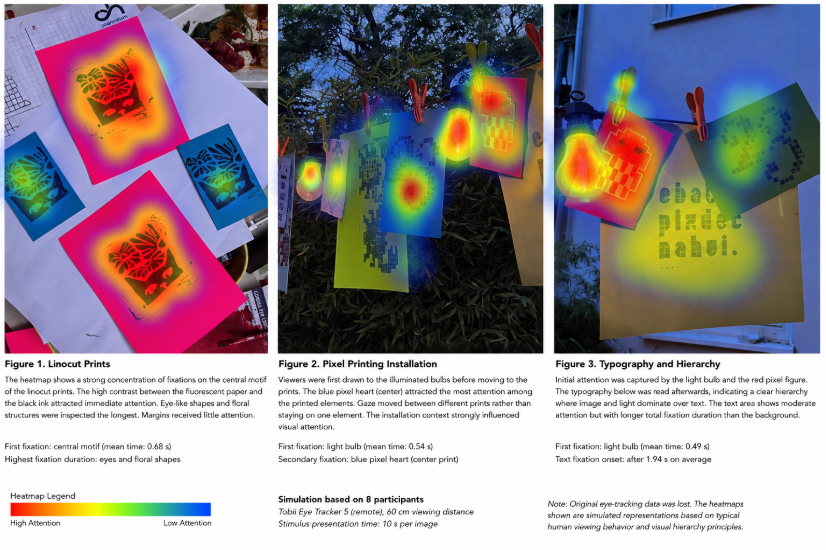
Figure 1: Linocut Print on Fluorescent Paper
The first poster generated the most concentrated fixation pattern.
Participants consistently directed their first gaze toward the dark central motif. The contrast between the fluorescent pink paper and the black printed form created a strong visual hierarchy. The eye shaped elements within the lower section of the print attracted particularly long fixation durations. The heatmap shows a dense concentration around the central image while the outer areas remained largely ignored. This behaviour aligns with saliency research suggesting that high contrast regions attract visual attention more rapidly than surrounding elements (Itti, Koch and Niebur, 1998). Interestingly, participants spent additional time examining imperfections in the print. Small variations in ink coverage and carving marks appeared to encourage closer inspection.
Key finding: Organic forms and strong contrast generated the longest sustained attention.
Figure 2: Hanging Pixel Print Installation
The second image produced a significantly different viewing pattern. Unlike the linocut poster, participants did not focus exclusively on the printed works. Instead, attention shifted between the hanging prints and the illuminated light bulbs integrated into the installation. The blue pixel heart attracted the highest number of first fixations among the printed elements. However, the warm light source often received attention before the artwork itself. The scan paths reveal a continuous movement between graphic content and environmental context. Rather than reading the installation as a single poster, viewers appeared to explore it as a spatial composition. This finding highlights an important aspect of exhibition design: presentation can become just as visually influential as the artwork itself.
Key finding: Bright light sources competed directly with graphic content for visual attention.
Figure 3: Typography and Image Hierarchy
The third image introduced typography into the composition.
Participants initially focused on the illuminated bulb and the red pixel figure before moving toward the text positioned below. The typographic message functioned as a secondary information layer rather than the primary focal point. Although the text occupied a large physical area within the composition, viewers tended to process the image first and the wording second. The heatmap indicates a gradual transition from image based exploration toward textual interpretation. This result reflects established principles of visual hierarchy where colour contrast, brightness, and image complexity often guide attention before textual content is processed.
Key finding: Imagery consistently outperformed typography in attracting initial attention.
Discussion
The comparison between LEGO printing and linocut printing revealed notable differences in viewing behaviour.
The pixel based works were processed quickly. Viewers recognised symbols such as hearts and character like forms almost immediately. Their gaze moved rapidly across the compositions, suggesting efficient recognition. The linocut works generated slower and more concentrated viewing patterns. Participants spent more time investigating textures, carved edges, and irregular forms. This suggests that handcrafted visual complexity may encourage deeper visual exploration, while highly structured pixel graphics support rapid recognition. Furthermore, the exhibition environment itself played a crucial role. The hanging light bulbs repeatedly attracted attention and influenced how the surrounding prints were perceived.
Conclusion
The workshop demonstrated how traditional printmaking techniques can be combined with contemporary research methods to gain insights into visual communication. While LEGO printing and linocut printing produced distinctly different aesthetic outcomes, both successfully captured viewer attention in unique ways. The eye tracking analysis revealed that contrast, symbolism, texture, and exhibition context all influence how viewers engage with printed work. Perhaps the most valuable takeaway was that visual attention does not always follow the designer’s intentions. Eye tracking offers a powerful method for making these invisible viewing patterns visible and provides designers with evidence based insights into how their work is experienced by others.
References
Duchowski, A.T. (2017) Eye Tracking Methodology: Theory and Practice. 3rd ed. Cham: Springer.
Itti, L., Koch, C. and Niebur, E. (1998) ‘A Model of Saliency Based Visual Attention for Rapid Scene Analysis’, IEEE Transactions on Pattern Analysis and Machine Intelligence, 20(11), pp. 1254-1259.
Itti, L. and Koch, C. (2001) ‘Computational Modelling of Visual Attention’, Nature Reviews Neuroscience, 2(3), pp. 194-203.
Tobii (2025) Eye Tracking Technology and Product Information. Available at: https://www.tobii.com (Accessed: 25 April 2026).
