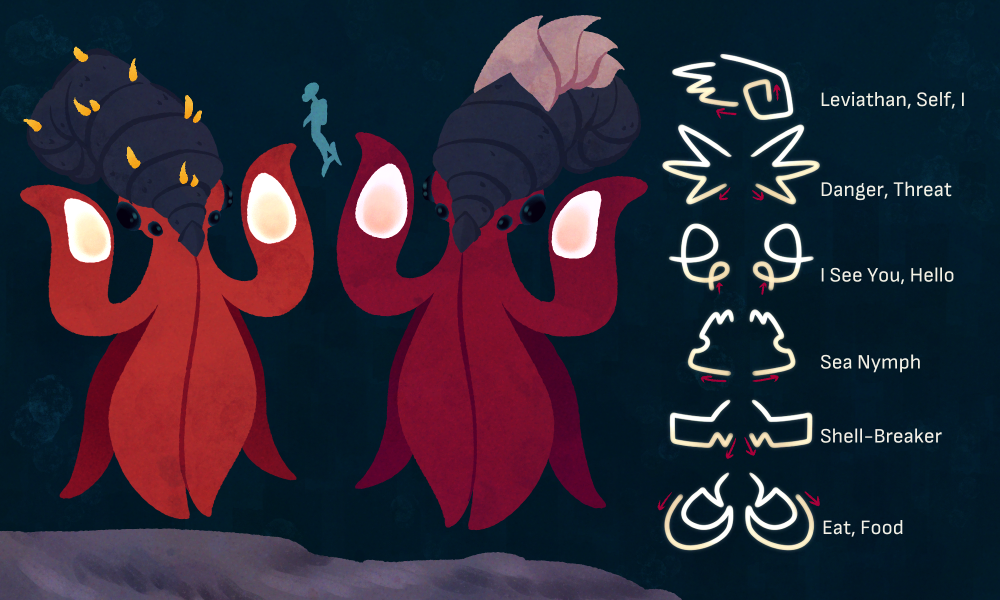
I initially didn’t plan another part for my Creature Design series, but after the feedback I received last time it felt necessary to go back and fix what I got wrong last time. So for this entry, I want to rework the Leviathans from my last entry to make them more believable.
Final Consumers
Leviathans are the dominant intelligent species living in the oceans of Europa. They are the largest members of the class Multibracchia, growing up to be around 8m tall. Their last common ancestor with other members of their class was around 10 million years ago, from which point they evolved away from being free-swimming, instead using their two front tentacles to traverse the ocean floor, leaving the other four free for the usage of tools and communication.
Their beak has moved from the centre of their tentacles, to the front of their head, giving them a forward-facing appearance similar to us humans. Like many other members of the Laminaferrea phylum, they have a shell. It connects through platting to their beaks and grows into a horn-like shape. Its rough texture frequently attracts members of the Caulispennatus phylum, like Antennae Trees, who settle on their shells. It was previously thought this serves towards camouflage, though in actuality it has cultural significance for the Leviathans. Being viewed as a sign of good fortune. This might be because Antennae Trees and the like attract prey animals.
Leviathans have a very complex system of sign language – using bioluminescent signs drawn with the spots atop their back-facing tentacles to communicate. Brightness, duration (not only of the signal itself, but also its brightening and fading) and fluctuation play into it. While there seems to be a lot of differences between regions, some signs appear to be mostly consistent between them – these being terms used for prey and predators.
They have settlements all across the mid-level oceans of Europa, built into the caverns of large-scale vents where rich ecosystems have been established. They’re almost exclusively hunter-gatherers, though some settlements towards the north have begun to farm of Iron Jaws, the much larger relative of the Iron Beak (and comparable to the Giant Clam on Earth) as well as making attempts to domesticate Sea Nymphs.
Some Leviathan tribes have also begun to settle along the cliffs bordering on the abyssal depths, where they hunt Shell-Breakers and other large Cancernatans. Abyssal Leviathans are biologically the same as their mid-level oceans relatives, though they seem to have developed some physical differences to adapt to the depths. They’re a bit larger, for starters, growing up to be around 9 to 10m. Their skin is a more saturated red as well. What also seems more wide-spread amongst them is their habit for self-decoration; many of them wear the carapaces of Shell-Breakers on their heads.
As it seems they’re still in the early stages of civilization. Though it is unknown to which degree they will be able to develop technology, given that their circumstances are very different to ours as they are confined to the depths of the ocean.