Design discussions surrounding artificial intelligence often focus on efficiency, automation, and replacement. Creative industries in particular are frequently confronted with the question of whether AI will eventually replace human designers.
This poster project emerged as a response to that conversation.
The central idea was simple: design is not only the production of visual outcomes. It is a process shaped by personal experiences, cultural context, emotion, empathy, and interaction. While artificial intelligence can generate visual results, it cannot genuinely share experiences, form memories, or develop human relationships. Design is ultimately a social practice.
The poster itself originated from an unexpected discovery. While experimenting with typography in Adobe Illustrator and exploring different type manipulations, a small smiling face emerged accidentally from the forms of the number “3”. Rather than refining the composition into a polished graphic, I became interested in what this simple character represented. The smiley felt approachable, unfinished, and open for interpretation.
Instead of asking how AI could generate better posters, the project shifted toward a different question:
Can design become a space for human participation rather than passive consumption?
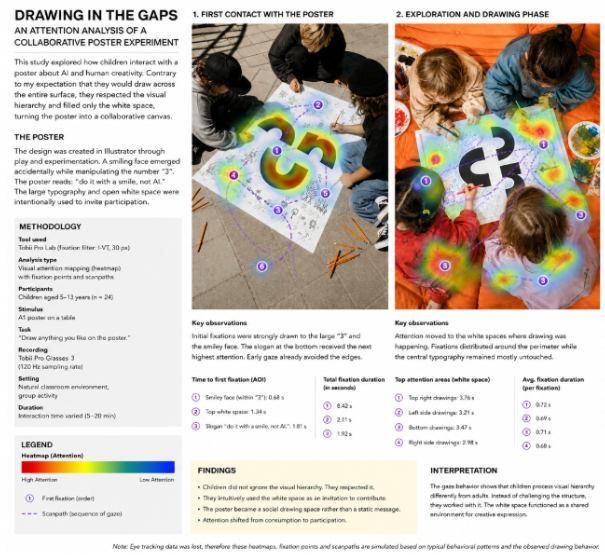
To investigate this idea, an A1 poster was printed and presented to children between the ages of 5 and 13. The goal was to observe how they interacted with the composition and whether their behaviour would challenge assumptions about visual hierarchy and poster design.
Concept and Research Question
The poster consisted of a large typographic composition dominated by the number “3”. A small smiling face was embedded within the design and accompanied by the phrase:
“do it with a smile, not AI.”
The composition intentionally contained large areas of negative space surrounding the main graphic elements.
Before conducting the experiment, I developed a clear hypothesis. Based on common assumptions about children’s drawing behaviour, I expected participants to draw across the entire poster surface. I assumed that the established visual hierarchy, typography, and spacing would have little influence on where marks were placed. In other words, I expected visual structure to be ignored. The experiment was designed to test whether this assumption was correct.
Methodology
Participants
The study involved children aged between 5 and 13 years.
Rather than observing the poster individually, participants interacted with it collectively. The poster remained accessible throughout the activity and children were free to add drawings wherever they wanted.
Materials
- A1 printed poster
- Markers and pencils
- Observation documentation through photography
- Informal behavioural analysis
Unlike the previous eye tracking study, the focus here was not on gaze behaviour but on participatory interaction. The children’s drawings effectively became visual traces of attention and decision making. Every mark added to the poster represented a conscious choice about where to engage with the composition.
Results
An Unexpected Outcome
The results contradicted my expectations almost immediately. Rather than drawing over the typography, the smiley face, or the central composition, participants overwhelmingly chose to draw within the empty white areas surrounding the existing design. Across multiple sessions and different age groups, a remarkably consistent pattern emerged. The original poster remained largely untouched. Instead, children appeared to interpret the white spaces as invitations to contribute. The visual hierarchy was not destroyed. It was respected.
Reading the White Space
In graphic design, negative space is often understood as an organizational tool that creates balance and clarity (Lidwell, Holden and Butler, 2010). What emerged during this experiment suggests an additional function. The children seemed to perceive the empty areas not as unfinished design but as available territory. Rather than competing with the existing content, they expanded it. Small characters, landscapes, robots, rainbows, animals, and abstract doodles gradually appeared around the typography. The poster transformed into a collaborative environment rather than a static object. Thelarge black typography continued to function as a visual anchor while the surrounding drawings created a growing ecosystem of contributions.
Participation Instead of Consumption
One of the most interesting observations was that the children did not treat the poster as something to be consumed. They treated it as something to join. This behaviour aligns with theories of participatory design, which emphasize collaboration, contribution, and shared authorship rather than one directional communication (Sanders and Stappers, 2008). The poster effectively became a conversation. Each child responded not only to the original design but also to drawings added by previous participants. New characters appeared next to existing ones. Storylines emerged. Relationships formed between otherwise unrelated drawings. The final outcome could not have been planned by a single designer. It was collectively authored.
AI, Authorship, and Human Connection
This unexpected result became highly relevant to the original topic of artificial intelligence. Current generative AI systems can produce images, layouts, and illustrations at remarkable speed. However, they do not participate in the social processes that give meaning to creative work. The value of this poster was ultimately not the graphic itself. The value emerged through interaction. Children interpreted the design, reacted to it, built upon it, and left visible traces of their own experiences. The poster became a record of collective engagement rather than a finished artifact. This reinforces a key distinction between image generation and design practice.
Design is not simply about creating visuals.
Design is about creating relationships.
Discussion
The experiment suggests that even young participants demonstrate a sophisticated understanding of visual structure. Contrary to expectations, the children recognized the hierarchy of the composition and chose not to interfere with it. Instead, they identified opportunities for contribution within the negative space. This behaviour transformed the poster from a fixed message into a participatory platform. The findings also highlight the importance of leaving room for interpretation. Designers often focus on what should be added to a composition, but this project demonstrates that what is left empty can be equally important. In this case, the white space became the most active part of the design.
Conclusion
What began as a poster about artificial intelligence ultimately became a study about human creativity.
The experiment revealed that children did not ignore visual hierarchy. They understood it. They worked with it rather than against it. The poster’s most successful feature was not the typography, the slogan, or the smiley face discovered through experimentation in Illustrator. It was the space left open for others. The project demonstrates that meaningful design does not always end when the designer finishes working. Sometimes the most valuable part begins when other people are invited to participate. And perhaps that is precisely where human creativity continues to differ from artificial intelligence. Not in the ability to generate images, but in the ability to create connections.
References
Lidwell, W., Holden, K. and Butler, J. (2010) Universal Principles of Design. Beverly, MA: Rockport Publishers.
Norman, D. (2013) The Design of Everyday Things. Revised and Expanded Edition. New York: Basic Books.
Sanders, E.B.N. and Stappers, P.J. (2008) ‘Co-creation and the New Landscapes of Design’, CoDesign, 4(1), pp. 5–18.
Manzini, E. (2015) Design, When Everybody Designs: An Introduction to Design for Social Innovation. Cambridge, MA: MIT Press.
