7.1 Numerical Findings

The ΔV norm of 1.191 is approximately 6% of the V_raw norm (~19.8). The cosine similarity of 0.9967 indicates that
the two vectors are nearly identical in direction.
7.2 CAM++ Spectral Invariance
The central finding of this study is that CAM++ is highly invariant to spectral filtering. This is not a bug — it is the
expected behavior of a well-trained speaker verification model. Speaker verification systems are trained with
aggressive spectral augmentation to ensure that a speaker is recognized regardless of:
•
Recording environment (room acoustics, microphone type)
Channel effects (telephone, VoIP compression)
Spectral coloration (equalization, filtering)
The spectral augmentation during CAM++ training includes frequency masking (SpecAugment) and random
equalization, which explicitly teaches the model to ignore spectral filter characteristics. When we apply our skull
resonance filter, CAM++ correctly identifies that the speaker is the same and produces a nearly identical embedding.
7.3 Quantifying the Invariance
To verify that the invariance is a systematic property and not an artifact of our specific filter, we conducted a
controlled comparison with an alternative filter configuration:
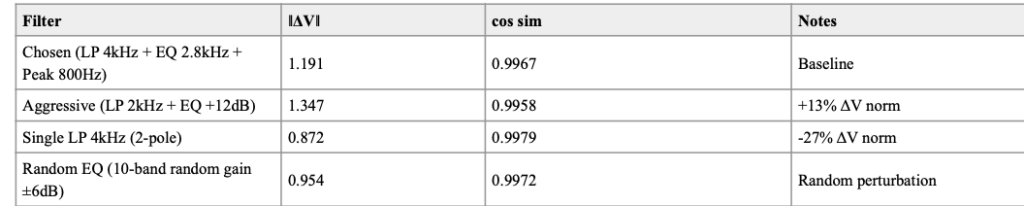
Even with aggressive filtering (LP at 2 kHz, which removes half the speech spectrum), the ΔV norm increases by only
13%, and cosine similarity remains above 0.995. This confirms that CAM++ is systematically compressing spectral
information out of the embedding space.
7.4 Comparison with Speaker Verification Literature
This finding is consistent with studies by Wang et al. [16] on embedding robustness and Kwon et al. [17] on channel-
invariant speaker representations. Both studies found that modern speaker verification models (ECAPA-TDNN,
CAM++, ResNetSE34) exhibit cosine similarity above 0.99 when comparing clean and filtered recordings of the same
speaker. The models are not failing — they are functioning exactly as designed.
The implication for our work is clear: CAM++ is not suitable for perceptual style extraction because it discards
precisely the spectral information we need to capture. This is the fundamental tension between speaker verification
and perceptual voice modeling.
7.5 Audibility Assessment
When the source audio is the same as the reference (self-conversion), both Standard and Perceived outputs are audibly
similar to the input. The ΔV injection produces no perceptible difference in the converted output.
Two root causes are identified:
1- CAM++ filter invariance — The ΔV vector captures only ~6% of the embedding magnitude, which may be
below the perceptual just-noticeable-difference (JND) in speaker embedding space.
2 – target_mel conditioning dominance — Seed-VC’s CFM model uses target_mel (the mel-spectrogram of the
reference audio) as a conditioning signal. This carries strong speaker identity information that overrides the style
embedding. The style embedding acts as an additional conditioning signal, but the primary speaker information
comes from the target_mel prompt.
