In the early days of film sound, Foley artists were often called Foley walkers or steppers. This historical nickname stems from their deep focus on replacing footsteps, which remains the absolute bedrock of the craft. Synthesizing these sounds is not simply about matching the timing of a foot hitting the ground, but about telling a story about the character. The sound of the footstep itself is a multifaceted interplay of different key factors, originating through foot-to-floor interaction, which is strongly influenced by the type of surfaces involved as well as the physical properties of the person walking.
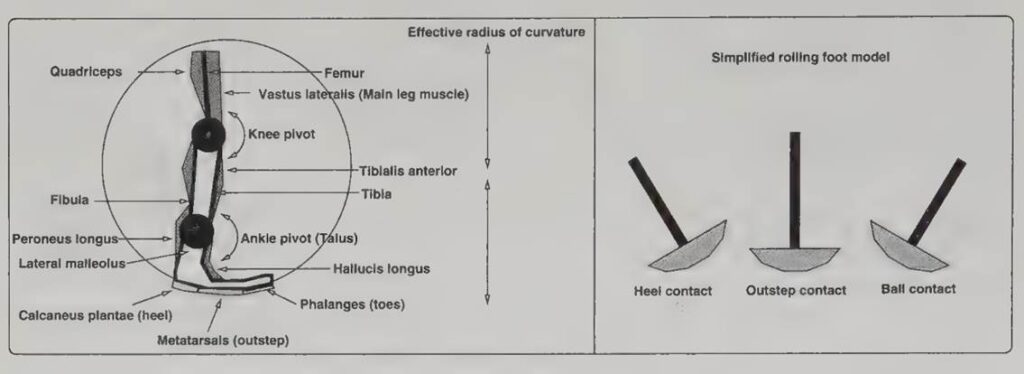
Simplification of the foot during walking. Farnell 2010, 548
An analysis of the step presents three distinct phases of ground contact. The first and hardest contact stems from the heel, where the calcaneus bone touches the surface. Thereafter, the weight smoothly shifts towards the metatarsal and rolls off to the toes. During this shift, the downward pressure applied to the ground is opposed by a complementary force from the ground to keep the body balanced. The two main considerations are the impact of the step in the first phase, followed by the friction produced by the shoe rolling over into the third phase. Together, these form the ground response force, which increases when the surface area decreases. This is why high heels exert much more intense pressure on the floor than a completely flat sole.
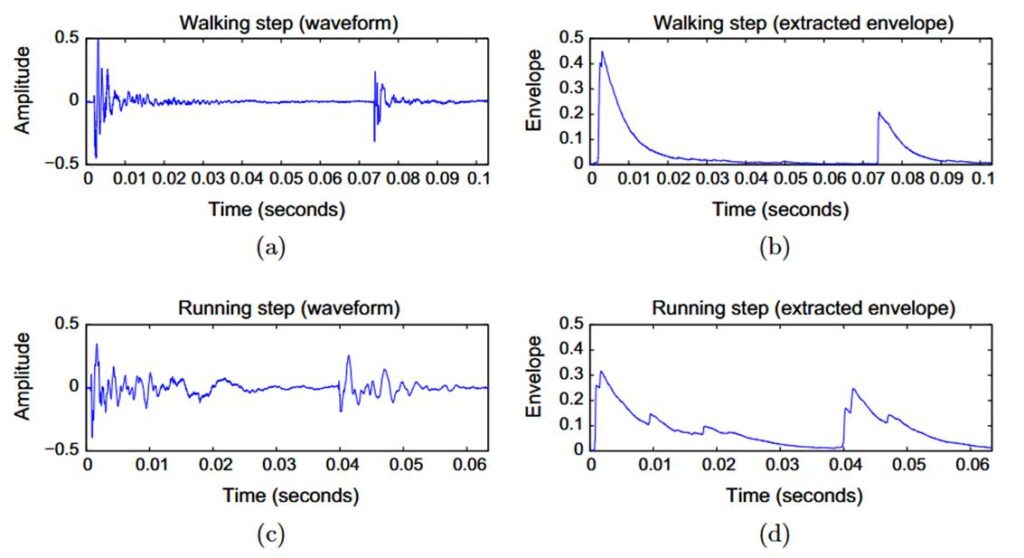
Waveform and amplitude envelope comparison. Turchet 2016, 50
Farnell, Andy. Designing Sound. Cambridge: The MIT Press, 2010.
Turchet, Luca. “Footstep sounds synthesis: Design, implementation, and evaluation.” Applied Acoustics 107, 2016: 46-68.
