Inclusion and accessibility are essential considerations in contemporary design and innovation. Considering diverse user groups and varying physical and cognitive abilities should not be an afterthought, but rather an integral part of the design process from the very beginning. By doing so, designers can develop solutions that are inclusive by default, rather than needing later adjustments. One useful method to support this approach is the creation of a map that outlines what is required for users to fully experience a product, considering not only personal and physical aspects, but also social and environmental factors. Such a map was developed for this project, which focuses on improving the UX design of German train platforms. It highlights the various conditions that must be met to ensure an optimal and inclusive user experience.
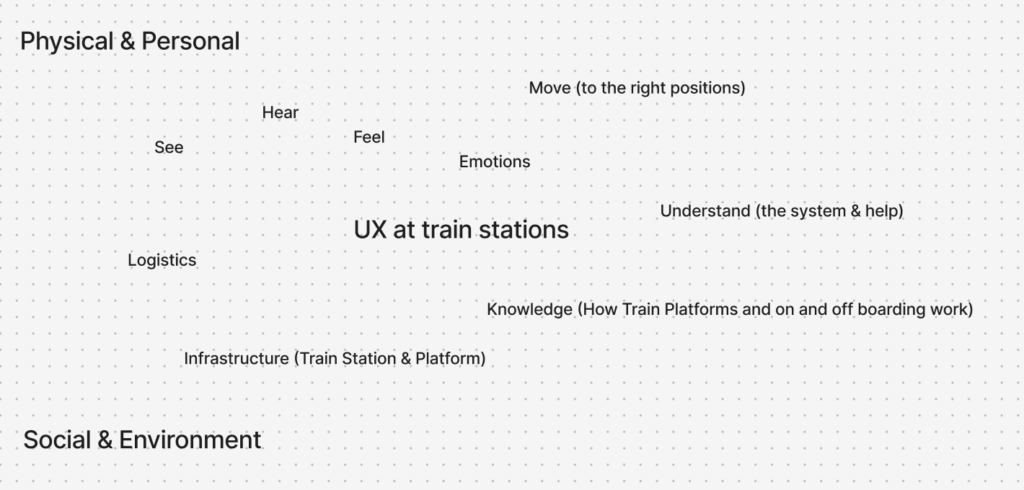
Building on this, a second mapping method was used to specifically analyze inclusion, problems, and barriers. This map takes a closer look at potential obstacles the design might create, identifies which user groups are included or excluded, and explores the problems that arise from these barriers. Most importantly, it also considers possible solutions to reduce or eliminate them. In this project, many of the identified barriers particularly affect people with disabilities or impairments, who may not be able to fully perceive or interact with certain elements of a physical design.
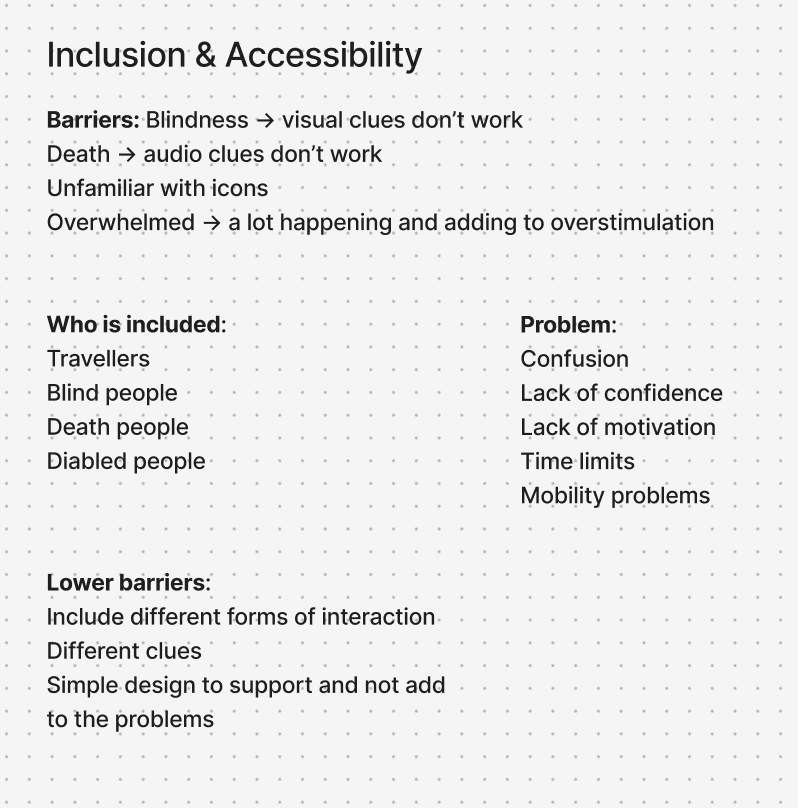
To address this, the goal is to provide multiple ways for users to experience and understand the design, ensuring accessibility for as many people as possible. At the same time, a clear and minimal design approach is prioritized to avoid adding further complexity or confusion to already busy train platform environments.
Overall, inclusion has been explored through these mapping methods as a foundational step in the design process. While further refinement is necessary, this work provides valuable insights into user needs and establishes a strong basis for developing more inclusive solutions moving forward.
